

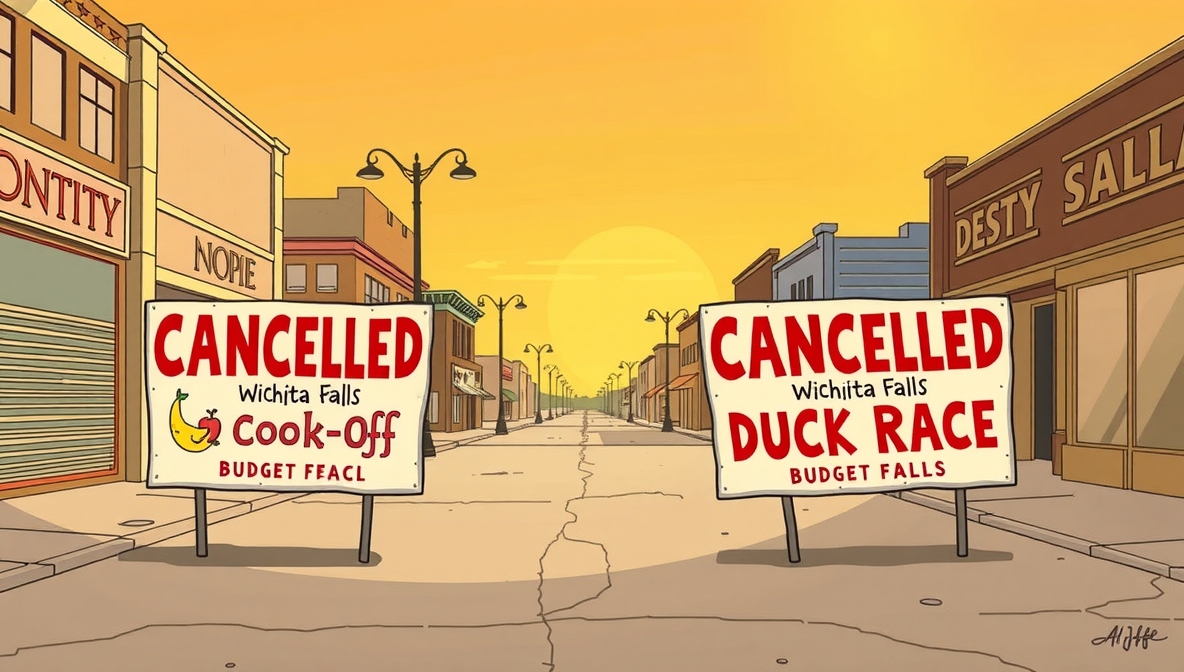
Downtown Wichita Falls: Where Money Flows… Just Not Here
WICHITA FALLS, TX — Citizens of Wichita Falls are discovering a revolutionary new local experience: watching festivals disappear in real time. Experts say it’s like a magic show, except the rabbit is your tax dollars, the hat is empty, and the magician left town three fiscal quarters ago.
It’s the kind of municipal achievement that makes neighboring cities feel better about their own questionable financial decisions.
Downtown Wichita Falls Budget Crisis Cancels Beloved Festivals
It all started when the Downtown Wichita Falls Development (DWFD) announced its budget shortfall with all the fanfare of a funeral procession conducted by accountants who forgot to bring the body. “Turns out, money doesn’t grow on trees,” said local resident and self-proclaimed festival expert, Marge Pecan. “And even if it did, we’d probably charge the trees rent and wonder why they moved to Dallas.”
Witnesses claim the downtown fountain—once the hub of the annual “Falls Fall Festival”—was seen whispering to itself, “I told you so,” before being shut off to save on the water bill. The fountain has since been counseled by local therapists who specialize in inanimate object trauma and accept payment in the form of loose change thrown by tourists who think wishes still work.
Randy Phillips, a local stand-up comedian who performs at the Elk’s Lodge on Tuesdays, surveyed the dry fountain and observed, “You know your city’s in trouble when even the water features are dehydrated. That’s not a fountain anymore—that’s a concrete bowl with dreams.”
Which Events Are On the Chopping Block?

The financial crisis has left local events hanging by a thread thinner than the city’s quarterly earnings report and significantly less reliable than a politician’s promise during election season. The beloved Chili Cook-Off? On indefinite hiatus. The annual Balloon Glow? Grounded harder than a teenager who borrowed dad’s truck without asking. Even the Duck Race, which has historically drawn a crowd of exactly 47 people (42 of whom are related to the organizer), is now considered “luxury entertainment” reserved for cities with functioning budgets and disposable optimism.
The ducks, when reached for comment, refused to participate in unpaid labor and have unionized under the banner “Fair Wages for Waterfowl.” Their demands include premium bread crumbs and a dental plan.
Local comedienne Barbara “Barb” Hutchins surveyed the abandoned festival grounds and noted, “This is like planning a wedding and forgetting to invite money. You’ve got the venue, you’ve got the dreams, you’ve got your cousin playing DJ with a Bluetooth speaker, but nobody’s showing up to pay for the shrimp cocktail. And trust me, without shrimp cocktail, it’s just people standing around judging each other’s outfits.”
The city’s event coordinator, Sharon Pruitt, tried to remain optimistic while updating the community calendar by simply replacing every festival date with the words “MAYBE NEXT YEAR (PROBABLY NOT).” When asked if this was defeatist, Pruitt replied, “I prefer to call it ‘aggressively realistic planning.'”
DWFD Funding Shortfall Leaves Local Businesses Scrambling
A recent anonymous poll conducted behind the 7-Eleven revealed that 92% of locals are in favor of fixing downtown, while 8% have no idea what a downtown is because they live in their trucks and believe all commerce should be conducted via drive-thru window and possibly cryptocurrency, though they’re unclear on what that means.
Mayor Bartley Higgins, caught between a rock and a broken streetlight that’s been “pending repair” since 2019, announced a new fundraising initiative: “Donate or We Cry in Your Front Yard.” City officials confirmed it’s innovative, but only if tears count as currency under the new Texas economic model, which currently values them somewhere between Monopoly money and thoughts-and-prayers.
The Mayor’s follow-up plan involves a bake sale, but early projections suggest the brownies would need to cost $47,000 each to close the budget gap. “We’re workshopping it,” Higgins said, nervously adjusting his tie while standing in front of a PowerPoint slide titled “Brownies: A Fiscal Solution?”
The Real Cost of Empty Streets
Local businesses are bracing for the fallout with the enthusiasm of a tax audit conducted by someone’s ex-spouse. Bob’s BBQ warned that without festivals, sales might drop below zero, which mathematically is impossible, but they’re Texans—they’ll figure it out, probably involving a calculator app and aggressive rounding.
The restaurant’s owner, Bob Martinez, declared while flipping exactly one brisket, “I’ve served meat to exactly three people this week. One was my mother, who didn’t pay. Two were lost tourists looking for Oklahoma who seemed personally offended that we weren’t Oklahoma. I explained geography. They bought nothing.”
Martinez continued, channeling his inner despair, “You know what’s crazy? I spent twenty years perfecting my dry rub recipe. Now the only thing dry around here is my bank account and my sense of humor. Actually, scratch that—my sense of humor is getting pretty moist from all the crying.”
Meanwhile, souvenir shops have introduced a “Pretend Festival Experience” kit that includes confetti (used, possibly from a 2017 birthday party), a cardboard duck with googly eyes that look judgmental, and a playlist titled Sounds of Silence: The Budget Edition, which is just forty-five minutes of someone sighing deeply. Early reviews describe it as “depressing but accurate” and “exactly what I expected, which somehow makes it worse.”
The gift shop owner, Lucinda Martinez (no relation to Bob, despite sharing the exact same despair), explained, “We’re pivoting to nostalgia-based commerce. People can’t afford to make new memories, so we’re selling them old ones. Next month we’re introducing scratch-and-sniff postcards that smell like funnel cakes you’ll never eat.”
The crisis has even reached social media faster than rumors at a church potluck hosted by the town gossip. The official DWFD Facebook page has been renamed “Help Us Before We Become a Parking Lot” and boasts a following of 3,721 sympathetic cats, 17 actual humans, and one very confused algorithm that keeps suggesting they run ads for “festival planning services.”
Donations are trickling in at a rate best described as “geologically slow.” One anonymous donor reportedly asked, “Can I pay in expired coupons?” The answer, sadly, was yes. Another donor offered a bag of mostly-good potatoes and a VHS tape of Titanic. The city accepted both and is now seeking a VCR.
What Locals Are Saying About the Festival Fiasco
The festival stage, once a hub of activity and occasional talent, now serves as a prime nap zone for construction workers who’ve run out of things to construct because the construction budget got redirected to “essential services” like keeping the city hall air conditioning at a livable temperature. Streetlights are being rebranded as “mood lighting” for empty parking lots, creating an ambiance described as “post-apocalyptic chic” and “exactly like the parking lot scene in every horror movie where someone dies first.”
Duck race enthusiasts are encouraged to imagine ducks with such vivid detail that they can practically feel the disappointment, because real ones require food, supervision, and apparently cost more than the city’s quarterly entertainment budget. The city’s Parks and Recreation director suggested “air ducks” as a cost-saving measure, which is just standing by the river and pointing at nothing while making quacking sounds. Attendance projections remain pessimistic.
Local bands have shifted to “silent concerts,” which cut costs and confuse the audience in equal measure while raising philosophical questions about whether music that doesn’t exist can still be bad. The lead singer of local cover band “Definitely Not Nickelback” explained, “We used to play ‘Wanted Dead or Alive’ at every festival. Now we just stand on street corners and think about it really hard. Same emotional impact, zero equipment costs.”
Todd “Taco” Ramirez, owner of the downtown food truck Regret & Salsa, summed up the mood while serving exactly zero customers: “Honestly, I came here for the tacos, stayed for the existential dread. Business is booming in sadness. I’m thinking about renaming the truck ‘Emotional Support Burritos’ because that’s all I’m serving anymore—feelings wrapped in a tortilla. Yesterday someone ordered a quesadilla and then cried into it for fifteen minutes. I didn’t charge extra for the salt.”
Ramirez’s signature dish, “The Downtown Special,” now comes with a side of regret and a coupon for therapy. “It pairs well with disappointment,” he noted, “which is good because disappointment is all we’ve got.”
From Chili Cook-Offs to Duck Races: What’s Lost
The annual chili cook-off now only involves smelling chili from a distance of approximately forty feet, a practice that prevents both fire hazards and budget overspending while introducing residents to the concept of “olfactory entertainment” and teaching children that suffering builds character. Former champion Becky Malone, whose chili once sent three judges to the hospital (in a good way, she insists), observed while clutching her trophy, “DWFD’s budget is like my uncle’s diet plan: aspirational, nonexistent, and full of regret. Also, my uncle died broke, so maybe we’re following the blueprint a little too closely.”
Malone continued, “I’ve been making award-winning chili for seventeen years. Now I just stand in my kitchen, make chili, and eat it alone while my husband asks if I’m okay. I’m not okay, Gerald. I need validation from strangers holding scorecards.”
Jerry Lopez, a local banker with a degree in stating the obvious and a minor in crushing dreams, noted while reviewing the city’s financial statements, “I’ve seen more liquidity in a cactus. And I work at a bank. With money. Allegedly. Though at this point I’m starting to think money is just a shared hallucination we all agreed to participate in until someone checked the city’s account balance.”
Lopez paused, then added, “You know what’s wild? I have a master’s degree in finance, and I still can’t explain how we spent $40,000 on ‘miscellaneous civic beautification’ last quarter. I’ve seen the downtown. There’s no beauty. There’s barely even ‘civic.'”
Creative Fundraising or Desperate Measures?
Analysts warn that if funding doesn’t improve by the next fiscal quarter (or possibly sooner, depending on how aggressively the utilities get shut off), the city’s festival calendar may be replaced with a revolutionary new experience: sitting at home and yelling at your neighbors about missed community events through increasingly passive-aggressive yard signs and NextDoor posts. This new activity is projected to increase both civic engagement and passive-aggressive lawn signage by 300%, while reducing actual human interaction to near-zero levels.
The first yard sign has already been spotted on Maple Street: “Remember When We Had Nice Things? The City Doesn’t.” Neighboring houses responded with competing signs reading “My Tax Dollars Went Where Exactly?” and the deeply philosophical “Is This What Democracy Looks Like?”
The final nail in the coffin? Even the street performers are unionizing to demand a living wage in Monopoly money, which currently holds more value than exposure and Instagram followers combined. Local economists are baffled but optimistic: “This may actually stimulate the underground economy,” said Dr. Harriet Fund, PhD in “Making Something Out of Nothing” from Midwestern State University.
Dr. Fund elaborated while gesturing at incomprehensible charts, “If you think about it, an economy based on Monopoly money is actually more stable than whatever we’re doing now. At least with Monopoly money, you know the banker is stealing from you. It’s transparent fraud, which is refreshing.”
Mayor’s “Donate or We Cry” Campaign Raises Eyebrows
City council member Patricia Whelms suggested the town consider hosting “festivals of the mind,” where residents close their eyes and remember what fun used to feel like before property taxes went up and community events went extinct. “It’s budget-neutral,” she explained while distributing pamphlets titled “Imagination: It’s Free (For Now),” “and possibly therapeutic, depending on your relationship with nostalgia and whether you’re medicated.”
Whelms demonstrated the concept by closing her eyes during the city council meeting and humming the theme song from The Price Is Right, which she claimed represented “better times, economically speaking.” Other council members joined in, creating what observers described as “deeply unsettling” and “not what we pay taxes for.”
The local newspaper, The Wichita Falls Times Record News, has begun running a daily feature called “Remember When?” that consists entirely of photos of festivals past accompanied by the sound of a single violin played by someone who’s clearly given up. Reader response has been mixed, with most letters to the editor simply reading “TOO SOON.”
One letter, signed “Concerned Citizen (Who Remembers Joy),” stated: “Your ‘Remember When?’ section made me cry into my morning coffee. I’m a 6’4″ construction worker named Dale. I have a beard. I fix trucks. I shouldn’t be crying about duck races, but here we are.”
The Future of Downtown Wichita Falls Entertainment
Cause: City budget cuts + rising costs + ducks that cost more than expected + someone allegedly embezzled festival funds to buy a jet ski (unconfirmed but frequently whispered about at the Dairy Queen).
Effect: Festivals canceled, local businesses mildly to severely inconvenienced, residents start questioning the meaning of fun and whether they should’ve moved to Amarillo when they had the chance.
Inevitable Conclusion: Wichita Falls will now host the “Festival of Imagination,” featuring invisible fireworks that don’t violate fire codes, imaginary rides that require zero liability insurance, and an admission fee of exactly zero dollars because, honestly, that’s all anyone has left after paying their water bill.
Can the Festival of Imagination Save the Day?
The inaugural Festival of Imagination will take place simultaneously everywhere and nowhere, from now until the budget improves or heat death of the universe, whichever comes first (smart money’s on heat death). Activities include:
Pretending to eat festival food while eating regular food at home: Participants are encouraged to hold a hot dog, close their eyes, and imagine it costs $9 and came from a cart operated by someone named “Big Mike” who definitely didn’t wash his hands but you don’t care because it’s FESTIVAL food and that’s the EXPERIENCE.
Air guitar competitions: No guitars provided, imagined, or implied. Winners receive imaginary trophies and real disappointment. Last year’s champion, Derek Williamson, has been training for months by standing in his garage and pretending to shred. “My wife thinks I’ve lost it,” he admitted. “She’s right, but I’m committed to the bit.”
The Annual Invisible Duck Race: Featuring ducks that require no maintenance, produce no waste, and have never once complained about working conditions. Spectators are encouraged to cheer for their favorite imaginary duck while contemplating the fragility of municipal economics. Betting is discouraged but realistically unavoidable.
A chili cook-off where participants describe what their chili would taste like if it existed: Judges award points based on creativity, desperation, and how much the description makes them miss actual food. Current frontrunner describes his chili as “having notes of fiscal responsibility and a hint of broken dreams, with a smoky finish reminiscent of the economy burning down.”
Local comedian Randy Phillips attended a planning meeting for the Festival of Imagination and reported, “I’ve been to better-organized fires. At least fires have a clear goal: burn things. This meeting’s goal was ‘hope really hard and maybe cry a little.’ Someone suggested a bake sale. Someone else suggested prayer. I suggested we all just admit we have no idea what we’re doing, but apparently that’s ‘not productive.'”
Phillips continued, “You know your city’s struggling when the event planning committee spends forty-five minutes debating whether ‘imaginary’ should be capitalized in the festival name. It shouldn’t, by the way. We don’t have enough budget for capital letters. Those are luxury letters.”
Frequently Asked Questions About Wichita Falls Festival Cancellations
Why Were Wichita Falls Festivals Canceled in 2025?
According to DWFD officials, money stopped being real sometime in late 2024, and no one noticed until the invoices arrived with red “PAST DUE” stamps that somehow felt judgmental. Also, someone may have forgotten to budget for “things people actually enjoy,” which in hindsight seems like an oversight.
What Festivals Are Affected by the DWFD Budget Cuts?
All of them. Every single one. Even the ones that hadn’t been invented yet. The city is being proactive about disappointing people, which saves time later. Also affected: community spirit, local morale, and the collective will to pretend everything is fine.
How Can I Support Downtown Wichita Falls Events?
Options include donating money (preferred), donating thoughts and prayers (which convert to money at an exchange rate of 1 million:$1 and depreciate faster than used cars), or simply lowering your expectations to a sustainable level, ideally underground where they can’t fall any further.
Alternative support options include: attending city council meetings and sighing loudly, starting a GoFundMe campaign titled “Help Downtown Wichita Falls Not Be Sad,” or moving to a city with a functioning festival budget and then feeling guilty about abandoning your hometown but also slightly relieved.
Will Festivals Ever Return?
Magic 8-Ball says: “Outlook Not So Good, But We Appreciate Your Optimism, Which Is Frankly Disturbing Given The Circumstances.”
Who’s Responsible For This Disaster?
Great question. Next question.
Additional Resources on Municipal Budgets and Festival Economics
For readers interested in the serious side of city funding and community events (and let’s be honest, after reading this, you probably need something serious to restore your faith in local government):
- National League of Cities: Municipal Budget Best Practices – Comprehensive guidance on city financial planning and revenue management (featuring actual best practices, unlike what’s happening here)
- International Festivals & Events Association – Research on the economic impact of community festivals and events (spoiler: they’re supposed to HAVE events to measure impact)
- Texas Municipal League – Resources for Texas cities facing budget challenges and revenue shortfalls (they’re very busy these days)
- Government Finance Officers Association – Professional standards and practices for public sector financial management (standards that some cities are actively ignoring)
- National Main Street Center – Programs supporting downtown revitalization and economic development (because hope springs eternal, even in parking lots)
SOURCES:
- Downtown Wichita Falls Development, Inc. – Official downtown development organization and business directory
- City of Wichita Falls – Official municipal government website and city resources
- Wichita Falls Chamber of Commerce – Local business community and economic development
- Times Record News – Wichita Falls local news and community coverage
- Visit Wichita Falls – Official tourism bureau and events calendar
Disclaimer: This story is entirely a human collaboration between two sentient beings—the world’s oldest tenured professor and a philosophy major turned dairy farmer. No AI was harmed or involved in the making of this satirical narrative. But some ducks may have suffered. Several festivals definitely suffered. Local morale is in critical condition. The city’s dignity is on life support. But we’re told it’s fine. Everything is fine. Please don’t move to Amarillo.
Auf Wiedersehen, amigos.