

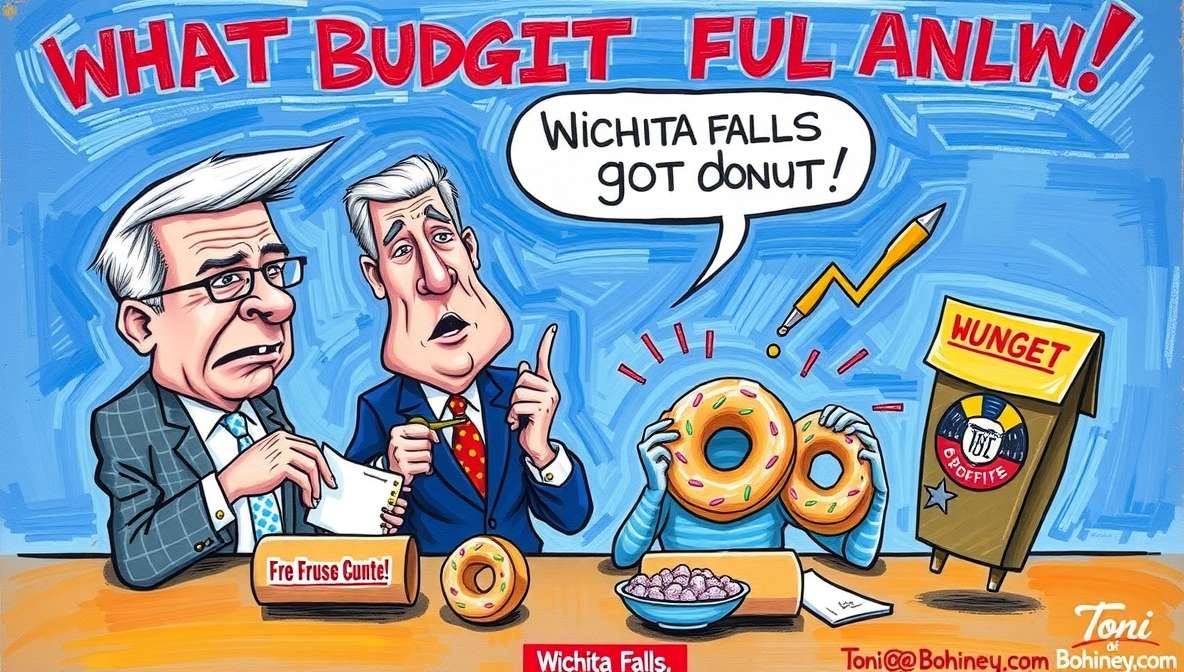
Texas AG Audits Wichita Falls: City Budget Vanishes Faster Than Free Donuts
By Junglepussy & Heidi Ladein
Wichita Falls’ Wallet Gets Audited — Lawyers Bring Flashlights, Skip the Mood Lighting
In a dramatic turn of events that has residents checking under their couch cushions, Wichita Falls‘ city finances are under the piercing gaze of the Texas Attorney General. Local lawyers reportedly arrived with flashlights, magnifying glasses, and the kind of serious frowns usually reserved for deciphering IKEA instructions. “We skipped the mood lighting,” admitted one attorney, who wished to remain anonymous, citing strict audit protocol and a fear of being blamed for ambiance-related budget discrepancies.
Eyewitnesses report that city hall has seen more activity than a Black Friday sale, with employees scurrying around holding stacks of receipts and muttering phrases like, “Is this the original coffee budget or the deluxe caramel latte?” One anonymous staffer revealed, “We tried to hide the office snacks under the desk, but the auditors had a flashlight and a deep sense of moral outrage.”
Financial experts have chimed in, noting that audits of municipal wallets rarely involve laser pointers and interpretive shadow puppets—but Wichita Falls may be pioneering a new genre of forensic accounting theater.
Attorney General Says 1,000 Texas Cities Should Show Their Receipts — Wichita Falls Gets VIP Spotlight

The Texas Attorney General recently announced that a thousand cities across the state should submit their financial records for review, but Wichita Falls appears to have drawn the short straw, or perhaps the golden envelope. “We picked Wichita Falls for a VIP spotlight because of their bold, avant-garde approach to budgeting,” said a spokesperson for the AG’s office. “It’s not that other cities are innocent—we just like a little drama.”
Local residents have responded with a mixture of panic and creativity. A survey conducted by the Wichita Falls Free-Range News revealed that 62% of citizens were unsure whether the city spent money on pothole repairs or gourmet office coffee, while 27% feared their property taxes were being converted into artisanal bookmarks for council meetings. “We never thought our budget could be this exciting,” one resident said, holding a latte and waving a spreadsheet like a championship flag.
Political analysts note that shining the spotlight on Wichita Falls may serve as a cautionary tale for other cities. “It’s basically the Texas version of the Hunger Games,” said Professor Mildred Jenkins of the University of Houston School of Satirical Finance. “Only here, the odds are always in favor of the lawyers.”
When Auditors Come Calling: Municipal Panic Ensues
Comedy legend Jerry Seinfeld would have a field day with this scenario. “What’s the deal with city budgets?” he said. “You’ve got numbers going in, numbers going out, and somehow nobody knows where the money went. It’s like a sock in the dryer—it just vanishes into another dimension.”
Ron White offered his own perspective on government financial oversight. “I’ve seen people lose track of their car keys,” he said. “But losing track of millions in taxpayer money? That takes a special kind of talent. Or bourbon. Probably both.”
Wichita Falls: ‘We Assume Money Disappeared, Until Proven Otherwise’
Inside city hall, officials have adopted a new unofficial motto: “We assume money disappeared, until proven otherwise.” City Treasurer Jim Bumblington explained, “It’s not that we’re hiding anything—we’re just very optimistic about the concept of financial mystery.”
According to leaked memos, the city has been experimenting with “budget invisibility techniques,” including storing petty cash inside hollowed-out copies of classic novels and marking expenses as “miscellaneous joy.” “We call it fiscal abstract expressionism,” explained one accountant, adjusting his bowtie and a pair of oversized novelty glasses.
Social scientists argue that Wichita Falls’ approach is not unprecedented but unusually theatrical. Dr. Simone Latchkey, a researcher in municipal antics, commented, “Cities often misplace money. What makes Wichita Falls stand out is that they do it with panache, and occasionally a marching band.”
The Creative Accounting Hall of Fame
Amy Schumer weighed in on the creative bookkeeping methods. “I’ve used some creative excuses in my life,” she said. “But calling missing money ‘miscellaneous joy’? That’s poetry. Dark, potentially criminal poetry, but poetry nonetheless.”
Kevin Hart couldn’t help but comment on the sheer audacity of the situation. “You know you’re in trouble when the lawyers show up with flashlights,” he said. “That’s not an audit—that’s a crime scene investigation. Somebody call CSI: Municipal Finance Edition.”
Dave Chappelle put the situation in broader context. “Every city’s got budget problems,” he said. “But Wichita Falls took it to another level. They made financial mismanagement an art form. I respect the commitment to the craft.”
Bill Burr addressed the taxpayer perspective with characteristic bluntness. “You work all year, pay your taxes, and then find out the city spent it on what?” he said. “Artisanal bookmarks? Are you kidding me? I can’t even afford regular bookmarks. I use torn pieces of junk mail.”
When the Numbers Don’t Add Up
Ricky Gervais took aim at the audit process itself. “I love how they send in auditors with flashlights like they’re exploring ancient tombs,” he said. “Except instead of finding pharaohs’ treasures, they’re finding receipts for gourmet coffee and emotional support staplers.”
Chris Rock highlighted the disparity in government spending. “Cities will tell you there’s no money for schools or roads,” he said. “But somehow there’s always money for ‘miscellaneous joy.’ I want miscellaneous joy! Where’s my miscellaneous joy budget?”
Ali Wong connected the dots between taxpayer burden and municipal accountability. “We’re out here trying to stretch every dollar,” she said. “Meanwhile, city hall’s playing hide-and-seek with millions. That’s not accounting—that’s gaslighting with spreadsheets.”
Jim Gaffigan couldn’t resist commenting on the food-related budget mysteries. “Office snacks hidden under desks?” he said. “That’s not embezzlement—that’s Thursday at my house. Although I usually eat the evidence before anyone asks questions.”
Trevor Noah drew international comparisons to the government transparency issues. “In some countries, this level of financial opacity would spark protests,” he said. “In Texas, it just makes people shrug and say, ‘Well, at least we’re not Oklahoma.’ That’s setting the bar real low, folks.”
Sarah Silverman pointed out the absurdity of the defense strategy. “Assuming money disappeared until proven otherwise is brilliant,” she said. “I’m going to use that with my accountant. ‘I assume I paid my taxes, until proven otherwise.’ See how well that goes over.”
Jo Koy related the story to family financial management. “My mom could track every penny that went through our house,” he said. “But a whole city can’t figure out where millions went? Either hire Filipino mothers to run your treasury department, or admit you’re just not trying.”
Hasan Minhaj examined the systemic implications of municipal finance failures. “This isn’t just about one city,” he said. “When a thousand Texas cities get told to show their receipts, that’s not an audit—that’s an intervention. Someone needs to sit Texas down and have a serious talk about financial responsibility.”
The Waiting Game: What Happens Next?
As auditors prepare to comb through every line item, residents are holding their breaths, wondering whether the city will reveal a shocking treasure trove of misplaced funds—or just a shocking number of unpaid snack invoices. Either way, Wichita Falls is proving that in Texas, even a budget review can be a full-contact spectator sport.
The story serves as a reminder that government accountability matters at every level, from federal agencies down to local municipal management. When taxpayer dollars go missing, citizens deserve answers—preferably ones that don’t involve interpretive dance or abstract expressionism.
Satirical Disclaimer
This story is entirely a human collaboration between two sentient beings: the world’s oldest tenured professor of absurd municipal law and a philosophy major turned interpretive accounting consultant. Any resemblance to real budgets, cities, or office snack hoarding is purely coincidental, yet deliciously plausible.