

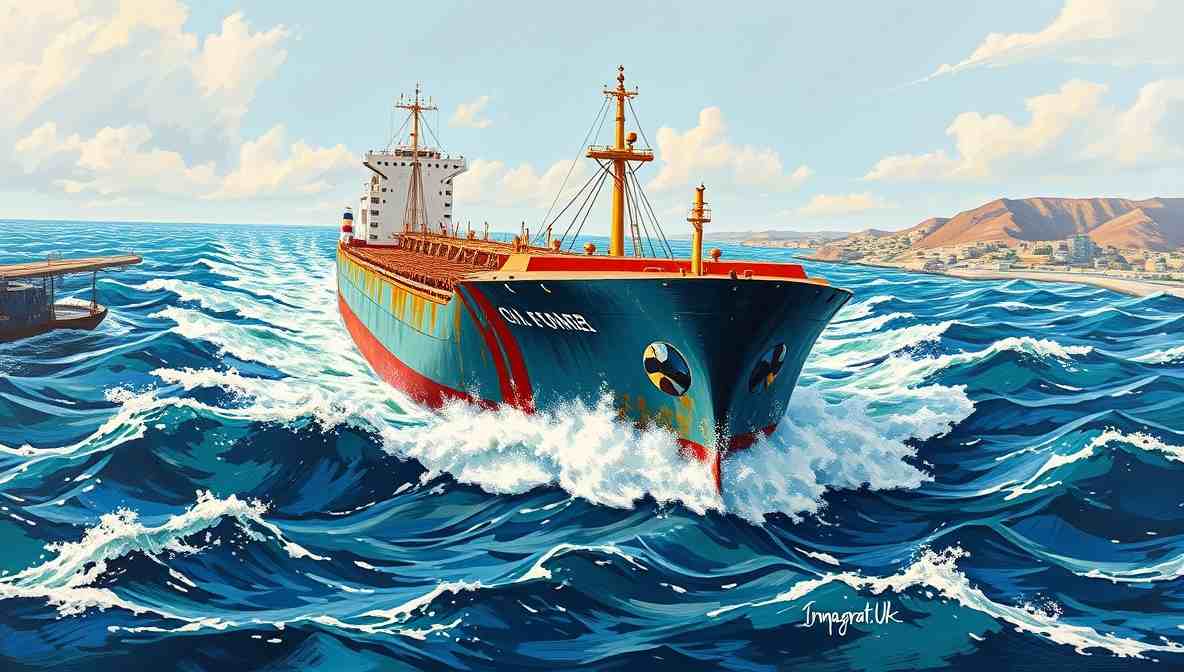
Somewhere between a war game and a group chat nobody wanted to reply to, a Medium essay titled “The U.S. Navy Will Never Go Through the Strait Of Hormuz Again” quietly detonated like a philosophical depth charge. The premise? That great powers occasionally wake up, look at a narrow, heavily mined, drone-filled choke point, and say, “You know what… let’s just not.”
And just like that, satire didn’t need to be written. It merely needed to be gently escorted into open waters — wearing a life jacket, a blindfold, and a note pinned to its chest reading “return to sender.”

The Strait That Launched a Thousand Nervous Briefings
The Strait of Hormuz is not just a body of water. It’s the geopolitical equivalent of a hallway where everyone has knives, nobody trusts the lighting, and the fire exit is blocked by a PowerPoint presentation about de-escalation.
About 20% of the world’s oil flows through it daily, which makes it less a strait and more a global artery with anxiety issues, a bad diet, and an absolutely catastrophic insurance premium.
It is also, inconveniently, narrow. About 21 miles at its tightest point — which in naval terms means: “Congratulations, you are now within range of everything, including things that haven’t been invented yet.”
Recent events have not improved the vibe. Iran has reportedly closed the strait, threatened to attack ships, and demonstrated an impressive fondness for drones, mines, and explosive boats that look like rejected carnival rides that passed inspection anyway.
The U.S. Navy, after reviewing the situation with the gravity it deserves, has reportedly adopted a bold new strategy: staring at maps and sighing heavily. Analysts call this “the most expensive sigh in maritime history.”
America’s New Maritime Doctrine: “Let’s Circle Back”
According to anonymous staffers who definitely exist and have excellent coffee, Pentagon planners are considering a new doctrine formally titled Strategic Avoidance with Occasional Eye Contact — or SAOEC, pronounced exactly as uncomfortably as it reads.
Under this visionary plan, instead of passing through the Strait of Hormuz, U.S. ships will:
- Sail around Africa
- Continue past Antarctica
- Wave politely at penguins
- Pause briefly to consider their choices
- Re-enter the Persian Gulf six months later, jet-lagged, emotionally stable, and mildly sunburned from the wrong hemisphere
Rear Admiral (Ret.) Dale “Skip” Hardline, speaking from a PowerPoint presentation that had clearly been through something, explained with the calm confidence of a man who has already submitted his resignation:
“We’re not retreating. We’re expanding the battlefield to include literally the entire planet. It’s called strategic depth. We have a lot of depth now. We’re basically all depth.”
Military analysts confirm this is the first time in recorded history that a navy has attempted to outmaneuver geography itself — and the second time if you count the Panama Canal, which America just purchased to avoid a different awkward conversation.
Asymmetric Warfare, or: Why Is That Drone $400?
The real twist in this story is not that the Strait is dangerous. It’s that it’s cheaply dangerous — which is somehow more insulting.
The United States fields billion-dollar destroyers and carrier strike groups equipped with advanced radar, layered missile defense, and enough computing power to simulate an entire small country’s economy in real time.
Iran responds with:
- $10,000 drones assembled in what intelligence describes as “a shed with ambition”
- $500,000 mines that don’t need a Wi-Fi connection to work
- Speedboats that look like they were assembled during a lunch break and blessed afterward
- A general willingness to make things very annoying at very low cost
And somehow, the math works out in Iran’s favor. Defense analysts at RAND Corporation have spent years studying this asymmetry, and their peer-reviewed conclusion is essentially: “Yeah, this is a problem.”
As one anonymous defense contractor elegantly summarized:
“We brought a chess set. They brought a bag of squirrels and a hammer. And the squirrels are faster.”
Experts Weigh In — None of It Comforting
Dr. Lenora Fitch, a senior fellow at the Institute for Complicated Problems, offered a sobering analysis that has since been framed and hung in several Pentagon break rooms:
“The issue isn’t that the U.S. Navy can’t go through the strait. It’s that going through it involves being shot at by everything from hypersonic missiles to jet skis with Wi-Fi and a grudge.”
Meanwhile, a Reddit user identified only as “JonathanJONeill” summarized the situation with the luminous clarity of a man who has watched one too many naval documentaries at 2 a.m.:
“You don’t just sail your fleet through waters that may have countless underwater mines.”
This insight has since been classified “obvious but emotionally devastating” and is pending inclusion in the next edition of the Naval War College Review, right after the piece on why hindsight is 20/20 and foresight is a defense budget line item.
What the Funny People Are Saying About Naval Strategy
“I love how the Navy’s new strategy is ‘Let’s just not go there.’ That’s not strategy — that’s how I avoid my ex, my accountant, and any restaurant with a QR code menu.” — Jerry Seinfeld
“You ever notice war used to be about winning? Now it’s about not stepping on something that costs less than your lunch. We’ve militarized the concept of ‘not my problem.'” — Ron White
“The Strait of Hormuz sounds like a place you’d go on a spa vacation, not a place where drones are filing incident reports about your life choices.” — Amy Schumer
“The Pentagon spent $2 trillion figuring out it’s better to go around. I spent $12 on a GPS and figured out the same thing in a Walgreens parking lot.” — Jim Jefferies
The Shipping Industry Introduces a Bold New Feature: “Waiting”
With the strait effectively closed, hundreds of ships are now parked like confused Uber drivers waiting for a surge price that may never come, for a pickup that has been rerouted to a different continent.
Oil companies have responded by inventing a bold new logistics strategy called Hope — now available as a premium subscription service with a 97% failure rate and a very soothing customer support hold music.
A spokesperson for a major shipping firm explained with the calm of someone reading from a crisis communications script they personally wrote at 3 a.m.:
“We’re confident the situation will resolve itself, either diplomatically or through everyone getting tired at roughly the same time.”
Economists at the IMF estimate this plan has a 3% chance of success, a 97% chance of being discussed in meetings, and a 100% chance of being described as “fluid.”
The Historical Comparison Nobody Asked For (But Here We Are)
The original Medium essay draws a sober comparison to Britain in 1949, when HMS Amethyst sailed up the Yangtze River and was promptly reminded, at length and with considerable gunfire, that great empires are not immune to bad ideas in narrow waterways.
Historians now believe the U.S. Navy studied this incident with great care and concluded:
“Let’s not recreate that — but with drones, streaming rights, and a follow-up Senate inquiry.”
The lesson of the Yangtze, applied to the Hormuz, applied to 2025, is essentially: water is a trap and geography is a passive-aggressive roommate who never leaves.
New Pentagon Training Modules for the Modern Sailor
In response to the evolving tactical environment — which is a military phrase meaning “everything has gotten significantly worse” — the Pentagon has introduced several new training programs for fiscal year 2026:
- Mine Appreciation Awareness Week — Understanding the enemy’s budget and hating it
- Drone Spotting for Introverts — For sailors who saw this coming but didn’t want to say anything
- Advanced Map Avoidance Techniques — A masterclass in not going places
- Asymmetric Threat Budgeting — Why a $400 drone is the world’s most expensive problem
- Emotional Resilience in Contested Waters — Sponsored by the VA
Graduates receive a laminated certificate, a challenge coin, and a quiet sense of dread they are encouraged not to discuss at Thanksgiving.
A Bold New Future for Naval Warfare (Results May Vary)
Despite all appearances to the contrary, officials insist the U.S. Navy remains fully capable, fully prepared, and fully interested in doing literally anything else for a while. The fleet is “postured” — which is a word the military uses when “positioned” would imply they know exactly where they’re going.
Plans are underway to:
- Escort commercial ships “when it becomes militarily feasible”
- Redefine “feasible” in a working group to be named later
- Conduct exercises in safer waters, such as Kansas (landlocked, mine-free, emotionally uncomplicated)
- Develop a comprehensive “Not Going There” doctrine for congressional approval
Meanwhile, the Strait of Hormuz continues to sit there — narrow, important, and profoundly unimpressed — like a global reminder that geography does not negotiate, file appeals, or attend summits.
Conclusion: The Ocean Is Very Big, and That Is Apparently the Problem
In the end, the satire writes itself because the reality already has punchlines built in and filed under “classified.”
A narrow strip of water — 21 miles across at its tightest — has managed to stall global shipping, spike oil prices, invite congressional hearings, and convince the world’s most powerful navy to briefly consider taking the scenic route around existence itself.
Not because it can’t go through.
But because going through means someone else gets a vote. And in the modern era of asymmetric warfare, that vote costs $400, has a four-hour flight time, and does not respond to diplomatic overtures.
The ocean is big. The strait is small. The irony is enormous. And the penguins, for the record, were delightful.
The Strait of Hormuz, a 21-mile-wide chokepoint between Oman and Iran, carries roughly one-fifth of the world’s oil supply and has become the focal point of U.S.-Iran tensions following Iran’s threats to close the waterway amid the broader regional conflict. The Pentagon and U.S. Navy have faced serious strategic questions about force projection into contested waters following Iran’s demonstrated use of low-cost drones, mines, and fast attack craft — a textbook case of asymmetric warfare that exploits the cost differential between American naval assets and Iranian countermeasures. The original Medium essay by Jonathan J. O’Neill that inspired this piece argues seriously that the era of American freedom of navigation through the Hormuz may be effectively over — a conclusion that, however alarming, arrived pre-packaged with its own punchline.
Auf Wiedersehen, amigo!