

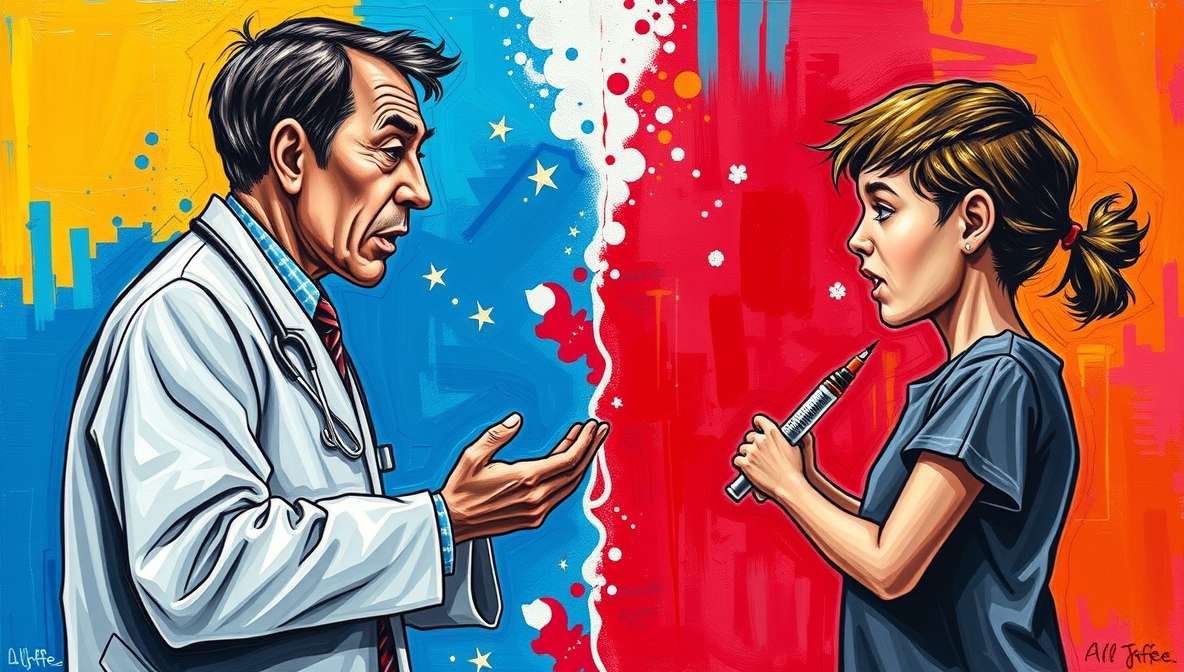
Americans Divided Over Childhood Vaccine Mandates — Also Divided Over Family Dinners
The Dual Crisis of Public Health and Thanksgiving Seating
Across America, families are arguing not only about childhood vaccine mandates but about what’s for dinner, who’s sitting next to whom, and whether Aunt Linda’s conspiracy theories count as dinner conversation or biological warfare.
A CDC spokesperson admitted that “Thanksgiving now qualifies as a high-risk political event, though not for the reasons we typically monitor.” The agency has quietly added “avoid talking about vaccines with family” to their list of holiday safety tips, right below “properly cooking turkey” and “not drinking all the wine before guests arrive.”
An anonymous therapist from Des Moines observed: “Half my clients are fighting over medical science; the other half over who microwaved the turkey. The common thread is that everyone feels attacked by information they didn’t ask for.”
The Statistical Reality of American Division
Recent polling by Pew Research shows that 36% of parents say childhood vaccines should be required for school attendance, 29% say they should be optional, and 35% say, “I’ll decide after I check what Joe Rogan said.”
This marks the first time in American history that a comedian podcaster has more influence on public health decisions than the entire medical establishment, a development that has immunologists questioning whether they should have gone into entertainment instead.
One pediatrician in Minnesota noted: “I spent twelve years in medical school and residency, but parents tell me I don’t know as much as a guy who watches YouTube and eats elk meat. It’s very humbling. By which I mean completely insane.”
How Medical Misinformation Spreads Faster Than Disease

Meanwhile, scientists remain baffled by people who distrust doctors but trust influencers who sell detox tea, crystal healing kits, and courses on “intuitive immunology.” Social media platforms have become the new medical schools, except the curriculum is determined by engagement metrics rather than clinical trials.
Dr. Anthony Fauci, who has spent decades studying infectious diseases, reports that his professional credentials are regularly challenged by people whose medical knowledge comes from Facebook groups named things like “Moms Against Science But For Freedom Eagle Liberty.”
One public health official said: “We used to fight diseases. Now we fight memes. The diseases are easier.”
The Family Dinner Table Debate
The division extends beyond public health policy into America’s dining rooms, where families now face the choice between serving vaccination-status-segregated seating charts or pretending politics don’t exist while passing the gravy.
Event planners report a 450% increase in requests for “neutral zone” dinner parties, where guests must sign agreements not to discuss vaccines, politics, or why Cousin Jerry believes the government is “putting things in the water to make us compliant.”
Larry David said, “We’ve gone from ‘Don’t play with your food’ to ‘Don’t trust your doctor.’ I miss when family fights were about who got the drumstick.”
Billy Crystal said, “In my family, herd immunity meant grandma’s lasagna fed everyone. Now it means we don’t invite certain relatives.”
The Science Versus Feelings Debate
Medical professionals attempting to explain vaccine science report increasing frustration with the phrase “I did my own research,” which typically translates to “I watched three YouTube videos and now I’m an epidemiologist.”
Peer-reviewed studies involving thousands of participants over decades somehow carry less weight than a single Instagram post from someone whose bio includes “wellness warrior” and “truth seeker” but not “medical degree.”
One immunologist explained: “Vaccines work by training your immune system. But apparently, we can’t train people’s brains to understand basic biology. The irony is devastating.”
The Economics of Fear and Distrust
The anti-vaccine movement has become a billion-dollar industry, with entrepreneurs selling alternative health products, detox protocols, and courses on “natural immunity” — which is just getting sick the old-fashioned way but paying $497 for the privilege.
Pharmaceutical skepticism has created a market for unregulated supplements, essential oils, and colloidal silver, none of which have undergone FDA approval but all of which promise to “boost immunity” through mechanisms never quite explained beyond “ancient wisdom” and “vibrations.”
Jim Gaffigan said, “People won’t trust a vaccine that’s been tested for years, but they’ll eat gas station sushi. That’s not a health philosophy; that’s a death wish.”
The Political Polarization of Public Health
What was once a nonpartisan issue — protecting children from preventable diseases — has become a political identity marker. Vaccine hesitancy now divides Americans more effectively than any gerrymandered district.
Conservative parents view vaccine mandates as government overreach, liberal parents view vaccine refusal as anti-science ignorance, and moderates are stuck in the middle wishing everyone would stop making measles a political statement.
One epidemiologist noted: “Measles doesn’t care about your voter registration. It’s an equal-opportunity infection. The virus is apolitical even if we’ve made immunity partisan.”
The Impact on Medical Professionals
Healthcare workers report increasing burnout from arguing with patients who believe Facebook posts over medical evidence. Doctors now spend more time debunking conspiracy theories than treating actual illnesses.
One family physician said: “I explain vaccines using peer-reviewed science. Parents nod politely, then ask, ‘But what does Gwyneth Paltrow think?’ I’m starting to question my career choices.”
Nurses attending family gatherings now hide their profession to avoid becoming unpaid medical consultants to relatives who want free healthcare advice but won’t take free healthcare advice.
Trevor Noah said, “Imagine studying medicine for a decade, only to have someone who got a C in high school biology tell you you’re wrong because they ‘feel it in their gut.’ That’s not intuition; that’s indigestion.”
Historical Context of Vaccine Resistance
Vaccine opposition isn’t new — resistance dates back to smallpox vaccination in the 1700s. What’s changed is the speed and reach of misinformation. Anti-vaccine pamphlets used to spread slowly; now, falsehoods circle the globe in seconds, liked and shared by millions before fact-checkers finish their morning coffee.
The difference is that previous generations didn’t have social media algorithms designed to amplify fear for profit. Facebook and YouTube have admitted their platforms spread vaccine misinformation but claim they’re “working on it,” which is corporate-speak for “we’re making too much money to fix this quickly.”
International Perspectives on American Health Debates
Other developed nations watch American vaccination debates with confusion. European health officials note that Americans spend more on healthcare than any nation while simultaneously refusing preventive medicine because “freedom.”
A Canadian doctor said: “You have universal access to vaccines but choose not to use them. We’re trying to improve our healthcare system, and you’re trying to demolish yours through memes. It’s fascinating in a horrifying way.”
Solutions That Won’t Work But We’ll Try Anyway
Public health experts suggest improved health literacy education, but Americans can barely agree on what books belong in libraries, so teaching immunology seems optimistic.
Some propose mandatory vaccination laws with limited exemptions, which would be effective except for the minor detail that half the country views mandates as tyranny worse than actual disease.
Others suggest letting natural selection handle it, which is technically evolution but cruel, impractical, and exactly what Charles Darwin didn’t want his theory used for.
Amy Schumer said, “We can’t agree on vaccines, climate change, or whether the earth is round. Maybe we should start smaller, like agreeing what day Thanksgiving is. Baby steps toward basic reality.”
The Role of Social Media in Health Decisions
Social media companies claim they’re fighting misinformation while simultaneously profiting from engagement algorithms that reward controversy over accuracy. It’s like claiming to fight fires while selling gasoline.
TikTok has become an unlikely health educator, where real doctors compete with wellness influencers for views. The doctors cite studies; the influencers cite “lived experience” and wear better outfits. Guess who gets more followers.
Chris Rock said, “People trust social media for medical advice, then wonder why their health advice comes with a side of product placement. It’s not healthcare; it’s an infomercial with extra steps.”
The Future of American Public Health
As vaccine-preventable diseases make comebacks in areas with low immunization rates, public health officials face a choice: accept that some Americans prefer 19th-century disease patterns, or continue explaining science to people convinced their immune systems are enhanced by oregano oil and positive thinking.
Measles outbreaks in previously eradicated areas serve as real-time experiments in what happens when herd immunity drops below critical thresholds. Spoiler: children get sick. Shocking development that epidemiologists predicted but everyone ignored.
The irony is that the same people demanding “medical freedom” will demand medical care when preventable diseases strike, asking doctors to fix problems those same people helped create through intentional ignorance.
The Satirical Reality of Modern Healthcare
In the end, America’s vaccine debate reveals a truth more contagious than any virus: we’ve confused opinion with expertise, feelings with facts, and Google searches with medical degrees.
Dave Chappelle said, “We used to respect doctors. Now we rank them below YouTube personalities and above nothing. What happened? When did survival become controversial?”
The answer is simple: we’re a nation that values freedom over function, individuality over immunity, and personal choice over public health — even when those choices make everyone sick.
Families continue gathering for dinners, avoiding vaccine conversations while secretly judging each other’s life choices. It’s very American. It’s very dysfunctional. And it’s definitely not covered by insurance.
Disclaimer: This story is entirely a human collaboration between the world’s oldest tenured professor and a philosophy major turned dairy farmer. No families were harmed during Thanksgiving dinner, but several relationships remain strained. Read more at Bohiney.com.
Image Gallery: America’s Vaccine Divide From Lab to Living Room
When Public Health Policy Meets Family Dinner Politics