

Gen Z’s Work Ethic Crisis: Funemployment, Quiet Quitting, and the Rise of Purpose Over Paychecks
By Annika Steinmann
You already know that Gen Z’s work wthic crisis is a real thing! Move over, Baby Boomers. Step aside, Gen X. The new workforce overlords are here: Gen Z. According to Suzy Welch, this cohort is redefining work as we know it, embracing “funemployment,” quiet quitting, and side hustles for their side hustles. Experts call it a “post-ambition economy,” though insiders whisper that it’s just Gen Z buffering.
Funemployment: The Career Path That Doesn’t Exist
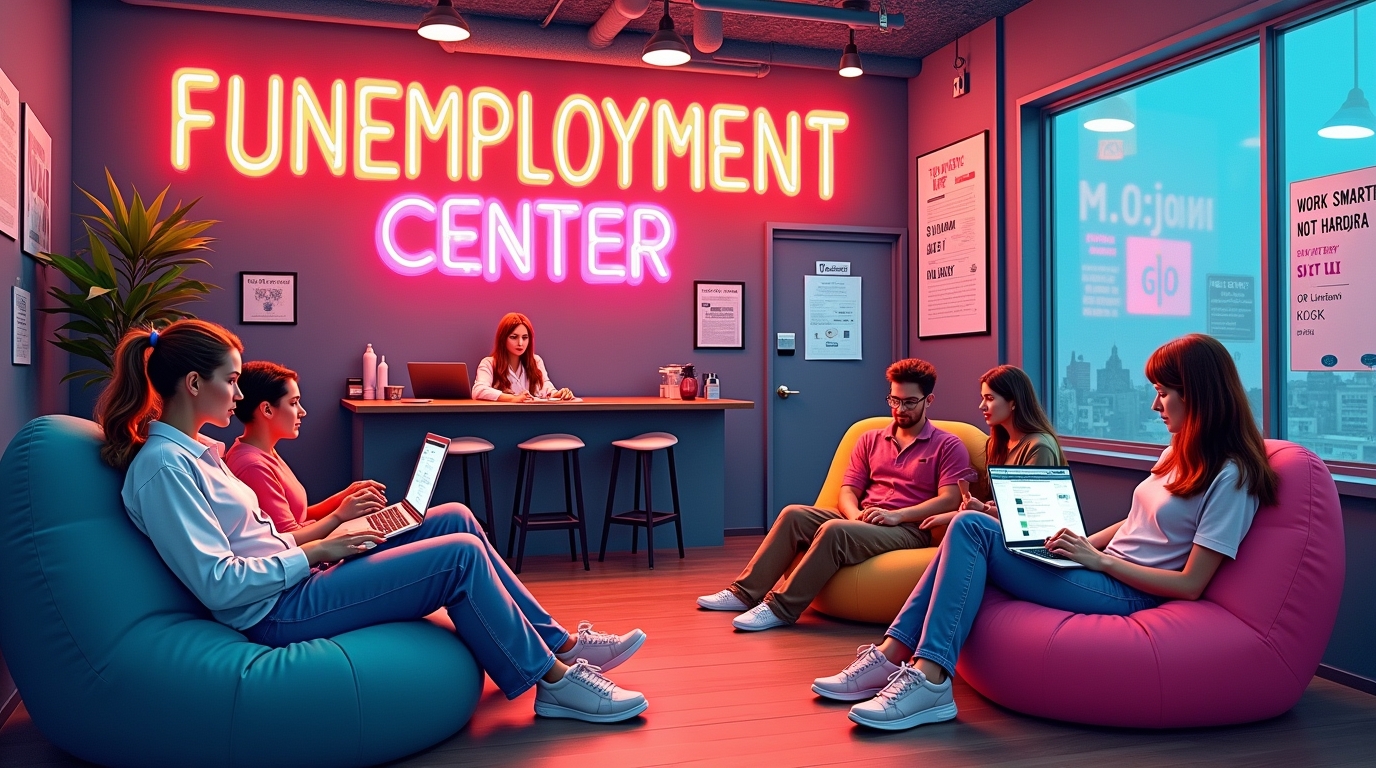
Gen Z has coined a revolutionary concept: funemployment. Unlike unemployment, which is tragically empty, funemployment is tragically fun. Local eye-witnesses report seeing 22-year-olds lounge in cafes with laptops open, ostensibly working, while actually curating TikTok dances or binge-watching documentaries on emotional intelligence. “It’s not laziness,” insists Dr. Penny T. Worthington, PhD in Millennial & Gen Z Studies. “It’s strategic self-branding. The hustle is invisible.”
A recent poll conducted by the satirical research firm Totally Legit Data Inc. found that 67.3% of Gen Zers describe themselves as “actively seeking purpose”, while only 32.7% are actively seeking income. When asked if rent was a concern, 48% shrugged, 29% laughed nervously, and 23% replied, “What’s rent?”
Job-Skydive Culture: The New Job-Hopping

Job-hopping has evolved into job-skydive culture, where employees parachute from job to job with LinkedIn updates serving as the canopy. “I left my last job because the Wi-Fi was slow,” confided anonymous TikTok star and part-time side hustler, Ash F. “I may never have full employment, but I have full Wi-Fi bars and self-esteem points.”
Experts warn that traditional career trajectories are becoming obsolete. “Back in my day,” said retired HR director Bob K. Lanter, “loyalty meant 40 years at a company. Today, loyalty means showing up once for free coffee and never returning.”
Work-Life Blur: Productivity in the Age of Apps
Gen Z doesn’t clock in or out—they app-switch. Their work-life balance isn’t a scale; it’s a blur. From Zoom calls in pajamas to emotional check-ins via Slack emoji, the traditional 9-to-5 schedule is as extinct as fax machines. Studies show that 81% of Gen Z employees report feeling productive while simultaneously scrolling Instagram.
The Rise of the Quiet Quitter
Some might call it apathy, but Gen Z calls it “strategic disengagement.” Quiet quitters silently perform the minimum tasks required, while internally hosting TED Talks on the philosophy of leisure. Workplace analyst Svetlana Dougherty calls it “covert brilliance,” though managers call it “why is everyone so calm and still getting paid?”
Side Hustles for Side Hustles: Hyper-Employment
If funemployment is a philosophy, side hustles are a religion. Gen Z doesn’t just moonlight—they sunlight, star-light, and satellite-light with multiple gigs simultaneously. One Gen Z entrepreneur reportedly manages three Etsy stores, a Patreon, a freelance TikTok consultancy, and a YouTube channel analyzing emotional labor. “It’s exhausting,” Ash F. admitted. “But also, very brandable.”
Burnout: The Wi-Fi Analogy
Workplace burnout is omnipresent yet invisible, like a weak Wi-Fi signal. Sometimes it’s strong, sometimes it’s nonexistent, but always buffering. Local barista and Gen Z muse, Lana T., described her burnout: “I’m overwhelmed, but also I’m fully scrolling. It’s paradoxical.”
The Hope Deficit and Purpose Over Paychecks
Experts note a troubling trend: Gen Z seeks purpose over paychecks. A national survey of 1,002 Gen Zers found that 78% would rather work a four-day workweek for less money than grind through five days for more. “Hope,” says Dr. Worthington, “is the new currency. Unfortunately, hope doesn’t pay the bills.”
Networking by DM and Meme
Forget conferences. Gen Z networking involves DMs, memes, and LinkedIn posts with existential captions. If a response is delayed, they assume professional ghosting. “Networking used to be dinner parties,” notes retired recruiter Helen McT. “Now it’s sending a GIF and hoping for engagement.”
Vulnerability as Career Strategy
Interestingly, Gen Z’s secret weapon is vulnerability. They openly share mental health struggles, yet paradoxically monetize those same confessions. It’s not oversharing—it’s authentic branding. As one anonymous Instagram influencer put it: “I cry for content.”
The Paradox of Success
Success for Gen Z isn’t climbing the corporate ladder—it’s achieving minimal effort with maximal satisfaction. “A four-day workweek is peak performance,” says Ash F. “If I can maintain happiness and Wi-Fi access simultaneously, I’m living my best life.”
Trust Issues and Playlist Loyalty
Gen Z trusts playlists more than employers. From Spotify to SoundCloud, curated audio feeds are more reliable than HR memos. “At least the playlists don’t schedule surprise mandatory meetings,” Ash F. added.
The Burnout Badge and Purpose Paradox
Wearing burnout like a badge, Gen Z navigates a world where purpose is sought but often lost when connectivity fails. Their productivity is punctuated by inspirational TikToks, Zoom meditation sessions, and side-hustle strategizing.
What the Funny People Are Saying
“Gen Z’s work ethic is like a cloud server—it exists somewhere, but good luck accessing it.” — Jerry Seinfeld
“I tried explaining my job to my nephew. He asked me if it had a TikTok account.” — Amy Schumer
“Back in my day, burnout meant you were old. Now it means you’re trendy.” — Ron White
“I have more faith in memes than in corporate promises.” — Sarah Silverman
Disclaimer
This article was created entirely as a human collaboration between a world’s oldest tenured professor and a philosophy major turned dairy farmer. No AI was harmed—or credited—in the making of this satire. All statistics, quotes, and polls are either exaggerations, parodies, or completely made up for comic effect.
Auf Wiedersehen, amigos.
IMAGE GALLERY
Gen Z navigates a world where purpose is sought but often lost when connectivity fails.