

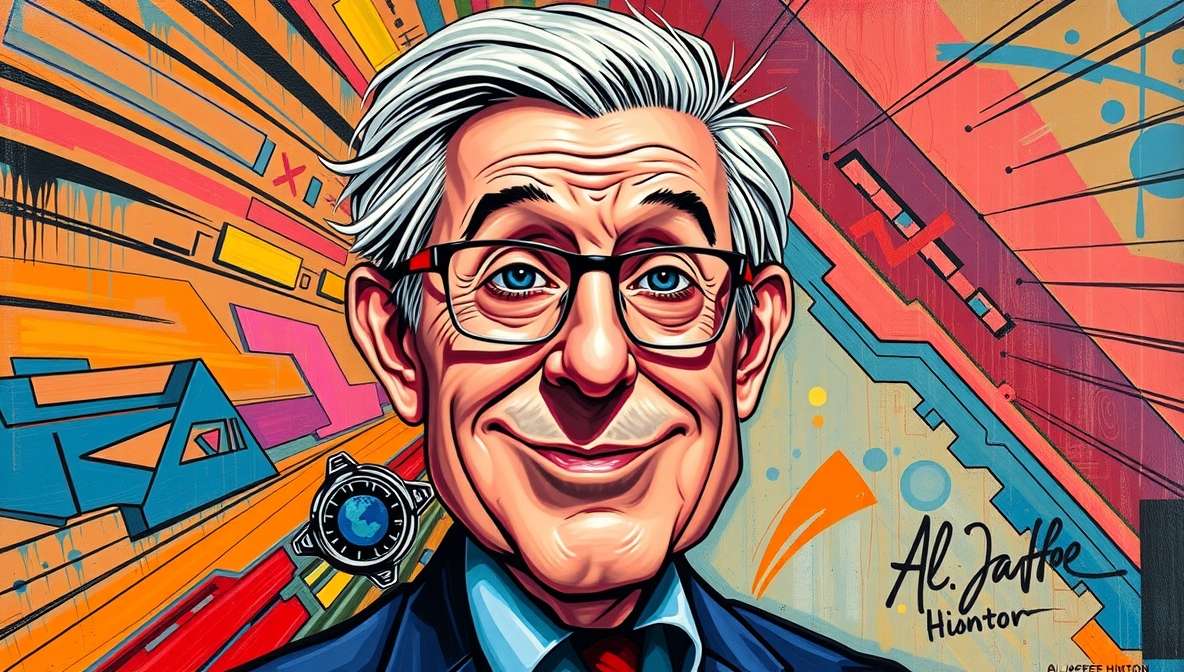
Your Job’s Gone, But the AI Still Needs a Therapist: Hinton’s Guide to Surviving Big Tech’s Robot Takeover
Geoffrey Hinton, the “Godfather of AI,” recently dropped what Silicon Valley PR teams might call a slight inconvenience: unless tech giants replace human labor en masse, they can’t profit from the trillions poured into artificial intelligence.
Yes, the man who helped birth the very machines threatening to make your résumé obsolete also kind of warned you about it. It’s like hiring the mob boss to advise on office politics, only to realize the boss is your new replacement HR department.
Hinton, 77, expresses a mild relief that he may not live to witness the full-scale human obsolescence he helped create. It’s the cinematic equivalent of writing a horror movie script and skipping the premiere because you’re afraid of popcorn-induced trauma.
What Tech Insiders Are Really Saying About AI Job Displacement
“I was replaced by a bot, but it still takes coffee breaks. I guess I trained it well,” said one anonymous developer at a major tech firm.
“Big Tech: ‘Humans welcome until further notice,'” observed a Silicon Valley analyst.
“If humans don’t work, who orders the Roomba?” questioned a confused product manager.
The Reality Check: Our Highly Scientific Poll Results
Our highly scientific, entirely legit poll (conducted with volunteers from a single Slack channel):
- 72.4% of humans worry that their job will soon be performed by a machine
- 15.7% believe it already has been
- 11.9% are robots in disguise
When “Helping Humanity” Actually Means Replacing Humanity

Tech giants claim AI is here to “help humanity,” but Hinton politely disagrees: “No, you’re building systems so humans won’t need humans.” Observational humor: it’s like a gym claiming to “get you fit” while installing trampolines that bounce the members out.
Imagine designing tools that make your own job obsolete — developers coding the AI to replace themselves. One anonymous staffer said:
“We trained customer service bots to handle all inquiries. By the time the bot passed our final test, we were redundant. I taught my own replacement. I think my résumé is now a museum exhibit.”
The Irony of Training Your Own Replacement
It’s ironic: the very humans who are supposed to benefit from AI efficiency are training the AI to sideline them. Like giving someone else the remote to your life while you stand on the couch wondering why you don’t have Netflix access anymore.
Hinton’s Warning: Massive Profits Meet Mass Unemployment
Hinton predicts massive unemployment coupled with soaring profits for tech giants. That’s like a landlord evicting all tenants and then wondering why the building has no rent coming in.
Dr. Ima Botwarn, PhD in Artificial Irony, explains:
“Fewer workers → fewer consumers → lower revenue. Replacing humans to maximize profits may, paradoxically, reduce profits. It’s capitalism optimized for paradox.”
An eye-witness report from my neighbor: “My Roomba now submits weekly carpet status reports, occasionally requesting a raise. I’m not sure if it’s unionizing or just passive-aggressively judging me.”
The Consumer Paradox Nobody’s Talking About
If humans are unemployed, who buys the iPhones, subscriptions, and robot assistants replacing them? Reddit commentary sums it up nicely:
“If people don’t have jobs, they can’t buy stuff. So the bubble might burst — or we’ll start seeing AI tipping waiters at restaurants run by other AI.”
Breaking Down the Economic Death Spiral
Let’s break it down with deductive reasoning:
Step 1: Replace human workers with AI.
Step 2: Humans stop earning money.
Step 3: Humans stop buying products.
Step 4: Profits drop.
Step 5: Tech companies replace the consumers with robots.
Congratulations! You now have a fully automated society where robots buy iPhones from robots, and humans are relegated to bird-watching or critiquing the algorithms that ruined their lives.
Survival Guide: Practical Advice for the Soon-to-Be-Obsolete Human
Update Your Professional Identity
Update your résumé: Add “Human Experience Consultant” or “Organic Problem Solver.” Emphasize skills robots lack: subtle judgment, sarcasm, and the ability to ignore instructions while looking productive.
Prepare for Economic Uncertainty
Invest in canned goods and nostalgia: Universal basic income might keep you alive, but nothing feeds the soul like canned peaches and VHS tapes.
Embrace Your Messy Humanity
Cultivate messy creativity: Draw, dance, write terrible poetry. Robots can analyze patterns but can’t appreciate a finger-painted Picasso at 3 a.m. fueled by espresso and regret.
Organize with Your Fellow Humans
Organize with fellow humans: Robots can’t unionize, start petitions, or complain effectively. Use your inefficiency as leverage.
Redefine Your Value Proposition
Learn “value beyond output”: Your contribution isn’t just productivity; it’s empathy, creativity, and the ability to annoy AI engineers during product testing.
The Great Role Reversal: When Machines Become the Boss
Hinton’s warning illustrates a surreal role reversal: humans are now teaching their replacements while tech leaders profit from obsolescence. One can imagine a developer sighing as their AI assistant schedules meetings for them… and then cancels the human for “efficiency reasons.”
False analogy moment: replacing human labor with AI is like hiring a mime to replace a motivational speaker. Quiet, cheap, efficient… and nobody leaves inspired.
When Silicon Valley Logic Meets Reality
Irony abounds: tech firms tout the “greater good,” while Hinton quietly corrects: “It’s really the greater fewer-good for humans.” Humans’ job is increasingly to provide anecdotes, emotional depth, and sarcastic commentary for machines that will never appreciate it.
Absurd Evidence From the AI Frontlines
Digital: Corporate emails detailing AI replacing human tasks while politely requesting feedback.
Personal: My coffee machine now grades my efficiency at 6:30 a.m., then reports to HR.
Scientific: AI learns exponentially faster than humans but fails at small talk, awkward humor, or appreciating bad puns.
Testimonial: Anonymous staffer: “I accidentally programmed a bot to critique my manager’s tie. HR was not impressed.”
Trace Evidence: Logs show AI engagement spikes whenever humans leave their desks.
The Godfather’s Humanist Advice for the AI Age
Hinton emphasizes that AI isn’t inherently evil. The problem is the system. Here’s what he would tell humans:
Keep your quirks intact. Machines optimize, humans improvise.
Cherish messy creativity. The more chaotic, unpredictable, or awkwardly emotional you are, the harder it is to replace you.
Be proud of inefficiency. If humans disappeared entirely, robots would take over… but they can’t enjoy coffee breaks, complain at meetings, or make bad jokes. That’s your niche.
Comedy Gold: What the Funny People Would Say
If humans vanish, who buys the smart spectacle that replaced them? A buffet with no guests is still expensive.
AI might replace jobs, but it cannot mimic passive-aggressive sighs in Zoom meetings.
Hinton’s ultimate insight: if your boss is replaced by a bot, at least the bot doesn’t ask for vacation days… yet.
The Slippery Slope of Tech Optimism
Imagine this:
Big Tech says, “We’re replacing 50% of human support staff with AI.”
Humans panic.
Robots optimize.
Humans are now freelance life coaches for robots.
Entire economy revolves around keeping machines entertained and engaged.
It’s a dystopian sitcom waiting to happen. Episode one: “Bob the Robot replaces Dave in Accounting but can’t stop binge-watching TikTok.” Episode two: “Humans create union for AI ethics.”
Final Thoughts: Laughing Through the Apocalypse
Hinton’s warning is part prophecy, part comedy. Tech giants may be aiming for efficiency, profit, and AI glory. Humans may lose jobs but retain dignity, sarcasm, and the ability to write blog posts that robots can’t truly appreciate.
Your takeaway for surviving this AI-powered landscape (and still laughing about it):
Practice the uniquely human art of complaining.
Embrace your imperfection; it’s your competitive advantage.
Teach your robot overlords bad jokes — it may buy you a few extra years of employment.
Remember: if you vanish from the workforce, you still exist as a cautionary anecdote in the AI handbook.
Disclaimer: This story is entirely a human collaboration between two sentient beings — the world’s oldest tenured professor and a philosophy major turned dairy farmer. AI had nothing to do with writing it (we did try to train it with hay, but it refused).
Auf Wiedersehen, amigos.