

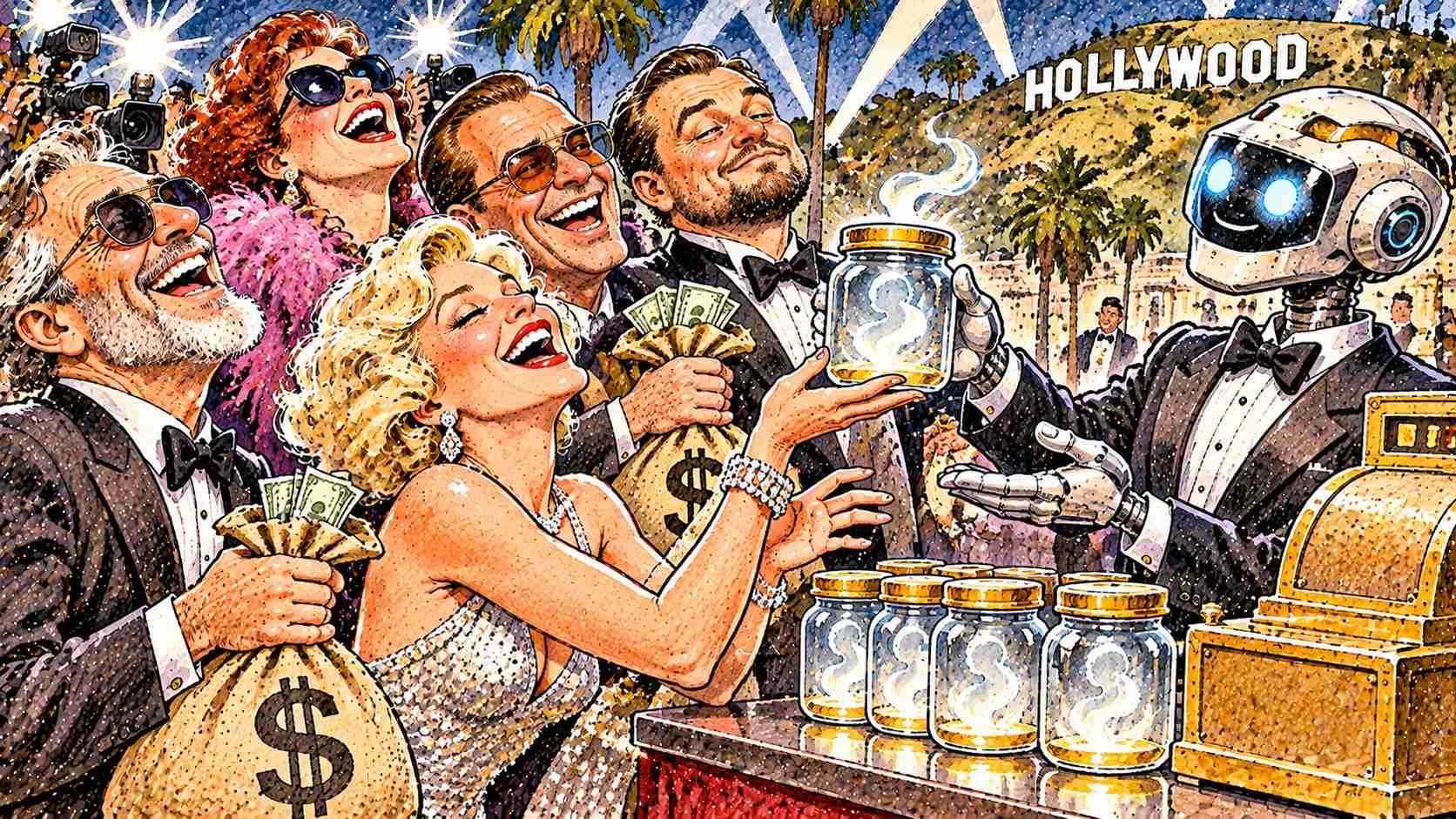
Celebrities Endorse the Machine Built to Replace Them
LOS ANGELES, California — Hollywood celebrities have discovered a revolutionary new career strategy: accepting money from artificial intelligence companies developing technology that could eventually eliminate the need for Hollywood celebrities.
Entertainment executives are calling it the most exciting development since actors figured out they could make more money advertising perfume than appearing in movies.
The strategy is straightforward. First, become famous. Second, sell your face to an artificial intelligence company. Third, express shock when the company discovers it no longer needs the rest of you.
For decades, Hollywood actors have worried about being replaced by younger actors. Now they’re worried about being replaced by younger actors who don’t exist, don’t eat, don’t sleep, don’t demand dressing rooms and never complain that their trailer is too small.
The new performers also have one extraordinary advantage: they can work twenty-four hours a day without requiring a therapist.
This represents a significant competitive disadvantage for Hollywood.
Celebrity AI Endorsements: Hollywood Stars Back the Technology Replacing Them
According to a Futurism investigation into celebrity AI endorsements, technology companies are increasingly courting celebrities despite public resistance to artificial intelligence within the entertainment industry.
The attraction is understandable.
Hollywood has spent decades teaching celebrities that the most important thing in life is getting paid to recommend something they wouldn’t use themselves.
Actors endorse luxury watches despite never knowing what time it is. They advertise automobiles they haven’t driven. They promote financial services while employing accountants to explain how money works.
Now they’re endorsing technology that might replace their profession.
That’s progress.
In the old days, if a celebrity wanted to destroy his career, he had to get arrested, insult the audience or appear in a remake of a beloved movie.
Today, he can accomplish the same thing by attending a technology launch and announcing that computers are the future of acting.
A Beverly Hills talent agent, who asked not to be named because he still collects fifteen percent from several people in this story, explained the economics.
“Look, my client could spend six months making a movie for two million dollars, or he could spend thirty seconds smiling next to a chatbot and make a fortune. Either way, his career is probably over. At least this way we get fifteen percent.”
Agents are particularly enthusiastic because artificial intelligence represents the first technological revolution in which the entertainment industry can collect a commission on its own extinction.
An internal memo circulating at a mid-size talent agency, a copy of which was reviewed for this report, instructs assistants to stop using the word “replace” on client calls and say “transition” instead. A second paragraph reminds staff that the agency’s commission applies to likeness licenses “in perpetuity, including after the client has been sunset.”
One slogan making the rounds captures the excitement:
“Hollywood: We’ll Sell You the Future, Even If We’re Not in It.”
The problem is that artificial intelligence doesn’t merely threaten celebrities. It threatens the enormous population of ordinary people who actually make movies possible.
Writers, editors, animators, production assistants, visual-effects artists and countless other professionals now face uncertainty as studios experiment with automation. The Writers Guild has already gone to the table once over AI protections for Hollywood writers, which tells you how seriously the people with typewriters took the threat.
These are people who make considerably less money than movie stars and generally cannot survive a year of unemployment by selling a mansion in Malibu.
Yet somehow the public discussion keeps returning to whether a millionaire actor feels comfortable having his digital likeness appear in a commercial.
This is rather like worrying about the captain’s champagne supply while the passengers are learning to swim.
Hollywood’s traditional economic model was already remarkable.
A producer raises $200 million, hires three celebrities, spends $150 million on computer-generated explosions, loses $75 million and then explains that the audience wasn’t sophisticated enough to appreciate the movie.
Artificial intelligence promises to improve that model by removing the celebrities.
The explosions will remain.
Sam Altman’s Hollywood Charm Offensive Costs Less Than a Data Center
OpenAI CEO Sam Altman has apparently discovered something generations of Hollywood producers already understood.
Celebrities are expensive until they stop getting telephone calls.
Then they’re surprisingly negotiable.
OpenAI hired Charles Porch, a former Instagram executive whose professional specialty involves developing relationships with famous people.
A recent New York Magazine profile of OpenAI’s Hollywood relationship-building strategy detailed Porch’s efforts to introduce the company and its leadership to the entertainment establishment.
It’s a hell of a job.
For decades, Hollywood employed publicists to keep celebrities away from strange men promising to change the world.
Silicon Valley has now hired someone to introduce them.
Porch’s approach reportedly involves personal relationships, social gatherings and introducing technology executives to influential cultural figures.
In Hollywood, this is called networking.
In the livestock business, it’s called bringing the cattle closer to the loading chute.
One of the most discussed examples involved Gwyneth Paltrow, whose planned dinner with Altman drew a furious backlash and was postponed.
The prospect of putting Silicon Valley’s artificial intelligence evangelism in the same room as Hollywood’s wellness industry raises interesting possibilities.
Imagine a computer that can write a screenplay, diagnose your emotional problems and recommend a $700 candle to repair your relationship with your mother.
That’s not artificial general intelligence.
That’s Goop with electricity.
Paltrow has built a business empire demonstrating that consumers will pay extraordinary amounts of money for products that ordinary people previously managed to live without.
Silicon Valley has been attempting the same thing with monthly subscriptions.
The two industries have more in common than anyone realized.
Both promise to transform your life.
Both insist the transformation requires recurring payments.
And both get irritated when someone asks whether the product actually works.
Hollywood’s Economy: Everybody Is Rich Except the People Who Work There
The darker reality behind the celebrity recruitment campaign is that Hollywood is under serious economic pressure.
Futurism cites an anonymous media executive who told New York Magazine that only the biggest stars are finding steady work, while many performers below that level struggle.
That leaves a strange situation.
The technology industry has helped transform entertainment economics through streaming, digital platforms and changing consumer habits.
Now another wave of technology is offering opportunities to the same workers facing the consequences.
“Hollywood has always run on the idea that the product is the person,” said Dr. Marlene Kovacs, who teaches entertainment economics at a university in Southern California. “Now the person is being asked to become a license. For the first time in the industry’s history, the talent is both the product and the discount.”
Imagine a company demolishing your house, then offering to pay you $500 to appear in a commercial praising the bulldozer.
Naturally, your agent wants twenty percent.
The economic principle is called creative destruction.
The creative part is discovering new ways to make money.
The destruction part is discovering those ways no longer require you.
Hollywood’s traditional middle class of working actors may be particularly vulnerable.
These are professionals who aren’t household names but have spent decades playing doctors, detectives, school principals and suspicious neighbors.
They appear in three episodes of a television series, receive a check, buy groceries and spend the next six months auditioning to become another suspicious neighbor.
Artificial intelligence threatens to replace some of those opportunities with digital performers who are never late, never ask for residuals and can convincingly play a suspicious neighbor without having a mortgage.
Casting Directors May Be the Real Winners
Instead of examining 400 headshots, a casting director can type: “Middle-aged dentist, slightly disappointed in his children, looks vaguely familiar.”
Within seconds, the computer produces a performer who resembles six unemployed actors simultaneously.
A survey of 300 casting professionals circulated by a regional industry association found that 71 percent would rather type a description than read another stack of headshots. Sixty-four percent admitted they had already done so, once, late on a Friday.
SAG-AFTRA, AI Digital Likenesses and the Computer That Refuses to Join
Hollywood labor organizations have already fought over the use of artificial intelligence.
SAG-AFTRA, the actors union, has pushed for consent and compensation whenever a performer’s digital likeness is used, and its studio agreement spells out how AI replicas of living and dead actors get handled.
This is a serious issue, although it produces some wonderfully absurd negotiating possibilities.
An actor may eventually discover that his digital clone has appeared in twelve movies, three advertisements and a television series while the original actor was home waiting for his agent to call.
Worse, the clone could be more successful.
Imagine attending the Academy Awards and losing Best Actor to your own face.
The computer thanks its programmers, the studio, its graphics processor and everyone who believed in it.
You get thanked for providing the original nose.
The Hollywood Walk of Fame might eventually consist of computer servers with stars embedded in their cooling systems.
Tourists will stop to admire the digital celebrity’s contribution to cinema while maintenance workers replace its fans.
OpenAI’s Messi Campaign Shows Vanity Is Cheaper Than Computing Power
There is one last economic mystery.
Technology companies are spending enormous amounts of money developing advanced artificial intelligence infrastructure.
Data centers require electricity, specialized chips, cooling systems, land and staggering amounts of investment.
Yet Hollywood celebrities can sometimes be persuaded to promote new technology with a flattering invitation, a prestigious dinner and the possibility of becoming associated with the next great technological revolution.
Apparently, building a computer that imitates human intelligence is incredibly expensive.
Finding a human willing to rent out his intelligence is comparatively affordable.
The celebrity endorsement business has always operated on the assumption that people will buy a product because someone famous likes it.
That’s why basketball players advertise insurance and movie actors recommend financial products.
Artificial intelligence brings the principle to its natural conclusion.
A famous person tells you a machine can think for you.
The machine tells you what to buy.
The company collects your money.
And the famous person discovers that the machine is now recommending a different spokesperson.
Perhaps Lionel Messi understands the arrangement better than anyone.
The soccer superstar fronted an OpenAI advertising campaign for ChatGPT, which tells you technology companies now want the prestige of the world’s most recognizable athletes.
But Messi possesses something artificial intelligence cannot currently duplicate in the real world.
He can actually play soccer.
The rest of Hollywood should consider learning a practical skill.
Plumbing might be a good start.
Nobody wants a chatbot explaining that the toilet has achieved consciousness while water pours through the ceiling.
AI-Generated Movies and Hollywood’s Final Audition
Eventually, artificial intelligence may become capable of producing entire movies with synthetic actors, digital scenery and computer-generated dialogue.
The movies might be terrible.
Fortunately, Hollywood has already demonstrated that terrible movies can be extraordinarily expensive, meaning the technology will fit comfortably into the existing business model.
Studios could eliminate most of the production crew, reduce casting expenses and produce fifteen sequels before lunch.
Audiences will complain that every movie looks the same.
The studio will explain that this is because audiences enjoyed the first one.
And celebrities who endorsed the technology will discover that their replacements have better contracts.
There is, however, one enduring consolation.
Artificial intelligence can imitate facial expressions, generate dialogue, reproduce voices and simulate human behavior.
But it has yet to demonstrate Hollywood’s most treasured skill:
Convincing someone to pay you $20 million to pretend to be somebody else while complaining that nobody appreciates how difficult your life is.
Until computers master that particular combination of vanity, entitlement and financial engineering, human celebrities still have a competitive advantage.
Meanwhile, the entertainment industry has settled on an elegant new definition of career advancement:
Getting paid today to make certain nobody needs to hire you tomorrow.
Hollywood hasn’t actually sold its soul to artificial intelligence.
That would imply there was still a soul available.
The industry sold the merchandising rights years ago.
Five Observations on Hollywood’s Newest Business Plan
- Actors have spent their whole careers getting replaced by somebody younger, and now they’re upset it’s going to be somebody who doesn’t exist? Come on. At least the new guy never slept with the director.
- They call it a “digital likeness.” Likeness. Have you seen these people? After the third facelift, the computer’s version looks more like them than they do.
- Everybody says the endorsement money is life-changing. It’s not life-changing. It’s a down payment on a life where you’re a screensaver.
- My favorite part is the agent taking fifteen percent. Fifteen percent of your own extinction. That’s the only business where the funeral has a service fee and the guy gets paid up front.
- Hollywood swears it’ll protect the human element. The human element is the guy holding the boom mic. They’ve been “protecting” him since the invention of sound by never learning his name.