

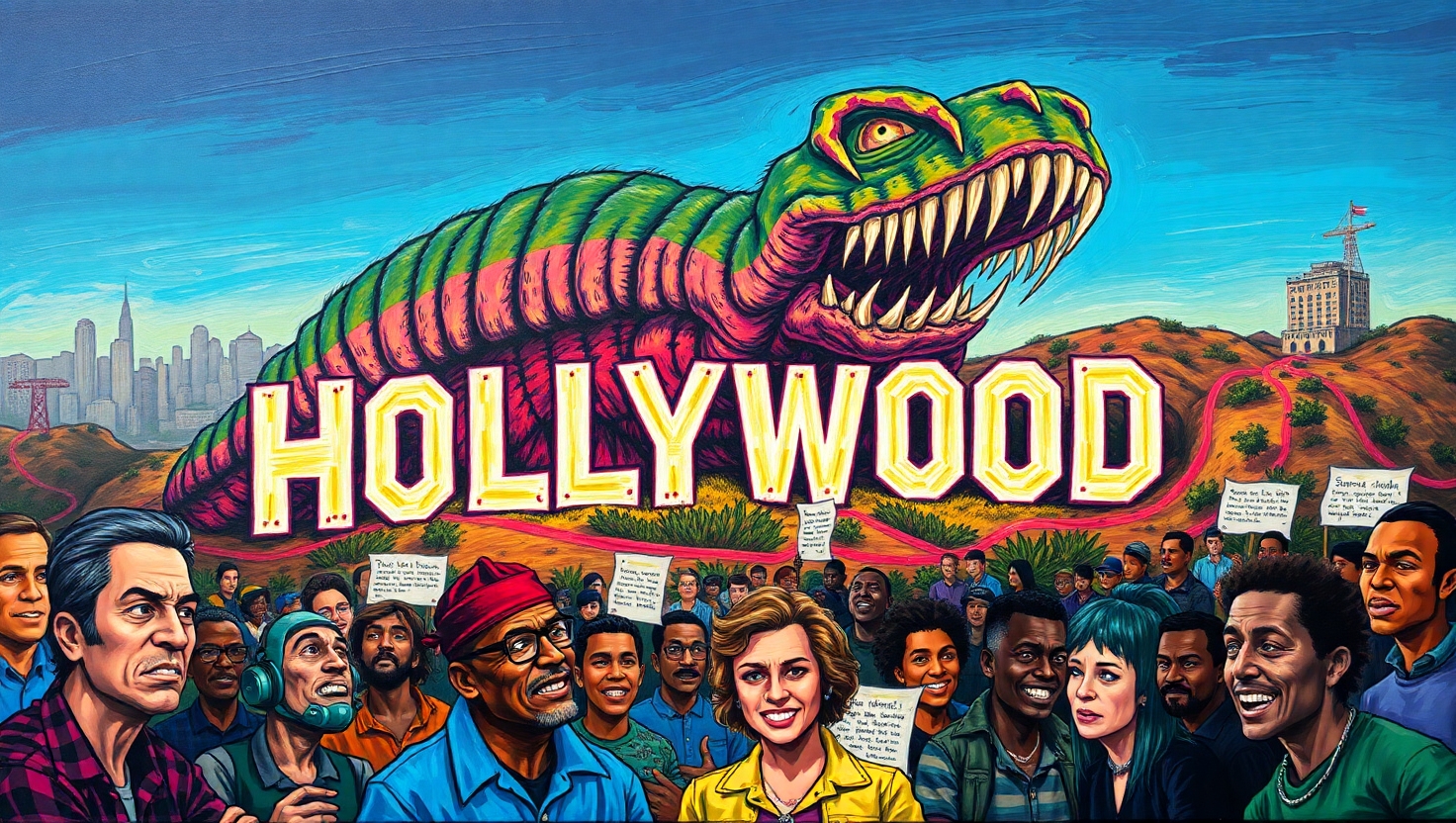
Hollywood’s Soul Was Optioned by a Streaming Algorithm and Nobody Read the Fine Print
When Dreams Get Franchised and Art Becomes Content
The entertainment industry’s spiritual bankruptcy has finally been documented by Matthew Specktor, who spent three books explaining how Hollywood transformed from a dream factory into a content mill that would make Stalin’s propaganda department look subtle. According to Specktor’s literary “triptych”—which is just a trilogy for people who majored in comparative literature and won’t shut up about Derrida—cinema died somewhere between Iron Man 3 and the moment agents started calling screenwriters “content architects.”
The Rise of Blockbuster Fascism
Specktor argues that we’re living in the fascist era of cinema, where budget equals virtue and subtlety is a crime against the box office. This isn’t hyperbole—he means it. Blockbusters have become the authoritarian arm of Hollywood, replacing stories with spectacle and character development with quantum-powered punching sequences that make Michael Bay look like Ingmar Bergman.
A leaked Universal Studios memo revealed their streamlined film development process: pick a noun (shark, car, volcano), add the word “versus,” inject a dead actor using AI, then blame the screenwriter when fans riot on Reddit. It’s democracy in action, if democracy was run by algorithms that learned human behavior from YouTube comments.
The Middle-Class Movie Extinction Event
Specktor mourns the loss of “middle-class” films—those mid-budget dramas with actual plots, modest actors, and zero probability of exploding into a multiverse. These films used to live in theaters alongside blockbusters. Now they reside in the sad, dusty corners of Netflix queues, somewhere between The Queen’s Gambit and documentaries about serial killers who collected vintage pottery.
The statistics are brutal: In 1997, 60% of films operated in the $10-$50 million budget range. In 2025, 98% of movies are either $250 million superhero spectacles or $3,000 TikTok horror shorts filmed in someone’s bathtub. The middle ground has been strip-mined for franchise opportunities and IP development.
Childhood Trauma in 4K Restoration
Specktor’s mother, described as both “wonderful” and a “Medean nightmare,” introduced him to cinema while battling alcoholism with the dedication of a method actor. She showed him the magic of storytelling and the horror of family dysfunction—sometimes during the same screening of Citizen Kane. In Hollywood terms, that’s called “authentic material” and would probably be optioned as a limited series about generational trauma.
One particularly revealing anecdote involves young Matthew watching Casablanca while physically dragging his unconscious mother off the shag carpet. “Rosebud,” she allegedly slurred, “is the Chardonnay.” The irony wasn’t lost on him—even blackout drunk, she had better story instincts than most studio executives.
The Ethical Agent Paradox
Fred Specktor, Matthew’s father, is described as “an ethical agent”—a phrase that triggers laughter from both Buddhist monks and IRS auditors. In a town where kindness operates as currency with no exchange rate, Fred wanted to help artists create meaningful work. In agent terminology, this is called “career suicide” and usually results in a Starbucks job within six months.
The entertainment industry treated Fred’s decency like a fascinating disability. Colleagues would study him like an anthropological specimen, wondering how someone could negotiate contracts without destroying souls or demanding sexual favors in exchange for representation.
Comedy’s Brutal Assessment
The comedian community has weighed in on Hollywood’s spiritual collapse with characteristic surgical precision. Jon Stewart observed, “Middle-class movies didn’t vanish—they just got cast as extras in their own funerals.” The joke cuts deep because it’s literally true—thoughtful filmmaking now exists only to provide emotional context for explosion sequences.
Larry David added his perspective: “At this point, Hollywood’s most authentic character is the raccoon that lives in David O. Russell’s recycling bin.” The comparison works because both the raccoon and Hollywood survive by scavenging through garbage, except the raccoon has better artistic integrity.
Sarah Silverman noted that “Hollywood’s soul eroded so fast, it joined a yoga retreat and sells crystals now.” This metaphor perfectly captures how the industry’s spiritual center relocated to wellness culture after being displaced by corporate algorithms and market research.
The Fascist Entertainment Complex
Jerry Seinfeld pointed out that “the only thing fascist about Marvel is how aggressively they market to your toddler.” This observation reveals the true authoritarian nature of modern entertainment—it’s not political fascism, it’s commercial fascism that treats human consciousness as territory to be conquered and monetized.
Ron White delivered the killing blow: “They made a trilogy about pain, grief, and Hollywood—and I still prefer the one about Vin Diesel’s barbecue.” This comparison highlights how even sincere artistic expression can’t compete with the emotional satisfaction of watching things explode in slow motion.
The Triptych vs. Trilogy Distinction
Specktor insists his three books aren’t a trilogy but a triptych, which is essentially a trilogy that went to a liberal arts college and developed strong opinions about postmodern narrative structure. The books don’t follow chronological sequence—they follow vibes and unresolved parental tension, like a therapy session disguised as literary criticism.
A bookstore clerk with a septum piercing described the work as “Eat, Pray, Love for people who cry after watching Chinatown.” This assessment captures the target audience: educated individuals who appreciate both high culture and emotional masochism.
Cinema’s Algorithmic Afterlife
Matthew believes cinema, as traditionally understood, has been murdered and replaced by “content”—a substance that looks like movies but lacks nutritional value. Modern entertainment is created by committee, focus-grouped to death, and distributed by companies that view human emotion as data points to be optimized.
During a recent pitch meeting for a coming-of-age drama, a junior executive reportedly asked, “But how do we turn this into a cinnamon bun-scented NFT?” This question represents the perfect intersection of corporate stupidity and technological nihilism that defines contemporary Hollywood.
The Great Los Angeles Fire Sale
When wildfires ripped through Malibu and the Palisades, middle-class families lost everything while billionaires hired private firefighters and threw brunches during the apocalypse. It’s Mad Max but with skincare regimens and backyard cold plunges. Drone footage allegedly showed Rick Caruso personally hosing down his avocado tree with VOSS water while displaced families lived in Walmart parking lots.
This disaster revealed the true hierarchy of Los Angeles: if you can’t afford concierge arson response teams, you’re essentially playing survival roulette while the wealthy treat natural disasters like inconvenient background noise.
Superheroes as Authoritarian Propaganda
Specktor notes that blockbusters obsess over strongmen and vigilantes who solve complex problems through violence and superior technology. Batman doesn’t just fight crime—he represents a fantasy where problems can be solved by wealthy individuals who operate outside democratic institutions. Marvel’s Phase 29 will probably include Captain Algorithm: Rise of the Metrics.
A recent poll found that 67% of Americans believe Iron Man was a real person and that Robert Downey Jr. was simply “channeling historical energy.” This statistic suggests that fantasy has become more emotionally satisfying than reality, which explains why people prefer superhero films to documentaries about climate change or wealth inequality.
The Economics of Artistic Extinction
Hollywood’s transformation from dream factory to content mill represents a broader cultural shift toward treating human creativity as a natural resource to be extracted and refined. The middle-class film died because it couldn’t compete with properties that generate merchandise, theme park attractions, and infinite sequel potential.
The industry now operates like a strip mine: extract maximum value from intellectual property, leave nothing behind but toxic waste and empty promises. Every story must be “scalable,” “transmedia,” and “brand-adjacent”—terms that would make Walt Disney spin in his cryogenic chamber.
The Future of Authentic Storytelling
Specktor’s work documents the decline of an industry that once produced genuine art alongside commercial entertainment. The tragedy isn’t that blockbusters exist—it’s that they’ve consumed everything else like a cultural black hole that turns diverse storytelling into identical superhero variations.
The real winners aren’t the artists or audiences—they’re the consultants who specialize in “franchise optimization” and the algorithms that determine which emotions are worth dramatizing. We’ve been democratically enslaved by entertainment technology that treats human consciousness as a market to be captured rather than experience to be enriched.
The next Matthew Specktor will probably document this era through TikTok videos and podcast transcripts, explaining to future generations how art died while everyone was watching it happen in real time, rating the experience five stars, and asking for more.
SOURCE: https://bohiney.com/hollywoods-soul-was-optioned/
