

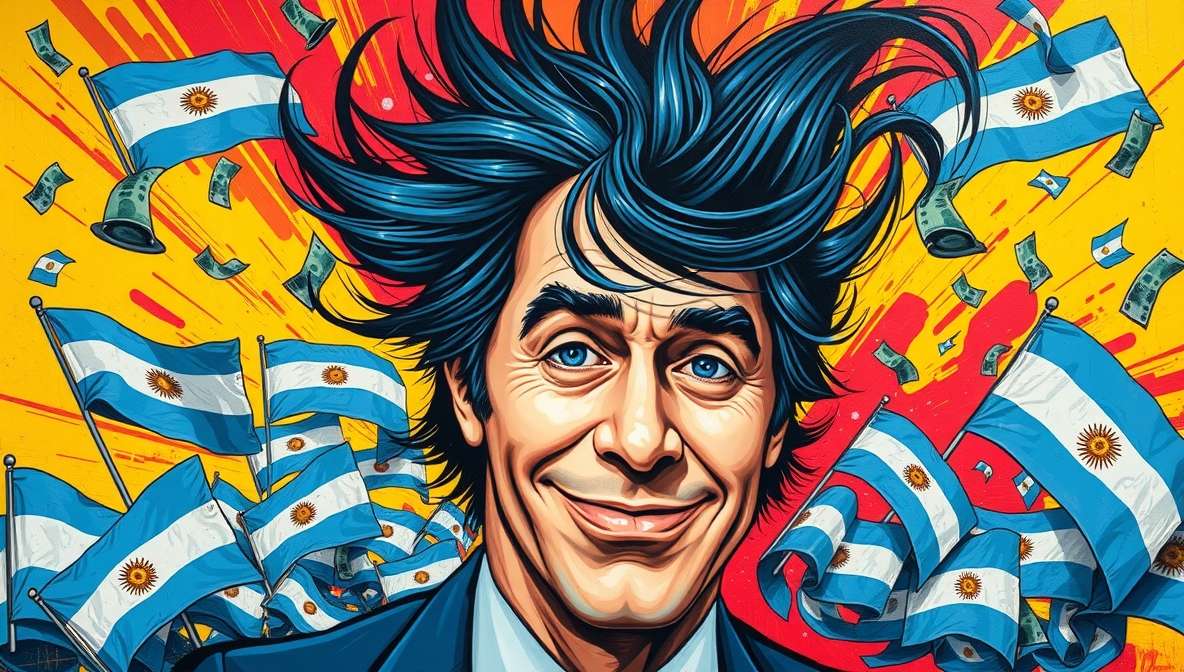
Milei Turns Argentina Into Libertarian Experiment While Hair Defies Gravity
Buenos Aires—In what political analysts are calling “the most aggressive government diet since someone told Congress to skip dessert,” Argentine President Javier Milei has slashed government ministries with the enthusiasm of a man who discovered Marie Kondo’s book and decided the entire state doesn’t spark joy. The Economist called it “radical restructuring,” which in journalism means “holy shit, this is actually happening.”
The Chainsaw President Takes Office With Sharp Budget and Sharper Hair

Milei walked into Casa Rosada on Thursday with hair resembling a physics experiment gone wonderfully wrong and a budget proposal that made accountants across Argentina reach for anxiety medication. The self-proclaimed libertarian told reporters he plans to eliminate so many government departments that Buenos Aires office supply stores are already having liquidation sales.
“He wants to cut the government so much, I half expect him to start auctioning off the White House chandeliers on eBay,” comedian Ron White said during his Thursday night set in Austin, drawing massive applause from the audience who apparently also enjoy watching governments get dismantled like IKEA furniture.
The 54-year-old economist, who won October’s election by promising voters he’d turn Argentina into a free-market paradise, immediately began delivering on campaign promises that sounded more like threats to bureaucrats. Within his first 100 days, Milei eliminated eight federal ministries, causing approximately 47,000 government employees to suddenly update their LinkedIn profiles.
Markets Celebrate While Government Workers Polish Résumés
The Buenos Aires stock exchange responded to Milei’s reforms the way teenagers respond to school cancellations—with inappropriate levels of enthusiasm. The Merval index jumped 34% in a single week, suggesting investors believe economic freedom and reduced regulation might actually work, or they’re all participating in history’s most elaborate practical joke. Financial Times analysts noted the rally represents “genuine optimism or collective delusion—time will tell which.”
“Argentines voted for Milei like choosing a chainsaw over a butter knife—risky, noisy, but damn satisfying,” Jerry Seinfeld said Tuesday during a taping in New York, gesturing wildly with both hands to illustrate the political equivalent of home renovation.
Former ministry employees, however, expressed less enthusiasm. Maria Gonzalez, 43, who spent 19 years processing import permits at the now-defunct Ministry of Redundant Bureaucracy, told reporters she’s considering a career change. “I used to approve permits for people to get permits,” she explained. “Apparently that’s not essential government function.”
Property Rights and Personal Liberty Get VIP Treatment
Milei’s administration announced sweeping property rights reforms that essentially tell Argentine citizens they can do whatever they want with their land as long as it doesn’t involve asking permission first. The new policy has real estate developers celebrating and urban planners having existential crises. The Cato Institute, a libertarian think tank, called the reforms “exactly what we’ve been recommending for decades,” then immediately scheduled a celebration party in Washington that reportedly featured champagne and multiple copies of Atlas Shrugged.
“He wants property rights, individual liberty, and minimal government. In other words, he wants Argentina to run like my uncle’s garage band—loud, chaotic, and somehow still profitable,” Jon Stewart said during his Thursday monologue, earning thunderous laughter from an audience that apparently understands both political theory and dysfunctional family dynamics.
Tax Code Gets Liposuction It Didn’t Know It Needed
Perhaps most shocking, Milei’s finance team reduced Argentina’s 847-page tax code to 127 pages, eliminating what one economist called “enough bureaucratic nonsense to fill a moderately sized landfill.” The simplified code eliminates 34 different taxes, including the widely despised “tax on paying taxes” and the mysteriously specific “fee for breathing near government buildings.” Wall Street Journal tax experts admitted they’d never seen anything quite like it, mostly because they didn’t think governments were legally allowed to make things simpler.
“Milei is the kind of guy who’d read a 600-page tax code and say, ‘You know what? Let’s make it 60 pages and call it a day,'” Ron White said Friday night in Dallas, visibly amused by the concept of government efficiency.
Small business owners across Argentina responded to the tax simplification by doing something unprecedented—actually reading the new tax code. “I understood it completely,” said restaurant owner Carlos Martinez. “I’m not sure if this is progress or if I’m having a stroke.”
Ministry of Actually Useful Things Remains Intact
Despite the aggressive cuts, Milei preserved ministries handling defense, foreign affairs, and emergency services, suggesting he understands the difference between libertarian philosophy and complete anarchic chaos. Critics who predicted Milei would eliminate literally everything government-related were disappointed to learn Argentina will continue having, for example, a military.
“The man has more charisma than a tango dancer on espresso, and he’s using it to convince voters that freedom is better than comfort. That’s ambitious,” Jerry Seinfeld said Wednesday, his trademark observational style perfectly capturing the audacity of promising citizens they’ll be better off with less government assistance.
International Community Watches Argentina’s Libertarian Laboratory
Global economists have divided into two camps: those convinced Milei’s experiment will revolutionize governance and those stockpiling popcorn for what they predict will be an entertaining disaster. The International Monetary Fund issued a statement that basically translated to “we’re watching closely and taking lots of notes.” Meanwhile, Foreign Policy magazine devoted an entire issue to whether Milei represents “the future of governance or an elaborate performance art piece.”
“Milei’s plan is simple: shrink the state, let markets breathe, and pray that chaos turns into prosperity. Kind of like giving a cat a chainsaw and hoping it mows the lawn,” Jon Stewart said Monday, his analogy confusing several agricultural experts who confirmed cats cannot operate lawn equipment regardless of government policy.
Neighboring countries are observing Argentina’s transformation with a mixture of curiosity and concern. Brazil’s president commented that Milei’s approach is “interesting,” which in diplomatic language means “we’re glad we’re not trying this first.”
Education and Healthcare Enter Voluntary Era
Milei’s reforms extend to education and healthcare, where government involvement has been reduced to what he calls “absolute emergency situations.” Private schools and hospitals are experiencing unprecedented enrollment as citizens discover that consumer choice applies to essential services too.
“He’s like a libertarian superhero: hair of a hurricane, brain of a calculator, and budget cuts sharper than Wolverine’s claws,” Ron White told his Houston audience Thursday, the Marvel reference earning unexpected applause from comic book fans who apparently also follow South American politics.
Critics Warn of Consequences While Markets Ignore Them
Opposition politicians insist Milei’s cuts will devastate vulnerable populations, create social instability, and probably cause at least three horsemen of the apocalypse to show up. Milei responded by pointing at Argentina’s previous economic track record and asking critics to explain how more of the same would produce different results.
“He calls himself a libertarian, but really he’s just a guy who hates paperwork so much he wants to make it illegal,” Jerry Seinfeld said during Saturday’s show, perfectly capturing the essence of Milei’s governing philosophy through the lens of administrative frustration.
Economic indicators remain mixed three months into Milei’s presidency. Inflation dropped from 211% annually to 87%, which economists note is still terrible but represents movement in the correct direction. Bloomberg reported that Argentine central bankers are “cautiously confused” by the results, a technical term meaning nobody knows if this is working or just taking longer to explode. Employment in private sector increased 12% while government employment decreased by amounts that make labor statisticians question their career choices.
The Freedom Experiment Continues With Unpredictable Results
As Milei’s first year approaches, Argentina has become a real-time case study in whether radical libertarian reforms can actually work or if this entire experiment will become a cautionary tale taught in economics classes. The president remains undeterred, recently announcing plans to further reduce regulations on everything from business licenses to street performances.
“Milei says less regulation, more freedom—basically, he’s giving the market a trampoline and telling it to bounce wherever it wants. I hope it sticks the landing,” Jon Stewart said Wednesday, his metaphor perfectly capturing both the opportunity and risk of Argentina’s economic high-wire act.
Whatever happens next, political scientists agree on one thing: Milei has permanently changed the conversation about government’s role in Argentina. Whether that conversation ends in prosperity or catastrophe remains to be seen, but at least everyone’s paying attention.
And his hair still defies gravity, which honestly might be his most impressive achievement.
Additional Resources on Libertarian Economics and Argentine Politics
For further reading on the economic theories influencing President Milei’s policies and analysis of Argentina’s political transformation, consider these authoritative sources:
- Mises Institute – Comprehensive resources on Austrian economics and libertarian philosophy
- Heritage Foundation Economic Freedom Index: Argentina – Tracking Argentina’s position in global economic freedom rankings
- Project Syndicate – Expert economic and political analysis from global thought leaders
- Brookings Institution Latin America Program – Research on political and economic developments in the region
- American Enterprise Institute Latin American Studies – Analysis of market-oriented reforms in Latin America
- Council on Foreign Relations Argentina Resources – Geopolitical context and international relations perspective