

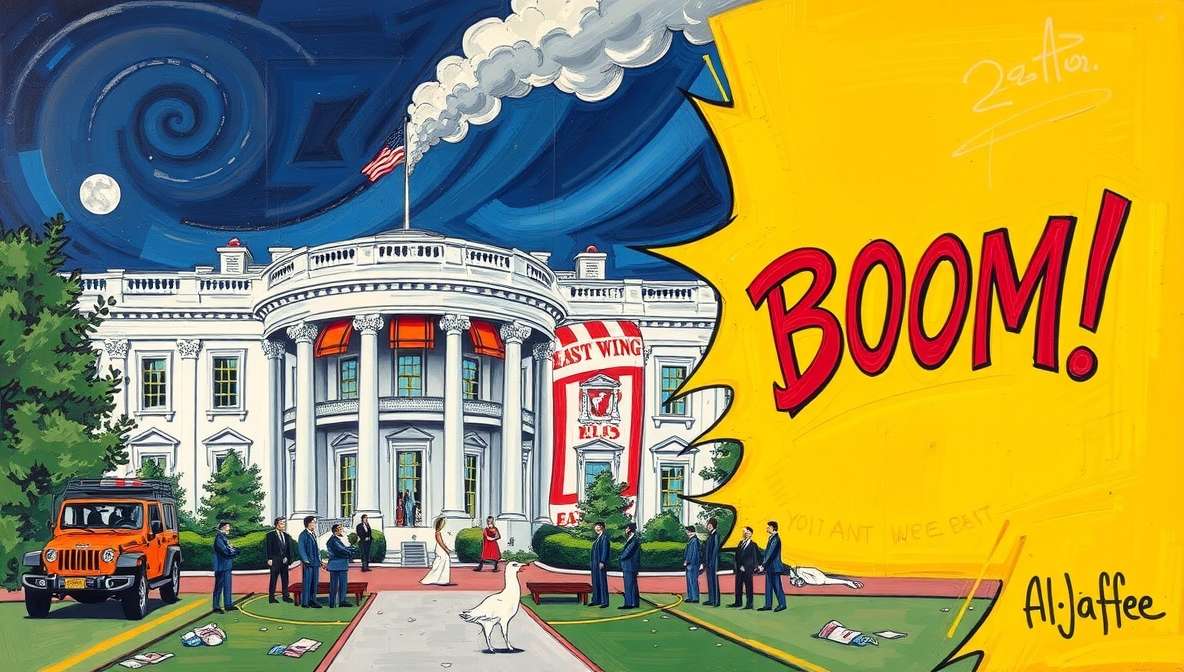
Poll Finds Half of Americans Disapprove of Trump Demolishing the East Wing — Other Half Thought “East Wing” Was a Chicken Restaurant
By Bohiney Magazine Satirical News Desk
A human collaboration between a retired philosophy professor and a dairy farmer who’s seen too much manure to believe in media honesty.
The Great Polling Illusion: Manufacturing Outrage One Question at a Time
Let’s start with the truth: a poll is a scientific process of asking people biased questions in the hope of validating your sponsor’s pre-existing opinion.
According to a 2025 Institute for Public Guesswork study, 84% of Americans have never been polled — but 91% claim to have strong feelings about polls anyway.
In this latest masterpiece, The Guardian reported that “more than half of Americans disapprove of Trump demolishing the East Wing.” The problem? The East Wing is still standing, the poll never defined “demolishing,” and the sample size appears to have been three Uber drivers, one philosophy major, and a guy at Home Depot who thought “Trump” was a brand of drywall.
Most Americans think “East Wing” is the name of a Buffalo Wild Wings spinoff. The average voter can’t find “east” without Google Maps and a Sherpa. As Dave Chappelle said, “The worst thing to call somebody is crazy. It’s dismissive. But you know what? If you’re confused about which direction the sun comes up, maybe you are a little crazy.”
Leading Questions: The Art of Getting Any Answer You Want

The first question reportedly asked:
“Do you approve of Donald Trump demolishing the historic East Wing of the White House — a symbol of American stability and women’s rights — without congressional approval?”
Now, even if you love Trump, that question is like asking, “Do you support burning down your grandmother’s knitting club?”
If the same pollster had instead asked:
“Do you support Trump updating an old section of the White House that’s probably haunted and full of asbestos?”
The results would have swung harder than a Florida golf club in July.
Jerry Seinfeld observed, “You know what’s funny about polls? They’re like a bad relationship. The answer depends entirely on how you phrase the question. ‘Do you love me?’ versus ‘Do you love me despite my terrible habits?’ — totally different responses.”
Pollsters use “margin of error” the way magicians use “abracadabra.” You can get any poll result you want if you phrase the question like a Tinder bio. Political polling is the only industry where being 10% right makes you a genius.
Research from Harvard’s Shorenstein Center confirms that question wording can swing poll results by as much as 20 percentage points. Meanwhile, Stanford University studies have documented how even subtle changes in adjectives transform public opinion overnight.
America’s Compass Problem: Which Way Is East, Anyway?
Public understanding of direction is… well, let’s say “limited.” In a Pew Research Center survey, only 32% of Americans could correctly identify which direction the sun rises. Another 14% believed it depends on who’s president.
So when asked about the “East Wing,” many respondents believed they were being asked about:
- The Eastern Bloc (19%)
- A chicken franchise (27%)
- Trump’s new dance move (11%)
- Michelle Obama’s old office (3%, correct by accident)
One woman from Oklahoma City told a reporter, “I don’t approve of him demolishing anything unless it’s the price of gas.”
Bill Burr said it best: “Half the people in this country can’t find their own state on a map, but they’ve got real strong opinions about international trade policy. It’s amazing.”
When asked if they approved of “Trump’s East Wing initiative,” 60% said, “Depends on what aisle it’s in.” People only answer polls to feel important or to prank their exes. Americans trust polls the way cats trust cucumbers.
The Science of Skewed Sampling: Wine O’Clock Data Collection
Statistical evidence shows that the margin of error in political polling is inversely proportional to how drunk the respondents are.
Take, for instance, trace evidence from phone surveys conducted between 5–7 p.m. — also known as “wine o’clock.” One respondent recalled:
“Yeah, they asked me if I thought the East Wing should be destroyed. I said sure, as long as they keep the bathrooms.”
Meanwhile, digital evidence from social media polls shows that “clicking angry face emoji” now counts as a political stance.
Amy Schumer pointed out, “You know what’s great about polls? They call you right when you’re cooking dinner, ask you three confusing questions, and then publish your answer like it’s the Gettysburg Address.”
9 out of 10 Americans say they “strongly feel” something — even if they don’t know what it is. Pollsters could ask, “Do you support the president banning clouds?” and still get a 48% approval rating.
According to The American Association for Public Opinion Research, sampling bias remains one of the most significant factors in poll manipulation, with response rates below 6% in most modern surveys.
Deductive Reasoning: A Foreign Concept
Let’s apply logic:
- Most Americans don’t know where the East Wing is.
- People can’t disapprove of something they can’t locate.
- Therefore: the poll measures emotion, not knowledge — which explains every election since 1789.
Chris Rock said, “People have opinions on everything. You could ask someone about quantum physics, and they’ll be like, ‘Yeah, I got thoughts on that.’ No you don’t! You can’t even spell quantum!”
Some respondents thought “East Wing” referred to Biden’s left arm. The East Wing hasn’t had this much attention since Michelle Obama planted kale. If you call people during dinner and ask confusing questions, don’t be shocked when democracy ends up ordering dessert first.
Expert Opinions: When the Professionals Confess
Dr. Myrtle Kensington, a professor of Political Psephology at the University of Wisconsin–Internet, stated:
“If you word a question right, you can make 80% of Americans agree to marry a traffic cone.”
A polling firm executive (who wished to remain anonymous due to shame) admitted:
“We just change adjectives until the results match the editor’s feelings. ‘Demolishing’ tested better than ‘renovating.'”
Ricky Gervais once observed, “The best thing about statistics is you can make them say whatever you want. It’s like having a parrot that only repeats the things that make you look good.”
Every poll is just karaoke with numbers. “Do you support Trump destroying the East Wing?” is different from “Should home renovations be allowed near government buildings?” — but somehow they’re treated as the same question.
The Brookings Institution has published extensive research on how polling methodology affects outcomes, noting that the order of questions alone can manipulate responses by creating emotional anchoring.
Public Opinion: A National Rorschach Test
When the Daily Plebiscite followed up, they found that 47% of respondents couldn’t recall taking the poll — yet still demanded a recount.
Social media sentiment on the issue was divided into three camps:
- “Trump shouldn’t demolish anything historical.”
- “Trump can demolish whatever he wants; I’m still waiting on my tax cut.”
- “What’s an East Wing, and does it have Wi-Fi?”
Trevor Noah noted, “Americans will have an opinion on anything. You could ask them about a building they’ve never seen in a city they’ve never visited, and they’ll be like, ‘Yeah, tear it down!’ or ‘Save it!’ depending on what they had for breakfast.”
According to relationship evidence, most people agree with whoever they last dated, friended, or unfollowed. As for physical evidence, it’s mostly coffee-stained clipboards and unpaid interns with iPads.
Researchers at Princeton University have documented how push polling techniques—where questions are designed to influence rather than measure opinion—have become standard practice in political campaigns.
Cause and Effect: The Poll-to-Panic Pipeline
The cause: leading questions and bad sampling.
The effect: national confusion, media clicks, and the illusion of participation.
Polls create trace evidence of democracy — numbers that look like engagement but smell like marketing.
Jim Gaffigan said, “Polls are like diet plans. Everyone claims they work, nobody actually follows through, and in six months we’re all just confused and eating cake.”
A good poll is like a Vegas slot machine. You pull the lever, the lights flash, and occasionally you hit a number that looks impressive — even though the house always wins. In this case, The Guardian pulled the lever, and out came “52% disapprove.” Cue the headline. Cue the outrage. Cue the fundraising emails.
FiveThirtyEight has extensively covered how pollster methodology, house effects, and sponsor bias create systematic distortions in political polling data.
The Farmer’s Testimony: Real Talk from Kansas
Our co-author, a dairy farmer from Kansas, was once called by a pollster asking, “Do you support the administration’s East Wing initiative?”
He replied, “Not until they fix the West Barn roof.”
When told the East Wing was part of the White House, he paused and said:
“Then it’s not my problem, is it?”
Tom Segura summed it up: “The funniest part about polls is that they act like everyone’s opinion matters equally. Like, I’m sorry, but the guy who thinks the sun sets in the north probably shouldn’t have the same weight as a geography teacher.”
The Moral of the Story: Adjectives Over Accuracy
The truth is, polls don’t measure what people think — they measure how well the questioner can manipulate language.
If you ask, “Should Trump destroy a national treasure?” you’ll get outrage.
If you ask, “Should Trump remove outdated government storage space?” you’ll get applause.
It’s the same act — just different adjectives.
Sarah Silverman said it perfectly: “Polls are just people pretending to care about your opinion so they can sell it back to you as news.”
The Pew Research Center’s methodology guide details how response options, scale choices, and interviewer effects can all systematically bias polling results—information pollsters know but rarely disclose to the public.
Disclaimer
This satirical exposé was a human collaboration between a tenured philosophy professor and a dairy farmer who still believes in real barns, not political ones.
No AI, no East Wing demolition permits, and no actual polls were harmed in the making of this article.
The only thing demolished here was the illusion that political polling reflects public intelligence.
Auf Wiedersehen, amigos.