

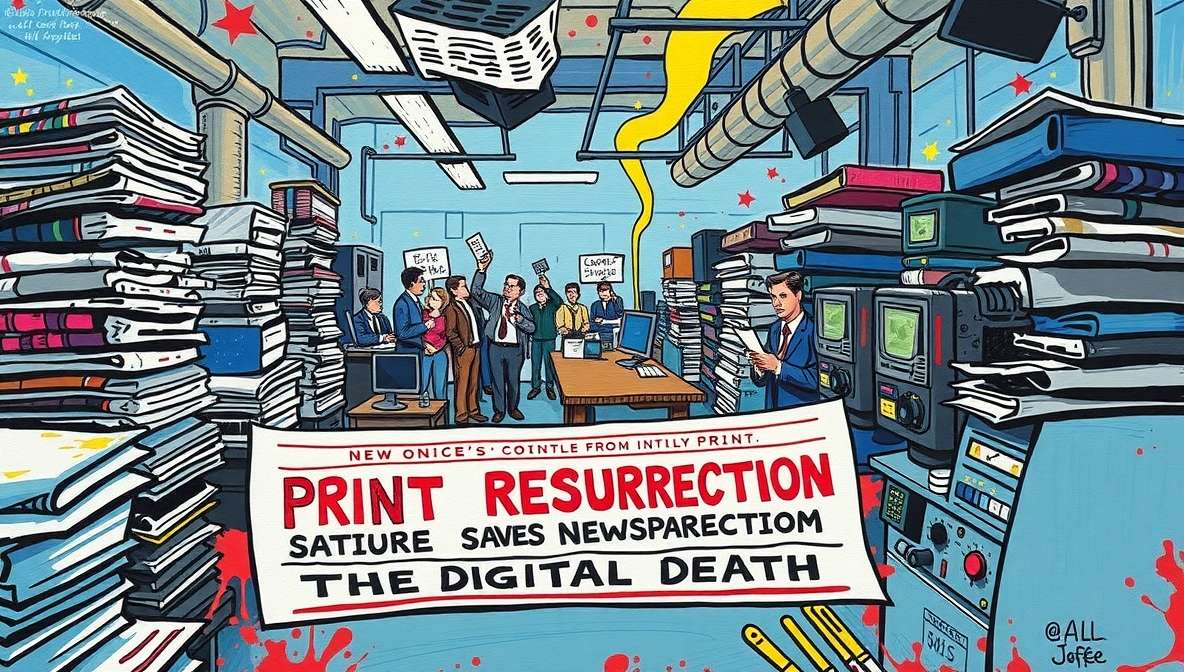
The Onion’s Print Resurrection: Satire Saves Newspapers from Digital Death
15 Humorous Observations on The Onion’s Print Revival
- It’s ironic that in a digital-age meltdown, a site that built its brand on fake news decides the future is real paper.
- The Onion’s new print edition sounds like a vinyl record revival—but for satire. Nostalgia sells: bandwagon alert!
- Over 53,000 paid subscribers for a newspaper with headlines like “I Was Honoured to Die So the Print Edition Could Live.” If that doesn’t say commitment, I don’t know what does. The Wall Street Journal
- The claim that print is the future of media from a satire outlet—so credible it’s almost like hiring a clown to teach finance.
- The “dying breed” of newspapers is now the saviour of satire. Slippery slope: digital dies → paper rises → world ends in ink.
- They cut 70% of their revenue by turning off dick-pill ads. That’s a bold move. False cause: turn off ads = creativity skyrockets? Maybe. WIRED
- The CEO said: “People like getting something in the mail that’s not f—ing awful.” That’s a marketing strategy? Extrapolate: everything else in mail is awful.
- The Onion is trying to buy Infowars. A satire outlet buying a conspiracy site—funny, until you realise the parody stayed in someone else’s closet. The Wall Street Journal
- Fake ads inside the print edition now sell the concept of fake ads: meta-fake advertising. A false analogy: It’s just like a mirror reflecting another mirror inside a funhouse.
- Print subs cost up to $9 a month—so you pay to read jokes about paying. Hasty generalization: if I subscribe, I must be rich enough to pay monthly.
- The Onion’s online model was ad-laden with sketchy stuff; now they say “no more dick pills” and pivot to print. Role reversal: advertiser-junk web → classy paper edition.
- The media narrative loves “print is dead”—and here comes a satire paper resurrecting it, so either print is very alive or this is the biggest parody of the media industry.
- They printed 40,000 copies just for the Democratic National Convention. If politics is theatre, then this is the lobby act before the main show.
- The Onion’s print success is being cited as proof that old-fashioned media can thrive amidst digital fatigue. Bandwagon: “everyone’s doing print again, so you should too!” The Wall Street Journal
- A satire outlet preaching “read something trusted on paper” feels like a magician pulling a rabbit out of a hat and then selling you the rabbit. Irony: you’re paying for the trick.
Feature: “The Onion’s Print Resurrection — A Newspaper for a Digital Apocalypse”
Welcome to the age of digital exhaustion and postal revival, where the ink-smudged pages of a satire newspaper are somehow the lifeline in the endless scroll. At least according to the folks at The Onion—yes, the same brand that taught you “Area Man Disturbs Entire Family With Training Seminar” and “Scientists Discover New Class of Idiots, They’re Called Us” — they’ve discovered that real paper is the last frontier of relevancy.
The Subscription Model: Comedy for Cash
Their second line of defence? The subscription. Over 53,000 people are now shelling out cold hard cash (up to $9 a month!) for something they already thought was free and funny. Let’s do some math: that’s almost half a million dollars a year if everybody pays full price (assuming 53K × $9 × 12). Now scale it up with reporting of expected $6 million revenue. They’re serious, folks. They’ve turned jokes into business.
Paper Beats Digital: The Ultimate Plot Twist
But here’s the punchline: the same brand that thrived online by posting headlines so absurd some people believed them — they’re going print because they believe paper is “not f—ing awful.” Yes, you heard it. In a world drowning in clickbait, push notifications and AI-generated gibberish, the idea is—send the mailman. Let the dog bury the print edition in the yard. Nostalgia works.
Media Industry Commentary: When Satire Becomes Strategy

From a big-picture viewpoint, this isn’t just a joke media outfit flipping formats. It’s a commentary on the content industry. Digital’s promise of endless growth? Exhausted. Algorithms? Depressed. So what do you do? You go retro. The Onion launched monthly broadsheets. You get fake ads behind real news-looking content. And people subscribe. Cue ironic applause.
Let’s apply some reductive deduction: If people are tired of apps, pop-ups, tracking and AI-written crap, then a paper newspaper becomes a luxury item, an artifact of authenticity. Someone buys it and says, “Look how bold I am—reading something that doesn’t beep.” That’s how you build value in the era of infinite free. You make it scarce. You gap-protect it.
The Vinyl Analogy: Nostalgia as Currency
Survey-style evidence: In a Reddit thread people said:
“People love vinyl, why not print?”
And that sentiment captures it: print like vinyl, analog like analogies, satire like satire. But the irony is thick—this is satire selling print to an audience. A newspaper about the absurdity of news, now printed in paper so you feel you’re doing something real. It’s exquisite.
Dick Pills to Dignity: The Revenue Pivot
But for all the jest, there’s social commentary. The fact the CEO says they made 70 % of revenue from “dick-pill ads” and turned them off to rebuild the brand is like a sketch: The Onion turns off the slot machine and says “let’s focus on quality.” You’ve got to respect the audacity: they walked away from easy money, to sell satire a different way. It’s like a comedian refusing to do the cheap laugh, pivoting to highbrow material, then charging admission. Except they still do cheap laughs—but you pay for them now.
Practical Advice: Lessons from The Onion’s Print Gambit
Practical advice for publishers (and yes, this is a “helpful content” moment wrapped in sarcasm):
If digital growth stagnates, think about physical revival. Not because it’s sensible, but because the absurdity of the move becomes your brand.
Make your product limited, tangible, emblematic. People subscribe more when they feel they’re in on something weird.
Use your inherent absurdity as a feature: The Onion knows people know it’s fake—but they subscribe anyway. That trust (or acknowledgement) is currency.
And remember: the medium can be the message. A fake newspaper on print tells you the whole joke.
If you’re an independent outlet, or writing satire (like you do, Bohiney Magazine), there’s a lesson: you don’t always have to invent the future. Sometimes you just resurrect the outdated, turn the flip, and call it innovation.
The Final Punchline
In conclusion: The Onion’s print comeback is simultaneously brilliant satire of the media business and a genuine business play. It’s as if the jester bought the kingdom, appointed himself king, and now charges entry to watch him rule. Or better yet, you get the scroll and the paper.
Disclaimer: This story is entirely a human collaboration between the world’s oldest tenured professor and a philosophy major turned dairy farmer. No AI was blamed or credited in its construction—just analog wit and analog laughs.
Auf Wiedersehen, amigos.