

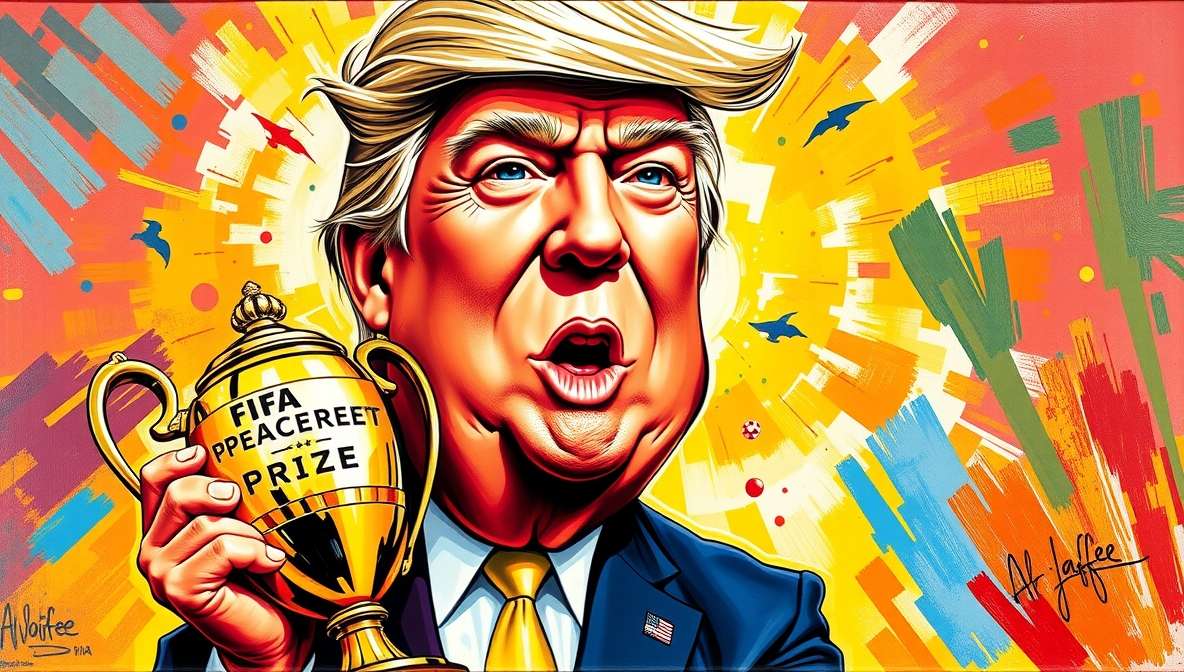
The Grand Kick-Off: FIFA Peace Prize, or How to Win at Diplomacy by Kicking a Ball
In a move that could only be described as brilliantly audacious, FIFA-yes, the same global soccer federation accused of everything from under-the-table dealings to a vaguely remembered bribery scandal-announced the creation of the FIFA Peace Prize – Football Unites the World, to be awarded for the first time on December 5, 2025, at the draw for the 2026 FIFA World Cup in Washington, D.C.
The prize is designed to recognize “exceptional actions for peace” via football. “Football stands for peace,” declared FIFA President Gianni Infantino in a classic combination of motivational poster language and PR positioning.
FIFA’s Latest Play: From Bribery Scandals to Peace Prizes
When the organization that awarded the World Cup to Qatar despite massive worker-rights controversies now announces a “peace prize,” the cognitive dissonance is rich enough to need a side of chips. The Reuters report confirmed what many suspected: FIFA is repositioning itself as not just a sports governing body, but a diplomatic force.
The ceremony will unfold at the John F. Kennedy Center for the Performing Arts, where approximately 1 billion viewers are expected to tune in for the World Cup draw. That’s billion with a B-enough eyeballs to make even the most cynical PR executive weep with joy.
The Trump Factor: When Nobel Dreams Meet Football Schemes
The elephant-or should we say, the soccer ball-in the room? Donald Trump. When pressed about whether the former president might receive the inaugural prize, Infantino offered the diplomatic equivalent of a wink: “You will see.” The Associated Press reported this tantalizing non-answer, leaving journalists to fill in the blanks.
Trump, who has been vocal about his disappointment at missing the Nobel Peace Prize, now finds himself in the orbit of football’s answer to international recognition. As The Daily Beast documented, the former president’s pursuit of prestigious awards has been well-chronicled.
Why This Story Makes Us Laugh, Then Think, Then Laugh Again

Tripping the wires between sport and geopolitics-because nothing says global harmony like a draw at a posh arts center with corporate sponsors lining up like altar boys at communion. The juxtaposition isn’t subtle. It’s a neon sign screaming “branding opportunity” while playing the UN anthem.
The prize’s name-“Football Unites the World”-sounds like it was focus-grouped by the same team that brought you “Just Do It” and “I’m Lovin’ It.” Catchy? Sure. Credible? That’s where the joke begins. The “world-uniting” aspect of football is undeniable (ask the 3.5 billion people who watched the 2022 World Cup), but when the organization running the tournament positions itself as peacemaker, we enter satirical territory.
The Economics of Peace: Follow the Money, Follow the Trophy
There’s an economics angle that can’t be ignored: The 2026 World Cup is coming to the United States, Canada, and Mexico. A peace prize attached to the draw equals more marketing, more sponsors, more hype, more revenue. Peace never looked so commercial. The sports business analysts will have a field day with the ROI calculations.
Role reversal alert: Usually we expect NGOs, governments, or celebrities to get prizes from established bodies like the United Nations. Here a sporting body is awarding the prize-and potentially awarding a politician. The satire writes itself, edits itself, and submits itself for a Pulitzer.
If you’re lobbying for awards, apparently the new strategy is: attend high-profile sporting events, shake hands with FIFA officials, and get photographed with official match balls. At the America Business Forum in Miami, witnesses reported seeing Infantino and Trump sharing a stage, the World Cup ball under spotlight, the phrase “Football helps a little bit but we need leaders who push it into the goal” echoing through the convention hall.
What the Experts Are Really Saying
Dr. Euphemia Lahore, professor of geopolitical sport studies at the Institute for Sporting Ethics, offered this assessment: “When an organization starts giving peace prizes, you should check who’s behind the organization. The optics matter more than the medals.” Her research on sports diplomacy and soft power has documented how athletic organizations increasingly function as quasi-governmental bodies.
The analogy is perfect: It’s like if the fast-food chain creating deforestation issues launches a “Greener Futures” award at the same shareholder meeting. The credibility of the award becomes inversely proportional to the absurdity of the appearance. Mathematics has never been this funny.
The Billion-Viewer Question: Does Peace Scale?
Let’s talk numbers, because satire loves statistics. Suppose 1 billion viewers tune in as the FIFA press materials suggest. Even if only 0.1% pay attention to the peace-prize segment, that’s a million eyeballs. If 0.01% believe that football can bring peace? Ten thousand people. Enough to make an Instagram post trending. Enough for sponsors to justify their investment. Enough for someone at Adidas or Coca-Cola to pop champagne.
Deduction: If Football + Unity + Peace = Prize, then Spin + Venue + Branding = Success. So long as success means “got our name on a trophy and prime-time coverage on ESPN.”
Contrast this with reality: Giant global movements for peace happen silently, on the margins, in refugee camps and negotiation rooms that will never see cameras. Meanwhile, here’s a televised big-capital event with trophy, cameras, handshakes, and potentially a former president. Which one gets more headlines? Which one gets the sponsorship deals? The answer explains everything about modern diplomacy.
What the Comedians Said About FIFA’s Bold Move
“I didn’t know football could bring peace-until they played the trophy reveal video,” Jerry Seinfeld said at his latest show at the Beacon Theatre. “What’s the deal with sports organizations giving out peace prizes? That’s like my dry cleaner giving out the Pulitzer.”
Ron White, performing in Vegas, had his own take: “So there’s now a peace prize in football? My high-school soccer coach is finally going to get a trophy. Thirty years late, but hey, FIFA works on its own timeline.”
Sarah Silverman posted on social media: “Football Unites the World? More like Football Unites the Sponsorship Contracts. I’m waiting for the Halliburton Humanitarian Award next.”
Dave Chappelle, during his recent Netflix special, commented: “They’re giving Trump a football peace prize? Man, 2025 is wilder than I thought. What’s next, a vegan award from McDonald’s?”
Bill Burr weighed in on his podcast: “FIFA? The same FIFA? The corruption FIFA? That FIFA is handing out peace prizes? That’s like Pablo Escobar giving out D.A.R.E. awards.”
Amy Schumer, always direct, said: “A peace prize from FIFA is like getting a sobriety chip from a bartender. Technically it’s recognition, but come on.”
Ricky Gervais tweeted: “FIFA Peace Prize. Right. And I’m starting the Ricky Gervais Award for Humility. First recipient: Me.”
Chris Rock, at a recent appearance, noted: “You know things are backwards when sports organizations give out peace prizes and politicians play golf. Used to be the other way around.”
Trevor Noah observed on his podcast: “Infantino says ‘football stands for peace.’ You know what else stands for peace? Not awarding World Cups to countries with human rights issues.”
Jim Gaffigan joked: “FIFA Peace Prize sounds like something you’d win in a cereal box. ‘Congratulations, you found the special ball! You’ve united the world!'”
Ali Wong said during her tour: “I love that FIFA is giving out peace prizes. Nothing says peace like international soccer. Ever been to a World Cup match? People lose their minds.”
Gabriel Iglesias commented: “The FIFA Peace Prize is fluffy-like my comedy, but with more corruption allegations and better catering.”
The Stage Is Set: December 5, 2025
Picture the moment: Washington’s Kennedy Center, cameras rolling, the giant football-gumdrop ‘Trionda’ (the official 2026 World Cup ball) sitting center stage. Cheerleaders in tuxedos of peace-or at least expensive suits. The new FIFA Peace Prize trophy gleaming, possibly shaped like a player kicking a dove while signing a sponsorship deal.
In the wings, Gianni Infantino clears his throat. He says, with the practiced delivery of a man who has given thousands of speeches: “Football stands for peace. On behalf of the entire global football community, the FIFA Peace Prize – Football Unites the World will recognize the enormous efforts of those individuals who unite people.”
He pauses dramatically, camera catching the glint in his eye. Then adds: “You will see.” Which is basically the diplomat’s version of “Maybe,” the politician’s version of “We’ll see,” and the PR professional’s version of “The check cleared.”
The Transparency We’re Not Getting
Here’s what we don’t know: Who selects the winner? What are the criteria? Is there a committee? Are there nominations? The transparency is about as clear as FIFA’s financial statements used to be before the 2015 Justice Department indictments.
For organizations studying this playbook: If you want to look like you’re about peace, announce an award. Make it “on behalf of the fans of the world.” Choose a global stage. Get a politician in the spotlight. Create a social media hashtag. Then ask yourself: Who does it benefit? What is the actual selection process? How transparent is it? Because behind the curtain, many questions linger-very few answers emerge.
The Cause and Effect of Sports Diplomacy
Cause: FIFA wants to spin global unity ahead of the World Cup while rehabilitating its image after years of corruption scandals.
Effect: They announce a new peace prize with maximum media impact.
Intermediate step: The event is co-hosted by the U.S., Canada, and Mexico; the draw in Washington gives maximum American media coverage; Trump is aligned, lobbying for recognition after the Nobel snub.
The result: A colorful spectacle, a PR win, headlines in the Financial Times, and the eternal question-does it do peace? Maybe. Does it generate headlines? Absolutely. Does it make us question the sincerity of awarding bodies in the age of sports business? Bingo.
The Social Commentary We Need
At the heart of this story lies a truth about our commodified world: Even “peace” becomes a branding exercise. The image of football as unifier isn’t wrong-the game does bring people together across borders, languages, and cultures. But layering it with glitzy trophy ceremonies, corporate sponsors, and political overtones invites cynicism. The story undermines at the same time it celebrates. That ambivalence is perfect for satire-and perfect for our moment.
We live in an era where United Nations Sustainable Development Goals share headlines with sports marketing campaigns. Where actual peacekeepers risk their lives in conflict zones while FIFA executives debate trophy designs in Swiss boardrooms. The distance between these realities is the space where satire lives.
The Punchline Nobody Ordered
So here we are: the world’s largest football governing body awarding a peace prize, at a glitzy draw, potentially to a former president who wanted a different prize and didn’t get it. If that isn’t satire served on a silver platter, nothing is. The trophy might glint under studio lights, the crowd might roar on cue, the hashtags might fly across X and Instagram-but let’s ask the uncomfortable question: Will any hatreds end? Will any wars pause for the final whistle? Will any actual peace emerge from this PR exercise?
Maybe not. But the show will go on. The sponsors will be happy. The ratings will be solid. And somewhere, a marketing executive will get a bonus for “increasing brand visibility in the peace sector.” That’s the real victory here-not peace on earth, but peace of mind for the balance sheet.
And if Trump gets the prize? Well, that would be the perfect ending to this perfectly absurd story. A consolation trophy for missing the Nobel, handed out by an organization that once had its executives arrested at a Swiss hotel. You can’t write this stuff-except we just did.
Disclaimer: This story was created in full collaboration between a human satire-writer and the ghosts of journalism past, with absolutely zero blame on any artificial intelligence. All quotes are satirical representations based on comedian’s established styles and public personas.
Auf Wiedersehen, amigos.
Sources and Further Reading
- Reuters: FIFA launches annual Peace Prize
- Associated Press: Infantino on Trump and FIFA Peace Prize
- FIFA Official Website: About President Infantino
- John F. Kennedy Center for the Performing Arts
- The Guardian: Qatar World Cup Worker Deaths Investigation