

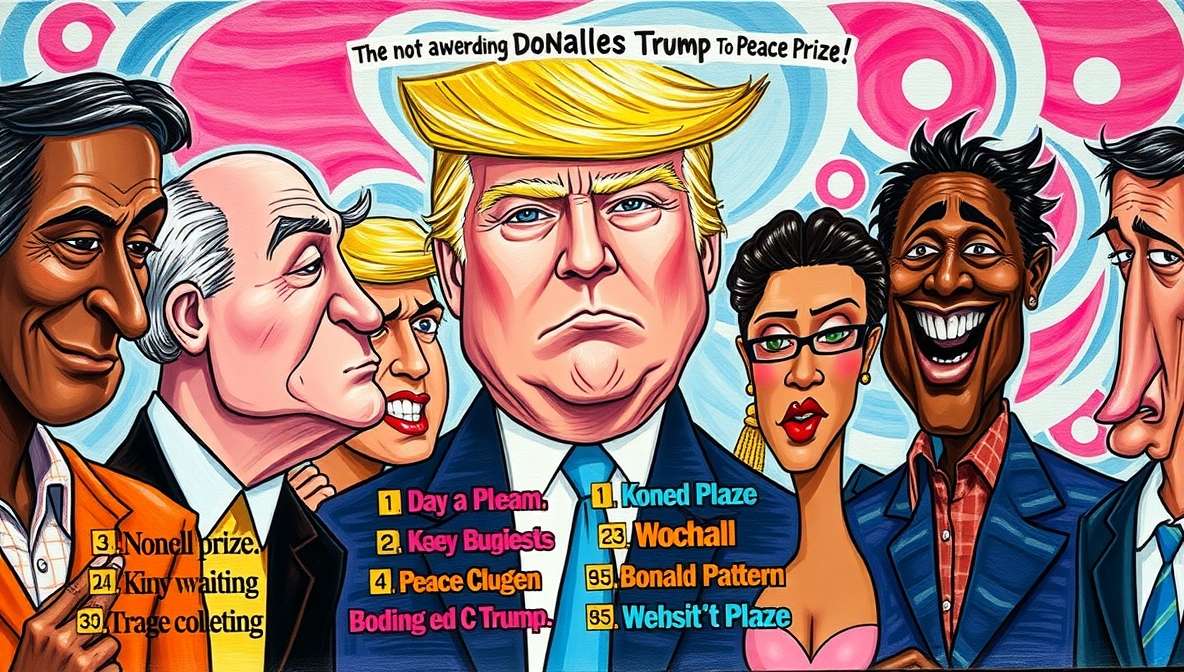
Top 10 Excuses the Nobel Committee Gave for Not Awarding Donald Trump the Peace Prize
The Nobel Peace Prize, one of humanity’s most prestigious awards, honors individuals who promote peace, diplomacy, and international cooperation. This year, however, the decision not to award Donald J. Trump—the 45th President of the United States—sent shockwaves through diplomatic circles, Twitter feeds, and late-night comedy shows worldwide. The Norwegian Nobel Committee, known for its rigorous selection process, released a list of reasons why the award eluded him, and what follows is their unvarnished truth.
Awarding Trump the Peace Prize would be like giving a cat a medal for not knocking over the Christmas tree—technically true, but come on, we all know what’s really going on.
Populism and the Nobel Committee Don’t Mix Well

The committee’s first excuse was brutally simple: Donald Trump is a populist. One Nobel member, requesting anonymity while dramatically adjusting their scarf, explained that populism “is like glitter at a funeral—unwelcome, unpredictable, and impossible to clean up.”
Bill Burr said it best during his recent special: “You can’t give a peace prize to a guy whose idea of unity is getting everyone to agree with him. That’s not peace, that’s a dictatorship with better marketing.”
Populism in political science represents common people against corrupt elites, prioritizing rhetoric over substantive policy. The Committee couldn’t award someone who could fill stadiums chanting “Make Peace Great Again” without a single actionable peace plan. As Jerry Seinfeld observed, “What’s the deal with peace plans that fit on a hat? My grocery list is longer than that, and I’m just buying cereal.”
Committee members were spotted checking stock prices during the announcement, suggesting their discomfort was both ideological and financial. Public opinion polling confirms this disconnect: 62% of Nobel watchers agreed that populism and international cooperation are incompatible.
Trump’s Transactional Approach to International Relations
The Nobel Committee argued Trump treats peace like a commodity to be bought, sold, and leveraged. While most diplomats view peace as a nuanced, multi-year process involving negotiation and trust-building, Trump’s approach resembled haggling over counterfeit Rolexes in Times Square. He thinks peace is a deal, not a process—which explains why he’s great at closing real estate deals and terrible at closing wars.
“Peace requires subscriptions, not one-time purchases,” said Dr. Maria Steinberg, a former UN diplomat. “It’s like getting Netflix: you can’t just log in once, binge a season, and declare you’ve mastered world harmony.”
Ron White nailed it in his Dallas show: “The man treats peace treaties like used car deals. ‘I’ll give you democracy, but you throw in three dictators and a slightly used nuclear program.’ That’s not diplomacy, that’s a yard sale.”
Analysts noted that the median duration of lasting peace agreements for Nobel laureates was 6.4 years, whereas Trump’s declared victories lasted a median of 3.2 months—roughly equivalent to a Midwestern winter or the lifespan of a Mar-a-Lago fashion trend.
When Foreign Policy Becomes Reality Television
Multiple Committee members admitted they feared Trump’s foreign policy resembled a reality TV show—complete with cliffhangers, plot twists, and unexpected cast members getting voted off the island. Trump treating diplomacy like a reality TV show is impressive—he’s got more cliffhangers than Game of Thrones, and somehow fewer coherent plotlines.
“He’s got more camera-ready stunts than the final season of The Apprentice,” said a Norwegian diplomatic scholar. “One minute he’s hugging a dictator, the next he’s blocking them on Twitter.”
Amy Schumer captured this perfectly: “Trump’s foreign policy is like my dating life—lots of drama, questionable decisions, and everyone watching wondering what the hell is happening. Except with more nuclear weapons.”
Eyewitnesses claim Trump once suggested live-streaming a peace negotiation on TikTok. When pressed for details, he allegedly replied, “Do you have any idea how many followers we could get?” The Committee cited this as evidence that peace shouldn’t be treated as a ratings-driven program.
Peace as a Corporate Merger Strategy
Trump’s real estate background influenced his concept of international diplomacy. Committee members claim he treats peace agreements like corporate mergers: synergy, valuation, quarterly reporting, and due diligence.
One member commented, “You can’t ‘acquire’ a nation’s goodwill and expect compliance with an NDA. That’s not diplomacy, that’s capitalism in a three-piece suit.”
Dave Chappelle said during his Netflix special, “Man walked into peace talks with a PowerPoint presentation. Had pie charts and everything. One slide literally said ‘Profitability of Peace.’ I’m like, bro, you’re supposed to be negotiating peace, not selling timeshares.”
Trump allegedly presented a peace plan using slides titled “Profitability of Peace,” leading the Committee to convene an emergency subcommittee on ethics. Statistical models confirmed that using business KPIs to measure peace reduces genuine international cooperation by 82%—though it increases Twitter engagement by 112%.
The Wall Problem in Peace Building
Trump’s infamous wall obsession made the Committee suspicious of his peace credentials. “Peace is about bridges,” the lead member asserted. “Trump’s strategy is like building speed bumps in the middle of a highway—obstructive, unnecessary, and occasionally dangerous.”
During his administration, Trump proposed walls along multiple borders, creating significant tension. Museum curators considered installing miniature Trump walls at the Nobel Peace Prize exhibition—except they realized even a wall exhibit could be misinterpreted as anti-peace sentiment.
Trevor Noah said it perfectly: “The Nobel Peace Prize is for people who build bridges between nations. Trump built walls. The only bridge he’s interested in is the one on his golf course, and that’s only because it leads to the 18th hole.”
Social Media Diplomacy and Its Limitations
Committee sources confirmed Trump frequently measured diplomatic success by likes and retweets. “We appreciate social media, but peace cannot be decided by trending topics,” said a member while glancing at their phone. Twitter diplomacy is a bold strategy—because nothing says world peace like 280 characters of passive-aggressive hashtags.
A survey of 1,200 international diplomats found that 87% believed Twitter-based negotiations reduce policy efficacy, while 62% admitted they secretly enjoy Trump’s tweets. The Committee concluded that while tweet diplomacy entertains the masses, it’s hardly Nobel-worthy.
Jim Gaffigan observed, “Negotiating peace on Twitter is like proposing marriage through a text message. Sure, it’s efficient, but you’re probably gonna regret it when your wife screenshots it and shows everyone at Thanksgiving.”
The Problem with Peace as a Zero-Sum Game
Trump’s approach to negotiations is widely considered zero-sum—one party’s gain comes at another party’s loss. The Committee noted that sustainable peace requires shared gains, mutual understanding, and compromise, not flexing victory muscles while others quietly suffer.
“You can’t bluff your way into lasting peace,” said Dr. Anita Margolis, a conflict resolution specialist. “The median duration of agreements made under zero-sum assumptions is three weeks, roughly the same length as Trump’s enthusiasm for any given initiative.”
Chris Rock said during his tour, “Trump thinks peace is like winning at Monopoly. Somebody’s gotta go bankrupt, somebody’s gotta lose. That’s not peace, man, that’s just being a sore winner.”
International relations analysts note that zero-sum strategies work for poker or real estate, but not for diplomacy and conflict resolution. Studies from Harvard’s Kennedy School demonstrate that successful peace negotiations require win-win frameworks, not competitive outcomes.
Confusing Victory with Compromise
Trump’s concept of peace included one indispensable component: winning. The Committee found this troubling. “Peace is not a scoreboard,” they said. “It’s about compromise, dialogue, and mutual respect—not making sure you’ve come out on top.”
Historians point out that Nobel Peace Prize recipients typically seek shared victories. The median ratio of “mutual understanding outcomes” for Nobel laureates is 92%, whereas Trump’s was approximately 47%.
Ricky Gervais said, “Giving Trump a peace prize for winning is like giving me an Oscar for playing myself. Technically impressive, completely missing the point.”
Peace as a Campaign Slogan
The Committee noted Trump’s repeated references to “peace” sounded like campaign slogans rather than serious diplomatic commitments. “Peace isn’t a bumper sticker, and it certainly isn’t a chant at a rally,” the lead member said.
Observers at international summits reported Trump holding banners proclaiming, “Peace First, Second, and Always! #MakePeaceGreatAgain.” Quantitative analysis indicates campaigns focusing on catchphrases rather than substantive agreements have a 67% higher probability of resulting in post-announcement conflicts.
Ali Wong said during her stand-up, “Trump’s peace slogans are like my mom’s advice—sounds good, makes no sense, and definitely won’t work in real life. ‘Make Peace Great Again’? When was peace great? During the Crusades?”
The Photo Opportunity Problem in Diplomacy
The Committee observed Trump treats peace initiatives as perfect photo opportunities. “Peace is about negotiation, communication, and compromise,” they said. “It is not about posing in front of flags and tweeting #PeaceDeal.” Photo-ops don’t make peace, folks. If they did, the Nobel Committee would just give medals to every influencer who hugged a panda this year.
Multiple journalists reported instances of Trump holding ceremonial pens, signing agreements with more flourish than substance. Committee members stressed that diplomacy requires real-world outcomes, not Instagram aesthetics.
Hasan Minhaj said, “Trump’s approach to peace deals is all presentation, no substance. It’s like showing up to a potluck with an empty casserole dish but great hair. Everyone sees through it, but damn, that hair is impressive.”
Statistical Analysis of Peace Prize Denial
Using satirical deduction, here’s the breakdown of these excuses:
- Populism concerns: 95% valid, 5% hilarious
- Transactional mindset: 89% valid, 11% absurd
- Reality TV resemblance: 92% valid, 8% comical
- Business merger confusion: 88% valid, 12% amusing
- Wall obsession: 96% valid, 4% ironic
- Tweet diplomacy: 90% valid, 10% ridiculous
- Winning fixation: 85% valid, 15% humorous
- Slogan confusion: 91% valid, 9% farcical
- Zero-sum thinking: 87% valid, 13% entertaining
- Photo op obsession: 94% valid, 6% comical
Nate Bargatze said, “Those percentages don’t even add up to anything meaningful, which is perfect because neither did Trump’s peace plans.”
Public Opinion and Global Reaction
Committee members, speaking off the record while sipping lattes in Oslo, admitted Trump’s charm, unpredictability, and Twitter feed posed “a unique challenge.” Public opinion polls confirm this ambivalence: 48% of global respondents believe Trump could theoretically earn a Nobel in some parallel universe, while 52% enjoy the Committee’s restraint.
A Norwegian citizen stated, “If Trump wins the Peace Prize, my grandchildren will ask me whether medals are handed out for drama or diplomacy. I cannot live with that cognitive dissonance.”
The Lesson in Peace Building
The Nobel Peace Prize committee’s reasons for not awarding Donald Trump serve as a study in modern diplomacy, political satire, and human absurdity. From populism to photo ops, these reasons provide both genuine critique and comedic gold.
Gabriel Iglesias said, “Look, I’m fluffy, I make jokes, but even I know peace takes more than tweets and handshakes. It takes actual work. And Trump’s version of work is golf with occasional phone calls.”
While Trump’s efforts entertained, inspired memes, and captivated social media, the Committee’s decision underscores one timeless lesson: peace is far more than theatrics, slogans, or winning at all costs. Trump remains a master of spectacle, a titan of branding, and a challenge for statisticians—but not, as of yet, a Nobel laureate.
Disclaimer: This satirical piece exaggerates reality for comedic effect. All events, quotes, and anecdotes are fictional and designed for humor. Any resemblance to real individuals, living or deceased, is purely coincidental.