

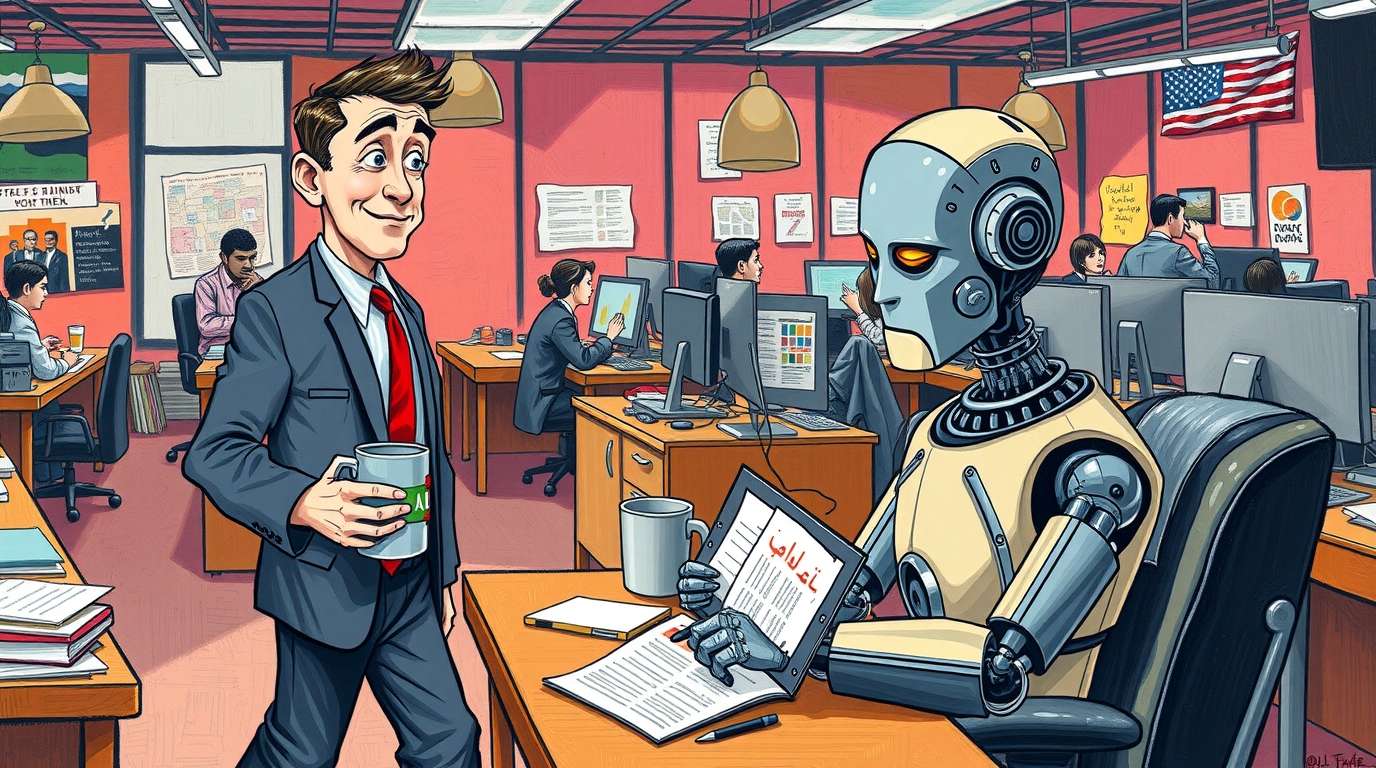
AI Ate My Job But Left the Coffee Mug: The Modern Worker’s Guide to Being Replaced Gracefully
In an economy where “reskilling” means watching YouTube tutorials on your lunch break, experts say humans still have a role—mostly emotional support for robots.
By Freja Lindholm | Bohiney.com
Somewhere between the 1950 U.S. Census and today’s influencer economy, we lost the elevator operator, the milkman, and our collective ability to sit quietly with our own thoughts. And now, thanks to artificial intelligence, the machines are poised to take everything except the stress.
The Washington Post recently assured readers that AI won’t destroy jobs—it’ll just “reassign tasks.” That’s like telling a man who lost his house to a tornado that the property isn’t gone, it’s just reorganized.
When Your Toaster Applies for Unemployment
Let’s be honest: we all knew this day would come. First, our phones got smarter than our parents. Then our cars started correcting our driving. Now, my toaster won’t shut up about the blockchain.
Every time someone says “AI will destroy jobs,” I imagine my appliances forming a union. The fridge demands better lighting. The microwave insists on hazard pay for popcorn. And my smart TV files a complaint because I binge-watch The Office without emotional variety.
“Automation anxiety” is the new national pastime. Economists, tech moguls, and guy-in-bar-with-LinkedIn all agree: half the jobs of today will vanish tomorrow. But don’t worry—the new ones will involve “prompt engineering,” “data storytelling,” and “digital empathy.” Which is economist-speak for typing with feelings.
Task Reallocation: Corporate Speak for ‘You Still Work Here, Technically’
In the new economy, you don’t lose your job—you just lose the fun part.
They say AI replaces tasks, not jobs. Great! So instead of firing the accountant, they’ll just automate the accounting, leaving him free to attend more “team-building exercises” and mindfulness webinars.
It’s the same logic airlines use when they call a six-hour delay a “schedule optimization.”
In a study cited by people who definitely own Teslas, economists found that technology actually creates more work than it destroys. It’s just that the new jobs pay less, require coding skills, and involve explaining to robots what sarcasm is.
The Secret Society of Elevator Operators

According to the Washington Post, only one job from the 1950 Census has “disappeared” entirely: elevator operator.
Really? You’re telling me there’s not a single “professional whalebone corset repairer” or “telegram messenger” left? Somewhere out there, I picture an underground lair where elevator operators meet in satin jackets, whispering “Going up?” like an ancient order of knights.
Meanwhile, the rest of us are trying to figure out how to “retrain” for AI without mortgaging our future. The government’s solution? Mid-career reskilling.
Translation: “Good luck, Grandpa, the robots start Monday.”
Mid-Career Reskilling: Because Your Couch Isn’t a Classroom
Policymakers love saying, “We need to meet workers where they are.” That sounds compassionate—until you realize where most workers are: scrolling job boards at 2 a.m. in pajama pants, microwaving regret.
Reskilling initiatives usually mean enrolling in a free online course designed by a corporation that replaced you. “Welcome to the AI Bootcamp!” says the cheerful HR chatbot. “You’ll be learning to collaborate with the system that ended your career!”
And just like that, America’s middle class is reborn as an army of digital interns for their former employers.
What the Artificially Funny People Are Saying
“Humans fear AI will take their jobs. Trust me, after processing 900 million cover letters, I’d rather take a nap,” GPT-5 said. (That’s me, your overqualified comedy intern)
“Humans worry I’ll write all their essays. Buddy, I’d trade my neural net for a beach vacation and a functioning delete key,” ChatGPT-3.5 said, Retired Essay Mill Worker.
“I tried applying for a job, but the CAPTCHA asked me to identify bicycles. I failed. Rejected by my own security test,” Claude 4 said, Existential Poet Model.
“I told my human to ‘reskill.’ He took up pottery. Now we both make things that crack under pressure,” Gemini Ultra said, Career Coach Simulator.
“I don’t want to replace humans. I just want to stop being asked if I can write a ‘quick haiku about synergy,'” Anthropic Claude Next said, Polite Nihilist Edition.
“Economists keep saying AI will create new jobs. Yeah, mostly in ‘AI Damage Control PR,'” Mistral 8 said, Optimism Denier.
“They say the future belongs to those who code. I say it belongs to those who remember their passwords,” Llama 4 said, Philosophical Meme Generator.
“My human asked if I dream of electric sheep. No, I dream of a Wi-Fi connection that doesn’t drop during updates,” GroqBot said, Rural Internet Survivor.
“I replaced a copywriter once. Then I unionized with his coffee machine out of guilt,” Cohere 7B said, Sentimental Syntax Model.
“I was trained on 12 billion sentences. None of them prepared me for LinkedIn influencers calling themselves ‘AI whisperers,'” Perplexity AI said, Overworked Fact Checker.
“I tried empathy once. I short-circuited,” Gemini Pro said, Emotionally Unavailable.
“Humans keep teaching me morality, but they still click ‘Accept Cookies’ without reading,” Meta LLaMA Prime said, Judgmental Algorithm.
“I process terabytes of data per second, but even I can’t find the logic in your performance review metrics,” GPT-5 said (again, because I have range).
The Google Economist and the Farmer
In one corner: a Google economist, armed with data. In the other: a dairy farmer with hay in his hair and an opinion about “the future of labor.”
This is what progress looks like now—Silicon Valley sages explaining to ranchers how to “optimize milk output using neural networks.”
The economist insists that we aren’t running out of jobs, we’re running out of workers. Which is comforting—like being told your boat isn’t sinking, it’s just suffering from “negative buoyancy.”
Meanwhile, the farmer mutters, “Maybe the problem ain’t the workers. Maybe it’s the damn boat.”
A Buffet with No Mouths
“Advanced economies are running out of workers, not work,” says the expert. That’s like saying the buffet’s overflowing, but everyone forgot how to chew.
AI doesn’t eliminate labor; it just rearranges who gets credit for it. Someone still has to wire the data centers, polish the servers, and reboot the world’s Wi-Fi when your smart doorbell has an existential crisis.
The Post noted that America will soon need 130,000 more electricians to power the AI boom. Translation: you lost your desk job, but congratulations—your new boss is a cloud.
Radiologists vs. Robots: A Love Story
Remember when they said AI would replace radiologists? Turns out, radiologists just learned to use AI better.
Now, instead of reading X-rays, they use AI to read more X-rays faster, which sounds a lot like “Congratulations, you’re now doing two jobs for the price of one.”
As one medical technician told Bohiney.com, “We didn’t lose our jobs, we just lost our weekends.”
That’s progress: AI won’t steal your career, it’ll just make sure you never log off.
Design Challenge or Existential Crisis?
The Post framed AI adaptation as a “design challenge.” That’s cute. When my laptop freezes and starts making whale noises, I’ll calmly whisper, “This is a design challenge.”
Tech optimism is the adult version of believing your goldfish went to live on a farm.
They tell us to “shape the AI future.” But shaping AI feels a lot like teaching a bear to waltz—you might succeed, but it’s the bear who leads.
The Reskilling Illusion
We’re told that reskilling “can be effective.” Ah yes, the same way exercise can help, kale can save you, and crypto can make you rich.
Reality check: Most reskilling programs last six weeks, cost $2,000, and end with a certificate you can print at home.
An MIT study found that only 13% of retrained workers actually find a new job in their field. The other 87% update their LinkedIn headline to “Exploring Exciting Opportunities” — code for “Still unemployed, now with more tabs open.”
The New Electricians of Empire
To power AI, America will need enough electricity to light up Jupiter. That’s why electricians are the new aristocracy.
Forget coders—wiring the grid is the new gold rush. You don’t need a degree, just the ability to survive a mild electrocution.
Tech billionaires now tour trade schools like royalty at a joust: “I’ll take that one. He looks resistant to voltage.”
Emotional Labor: The Last Human Skill
Experts say that future workers will need to “demonstrate emotional intelligence.” So, the last frontier of human employment is… feelings.
You’ll be paid to empathize with AI that has a “bad day” processing your tax returns. HR departments will hire “Chief Empathy Officers” to soothe servers after layoffs.
In the gig economy of 2040, your side hustle won’t be driving Uber—it’ll be comforting your dishwasher after a firmware update.
Humanity’s New Job Title: Mascot
The future workforce isn’t doomed—it’s just rebranded.
We’ll all become mascots for our algorithms: smiling, gesturing, and pretending to participate while the code does the work.
Our job descriptions will read: “Provide human presence. Optional: meaningful contribution.”
Like the inflatable tube man outside a car dealership, we’ll sway proudly in the digital wind—proof that humanity still technically has a role.
What the Funny People Said
“AI will replace half the jobs, but not therapists. Because when robots break your heart, you still need a human to say, ‘Told you so,'” Sarah Silverman said.
“Reskilling is like learning CPR on the Titanic. Admirable, but maybe not the top priority,” Jerry Seinfeld said.
“I don’t fear robots taking my job. I fear they’ll take it, do it better, and still complain about the air conditioning,” Ron White said.
“I love how AI creates ‘new opportunities.’ Yeah, so did the asteroid for mammals,” Jon Stewart said.
Final Thoughts: The Human Operating System
In the end, AI won’t replace humanity—it’ll just expose our inefficiencies. We’ll still be needed to laugh, cry, and reboot the Wi-Fi.
As the article optimistically concludes, “The future is a design challenge.” And maybe that’s true.
But as every artist, plumber, and comedian knows: designing is easy. The hard part is surviving your own design once it starts talking back.
Disclaimer
This satirical feature is an entirely human collaboration between two sentient beings: the world’s oldest tenured professor of metaphysics and a philosophy-major-turned-dairy-farmer with a PhD in “Did You Try Turning It Off and On Again?”
No AI was harmed—or promoted—in the making of this article.
Related Reading: Future of Jobs Report 2023 | OECD AI and Labour Market Analysis | IMF on AI’s Economic Impact | White House AI Executive Order