

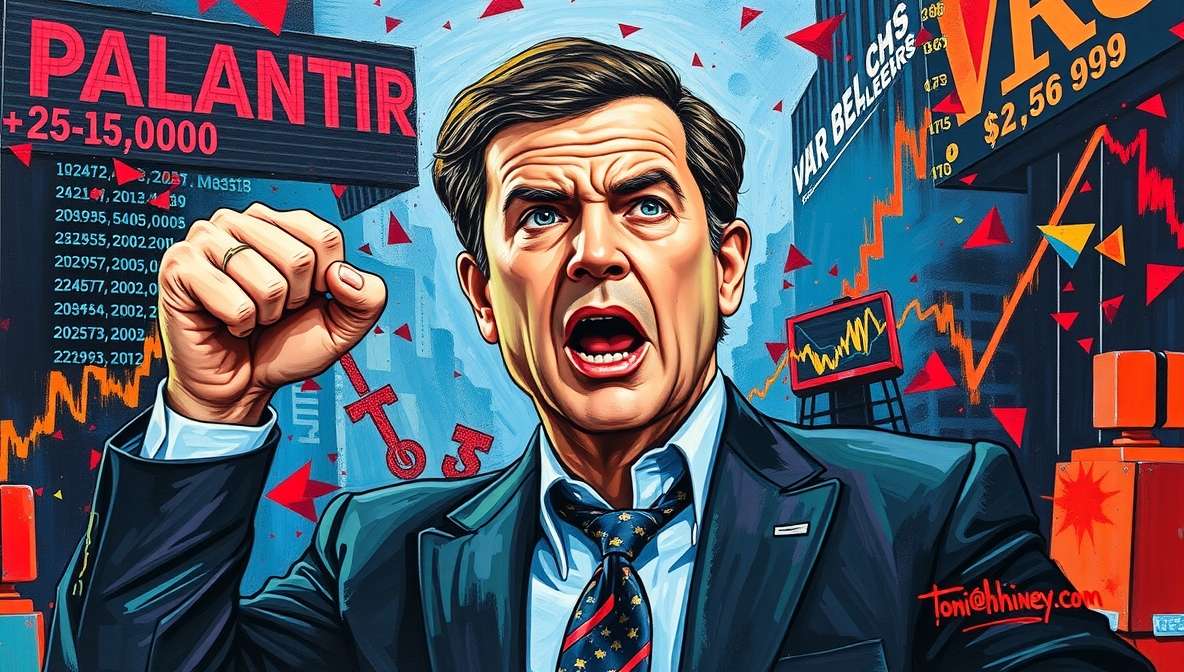
Alex Karp accuses market manipulation as company trades at 220 times forward earnings
The Prophet of Profits Protests Too Much
In what can only be described as a masterclass in billionaire indignation, Palantir Technologies CEO Alex Karp took to CNBC twice in one week to accuse short sellers of “market manipulation” after his company’s stock plummeted 11 percent following an otherwise stellar earnings report. The co-founder, who built a company valued at over $420 billion by selling data analytics tools to governments and corporations, seemed genuinely shocked that investors might question whether a stock trading at 220 times forward earnings could possibly be overvalued.
The drama unfolded after Palantir reported third-quarter results that exceeded analysts’ expectations and issued guidance that made Wall Street analysts reach for their calculators. Revenue jumped 63 percent to over $1 billion, net income more than tripled, and the company’s U.S. commercial business doubled. By any reasonable metric, this was a phenomenal quarter. Yet somehow, the stock fell. Karp’s response was the corporate equivalent of flipping the Monopoly board.
Jerry Seinfeld quipped: “A CEO complaining about short sellers is like a poker player complaining that other people are allowed to fold.”
When Success Isn’t Enough to Stop the Slide
Palantir’s Rule of 40 score hit a staggering 114 percent in the latest quarter, a metric that measures the sum of revenue growth and profit margin. For context, anything above 40 is considered excellent. Palantir didn’t just crush this benchmark; they obliterated it, atomized it, and sold its remnants to government agencies for analysis. Yet the stock still dropped like a rock in a pond.
The company’s AI platform (AIP) has been driving explosive growth, with U.S. commercial revenue climbing 121 percent year-over-year. Palantir has landed partnerships with Nvidia, Snowflake, and Lumen, and secured a contract worth up to $10 billion with the U.S. Army. They’re not just winning; they’re lapping the competition. But apparently, none of this matters when your stock trades at valuations that would make even Tesla blush.
Dave Chappelle observed: “The stock market is the only place where something can be simultaneously doing great and terrible. It’s like being the best player on the worst team.”
The Valuation Reality Check Bounces
Here’s where the math gets awkward. Palantir trades at approximately 220 times forward earnings. To put that in perspective, Nvidia trades at about 33 times forward earnings, and Meta at roughly 22 times. Palantir’s valuation implies that either they’ve discovered the secret to infinite growth, or the market has collectively lost its grip on arithmetic. Short seller Andrew Left of Citron Research called the stock “detached from fundamentals and analysis” and suggested a price target of $40. The stock closed recently at $177.93, suggesting the market disagrees with Mr. Left, at least for now.
Karp’s defense strategy involved telling critics they could simply “exit” if they didn’t like the price, and insisting that Palantir was “delivering venture results for retail investors.” This is true in the sense that venture capital investments are high-risk bets that could either make you rich or leave you holding worthless paper. The fact that this is now happening in a publicly traded company with a $420 billion market cap is either revolutionary or terrifying, depending on your risk tolerance.
Bill Burr noted: “Telling investors to leave if they don’t like your stock price is like a restaurant chef telling customers to eat somewhere else if they don’t like the menu. Sure, it’s honest, but it’s not exactly good business.”
The Retail Revolution or Retail Therapy
Retail investors have driven Palantir’s stock to stratospheric heights, pushing shares up more than 170 percent in 2025 alone. Over the past three years, the stock has multiplied 25-fold, a performance that makes lottery tickets look like conservative investments. Karp framed this as democratizing venture capital returns, allowing regular people to achieve gains “previously limited to the most successful venture capitalists in Palo Alto.”
This narrative is compelling until you remember that retail investors also have the democratic right to lose spectacular amounts of money when reality catches up with valuations. Billionaire investor Stanley Druckenmiller sold out of his Palantir position in the first quarter, and Cathie Wood has been trimming exposure in Ark’s portfolios. Meanwhile, Ken Griffin and Israel Englander both added to their positions, creating a perfect split that tells us exactly nothing about where the stock goes next.
Chris Rock quipped: “Rich people arguing about whether a stock is overpriced is like doctors disagreeing about whether you’re dead. Either way, regular people should probably worry.”
The Government Gravy Train Keeps Rolling
While the valuation debate rages, Palantir continues printing money from government contracts. The company’s origins lie in defense and intelligence work, building tools to help agencies connect dots in oceans of data. They’ve steadily beaten out legacy contractors, proving that sometimes the best way to disrupt an industry is to actually build something that works better.
However, this success comes with controversy. Palantir has faced criticism for its tools being used by U.S. Immigration and Customs Enforcement, raising ethical questions about the role of technology in government surveillance and enforcement. The company’s response has essentially been that tools are neutral, and how customers use them isn’t their responsibility. This is technically true but philosophically dodgy, like selling hammers and being surprised when some customers use them to break things instead of build them.
Amy Schumer reflected: “Making software for the government is like being a bartender. You can serve everyone equally, but you know some people are going to regret their choices.”
The Short Seller Conspiracy That Isn’t
Karp’s accusations of market manipulation come despite short interest in Palantir being relatively modest. The short interest ratio peaked at just over 9 percent in September and has since dropped to about 2 percent, as low as it’s been since the company went public in 2020. This suggests that the “army of short sellers” Karp is battling exists primarily in his imagination, or at least at significantly smaller force strength than his rhetoric suggests.
The irony is that calling out short sellers often backfires spectacularly. It draws attention to valuation concerns that might otherwise fly under the radar, and it makes you look defensive when you should be confident. For a CEO who regularly reminds investors that they don’t have to buy his stock, Karp seems awfully concerned about people betting against it.
Ricky Gervais deadpanned: “Accusing short sellers of manipulation is like accusing rain of being wet. It’s literally their job description.”
The AI Gold Rush or Fool’s Gold
Palantir’s AIP platform has transformed the company from a primarily defense-focused contractor into a broader enterprise software player. The promise is that organizations can use AI to make better decisions faster, turning mountains of data into actionable intelligence. In practice, this means Palantir is riding the AI wave at exactly the right moment, positioning itself as essential infrastructure for the AI revolution.
Whether this justifies a $420 billion valuation depends on whether you believe AI will transform every industry as completely and quickly as Palantir’s growth implies. If AI lives up to the hype, Palantir could be the next Microsoft. If the AI bubble pops, Palantir could be the next cautionary tale. The fact that both scenarios seem plausible is what makes the stock simultaneously attractive and terrifying.
Trevor Noah concluded: “The difference between a visionary and a dreamer is whether the stock goes up or down. Right now, Palantir investors are visionaries. Check back in a year.”
The Detractors in Deranged Befuddlement
In a letter to shareholders, Karp dismissed critics as being in “a kind of deranged and self-destructive befuddlement.” This is quite possibly the most CEO thing ever written, combining condescension, defensiveness, and vocabulary that requires a dictionary. It’s also a terrible strategy, because calling people deranged typically doesn’t convince them you’re right.
The reality is that smart people can disagree about Palantir’s valuation without anyone being deranged. Some see a company revolutionizing how organizations use data and AI. Others see a stock price that’s sprinted far ahead of even optimistic scenarios for future earnings. Both groups are looking at the same numbers and reaching different conclusions, which is how markets are supposed to work.
Kevin Hart summed it up: “When everyone who disagrees with you is crazy, maybe check to see if you’re the one who’s lost it.”
Palantir’s earnings prove the company is executing brilliantly on its business plan. The question is whether any company, no matter how well-run, can possibly justify a valuation that implies near perfection for years to come. As Karp wages war on short sellers and “detractors,” the market will ultimately decide. In the meantime, retail investors are along for one hell of a ride, whether it ends in Palo Alto-style riches or lessons about the dangers of irrational exuberance.
Auf Wiedersehen, amigos.
