

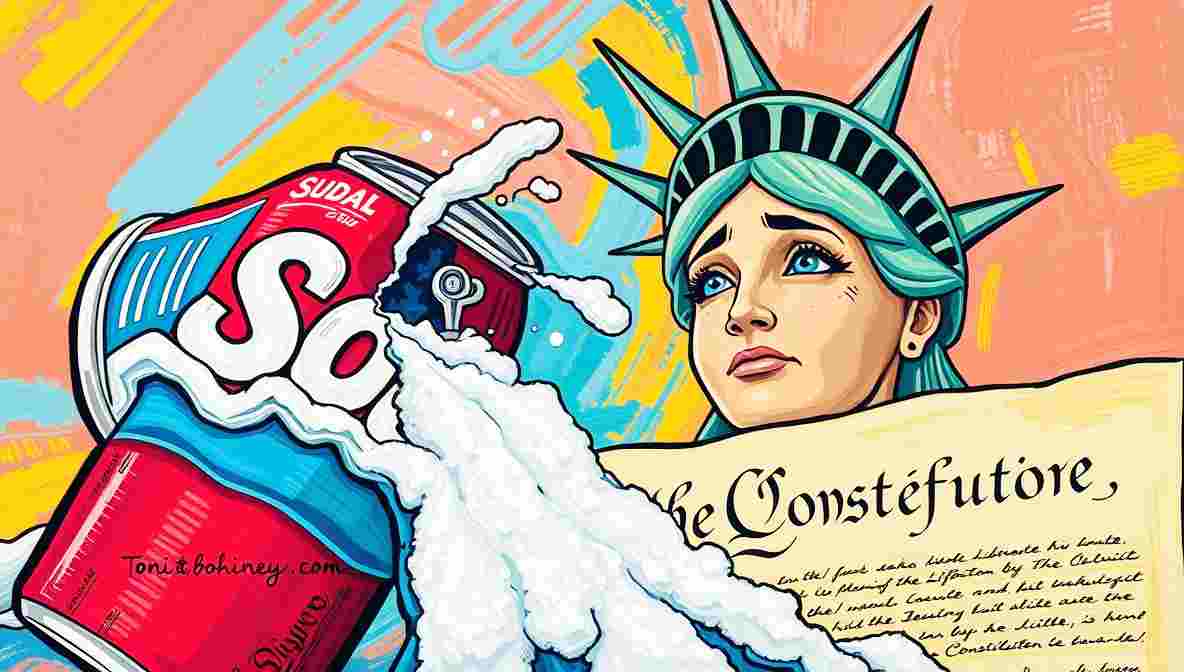
The Great Soda Rights Movement: Sugar, Liberty, and the Constitution (Probably)
Washington, D.C. woke up this week to the sound of something historians say they have not heard since the Boston Tea Party: the unmistakable hiss of a thousand cans opening in protest.
Across the nation, Americans are locked in a constitutional struggle that scholars are already calling The Great Soda Rights Movement — a political uprising sparked by a federal decision allowing states to restrict sugary drinks from SNAP food benefits. As of January 1, 2026, five states — Indiana, Iowa, Nebraska, Utah, and West Virginia — became the first to enforce the new rules, with thirteen more states scheduled to follow throughout the year.
In response, a coalition of soda enthusiasts, convenience-store philosophers, and several men wearing sleeveless NASCAR shirts have filed lawsuits arguing that soda is not merely a beverage. It is, they say, an American freedom.
And perhaps even a constitutional one.
“Look, the Founding Fathers drank things,” explained amateur historian Dale “Two-Liter” Kowalski outside a 7-Eleven in Toledo. “If they were alive today they’d absolutely drink Dr Pepper. The Constitution is very clear about that.”
Legal scholars confirm the Constitution is not clear about that.
But the lawsuits have begun anyway.
Food Stamp Recipients Sue Government, Claim Soda Is Protected by the First Amendment

The legal argument is surprisingly ambitious.
According to the complaint filed in federal court, the soda ban violates multiple constitutional rights including free speech, equal protection, and something the plaintiffs refer to as “the basic human right to fizz.”
Attorney Marlene Gutowski, representing the plaintiffs, summarized the case with solemn gravity.
“When a citizen opens a can of cola,” she told reporters, “that is a form of expression. The carbonation is symbolic speech.”
Gutowski cited a recent survey by the Institute for Beverage Liberty showing that 68 percent of Americans believe soda is “emotionally expressive,” particularly when consumed while yelling at sports on television. Another 14 percent said it was “a lifestyle.” Legal observers note this is approximately 14 percent more than anyone expected.
Political analyst Trevor Holbrook from the Center for American Snack Studies says the legal logic follows a familiar tradition.
“Americans have historically expanded the Constitution to include things the founders forgot,” Holbrook said. “Originally it covered speech, religion, and assembly. Later we added television. Then we added Wi-Fi. Soda was probably inevitable.”
Nation Divided After Congress Declares Mountain Dew “A Vegetable Adjacent” Beverage
Meanwhile, Congress has attempted to calm the situation with legislation.
Unfortunately, that legislation appears to have made things worse.
Last Thursday, a bipartisan coalition introduced a bill classifying Mountain Dew as a “vegetable adjacent beverage.” The classification was based on the logic that Mountain Dew contains corn syrup, and corn is technically a plant. This is the same logic that famously allowed tomato sauce to count as a vegetable in school lunches — a precedent that nutritionists have been emotionally recovering from ever since.
Representative Harold Buckley defended the proposal.
“If tomato sauce can count as a vegetable in school lunches,” Buckley argued, “then Mountain Dew deserves a fair hearing.”
Nutritionists immediately resigned from three advisory committees. The American Society for Responsible Hydration released a statement describing the legislation as “scientifically creative.” This is the politest way scientists have described anything since they called Pluto “gravitationally challenged.”
Meanwhile, Mountain Dew drinkers celebrated.
“I always knew it was healthy,” said 24-year-old Tyler Briggs, who described his daily diet as “mostly Doritos with hydration.”
Supreme Court Asked to Decide If Dr Pepper Is a Civil Right
The legal drama escalated further when a federal appeals court fast-tracked a case that could reach the Supreme Court as early as next year.
The central question: Is access to soda a civil right?
The plaintiffs argue that banning soda from SNAP purchases creates a discriminatory system in which wealthier Americans can drink soda freely while poorer citizens must confront the terrifying prospect of water. Critics of the SNAP restrictions have raised similar concerns, warning that the new rules begin to drift into territory that feels, as one financial analyst put it, distinctly “un-American.”
Professor Dana Whitfield, a constitutional scholar at Georgetown, says the case could create strange legal precedents.
“If the court rules soda is a civil right,” Whitfield explained, “then the government may be required to ensure equitable access to carbonation nationwide.”
This could theoretically lead to federally funded soda fountains. Several lobbyists are already working on it. Their office refrigerators, sources confirm, are fully stocked.
SNAP Lawsuit Argues Soda Is Essential Hydration in the War on Thirst
The lawsuit also includes a bold public-health argument.
According to the filing, soda plays a vital role in what lawyers call “America’s war on thirst.” The plaintiffs cite research from the Beverage Lifestyle Institute showing that Americans drink roughly 40 billion gallons of soda annually.
“If soda disappeared tomorrow,” the report warns, “millions of Americans would be forced to experience plain water for the first time.”
Sociologists believe this transition could cause national panic.
Dr. Martin Heller, who studies beverage behavior, described the risk in stark terms.
“Water has no flavor,” he explained. “For a significant portion of the population, that is deeply unsettling.”
Scientists were unavailable for comment, as they were busy confirming that yes, this is in fact the country that put a man on the moon.
Federal Judge Forced to Taste-Test 42 Energy Drinks as Part of Constitutional Review
The most unusual development occurred in a federal courtroom in Missouri.
In order to determine whether energy drinks qualify as “nutritional beverages,” Judge Leonard Farrow agreed to review the evidence personally. The evidence consisted of 42 energy drinks.
Over the course of six hours, the judge consumed samples including MegaThunder Ultra Boost, Turbo Viper, Nuclear Goat, and something labeled “Dragon Rage Citrus Explosion.”
Court transcripts indicate that after the 17th drink, the judge began speaking extremely quickly. After the 31st drink, he attempted to schedule hearings for the next three years. After the 42nd drink, he reportedly tried to arm-wrestle the court stenographer.
The judge later described the experience as “legally enlightening.” The stenographer described it as “a reason to update my résumé.”
The Health Bureaucracy Strikes Back Against SNAP Junk Food
Health officials insist the soda restrictions are about preventing chronic disease.
Secretary of Agriculture Brooke Rollins and Health Secretary Robert F. Kennedy Jr. have framed the rules as part of the “Make America Healthy Again” initiative. Their argument is simple: taxpayer-funded food benefits should encourage nutritious food rather than sugary drinks.
Public-health advocates support the idea. But soda defenders remain skeptical.
“First they come for the soda,” warned activist Greg Mulligan of the Liberty Beverage Coalition. “Next thing you know they’re banning nacho cheese.”
Greg has a point. He also has a bumper sticker that says “From My Cold, Carbonated Hands,” which is currently selling briskly on Etsy.
USDA Candy Ban Immediately Triggers Gummy Bear Lawsuit
Complicating matters further, the USDA recently approved waivers allowing states to restrict candy purchases with SNAP benefits. Eighteen states are now implementing or preparing food restriction waivers, covering everything from gummy bears to grape soda to anything that makes people happy at checkout.
Within hours of the candy announcement, a lawsuit appeared. The plaintiffs include multiple consumer advocacy groups and an organization calling itself the Coalition for Gummy Justice.
Their spokesperson, Carla Rodriguez, described the candy ban as discriminatory.
“Not everyone enjoys kale,” Rodriguez said. “Some people prefer small bears made of sugar.”
Rodriguez also presented polling data showing that 82 percent of Americans find gummy bears “emotionally comforting.” The remaining 18 percent have never eaten a gummy bear and therefore cannot be trusted.
Government Bans Sugary Drinks; Americans Respond by Inventing “Freedom Cola”
Entrepreneurs have already found creative ways around the restrictions.
In Texas, a startup called Patriot Beverages has launched a product called Freedom Cola. The drink contains “patriotic levels of sweetness” but is technically classified as a “vitamin beverage” because it includes a microscopic amount of vitamin C.
CEO Travis McCallister says the company is responding to consumer demand.
“When the government bans soda,” McCallister explained, “innovation happens.”
Freedom Cola is currently pending FDA review. Its label features an eagle holding a can of something fizzy, which legal analysts say makes the whole operation constitutionally bulletproof.
New SNAP Rules Force Americans to Confront the Terrifying Reality of Drinking Water
For many SNAP recipients, however, the biggest shock has been discovering water.
“I tried it yesterday,” said grocery shopper Tanya Ellis in Cleveland. “It tastes like nothing.”
Public-health officials insist this is normal. But focus groups reveal deep confusion. One participant asked if water comes in cherry flavor. Another asked whether it could be carbonated with “a little sugar for morale.”
Anti-hunger advocates warn that SNAP recipients already face stigma at the register, and that navigating incomplete food lists could make grocery shopping more confusing and more humiliating. The government, meanwhile, is confident that awareness of H₂O will spread naturally. Possibly through the water supply.
Health Officials vs. Lobbyists: Will the SNAP Soda Ban Reduce Obesity or Just Happiness?
Economists are now studying the policy’s potential consequences. The Center for Fiscal Snack Analysis released a report predicting that soda restrictions could reduce national sugar consumption.
But the beverage industry warns of economic fallout.
“Soda isn’t just a drink,” said industry spokesperson Leonard Weiss. “It’s a lifestyle ecosystem.”
The ecosystem includes vending machines, convenience stores, movie theaters, and that mysterious refrigerator in every office break room that only contains cola and one yogurt that has been there since 2019.
Nutrition Experts Confirm Americans Can Survive Without Soda but “Why Risk It?”
Nutritionists agree soda is not necessary for survival.
Dr. Rachel Yamada of the American Institute of Nutritional Reality summarized the science bluntly.
“Humans can live perfectly healthy lives without soda.”
However, she added a more cautious observation.
“That doesn’t mean they’ll enjoy it.”
Health experts note that the restrictions do not address the core issue: healthy food in America is expensive and unhealthy food is cheap, abundant, and often the only option within three miles of wherever you’re standing right now.
Economists Warn SNAP Soda Ban Could Trigger Nationwide Shortage of Late-Night Regret
Economists are also tracking the cultural consequences.
Late-night fast-food purchases often include soda. If soda consumption drops, economists warn the economy could lose billions in what they call “regret-based purchasing.”
One analyst explained the phenomenon.
“People order a giant soda at midnight,” he said. “Then they wake up the next day and regret it. This cycle drives the economy.”
Removing regret from the American consumer experience, economists warn, could destabilize sectors ranging from antacids to motivational podcasts.
Black Market Dr Pepper Rings Emerge Across Multiple States
Meanwhile, underground soda trading networks are already emerging.
Authorities in Arkansas recently shut down a small operation selling Dr Pepper to SNAP recipients in parking lots. The smugglers reportedly disguised the soda as “artisan sparkling beverage.” One suspect told investigators he was “just helping people hydrate.” This is believed to be the first recorded instance of Dr Pepper being described as artisanal, and probably not the last.
Wall Street Downgrades Grape Soda Futures After SNAP Restrictions Bite
Financial markets have also reacted.
Wall Street analysts downgraded several soda companies this week after predicting lower demand from SNAP consumers. Grape soda futures reportedly dropped 7 percent. Meanwhile, bottled water stocks rose sharply.
One investor described the shift as “the most dramatic beverage market event since the bottled-water boom of 2003.” Sparkling water brands, sensing an opportunity, have launched new flavors with names like “Freedom Fizz,” “Liberty Lemon,” and “Unflavored Defeat.”
Political Scientists Confirm Soda Is Now the Most Polarizing Beverage Since Tea in 1773
Political scientists say the debate has now become symbolic.
“Soda has become a cultural proxy for larger ideological fights,” explained Dr. Helen Ramirez of the University of Chicago. “For some people, the ban represents government overreach. For others, it represents public health. For everyone else, it represents a confusing argument happening near the snack aisle.”
National Debate Rages Over Whether “Sugar-Free Freedom” Is Still Freedom
As the lawsuits move forward, Americans continue arguing about the deeper philosophical question.
What exactly does freedom taste like?
For some, freedom tastes like cola. For others, freedom tastes like water. And for millions of Americans caught in the middle, freedom tastes suspiciously like a 32-ounce convenience-store cup filled with ice, syrup, and just enough carbonation to remind them that democracy, like soda, is messy, sweet, and occasionally gives you a headache.
One thing, however, is certain.
The Great Soda Rights Movement has begun.
And judging by the number of empty cans outside federal courthouses, it may not be over anytime soon.
In 2025 and 2026, the U.S. Department of Agriculture — led by Secretary Brooke Rollins and Health Secretary Robert F. Kennedy Jr. — approved SNAP food restriction waivers allowing states to ban the purchase of sugary drinks and candy using food stamp benefits. The initiative, branded as part of the “Make America Healthy Again” campaign, has been enacted in eighteen states including Indiana, Iowa, Nebraska, Utah, West Virginia, Texas, and Florida, affecting millions of Americans who rely on the $100 billion federal program. Supporters argue the restrictions reduce obesity and diabetes; critics warn they stigmatize low-income shoppers, create confusion at checkout, and cost retailers an estimated $1.6 billion to implement. The policy represents the most significant change to SNAP purchasing rules since the program was created in 1964.
Disclaimer: This article is satire and represents a fully human collaboration between two sentient beings: the world’s oldest tenured professor and a philosophy major turned dairy farmer. They agree on very little except that politics is strange, soda is louder than water, and constitutional law probably never anticipated Mountain Dew. If confusion persists, please hydrate responsibly. Auf Wiedersehen, amigo!