

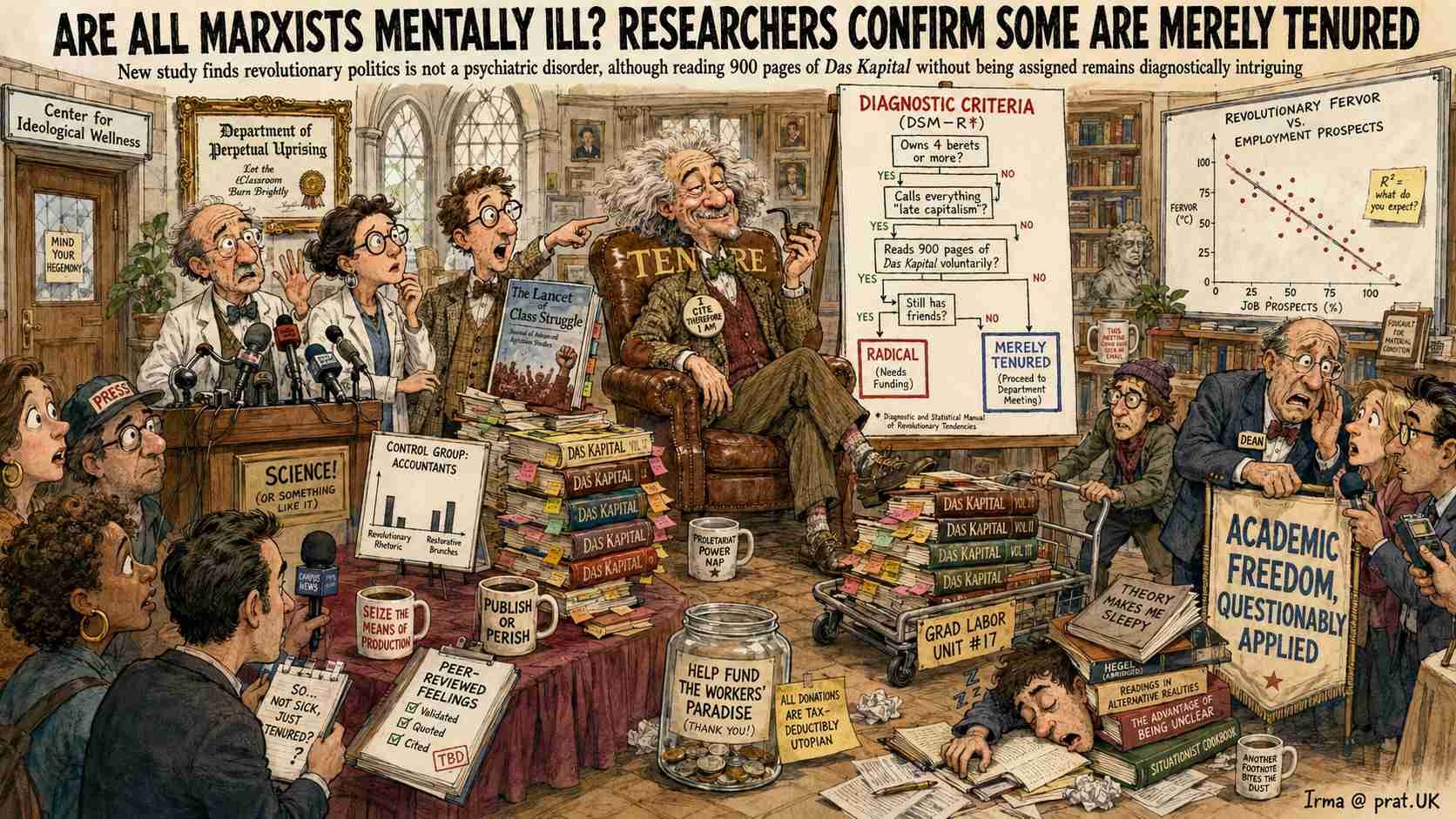
Are All Marxists Mentally Ill? Researchers Confirm Some Are Merely Tenured
New study finds revolutionary politics is not a psychiatric disorder, although reading 900 pages of Das Kapital without being assigned remains diagnostically intriguing
MADISON, Wisconsin — Following renewed discussion about Wisconsin politician Francesca Hong’s previously disclosed history of bipolar disorder, hospitalization and self-harm, America has returned to its favorite medical tradition: diagnosing millions of strangers according to which yard signs they own.
Political researchers announced Thursday that Marxism is not officially classified as a mental illness, despite exhibiting several recognizable symptoms, including compulsive manifesto production, intolerance of price signals and the persistent belief that the next nationalization will work because the correct people will finally supervise it.
“There is no clinical evidence that every Marxist is mentally ill,” explained Dr. Margaret Colley, director of the Institute for Ideological Wellness and Revolutionary Gift Shops. “Some are perfectly healthy people who simply believe the government can operate a grocery store, an automobile factory and the entire national economy with the efficiency of the Department of Motor Vehicles.”
Colley stressed that bipolar disorder is a genuine medical condition that affects people across the political spectrum. It should never be confused with Marxism, which generally involves more meetings.
“Bipolar disorder is diagnosed by qualified clinicians,” she said. “Marxism is usually diagnosed when somebody at brunch says billionaires shouldn’t exist and then asks a billionaire-owned application to deliver avocado toast.”
Marxism Remains Absent From Diagnostic Manual
The American Psychiatric Association confirmed that Marxism does not appear in the Diagnostic and Statistical Manual of Mental Disorders. It does, however, appear frequently in university course catalogs, protest literature and conversations that begin with, “Actually, Cuba has excellent literacy rates.”
Mental illness involves clinically significant disturbances in thought, emotion or behavior. Marxism involves explaining that every observable economic failure is merely capitalism wearing a fake mustache.
The distinction is important.
A person experiencing depression may lose interest in ordinary activities. A Marxist may lose interest in ordinary activities because the workers have not yet seized them.
A person experiencing paranoia may believe unseen forces control daily life. A Marxist knows exactly which forces control daily life and has drawn them on a whiteboard using arrows connecting landlords, oil companies, NATO and the neighborhood delicatessen.
A person experiencing delusions may maintain a belief despite overwhelming contradictory evidence. A Marxist calls the contradictory evidence “CIA propaganda” and assigns it for next week’s seminar.
Medical authorities nevertheless insist that these similarities do not justify amateur diagnosis. Otherwise, every political convention would require nurses, and Congress would need to be converted into an inpatient facility with unusually poor discharge outcomes.
Survey Finds Most Americans Prefer Diagnosing the Other Party
A nationwide Bohiney–Prat survey of 1,204 adults, three bartenders and a man waiting for his tires to be rotated found that 91 percent of Americans believe the opposing party suffers from a serious psychiatric condition.
Only 4 percent believed their own party had mental-health problems. Those respondents were immediately expelled for insufficient commitment.
Republicans most commonly diagnosed Democrats with “compulsive redistribution disorder,” while Democrats diagnosed Republicans with “chronic democracy intolerance.” Libertarians diagnosed everybody with dependency issues and then declined treatment because the clinic accepted federal funding.
Marxists rejected the survey because its numerical results constituted private property.
“Political disagreement has become wonderfully efficient,” observed local philosopher Alan Nafzger. “You no longer need to understand an opponent’s argument. You merely diagnose him, stigmatize him and congratulate yourself for supporting mental-health awareness.”
Nafzger added that Americans now demand compassion for every psychological condition except the one they have assigned to someone who votes differently.
Historians Examine the Evidence
Supporters of Marxism argue that the philosophy cannot be mentally ill because it has attracted millions of followers. This is the bandwagon argument, traditionally employed to prove that disco, mullets and variable-rate mortgages were excellent ideas.
Critics point to the Soviet Union, Maoist China, Cambodia, East Germany and Venezuela as evidence that centrally planned economies produce shortages, repression and an unusually strong national interest in escaping.
Marxists counter that none of those countries practiced authentic Marxism. Authentic Marxism apparently exists in the same metaphysical realm as calorie-free cheesecake: universally desired, frequently promised and never observed under controlled conditions.
Professor Nigel Wainscott of the London School of Circular Reasoning compared Marxism to a restaurant that has poisoned every customer but continues receiving favorable reviews because the menu describes a magnificent dessert.
“The waiter says the previous chefs misunderstood the recipe,” Wainscott explained. “Then he confiscates your wallet, removes bread from the table and arrests you for asking when dinner arrives.”
Still, historians cautioned against declaring Marxists insane. Many Marxists are intelligent, educated and fully functional. This arguably makes the situation more mysterious.
“It requires no special talent to misunderstand economics accidentally,” Wainscott said. “To misunderstand it professionally, after four degrees and a research fellowship, demonstrates extraordinary discipline.”
Francesca Hong’s Serious Mental-Health History
Hong’s disclosed mental-health crisis occurred when she was 18, in an interview she gave to Meal Magazine that has since been widely reported by outlets including The Post Millennial and National Review. According to that interview, Hong disclosed:
- A diagnosis of bipolar disorder at age 18.
- A severe mental breakdown.
- A week-long hospitalization in a child psychiatric hospital.
- Profound numbness and emotional pain that led her to cut herself deliberately.
- Treatment involving SSRIs and lithium.
- An overdose on lithium.
- Serious feelings of isolation, disconnection and meaninglessness.
- Missing her high-school graduation ceremony because she was hospitalized.
Those are the details Hong personally disclosed. Neither Hong’s original interview nor the National Review commentary provides reliable information about her current symptoms, treatment or medical stability — and this article does not attempt to supply that information either. These are grave personal matters — not punchlines and not evidence that everyone sharing her political philosophy has the same condition.
Her policies, statements and legislative record remain legitimate subjects for rigorous criticism. Voters may reasonably question proposals to defund police departments, abolish institutions, expand government control or impose democratic-socialist economics.
None of those disagreements requires pretending to be her psychiatrist.
A candidate’s present capacity for office should be assessed through current conduct, transparency, judgment and credible evidence. Diagnosing her from old quotations or a facial expression in a video is not medicine. It is political palm reading with a copay.
The same standard should apply universally. Otherwise, socialists could diagnose capitalists with “pathological accumulation syndrome,” environmentalists could diagnose motorists with “internal-combustion dependency,” and Congress could diagnose taxpayers with “involuntary generosity.”
Department of Revolutionary Health Issues Guidance
The newly created Department of Revolutionary Mental Health released practical guidance for citizens concerned that a family member may be becoming Marxist.
Early warning signs reportedly include referring to every inconvenience as “systemic,” using “late-stage capitalism” to describe a delayed pizza and insisting that private property is theft while writing a name inside every personal book.
More advanced symptoms may include owning four Che Guevara shirts, demanding worker control of the coffee shop and refusing to return a roommate’s charger because technology belongs collectively to the people.
Officials recommended calm conversation.
“Do not confront the Marxist with several historical examples at once,” the department advised. “This may trigger an acute ‘not-real-communism’ response. Introduce basic supply-and-demand concepts gradually, preferably in a safe environment containing locally sourced coffee.”
Families were encouraged to establish boundaries. If the Marxist proposes collective ownership of the household refrigerator, relatives should label their yogurt immediately.
Capitalism Also Referred for Evaluation
To ensure ideological equality, investigators examined whether capitalists might also be mentally ill.
Researchers identified billionaires building private rockets, corporations holding meetings about reducing meetings and consumers paying $1,200 for telephones that require a separate subscription to store photographs of lunch.
“Capitalism has its own peculiar behaviors,” Colley acknowledged. “The difference is that capitalism sells medication for them, advertises it during football and raises the price 14 percent annually.”
The final report concluded that Marxists are not collectively mentally ill. Neither are conservatives, liberals, socialists or libertarians.
They are political human beings: capable of reason, self-deception, compassion, tribalism and explaining every personal disappointment through federal tax policy.
The truly irrational belief is that one’s opponents must be medically defective because otherwise one might have to answer their arguments.
That sounds exhausting.
It is much easier to call everybody crazy and return to social media, where psychological health is maintained by screaming at strangers until an algorithm sells you a mattress.
Five Humorous Observations From This Report
- The only economic system Marxists agree has never been tried is the one currently being tried somewhere, badly, right now.
- A man who diagnoses his uncle over Thanksgiving turkey has never once diagnosed himself over the cranberry sauce.
- Every centrally planned economy has produced a five-year plan and a much shorter waiting line for the exit visa.
- Capitalism’s most reliable symptom is a subscription fee for a feature the product used to include for free.
- The revolution keeps getting postponed, but the seminar about the revolution always starts precisely on time.
Disclaimer
This is satire. Mental illness is a serious medical subject, and political ideology is not a psychiatric diagnosis. The public figures, policies and ideological contradictions discussed here remain fair subjects for commentary; clinical claims require qualified evidence. This story is entirely a work of satirical journalism and satirical news commentary, a human collaboration between two sentient beings — the world’s oldest tenured professor and a philosophy major turned dairy farmer.