

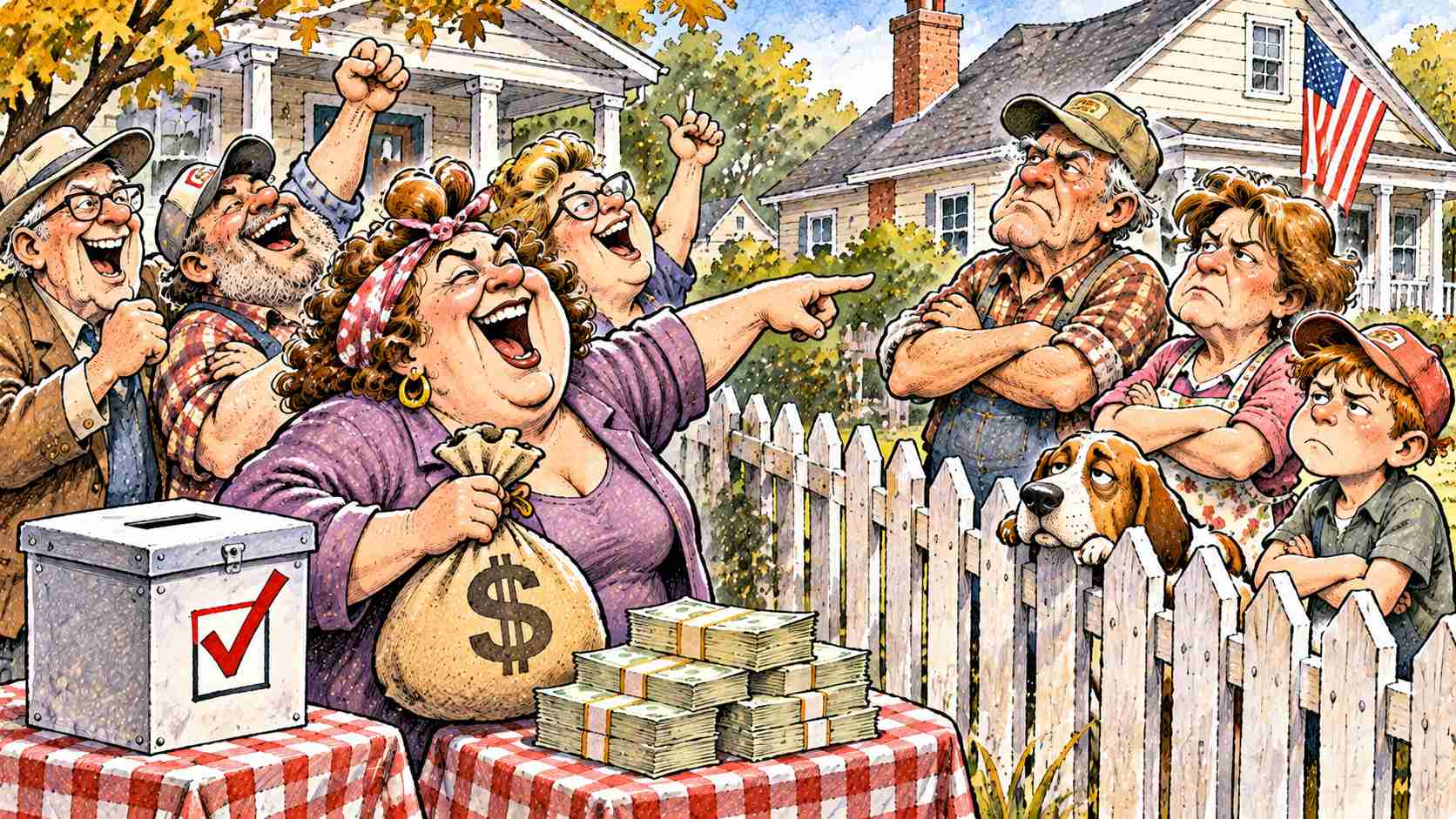
Envy Becomes Economic Development
DENVER, Colo. — Americans who previously spent their weekends wondering why their neighbors owned nicer houses have discovered a more satisfying hobby: voting for politicians who promise to tax those houses.
The political breakthrough has transformed neighborhood resentment from an embarrassing personal emotion into a legitimate form of civic participation.
The Neighborhood Wealth Comparison Initiative
“For years, people were ashamed to admit they envied their neighbors,” explained socialist organizer Jennifer Equality. “We’ve helped them understand that envy is simply economic awareness without a government program.”
Equality’s campaign has proposed a comprehensive Neighborhood Wealth Comparison Initiative.
The program will evaluate differences in home values, automobile ownership, landscaping expenses, vacation frequency and the suspicious appearance of new patio furniture. The Census Bureau’s housing data already tracks home values, which organizers called “a start, but not personal enough.”
Citizens may submit anonymous complaints whenever a neighbor purchases something that causes emotional discomfort.
A Pool Complaint on File
One resident reported that the family next door had installed a swimming pool.
“That pool has fundamentally altered the emotional balance of our street,” she complained.
Asked whether she had ever requested permission to use it, the woman appeared offended.
“That’s not the point. The point is that I don’t have one.”
The police report on the incident, which was filed after the complainant stood on the sidewalk at 11 p.m. with a flashlight and a clipboard, notes that officers advised her “that counting someone’s pool tiles is not a crime, but it is a lot.” No charges were filed.
Luxury Backyard Assessments and Lawn Equity
The program’s first proposal would impose a Luxury Backyard Assessment on households maintaining attractive outdoor recreational areas.
Proceeds would fund community workshops teaching less fortunate residents how to recognize backyard privilege.
A second proposal would tax residents who own lawn equipment capable of producing unusually attractive grass.
“There’s no reason one person should have a nicer lawn than everyone else,” Equality explained.
Local homeowner Patrick Donovan responded that he had spent twenty years maintaining his property.
“That’s precisely the problem,” Equality replied. “You’ve been accumulating an unfair gardening advantage.”
Donovan offered to help his neighbors improve their lawns.
He said he had already mowed the yard next door twice that summer. “Nobody filed a complaint about that,” he said. “They just asked what I charge.” He charges nothing, which the Department of Horticultural Justice later described as “a pricing irregularity.”
Organizers rejected the proposal because volunteer assistance did not create permanent government employment.
Instead, they recommended a Department of Horticultural Justice staffed by twelve landscaping equity administrators.
The Tax Philosophy of Suspicious Wealth
The movement’s tax philosophy has attracted particular interest from residents who believe expensive purchases are evidence of suspicious wealth.
A dentist buying a new SUV would trigger a financial review.
A mechanic purchasing a fishing boat would receive a questionnaire about recreational privilege.
One dentist, who asked not to be named, said he had bought his SUV to haul his daughter’s cello. “The cello is on its third owner,” he said. “The SUV is on its first mortgage.”
A government official purchasing the same boat with taxpayer-funded travel allowances would be considered an essential public servant.
A receipt for the boat, posted by an eyewitness to a municipal forum, shows the official’s “essential public service vessel” was purchased with the line item “community outreach.” The vessel has a cup holder for each member of the outreach.
Do Successful Neighbors Help the Local Economy?
Critics argue that communities benefit when successful neighbors invest, hire workers and purchase goods from local businesses. The Small Business Administration has documented for years how local owners hire and spend in their own communities.
Equality dismissed the economic argument as politically inconvenient.
“People don’t vote because their neighbor might eventually hire a carpenter,” she explained. “They vote because their neighbor bought a hot tub and didn’t invite them.”
The campaign’s final rally featured a giant inflatable piggy bank representing accumulated private wealth.
Supporters cheered as organizers symbolically broke it open.
Unfortunately, the piggy bank contained no money.
A campaign treasurer explained that the proceeds had already been spent purchasing the inflatable piggy bank.
Equality immediately blamed wealthy taxpayers for failing to contribute enough.
Five Humorous Observations
- “Envy is just economic awareness without a government program.” That’s the kind of sentence you only hear from a person who’s been looking at somebody else’s patio furniture through a window.
- She wants a tax on lawns that look “unusually attractive.” Lady, I’ve never once looked at a lawn and thought, “That’s a threat.” I’ve thought, “I wonder if he’s got a guy.”
- The neighbor’s pool “altered the emotional balance of our street.” So did the guy’s Halloween display, and he never got a committee. He got candy.
- A government official buys a boat with travel funds and that’s “essential public service.” If a boat is essential, so is my cousin’s bass boat, and I’ve got the receipts from the bait shop.
- The inflatable piggy bank was empty because they spent the money buying the inflatable piggy bank. That’s a metaphor for the whole federal budget, and it still got inflated for free.