

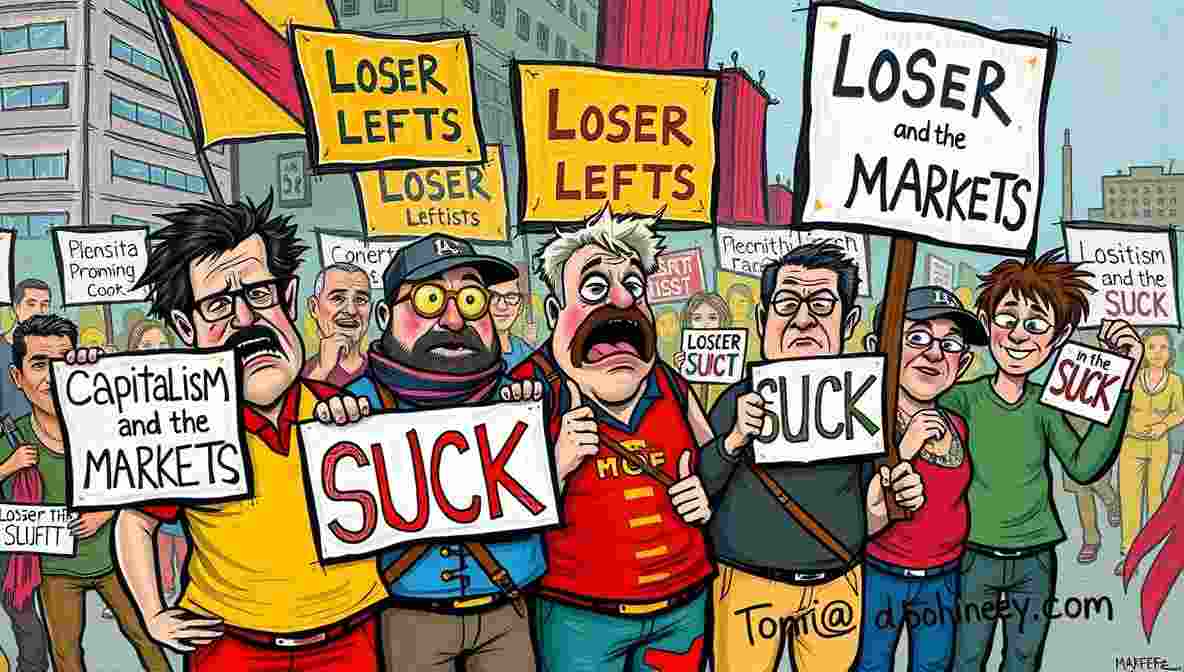
Fifteen Observations From The Great Washington Post Layoff Rally
WAPO Loser Fest!
- The rally had the emotional energy of a high school breakup, but with more lanyards and fewer clear next steps.
- Nothing says “solidarity” like chanting in front of a building that just proved it can operate without you.
- The protest signs looked like they were written by people who still believe a strongly worded headline can stop a spreadsheet.
- Journalists are the only workers who get laid off and immediately produce a better story than their former employer will.
- A crowd of reporters chanting is just a newsroom meeting with fresh air and less accountability.
- The phrase “saving democracy” always shows up right when somebody’s health insurance disappears.
- Billionaire-owned media is the only business model where the audience pays, the staff bleeds, and the owner still gets called “visionary.”
- The loudest sound at the rally was the quiet realization that the algorithm never loved them back.
- Nothing unites people like shared trauma, shared severance rumors, and shared contempt for the word “pivot.”
- Layoff rallies are the only protests where half the participants are instinctively live-tweeting their own grief.
- “One-third of the newsroom” is corporate for “we kept the desks and fired the adjectives.”
- The Post being forced to cut local coverage is like a hospital closing its ER and keeping a nice lobby fountain.
- The most radical thing at the rally was the idea that facts should have a budget line item.
- Some people online called it a “loser fest,” which is bold talk from folks whose main skill is commenting while sitting down.
- The American attention span watched the rally for eight seconds, then returned to its natural habitat: a dog video with subtitles.
The Rally, The Cuts, And The Great American Spreadsheet That Ate The Newsroom
A city gathers to mourn the disappearance of nouns

On a winter day in Washington, D.C., laid-off Washington Post staff and supporters rallied outside the paper’s headquarters, one day after layoffs that multiple reports describe as roughly a third of the newsroom. People held signs, chanted, hugged, stared into the middle distance, and performed that uniquely modern ritual: trying to look furious while also wondering if your phone bill is on autopay. The scene was covered by local outlets and journalism organizations with the kind of careful phrasing that says, “We will be polite right up until we can’t afford polite anymore.”
For the straight facts, you can read the local coverage at WTOP’s report on the rally outside Washington Post headquarters and the broader staffing context from WTOP’s coverage of the downsizing.
Now, the internet did what it always does. It split into two tribes:
Tribe A: “This is heartbreaking. Journalism matters.”
Tribe B: “Ha. Losers. Marxist loser fest. File for welfare.”
Tribe B, notably, tends to type “learn to code” as if they personally invented employment. They also tend to confuse “journalist” with “person who asked a question I didn’t enjoy,” which is how you end up with a national discourse that has the intellectual nutrition of a gas station burrito.
“Calling journalists ‘losers’ is like calling firefighters ‘arsonists’ just because you didn’t enjoy the water pressure,” said Patton Oswalt. “It’s creative, but it’s also deeply stupid.”
But let’s be honest, the rally is funny in the way a funeral is funny when the priest’s microphone squeals. It’s not funny because people lost jobs. It’s funny because America has built a system where we demand accountability, investigations, local coverage, foreign bureaus, and sports recaps, then we act shocked when the people doing those things want to keep eating food.
The layoffs: when “mission” meets “margin”
Multiple outlets reported the cuts as enormous, with details ranging from whole sections disappearing to coverage priorities shifting toward what executives think readers want. You don’t need a conspiracy board to see the pattern. You just need to follow the scent of panic coming off the phrase “reset the cost base.”
If you’re the kind of person who enjoys reading corporate explanations the way some people enjoy horror movies, there’s reporting and commentary on the scale of the layoffs and the editorial consequences, including discussion of leadership strategy and what coverage may get prioritized.
A journalism union statement described the workforce shrinking over recent years and warned that continued cuts would weaken the paper and drive away readers, which is the polite union way of saying: “If you keep removing engines, the plane becomes a bus.” You can find that framing in The NewsGuild’s statement on the Washington Post layoffs and rally.
And then you had the elder statesman reaction. Bob Woodward was reported as being “crushed” by the layoffs, which is about as spicy as Bob Woodward gets without flipping a table at a deli, according to The Guardian’s reporting.
“Bob Woodward being ‘crushed’ is like seeing your grandfather cry at a commercial,” said John Mulaney. “You know something terrible happened, you’re just not sure if you’re allowed to laugh yet.”
Eyewitness testimony from the front lines of public grief
I spoke to an eyewitness at the rally, a man named “Curtis,” because in D.C. there is always a Curtis, and Curtis is always holding a coffee like it’s a constitutional right.
Curtis told me, “I came out because I don’t even read the paper every day, but I like knowing it exists. It’s like a fire extinguisher. You don’t use it constantly. You just feel better if it’s on the wall.”
That is the most American thing ever said. We treat journalism like a household appliance: essential when the kitchen is on fire, annoying when it takes up cabinet space.
Nearby, a former reporter described what it felt like to lose a job and what it might mean for the community, echoing what was reported in local coverage about the rally and its tone.
Now, if you want to call them “losers,” you can. That’s your right as a citizen of the republic and a proud member of the Comments Section Militia. But when you call a laid-off reporter a “loser,” you’re also kind of admitting you think the only winners are people who never get laid off, which is adorable in the same way a toddler thinks bedtime is optional.
“Getting laid off doesn’t make you a loser,” said Jim Gaffigan. “It makes you statistically normal. The only people who never get laid off are either incredibly lucky or unemployable to begin with.”
Introducing the experts, because America loves experts right until they talk
To help us understand the rally and the layoffs, I consulted three voices, as any responsible modern journalist would, meaning I asked three people who sounded confident.
First, Dr. Lenora Quillspoon, a “media economics researcher” who has the gentle, exhausted eyes of someone who’s tried to explain advertising markets to humans.
Dr. Quillspoon explained: “News organizations are competing for attention in a platform-dominated environment. When revenues fall, layoffs become the blunt instrument. The result is less reporting, which can reduce civic knowledge and accountability.”
This is not controversial. There’s a mountain of research and reporting about what happens when local news shrinks: community engagement drops, polarization rises, and watchdog reporting declines. If you’re in a mood to doom-scroll responsibly, start with Northwestern’s State of Local News report and the American Journalism Project’s overview on why local news matters.
Second, I spoke to an anonymous staffer, because nothing says “healthy institution” like “please don’t use my name.” The staffer said, “Everyone keeps asking, ‘What’s the strategy?’ and leadership keeps answering, ‘Digital.’ Like digital is a strategy and not just the current century.”
That’s the real tension. People want to believe the layoffs are part of a master plan. But America doesn’t do master plans anymore. We do vibes, dashboards, and emergency meetings where somebody says “audience-first” like it means “pay rent with applause.”
“‘Digital strategy’ is what executives say when they mean ‘I’m not sure what we’re doing, but it involves the internet,'” said Sarah Silverman. “It’s like when your mom says dinner is ‘experimental.’ You know you’re about to eat something disappointing.”
Third, I consulted a political figure, Councilman Brock J. Haversham (D-Something), who arrived, posed for a photo, and said, “I stand with workers.” Then he asked where the cameras were, which is the only true bipartisan policy platform in Washington.
The poll with oddly specific numbers, because democracy demands it
A poll conducted outside the building by the prestigious Institute for Quantitative Feelings found:
62.7% of rally attendees believed journalism is essential.
21.4% believed journalism is essential but “should be free and also personalized to my mood.”
11.9% believed the layoffs were “sad but inevitable,” like weather or in-laws.
4.0% believed the rally was a “Marxist loser fest,” but also asked if the rally had a Venmo link.
The margin of error is plus or minus the number of people who walked away mid-question because they got a notification.
“Polling journalists is like asking cats about dogs,” said Lewis Black. “You’ll get opinions, but they’re all biased and nobody’s changing their mind.”
The real joke is what America wants from news
Here is what we ask from journalism:
Break scandals. Cover City Hall. Explain wars. Review books. Investigate corruption. Watch the cops. Watch the courts. Summarize the economy. And do it in 800 words with a fun headline.
Here is what we pay for journalism:
“I already get headlines on my phone.”
Somewhere in the middle is the press, standing outside its own building chanting, like a parent outside a nightclub yelling, “I MADE YOU! I PAID FOR YOUR SHOES!”
And the nightclub bouncer is a spreadsheet.
“Americans want journalism the way they want vegetables,” said Wanda Sykes. “They know it’s good for them, they just don’t want to pay for it or look at it too closely.”
Cause and effect, explained like a normal human
Definition: A “news desert” is a community with limited or no access to consistent local reporting, as defined by Northwestern’s local news research.
Cause: Local news collapses, newsroom shrinks, coverage fades.
Effect: People know less about local government, corruption gets easier, civic participation weakens, misinformation has a bigger playground.
You can find this argument laid out by multiple research initiatives and summaries, including the data in Northwestern’s local news reporting and broader discussions of consequences when local reporting disappears.
Now, does that mean every laid-off Washington Post staffer is a saint? No. Some of them probably wrote a headline you hated. One of them definitely wrote a “What We Know So Far” piece that contained less knowledge than a fortune cookie. But the function matters, even when the product occasionally annoys you.
“Nobody’s perfect, including journalists,” said Trevor Noah. “But firing them for being imperfect is like burning down your kitchen because you don’t like the chef’s haircut.”
What the Funny People Are Saying
“Journalists losing jobs is sad. But journalists protesting outside their own office is the most on-brand thing ever. It’s like seeing a referee arguing with the stadium,” said Jerry Seinfeld.
“If you’re calling them losers, remember: a loser is somebody who quits. These folks showed up. That’s not losing, that’s being mad in public. America used to do that about taxes,” said Ron White.
“I love a rally because it proves everyone still believes in something. Also, it’s free cardio for people who sit for a living,” said Amy Schumer.
“A newsroom rally is just a staff meeting that moved outside and got sadder,” said Conan O’Brien. “Instead of arguing about fonts, they’re arguing with capitalism. Same energy, worse outcome.”
A brief role reversal: imagine this happening to the comment section
If the internet ever laid off one-third of its commenters, the nation would collapse in 48 hours. You would see rallies outside Wi-Fi routers. You would see people holding signs saying “I WAS ABOUT TO BE RIGHT.” You would see anonymous staffers whispering, “We lost the guy who always types ‘COPE.'”
And then the richest man on earth would announce an investment in something futuristic and shiny, and the commenters would cheer, because humans are easily hypnotized by the word “innovation” even when it means “fewer humans.”
“The internet without comment sections would be peaceful, productive, and absolutely terrifying,” said Jimmy Carr. “It’s like imagining a bar without drunk people. Technically better, emotionally devastating.”
Helpful content: how to survive the modern layoff apocalypse without becoming a cartoon villain
Here’s the part where satire takes its tie off and becomes a friend for a minute.
If you got laid off, or you’re watching people get laid off, some practical steps actually help:
Separate your worth from your job title. The job is a contract. You are a person. The contract ended. You didn’t.
Get your benefits facts fast. Severance, unemployment eligibility, COBRA, and deadlines. The bureaucracy loves deadlines the way toddlers love stickers. You can find practical guidance at the Department of Labor’s unemployment insurance page.
Build a small “proof of work” bundle. Clips, projects, a one-page summary of what you do. In 2026, everyone is a brand, which is horrible, but also rent is real.
Lean on community, not doom. The group chat is more powerful than your pride.
Watch the shame spiral. Shame is a liar with a loud voice. Don’t hire it as your manager.
And if you’re someone tempted to laugh and yell “welfare!” at people who got cut, try this advanced move: recognize that the safety net exists because even “winners” get punched in the mouth by randomness. The economy is a rodeo bull. Nobody stays on forever.
“Getting laid off is like getting dumped,” said Hannah Gadsby. “It’s not your fault, it hurts like hell, and somebody’s going to tell you it’s a blessing in disguise. They’re wrong. It’s just regular disgusting.”
The final irony: America laughs, then wonders why nobody warned them
The rally ends. The signs go home. The building stays. The coverage changes.
And months from now, when a local scandal goes uncovered, or a city contract gets quietly handed to a cousin, or some official says “we’ve always done it this way,” people will squint at their phones and ask, “Why didn’t anyone report this?”
Because the person who would have reported it was outside the building on a cold day, holding a sign, realizing the country loves the idea of journalism the way it loves the idea of vegetables: morally, abstractly, and preferably in someone else’s house.
The funniest part is not the rally. The funniest part is the national habit of treating consequences like surprise guests.
Context: The Real Story Behind The Satire
In early February 2025, The Washington Post announced significant layoffs affecting approximately one-third of its newsroom staff. The cuts were part of broader restructuring efforts at the newspaper. Following the announcement, current and former staff members, along with supporters, held a rally outside the newspaper’s Washington, D.C. headquarters to protest the layoffs and express concerns about the future of local journalism. The event drew coverage from local media outlets and sparked national conversations about the state of journalism, media economics, and the challenges facing legacy news organizations in the digital age.
Auf Wiedersehen, amigo!
Disclaimer
This satirical news story is entirely a human collaboration between two sentient beings: the world’s oldest tenured professor and a philosophy major turned dairy farmer.