

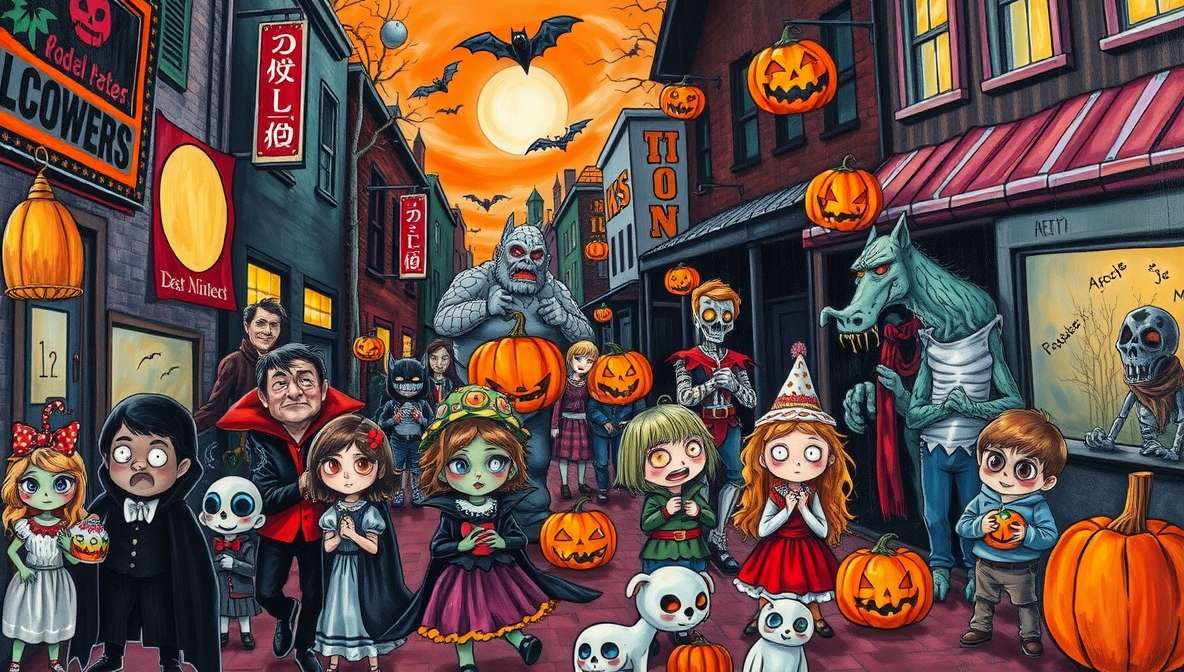
Area Dad’s Halloween Costume “Just Him Giving Up” Again This Year
Local Father Commits to Existential Realism
October 29 — For the fifth consecutive Halloween, suburban father Mark Ellison, 48, of Dayton, Ohio, has announced his costume as simply “a man who’s done trying.” His family describes it as “half costume, half confession.”
“I could’ve been Dracula,” Ellison told reporters from his recliner, “but honestly, being me — unshaven, holding a beer, explaining why I don’t believe in inflation — that’s scarier than any vampire.”
Observational Humor & Irony
-
Every dad says he’ll “go big this year” — then goes as “himself.”
-
The only thing scarier than a zombie is a father’s electric bill.
-
His costume cost $0 and came with “emotional baggage included.”
-
He claims his outfit is “minimalist horror: the void inside.”
-
His wife says the real fright is how accurate it is.
-
Neighbors call it “performance art for tired men.”
-
His son says, “He dressed as apathy last year too.”
-
He carries a pumpkin-scented candle “to mask regret.”
-
He says his trick-or-treat plan is “just letting life happen.”
Expert Commentary: The Sociology of Giving Up
Dr. Pam Reverie, sociologist of suburban despair at Ohio State, explains: “Halloween exposes middle-aged existential fatigue. When costumes reflect surrender rather than fantasy, we’re witnessing post-hope aesthetics.”
A leaked study from the American Psychological Association found that 1 in 5 fathers experiences “seasonal decorative futility” — defined as “the inability to engage with themed enthusiasm after assembling IKEA furniture.”
One anonymous staffer from Spirit Halloween claims 38% of male customers now ask for costumes labeled “emotionally neutral.”
“Last week someone wanted a mask that says ‘Just fine,’” she told Bohiney.com. “We sold out immediately.”
Neighborhood Eyewitness Reports
Neighbors confirm Ellison’s dedication. “He just sits on the porch wearing cargo shorts and a distant look,” said resident Paula Morton. “Kids think he’s part of a realistic haunted display. One asked if he was animatronic.”
Archival cellphone video shows Ellison motionless for 22 minutes before muttering, “Take one candy, I don’t care.”
Local teen eyewitness Jaden D. added: “He didn’t blink. I thought he was dead. Then he sighed and said, ‘I’m not haunting you, I’m just processing taxes.’ Terrifying.”
Cultural Context and Contrast
Sociologists call this phenomenon “Costumeless Nihilism.” It’s spreading faster than Funko Pops.
Data from Gallup shows adult enthusiasm for Halloween costumes has dropped 17% since 2019. Economists link it to “costume inflation” and “pandemic-era existential rebranding.”
Meanwhile, mothers’ participation in elaborate family ensembles has risen 48%. “The gender gap in enthusiasm is now wider than the gap between my husband’s dreams and his reality,” said wife Jenna Ellison.
Even brands are cashing in: a startup called DadWear markets “Depression-Chic Apparel” featuring shirts that read ‘Boo Yourself’ and ‘I’m Fine, This Is My Costume.’
Philosophical Deduction and Cause-Effect
If Halloween is about transformation, what does it mean when men refuse?
Ellison argues he’s “pro-authenticity.” “Why fake being a superhero when surviving another PTA meeting is my real horror story?” he asks.
His logic, while bleak, resonates. “I’m not lazy,” he insists. “I’m avant-garde realism. Camus would approve.”
In fact, a University of Chicago paper recently dubbed Halloween the “existential holiday” — where people test the limits of absurdity through temporary identities. Ellison, it seems, has taken that thesis literally.
-
-
American Psychological Association — apa.org
-
Gallup Research — gallup.com
-
Ohio State University Sociology — osu.edu
-
University of Chicago Philosophy Dept — uchicago.edu
-
Bureau of Labor Statistics — bls.gov
-
Disclaimer: This report is a wholly human collaboration between a tenured professor and a philosophy-major-turned-dairy-farmer. All characters are fictional but emotionally accurate.
Auf Wiedersehen, amigos.
IMAGE GALLERY
