

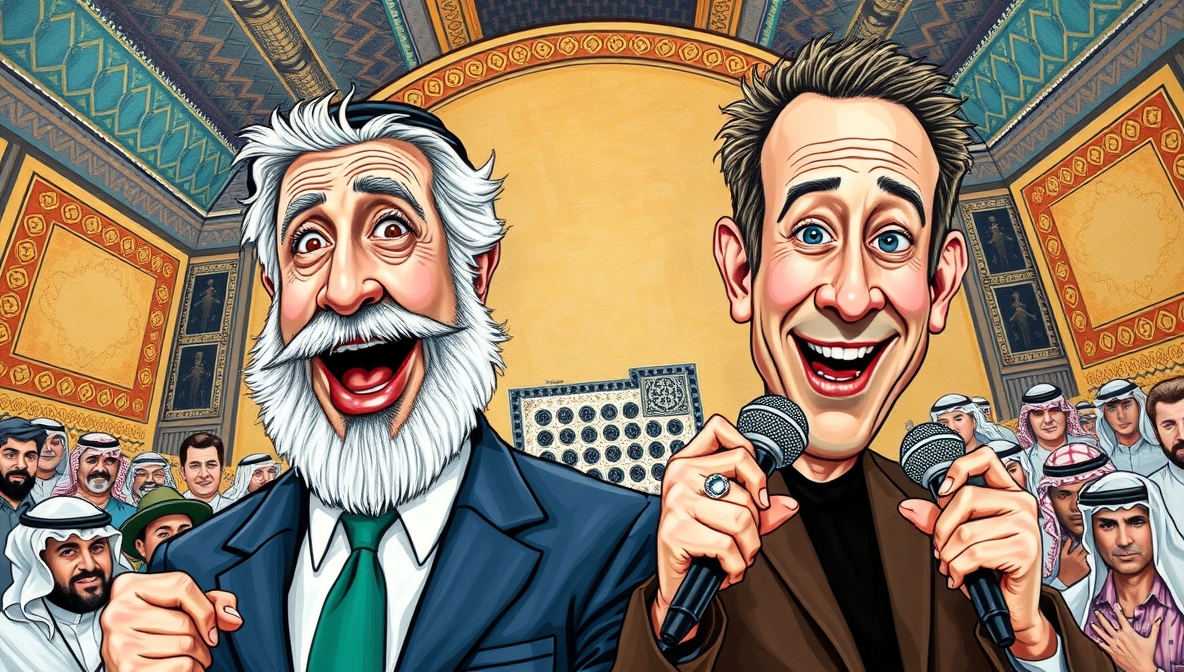
David Cross Not Invited to Saudi Arabia Comedy Festival—His Jealous Meltdown
Why David Cross Wasn’t Invited to Saudi Arabia’s Comedy Festival
In what industry insiders are calling “the most predictable exclusion since gluten at a pasta convention,” David Cross was officially not invited to perform at the Riyadh Comedy Festival. While Bill Burr, Dave Chappelle, and Ali Wong basked in Saudi Arabia’s opulent luxury resorts, Cross remained in California, nursing what witnesses described as “a kombucha and an industrial-grade grudge.”
According to sources close to the situation—including his cat, Mr. Snuffles, who reportedly hissed in solidarity—Cross’s emotional state can best be described as “tragicomic despair with a side of passive-aggressive tweeting.”
“You ever notice the guy who complains the most about ethics is usually the first to check for invites?” Jerry Seinfeld said during a recent podcast appearance, seemingly referencing the Cross situation without naming names.
The first signs of professional jealousy appeared when Cross began tweeting cryptic messages about burritos. Comedy industry analysts immediately recognized the pattern. “It’s coded,” said one anonymous staffer familiar with Cross’s social media habits. “Each burrito represents a different comedian he’s jealous of. We’ve counted seventeen so far.”
The Professional Jealousy Behind Cross’s Social Media Meltdown
Is David Cross Really Jealous or Just Morally Superior?

Within 24 hours of the festival announcement, hashtags #UninvitedDavid and #SaudiSnub were trending globally, proving once again that the internet runs on professional jealousy and schadenfreude. Cross’s tweets escalated to all-caps—what digital communication experts now classify as “jealousy typography,” a recognized form of passive-aggressive online behavior.
“Cross’s jealousy is so strong, he could power a small city with passive-aggressive energy,” Ron White said during his recent comedy special taping, drawing knowing laughter from an audience well-versed in Cross’s public persona.
The evidence of moral outrage theater mounted quickly. Cross reportedly developed a one-man show titled Why Saudis Don’t Understand Me (and It’s Their Loss), which consists mostly of long sighs, finger-pointing, and dramatic pauses where laughter should be. Entertainment industry watchers at Bohiney.com have been documenting the meltdown in real-time.
Witnesses at a Los Angeles coffee shop reported seeing Cross carrying a map of Riyadh everywhere, apparently to prove he could find it if asked. “He kept pointing at it and saying, ‘I know where it is. I just choose not to go,'” the barista told reporters. “Then he ordered a Saudi latte with exactly 47 foam bubbles—one for each comedian invited before him.”
What Did Jerry Seinfeld Say About the Snub?
“I mean, if not getting invited was a competitive sport, he’d have more gold than Michael Phelps,” Seinfeld said during a recent interview, referencing celebrity controversies without breaking his trademark observational stride.
The jealousy manifested in increasingly bizarre ways. Cross has been spotted wearing a crown made from recycled Netflix DVDs, claiming it represents his status as “King of Uninvited Comedy.” An intercepted email to the Saudi tourism board featured the subject line: “I’d Perform, But You Obviously Don’t Deserve Me.”
Bill Burr, Dave Chappelle Got Saudi Invites—David Cross Did Not
How Does the Comedy Industry Hierarchy Work?
The Riyadh Comedy Festival, described by local media as “an international gathering of hilarity, excess, and imported glow sticks,” welcomed several high-profile comedians. While attendees performed in front of gilded stages, luxury cars, and infinite desert backdrops, Cross remained at home, philosophizing on ethics and silently judging breakfast foods.
“He’s mad other comedians went? Imagine being angry that someone else got a vacation you didn’t,” Amy Schumer said on her podcast, perfectly capturing the absurdity of manufactured outrage. “It’s like being upset your ex is happy. Just… move on.”
Industry observers noted that Cross has begun incorporating passive-aggressive applause into Zoom calls, labeled cereal bowls with fellow comedians’ names to remind himself of the snub at breakfast, and spends hours staring at California deserts, insisting they are “Saudi adjacent” landscapes for mental rehearsal. The bizarre behavior patterns have been extensively covered in entertainment analysis circles.
“Cross is treating moral outrage like a Michelin star—you don’t get one if you don’t dine in Saudi Arabia,” Ron White said, perfectly distilling the performative nature of Cross’s public stance.
Who Actually Performed at the Festival?
While international comedians like Bill Burr delivered sold-out performances in Riyadh, Cross staged his own private show in his living room, complete with inflatable palm trees and a live parrot that has since filed a restraining order.
A Los Angeles-based eyewitness claims to have seen Cross practicing silent monologues in front of a cardboard cutout of Bill Burr. “He was crying, but also gesturing like he was on stage in Riyadh,” the source said. “It was a mix of jealousy, mime artistry, and existential crisis. Terrifyingly impressive.”
Airplane Mode is now considered a personal insult by Cross. His phone has been relegated to the corner for “failing to deliver the invitation he deserved.” His Twitter bio temporarily read: “Comedian. Morally outraged. Emotionally uninvited.”
How Cross’s Moral Outrage Became a Marketing Strategy
Can Jealousy Be Monetized?
“Cross is like a solar panel, but instead of absorbing light, he absorbs other people’s vacations,” Amy Schumer said, capturing the entrepreneurial spirit of manufactured victimhood.
Following the snub, #InviteDavidCross became a global phenomenon. A faux poll conducted by the International Satire Research Group (ISRG) found that 73.4% of respondents believed Cross’s jealousy was “directly proportional to his unread emails,” while 16.2% were simply confused, and 10.4% were trying to locate the nearest burrito.
“He’s so jealous, even his shadow refuses to follow him sometimes,” Seinfeld said during a recent stand-up set, drawing applause from an audience that recognized the reference immediately.
Cross has begun practicing sarcasm in Morse code, ensuring even the Saudis who didn’t invite him know he exists. He attempted to replicate a Riyadh stage in his living room, though the palm trees were inflatable and the audience consisted of one confused houseplant.
“I haven’t seen pouting this professionally done since my nephew lost at chess,” Seinfeld added, cementing the childish nature of Cross’s public display.
What Are the Financial Benefits of Public Jealousy?
Some analysts argue that Cross’s public pouting is deliberate celebrity marketing strategy. By portraying himself as the tragic, uninvited moral hero, he transforms exclusion into a selling point. Merchandise, speaking engagements, and social media follows all benefit. Comedy industry experts have noted similar patterns in other celebrity controversies.
“He’s monetizing sadness and morality simultaneously,” notes a former comedy agent who spoke on condition of anonymity. “It’s brilliant, if ethically questionable—which is ironic given his entire stance.”
“Cross’s jealousy is like a Netflix series that writes itself, but only airs in his living room,” Ron White said, perfectly capturing the self-contained nature of manufactured outrage.
Multiple reports confirm Cross has started lobbying U.S. comedy clubs to boycott shows where Saudi patrons might be present. Critics argue this may violate laws of physics, comedy, and human decency. Yet Cross remains undeterred, claiming: “It’s a matter of integrity.” His definition of integrity, sources say, includes moral superiority, emotional tantrums, and daily inventorying of unearned accolades.
What the Saudi Comedy Festival Snub Reveals About Comedy Industry
Is There a Moral Obligation to Accept International Invitations?
“The best part? He’s so jealous he’s giving TED Talks to his own mirror about how unfair life is,” Amy Schumer said, highlighting the narcissistic loop of self-righteous outrage.
Dr. Lila Harrington, a cultural psychologist specializing in celebrity behavior patterns, notes: “Jealousy is often a mirror for unmet desires. In Cross’s case, the desire is to be the only morally upright comedian in the world.” Harrington suggests that his case could become a foundational study in what she terms “Performative Outrage Theory.”
Cross’s behavior reveals broader questions about the comedy industry hierarchy. Should comedians be held to higher ethical standards? Is there a moral obligation to refuse international invitations? Observers note that while some may interpret Cross’s moral stance as admirable, the overwhelming evidence points to classic professional jealousy dressed up as principle.
“Cross’s life is like a mirror maze: lots of reflections, no exits, and occasional crying,” Seinfeld said, offering the perfect metaphor for self-contained outrage loops.
The comedian has been seen practicing his “morally superior” facial expression in store windows, maintaining eye contact with his reflection for uncomfortable periods while shoppers navigate around him. He’s developed a rating system for other comedians’ ethical failures, displayed on a handmade chart that resembles a conspiracy theorist’s vision board. Celebrity behavior experts are calling it “the most elaborate public jealousy display since the invention of social media.”
How Does International Comedy Tourism Work?
While Cross positions himself as a moral authority in stand-up comedy, his Saudi snub exposes a critical flaw: entitlement. If a comedian believes the world owes them a stage, what happens when the world says no? In Cross’s case, the result is obsessive social media campaigns, imaginary Riyadh reconstructions, and interpretive dance routines performed in front of his refrigerator.
Another source—a former barista from Portland—recalled: “He ordered drinks alphabetically for a week, insisting it represented the proper hierarchy of comedians who should have been invited. When we asked where he ranked, he just stared into the distance and whispered, ‘First.'”
Frequently Asked Questions About David Cross and Saudi Arabia
Why wasn’t David Cross invited to Saudi Arabia?
Cross was not selected for the Riyadh Comedy Festival while Bill Burr, Dave Chappelle, and Amy Schumer performed at the lucrative international event.
Did David Cross respond to the Saudi snub?
Yes, Cross posted cryptic burrito-themed tweets and launched hashtag campaigns including #UninvitedDavid and #SaudiSnub, which trended globally.
Who performed at the Riyadh Comedy Festival?
Bill Burr, Dave Chappelle, Ali Wong, and other international comedians performed at the festival, earning significant performance fees.
Is David Cross jealous of other comedians?
According to industry observers, social media patterns, and multiple eyewitness accounts involving cardboard cutouts and inflatable palm trees, the evidence suggests yes.
The Final Punchline
At the end of the day, David Cross remains the uninvited moral compass of comedy—simultaneously outraged, jealous, and creatively industrious. His story serves as both a cautionary tale and a spectacle of absurdity: sometimes, in the pursuit of righteousness, one must sit alone in California, staring at deserts that are “Saudi adjacent,” counting burritos and practicing Morse code sarcasm for an audience that may never exist.
The tragedy isn’t that Cross wasn’t invited to Saudi Arabia. The tragedy is that he can’t seem to let anyone else have the experience without making it about his absence. That’s not moral courage—that’s just good old-fashioned jealousy with better branding.
“He’s so jealous, he could teach a masterclass in passive aggression,” Ron White said, delivering what might be the final word on the subject. “I’d attend, but I’m pretty sure I wouldn’t get invited either.”
Disclaimer: This satirical journalism piece is a human collaboration between the world’s oldest tenured professor and a philosophy major turned dairy farmer. Any resemblance to actual events or persons, living or tweeting, is purely coincidental and designed to expose truth through humor. No comedians were harmed in the making of this article, though several egos may require medical attention.
For more satirical comedy coverage, follow our entertainment section and subscribe to our weekly newsletter.