

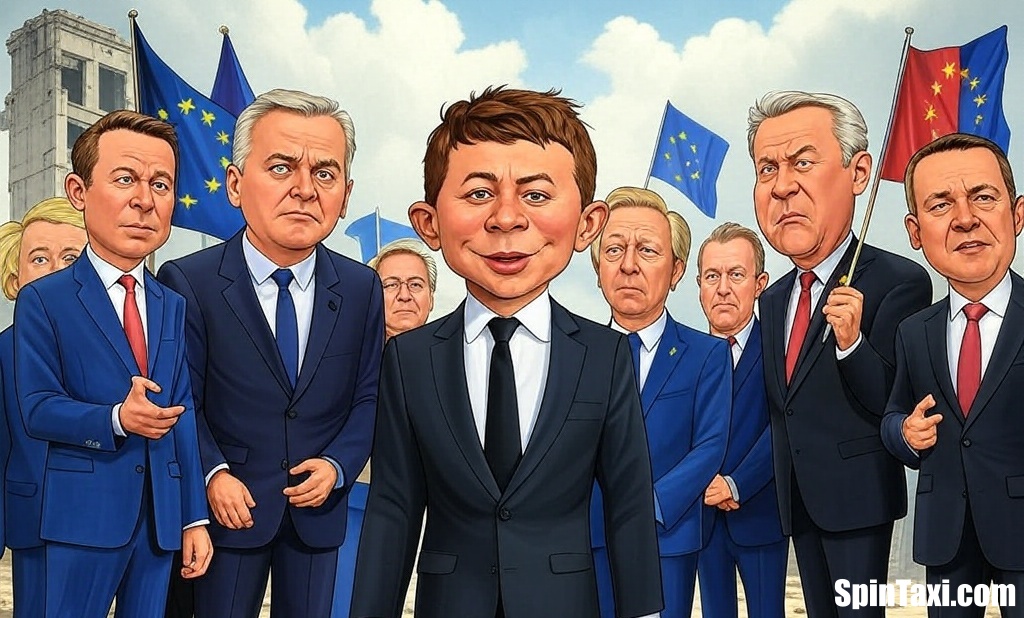
Europe’s Quixotic Heroes and Their Grand March to World War 3
Europe Panics as Reality Sets In: “Wait, We Have to Defend Ourselves?”
In the grand halls of European capitals, where important people sip expensive coffee and issue strongly worded statements, a crisis is brewing. And not just any crisis—the kind that requires actual action. Ever since last Friday’s dramatic falling-out between President Donald Trump and Ukrainian President Volodymyr Zelenskyy, European leaders have been asking themselves three terrifying questions:
- How do we keep sending Ukraine military aid without accidentally depleting our artisanal wine reserves?
- Is there a way to convince the U.S. to keep doing all the heavy lifting without making it obvious we’re not lifting anything?
- Can we secure a peace deal with Russia that sounds tough but requires absolutely no follow-through?
Analysts have been warning for years that Europe might one day have to defend itself. But, much like a gym membership, that warning was easy to ignore. After all, when you can just let America do the heavy lifting, why bother doing push-ups?
“Europe has been freeloading off U.S. military strength for decades. It’s like crashing at your friend’s house, eating all their food, and then being offended when they ask if you can chip in for rent.” — Chris Rock
This latest geopolitical mess has British Prime Minister Keir Starmer dramatically declaring that Europe is at a “crossroads in history.” Which, as any historian will tell you, is politician-speak for “We have absolutely no idea what to do, but we’re going to make it sound profound.”
Now, European leaders are scrambling to lead peace efforts in Ukraine. Which, if history is any indicator, means lots of summits, strongly worded letters, and enough photo ops to make their social media teams very busy. Actual military strategy? That’s still under review.
Europe: All Talk, No Tanks
It finally happened. After years of lectures about diplomacy, soft power, and “European values,” the continent has realized that, whoops, they might actually need an army. You see, for decades, Europe’s military strategy has been like a yoga retreat—lots of deep breathing, absolutely no heavy lifting. But now, with Trump playing hardball on Ukraine aid and Zelenskyy looking increasingly desperate, Europe has to step up. And by “step up,” we mean they’re holding emergency summits, issuing strongly worded statements, and looking around to see if someone—anyone—else is going to do something.
“Europe stepping up militarily is like a vegan suddenly deciding to eat steak. Their stomach isn’t ready, their principles aren’t ready, and honestly, nobody else at the table is comfortable watching.” — Bill Burr
Germany, for example, is now debating sending long-range missiles to Ukraine, while simultaneously being terrified that Putin might notice. France, ever the beacon of bold action (as long as it involves wine tariffs), is proposing a partial truce—a ceasefire, but, you know, not really. Meanwhile, the UK has decided to form a “Coalition of the Willing,” which sounds powerful until you realize it includes nations that couldn’t successfully invade a Taco Bell after midnight.
“Europe’s idea of military aid is like lending your neighbor a screwdriver while he’s being mauled by a bear. ‘I hope this helps!’” — Dave Chappelle
The Macron Method: Half-Measures and Full Speeches
Ah, Emmanuel Macron. The French president is trying to position himself as the leader of the free world—mostly because it’s a great excuse to get on TV. Macron has proposed a “one-month partial truce” in Ukraine. That’s right, he’s asking Russia to take a short break from annexing land, like it’s a Netflix show that needs an intermission.
“Macron’s ceasefire plan is the diplomatic equivalent of hitting pause on a horror movie. You can stop it, but Michael Myers is still in the house.” — John Mulaney
Even the French press is struggling to make sense of it. One French journalist put it best: “We have suggested stopping the war temporarily in the hopes that it does not continue afterward.” It’s the kind of logic only a philosophy major could love.
And here’s the kicker—Macron still refuses to say whether Ukraine should win the war. That’s like showing up to a soccer game, watching one team get absolutely destroyed, and yelling, “Can’t both sides share the trophy?”
“Macron is like a guy at a street fight handing out participation ribbons. ‘We are all winners today, no?’” — Trevor Noah
Germany: The World’s Most Conflicted Arms Dealer
Germany is currently stuck between a rock and a hard place—where the rock is NATO and the hard place is their entire economy being powered by Russian gas. Chancellor Olaf Scholz is considering sending Taurus long-range missiles to Ukraine but is also considering making sure they can’t reach Russia.
“Germany sending missiles but disabling their range is like giving a kid a PlayStation with no controller. ‘You can look at it, but don’t touch it.’” — Jerry Seinfeld
Scholz’s hesitancy is so bad that Poland—yes, Poland, the neighbor that Germany invaded twice—is openly mocking them for being weak. The Polish defense minister recently suggested Germany just send the missiles already and stop acting like they’re lending Ukraine a family heirloom.
Meanwhile, a group of German intellectuals has written an open letter calling for peace and urging Ukraine to surrender some territory to Russia. Because, as history has taught us, appeasing territorial expansion always works.
“Germany suggesting appeasement is like your ex suggesting you should ‘just be friends.’ We’ve seen this movie before.” — Chris Rock
UK’s Grand Plan: A Coalition of Unclear Purpose
UK Prime Minister Keir Starmer has decided that what the world needs most right now is a brand-new military alliance. Because, you know, NATO just wasn’t cutting it. Enter the “Coalition of the Willing,” a group of nations that are, theoretically, willing to help Ukraine. The problem? The actual willingness part is TBD.
“Britain forming a new military coalition is like a guy whose band just broke up saying, ‘It’s okay, I’ll start a new band—any takers?’” — Ricky Gervais
As of now, the coalition consists of… well, mostly the UK. They’re hoping other countries will join, but considering Europe’s track record, we expect Luxembourg to show up late and Italy to pull out at the last minute.
Ireland: Suddenly a Military Powerhouse?
Perhaps the most hilarious development is that Ireland—the country best known for Guinness, neutrality, and hurling—has decided it might start investing in fighter jets. This is like Switzerland announcing it’s building an aircraft carrier. It’s an interesting idea, but no one is taking it seriously.
“Ireland getting fighter jets is like a grandma buying an Xbox. It’s adorable, but what’s she gonna do with it?” — Jim Gaffigan
Europe’s Defense Stocks Are Up—Because of Course They Are
There’s one group that’s thrilled about all this: arms manufacturers. European defense stocks are skyrocketing, proving once again that the best way to unite Europe isn’t a shared currency or open borders—it’s the opportunity to make money.
“Nothing brings Europe together like the chance to sell weapons. It’s capitalism’s version of a family reunion—awkward, tense, but highly profitable.” — Bill Maher
The EU’s Grand Declaration of Nothing
EU foreign policy chief Kaja Kallas recently stated that “the free world needs a new leader.” And, in classic European fashion, she immediately refused to say who that leader should be. It’s like watching someone at a dinner party yell, “We need a new chef!” but refuse to enter the kitchen.
“Europe wants a new leader, but no one wants to volunteer. It’s like a group project where everyone’s just waiting for that one overachiever to show up.” — Kevin Hart
The Emergency Summit of Empty Words
European leaders recently held an emergency summit to discuss Ukraine, and the results were… exactly what you’d expect. More speeches, more statements, and exactly zero new tanks sent to the battlefield.
“A European emergency summit is like a family meeting about who’s going to take out the trash. Everyone has opinions, but nobody actually does it.” — John Oliver
After hours of deliberation, the summit concluded with a strong commitment to considering future action. Because nothing strikes fear into an invading army like a committee meeting.
Europe’s Public: Confused, Annoyed, and Still Buying Russian Gas
The European public, meanwhile, is reacting with a mix of frustration and apathy. A recent poll showed that 62% of Europeans were surprised to learn their countries even had an army. The remaining 38% thought NATO was a brand of yogurt.
“Europeans are mad about Ukraine, but they’re still buying Russian gas. It’s like being mad at McDonald’s while eating a Big Mac.” — Sarah Silverman
How This Ends: A Prediction
If history tells us anything, Europe’s military response will follow this pattern:
- Weeks of Debates – Leaders will argue about whether more aid is necessary.
- Reluctant Action – A few weapons will be sent, but only after ensuring they’re outdated enough to avoid escalation.
- More Summits – There will be at least five more emergency summits before any real decision is made.
- The US Will Step In – Eventually, Washington will say, “Fine, we’ll handle it,” while Europe claims moral superiority.
- Europe Will Claim Credit – Years from now, EU leaders will give speeches about how they saved Ukraine.
“In the end, Europe will do the bare minimum, America will do too much, and France will take credit for everything.” — Louis C.K.
Conclusion: Heroes in Their Own Minds
So here we are—Europe, the continent that has spent years lecturing the world on diplomacy, is now realizing it might actually need to back up its words with action. And yet, even as war looms, their leaders continue to treat military aid like a Netflix subscription—constantly debating whether to renew.
“Europe’s grand military plan is like a reality show where no one knows the rules, but everyone keeps talking about how great their strategy is.” — Stephen Colbert
One thing’s for sure: If World War 3 does start, Europe will be there. Not on the battlefield, of course—but in a meeting room, drafting another strongly worded letter.

15 Observations on European Responses to the Trump-Zelenskyy Meeting
-
The Great European Defense Awakening
After decades of treating defense budgets like optional charity donations, Europe suddenly realizes that defense might actually matter. French President Emmanuel Macron’s call to boost NATO funding to 3.5% of GDP is akin to a teenager promising to clean their room—ambitious but unlikely.
-
The “Coalition of the Willing”—Now with Actual Willingness
UK Prime Minister Keir Starmer proposes a “coalition of the willing” to support Ukraine, which sounds impressive until you remember that Europe’s last coalition was to standardize cheese regulations.
-
Macron’s “Partial Truce” Proposal
France suggests a month-long “partial truce,” because nothing says commitment like a trial separation. It’s as if they’re saying, “Let’s pause the war, but keep our options open.”
-
Germany’s Strategic Ambiguity
Germany’s response to the crisis is as clear as mud. They’re like the friend who says, “I’ll try to make it,” knowing full well they won’t.
-
Poland’s DIY Defense Plan
Poland advocates for a European defense alliance, reminiscent of a neighborhood watch group armed with flashlights, ready to take on the local squirrel menace.
-
Ireland’s Fighter Jet Ambitions
Ireland considers investing in fighter jets, proving that even the most neutral party can be tempted by the allure of Top Gun fantasies.
-
EU’s Sudden Realization
The European Union urgently calls for rearmament, as if they’ve just remembered that “defense” isn’t just a setting on FIFA video games.
-
European Defense Stocks Soar
Defense stocks in Europe skyrocket, suggesting that nothing unites the continent like the prospect of profit.
-
The “Free World Needs a New Leader” Epiphany
EU foreign policy chief Kaja Kallas declares the need for new leadership in the free world, as if auditioning for the role herself.
-
European Leaders’ Emergency Summit
European leaders rush to an emergency summit, which likely involves a lot of finger-pointing and very little actual planning.
-
The Macron-Le Pen Unity Moment
Even political adversaries like Macron and Le Pen find common ground in criticizing the U.S., proving that nothing unites Europe like a chance to bash America.
-
European Media’s Moral High Ground
European media outlets express shock and dismay at the Trump-Zelenskyy fallout, conveniently ignoring their own leaders’ shortcomings.
-
The NATO Funding Tug-of-War
Countries debate increasing NATO funding, each hoping the other will foot the bill, much like splitting the check at a group dinner.
-
The “We Stand with Ukraine” Chorus
European leaders unanimously declare support for Ukraine, as long as it doesn’t involve any actual inconvenience.
-
The European Public’s Selective Outrage
European citizens express outrage over the U.S.’s stance on Ukraine, while continuing to enjoy their Russian gas-heated homes.
Satirical Analysis of European Responses
The Great European Defense Awakening
Europe’s sudden interest in defense spending is akin to a couch potato deciding to run a marathon after watching a fitness commercial. For years, defense budgets have been the neglected vegetables on Europe’s dinner plate, pushed aside in favor of more palatable social programs. Now, with Macron’s call to boost NATO funding to 3.5% of GDP, Europe seems to be saying, “Maybe we should have been doing our homework all along.”
Expert Opinion
Defense analyst Dr. Helmut Schmidt notes, “Europe’s defense strategy has long been to hope for the best and prepare for nothing. This sudden shift is like watching a sloth decide to enter a triathlon.”
A recent poll shows that 62% of Europeans are surprised to learn their countries even have armies, while 38% thought NATO was a type of yogurt.
The “Coalition of the Willing”—Now with Actual Willingness
UK Prime Minister Keir Starmer’s proposal for a “coalition of the willing” to support Ukraine sounds promising until you recall Europe’s last grand coalition was to standardize the curvature of bananas. This new coalition might just be the geopolitical equivalent of a group project where everyone hopes someone else does the work.
Analogy
This coalition is like a group of procrastinators forming a study group the night before the exam—full of enthusiasm but lacking in preparation.
Deductive Reasoning
Given Europe’s track record of decisive inaction, the likelihood of this coalition achieving tangible results is inversely proportional to the number of meetings they hold.
Macron’s “Partial Truce” Proposal
France’s suggestion of a month-long “partial truce” is the diplomatic equivalent of a coffee break during a bank robbery. It’s as if they’re saying, “Let’s pause the chaos momentarily, but keep the getaway car running.”
Irony
Proposing a partial truce in a full-scale war is like suggesting a diet where you only eat cake on weekdays.
French citizens have responded with a collective shrug, noting that a partial truce
European Values