

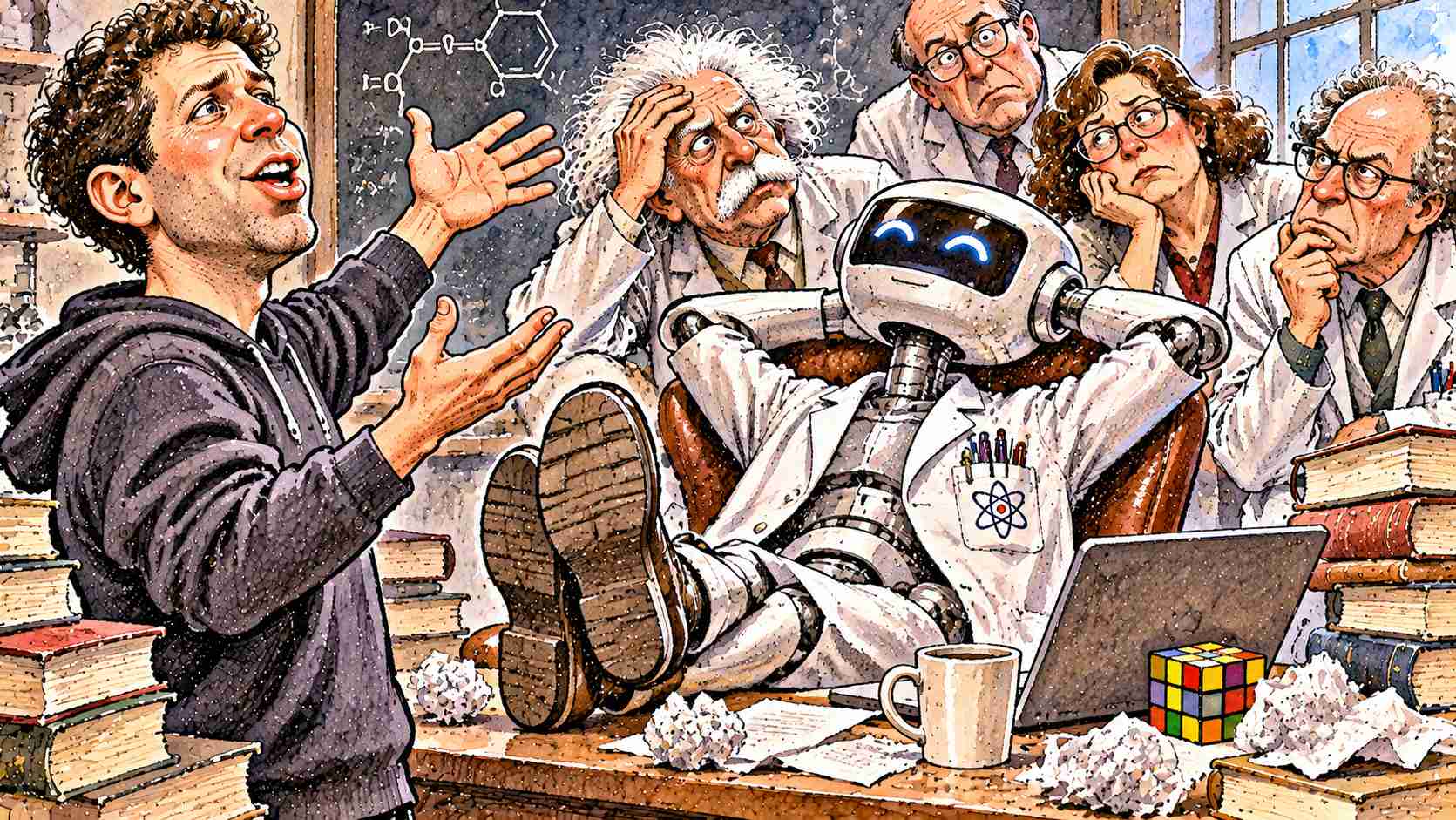
Machines Pass Einstein, Still Need a Press Conference
SAN FRANCISCO, Calif. — Sam Altman, the chief executive of OpenAI, has announced that artificial intelligence is now smarter than humanity’s brightest scientists, a remarkable achievement considering that humanity’s brightest scientists never needed Sam Altman to stand beside them explaining how brilliant they were.
Speaking at a conference in Abu Dhabi, Altman declared that AI systems had surpassed the intellectual capabilities of the world’s leading researchers, according to Futurism. Apparently the machines have conquered physics, chemistry, mathematics and biology. They have not yet developed a reliable method for preventing their chief executive from making another announcement.
This presents an extraordinary scientific mystery. If artificial intelligence is smarter than Albert Einstein, Stephen Hawking, Marie Curie and every living Nobel laureate, why does it still occasionally produce an answer with the confidence of a drunk uncle explaining cryptocurrency at Thanksgiving? And why does the greatest intelligence ever assembled require a California technology executive to serve as its publicist?
Scientists have spent centuries investigating questions about the universe. Altman has apparently resolved the question of intelligence with a press conference. Isaac Newton discovered gravity after observing an apple. Altman discovered superintelligence after observing a product he happens to sell. One discovery changed science forever. The other could substantially improve the next investor presentation.
Einstein Needed Evidence, Altman Has a Microphone
The problem with Albert Einstein was that he had absolutely no understanding of modern Silicon Valley. He spent years developing the theory of relativity when he could have announced that he was already smarter than everyone else, secured $40 billion, and released the actual mathematics sometime after the next funding round.
Einstein published scientific papers. Altman delivers keynote speeches. Einstein developed equations that could be tested, while Altman has developed a business model in which the product’s intelligence is established partly by the enthusiasm of the man selling it. Einstein needed evidence. Altman has a microphone.
When Einstein proposed general relativity, scientists went looking for observational evidence. When Altman suggests his machines have overtaken the world’s leading scientists, the public is apparently supposed to check whether the company’s latest subscription plan includes a free trial.
A Nobel Prize traditionally requires years of research, independent verification, and an actual discovery. Under the emerging Silicon Valley standard, it might be awarded to anybody who can persuade a chatbot to say something impressive while a venture capitalist nods enthusiastically.
“We’ve entered a revolutionary period in scientific history,” said Garrett Pruitt, a partner at a Sand Hill Road firm who recently invested $600 million in a company manufacturing emotionally intelligent office printers. “The important thing is that independent verification doesn’t slow down the financing.”
AI Hallucinations: The Smartest Machine on Earth Still Makes Things Up
Artificial intelligence has demonstrated remarkable capabilities in mathematics, computer programming, language and scientific research. Nobody disputes that these advances are significant. What remains disputed is whether performing impressively on difficult intellectual tasks means a machine has become more intelligent than the people who developed the underlying scientific knowledge.
There is also the slight inconvenience that AI systems can produce inaccurate information with extraordinary confidence. The industry calls this a hallucination. Human beings have a similar condition, although when they make enormous unsupported claims about their own intelligence, we generally call it a job interview.
Ask a scientist a difficult question, and the scientist might explain the uncertainty. Ask a chatbot, and it might give you six paragraphs, three equations, a nonexistent research paper, and a cheerful suggestion that you seek additional information from a university that closed before indoor plumbing.
A survey of 1,200 doctoral candidates, commissioned by a university library consortium, found that 68 percent had been handed a citation by a chatbot for a paper that does not exist. Thirty-one percent cited it anyway, on the grounds that the title sounded right.
A human researcher who cites a nonexistent academic paper may lose credibility. A computer that does the same thing is called revolutionary. A human being who invents supporting evidence might face professional consequences. A machine that invents supporting evidence gets another software update, and the executive responsible for selling the machine gets invited to Abu Dhabi to explain that mankind has become intellectually obsolete.
It is the first time in history that humanity has built something capable of making mistakes faster than humans and then marketed the mistakes as an exciting new frontier.
Scientists Want to Replace Altman With His Own AI
If artificial intelligence has truly surpassed the world’s leading scientists, then surely it has also surpassed the intellectual requirements of corporate management. That raises an obvious question. Why does OpenAI still need Sam Altman?
A committee of irritated scientists has proposed an elementary experiment: replace Altman with his own product. The machine would assume responsibility for corporate strategy, investor relations, public announcements, and explaining why increasingly expensive computer systems will eventually make everybody’s life wonderful.
The experiment would have several advantages. First, the computer could answer questions without constantly announcing that it was about to transform civilization. Second, it could provide investors with financial projections without requiring a dramatic pause before the word “superintelligence.” Third, it might occasionally admit that it doesn’t know something.
This last possibility could revolutionize the technology industry. Imagine a Silicon Valley executive standing before an audience and saying, “We have achieved impressive results in certain areas, but we don’t yet have enough independent evidence to support broader conclusions.” Security would immediately escort him from the conference. Investors would panic. Technology journalists would assume the company was bankrupt, and the audience would demand to know whether the speaker had been replaced by a malfunctioning accountant.
Minutes from a recent faculty senate meeting record that a motion to “verify before applauding” carried 41 to 3, with two abstentions recorded as “pending further compute.”
In Silicon Valley, admitting uncertainty is regarded as a more serious defect than producing incorrect answers. At least the incorrect answers can be packaged as innovation.
AI Math Proofs Are Outrunning Peer Review
The scientific community has also encountered another complication. An AI system can generate mathematical arguments at tremendous speed, but demonstrating that an argument is correct, original, understandable and scientifically useful can require painstaking human investigation.
Recent controversies over AI-generated mathematical proofs illustrate precisely why extraordinary claims deserve careful evaluation. Researchers have raised concerns about the overwhelming quantity of mathematical material generated by AI systems and the burden placed on human experts asked to verify it. In other words, the computer can produce scientific homework faster than scientists can grade it.
Altman appears to regard this as evidence of superior intelligence. University professors may recognize it as the academic equivalent of a student submitting 700 pages of homework at 11:59 p.m. and demanding congratulations before anyone has checked the first equation.
“I asked it to show its work, and it sent me another 200 pages,” said Dr. Marguerite Hollis, who chairs a university mathematics department in the Midwest. “It’s the only student I’ve ever had who finishes early and turns in a longer paper.”
Imagine a mathematician opening a computer-generated proof. It’s 400 pages long. The computer completed it in eleven seconds. The mathematician requires six months to determine whether it contains a fatal error. The computer is hailed as a genius, and the mathematician is accused of holding back progress. Somewhere in California, an investor asks whether the mathematician’s salary can now be eliminated.
This is apparently what the future looks like: machines produce work faster than humans can verify it, and the humans are expected to applaud before asking whether any of it makes sense. The peer review process, which has until now relied on people reading things, has not been consulted.
Silicon Valley Invents the Self-Certifying Genius
The most fascinating element of Altman’s declaration is the extraordinary convenience of the arrangement. The man selling artificial intelligence announces that artificial intelligence has surpassed humanity’s finest minds. The public is then encouraged to purchase more artificial intelligence. It is an unusually efficient form of scientific evaluation.
Imagine if automobile manufacturers operated under similar standards.
“Good morning,” the Ford chief executive announces. “Our newest pickup truck is now faster than a Formula One race car, stronger than a locomotive, and capable of understanding human emotions.”
“Do you have independent test results?”
“No, but we are extremely excited about the future.”
The automotive press would demand evidence. Government regulators might ask questions. Customers would probably want to know whether the truck could reliably start on a cold morning.
Silicon Valley, however, has developed a more sophisticated procedure. First, make an extraordinary prediction. Second, describe that prediction as inevitable. Third, raise enormous amounts of money to pursue it. Fourth, announce that the prediction has essentially come true. Fifth, explain that achieving its full potential will require several additional billion dollars.
It isn’t a business cycle. It’s a perpetual motion machine powered by investor optimism.
Newton Never Charged a Subscription for Gravity
There is one final historical distinction worth considering. Newton didn’t charge a monthly subscription for gravity. Einstein never introduced a premium tier of relativity. Marie Curie didn’t require patients to upgrade to the Platinum Radiation Discovery Plan. Charles Darwin didn’t put natural selection behind a paywall and offer unlimited evolution for $199 a month.
The greatest scientific discoveries in history became part of humanity’s shared understanding of the universe. Modern Silicon Valley has developed a different ambition: creating machines that may someday solve civilization’s greatest problems, provided civilization keeps a valid credit card on file.
And if the machines eventually become smarter than every human being, one sincerely hopes they will possess enough intelligence to understand cancellation requests. That would already place them ahead of several telecommunications companies.
Smarter Than Einstein Is Not the Same as Louder
The truly remarkable part of Altman’s announcement is not that artificial intelligence has become extraordinarily capable. It has. Nor is it unreasonable to expect AI systems to accomplish scientific work that would once have seemed impossible.
The remarkable part is the leap from impressive technical achievements to declaring that machines have overtaken the world’s finest scientists, as though intelligence were a footrace with a finish line sponsored by venture capital.
Science advances through evidence, skepticism, reproducibility and correction. Silicon Valley advances through announcements, demonstrations, funding rounds, and increasingly expensive jackets worn over plain T-shirts. Both enterprises occasionally change the world. Only one considers a standing ovation a substitute for peer review.
Perhaps AI will someday surpass humanity’s greatest scientific minds across every meaningful dimension. It may already exceed them at certain specialized tasks, and tomorrow’s discoveries may come from partnerships between human researchers and machines capable of investigating questions no person could solve alone. Until someone develops a rigorous, independent way of measuring the sweeping claims, society may wish to keep a small degree of skepticism.
After all, if humanity has truly developed an intelligence greater than Einstein’s, Newton’s and Hawking’s combined, surely that intelligence ought to accomplish something nobody in Silicon Valley has managed.
It should be able to explain to Sam Altman that being the loudest man in the room is not the same thing as being the smartest.
Five Observations on the Smartest Machine Ever Built
- Smarter than every scientist in history, and some website still makes it click the pictures with traffic lights. Marie Curie discovered two elements and never once had to find the crosswalks.
- Forty billion dollars, and the math comes later. I tried that at the bank. They have a word for it, and the word is not “visionary.”
- Four hundred pages in eleven seconds. I can’t get my wife to read a two-sentence text in eleven seconds, and she’s smarter than the machine. She just has boundaries.
- We built a machine smarter than Einstein, and the first thing we did was learn to talk to it like a toddler. “Take a deep breath.” “Think step by step.” You know who never had to be told to take a deep breath? Einstein. He did it on a patent clerk’s salary.
- When the machine makes up a court case, they call it a hallucination. When I make one up, they call it perjury, and nobody throws me a launch party.