

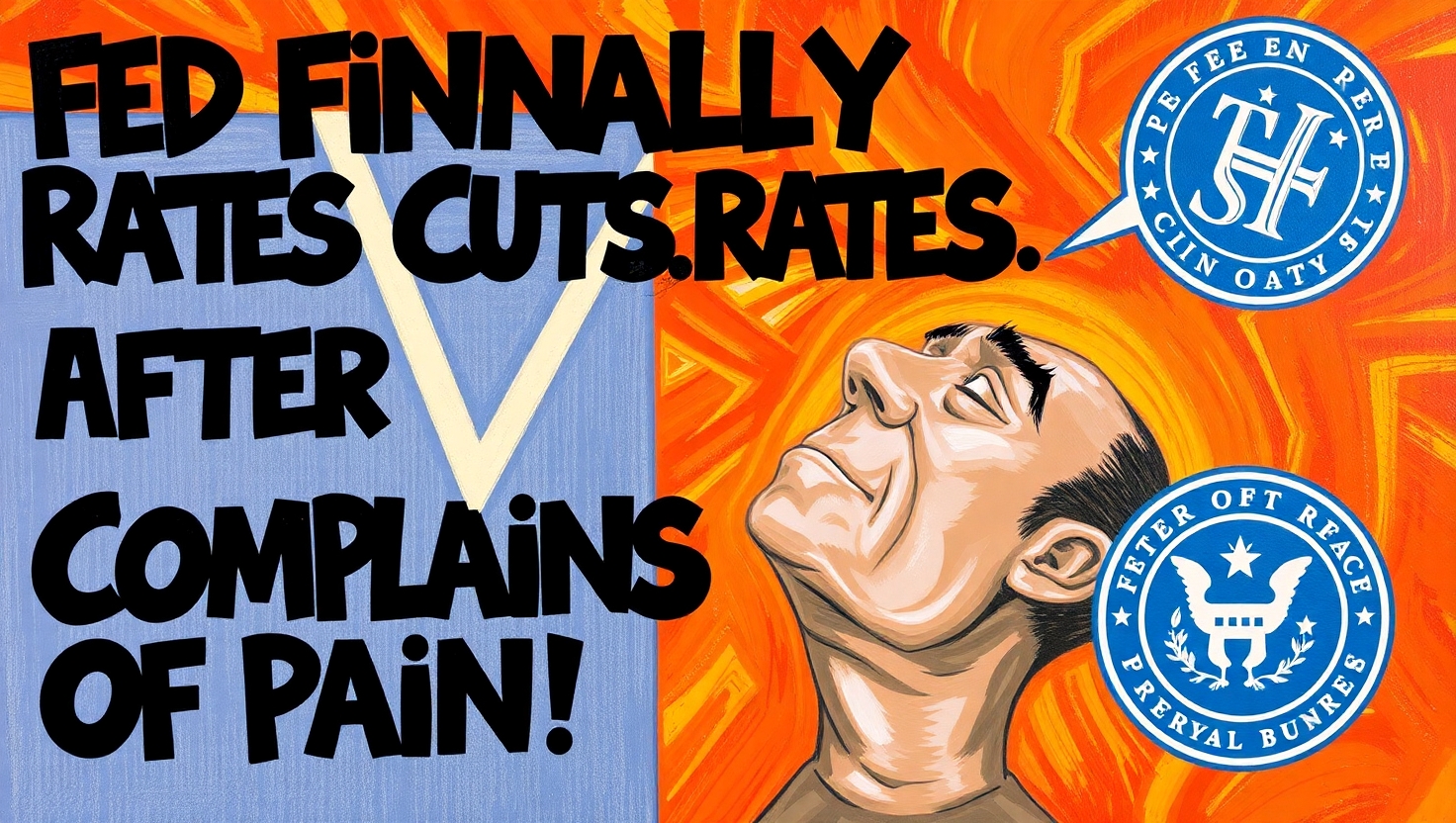
Fed Finally Cuts Rates After Economy Complains of Neck Pain
Federal Reserve Discovers Economy Has Been Looking Up at Interest Rates for Too Long
WASHINGTON — In an unprecedented move that stunned financial markets worldwide, the Federal Reserve announced Wednesday it would finally cut interest rates after the U.S. economy filed a formal complaint with the Department of Labor regarding chronic neck pain from constantly looking up at towering borrowing costs.
“We had no idea the economy was suffering from such severe cervical strain,” said Federal Reserve Chair Jerome Powell during a hastily arranged press conference, where he demonstrated the awkward crane-neck position Americans have been forced to adopt while attempting to secure mortgages. “Our economists have been so focused on inflation data, we completely missed the chiropractor bills piling up across Main Street.”
Economy Seeks Workers’ Compensation for Rate-Related Injuries
The economy, represented by a coalition of small businesses, homebuyers, and anyone who’s ever looked at a credit card statement and immediately needed physical therapy, filed the complaint after reporting widespread musculoskeletal disorders directly linked to “excessive upward gazing at interest rate charts.”
Dr. Sarah Martinez, an orthopedic specialist at Georgetown University Hospital, confirmed that emergency rooms have seen a 400% increase in neck-related injuries since rates began their skyward journey. “We’re seeing classic ‘Fed-neck syndrome,'” Martinez explained. “Patients come in with severe cervical compression from spending months literally looking up at 5.5% mortgage rates like they’re trying to spot a UFO.”
The complaint, filed under the Occupational Safety and Health Administration (OSHA), cited “unsafe working conditions” for an entire national economy forced to operate while constantly craning necks upward to glimpse borrowing costs that seemed to live somewhere near low-Earth orbit.
Wall Street Celebrates with Collective Chiropractic Appointment
Trading floors erupted in cautious celebration, though many traders were observed wearing neck braces and applying ice packs while cheering. “This is exactly what we needed,” said Goldman Sachs analyst Rebecca Torres, speaking through a cervical collar. “I haven’t been able to look straight ahead since the Fed started hiking rates. My peripheral vision has been completely shot.”
The Dow Jones Industrial Average jumped 300 points in morning trading, though market observers noted the rally appeared somewhat stiff and mechanical, likely due to collective muscle tension among institutional investors.
Small Business Owners Report Immediate Relief
Martha Henderson, owner of Henderson’s Hardware in Toledo, Ohio, was among the first to report symptoms improving. “I spent two years looking up at those interest rates like I was watching a really boring fireworks show,” Henderson said, gently rotating her shoulders. “When Jerome Powell announced the cut, I literally felt my neck vertebrae pop back into place. It was like that moment in The Matrix when Neo sees the code for the first time, except instead of green numbers, it was just relief that I could finally afford to expand my store without taking out a second mortgage on my soul.”
The Small Business Administration has announced it will provide federal funding for ergonomic assessments at businesses nationwide, acknowledging that “economic policy shouldn’t require physical therapy to understand.”
Fed Officials Admit to Rate-Setting Myopia
In a rare moment of bureaucratic honesty, Fed officials acknowledged they had developed “tunnel vision” regarding monetary policy, literally and figuratively. “We were so focused on fighting inflation, we forgot that humans have to live with these rates,” admitted Federal Reserve Bank of San Francisco President Mary Daly. “Turns out, when you make borrowing money as accessible as a cookie jar on top of a refrigerator, people develop chronic pain trying to reach it.”
The Fed’s decision came after a comprehensive ergonomic study conducted by the Department of Health and Human Services revealed that Americans were spending an average of 47 minutes per day looking upward at financial charts, leading to what researchers termed “monetary cervicalgia.”
Inflation Reportedly Feeling Neglected
Sources close to inflation data suggest the economic indicator is feeling somewhat abandoned following the Fed’s pivot to addressing physical health concerns. “Inflation worked really hard to get everyone’s attention, and now suddenly it’s all about neck pain,” said an unnamed economist who requested anonymity due to fear of retaliation from both inflation metrics and chiropractors.
Consumer Price Index data, reached for comment through its representative at the Bureau of Labor Statistics, declined to provide an official statement but was reportedly seen sulking in a corner of the Economics Department at the University of Chicago.
Healthcare Industry Braces for Economic Recovery
The American Chiropractic Association expressed mixed emotions about the Fed’s decision. “On one hand, we’re thrilled that monetary policy is finally considering spinal health,” said Dr. Michael Brennan, president of the association. “On the other hand, we’re about to lose about 40% of our client base once people can afford mortgages without developing permanent neck deformities.”
Physical therapy clinics across the nation are reportedly offering “Post-Rate-Cut Recovery Programs” for Americans who need assistance learning to look straight ahead again after years of upward financial gazing.
Economic Indicators Show Signs of Postural Improvement
Early data suggests the rate cut is already having positive effects beyond traditional economic metrics. The National Bureau of Economic Research has begun tracking “Cervical Alignment Index” alongside traditional indicators like employment and GDP growth.
“We’re seeing remarkable improvement in the economic posture of the American people,” said NBER economist Dr. James Crawford. “For the first time in two years, focus groups can discuss mortgage rates without instinctively tilting their heads back 45 degrees.”
Future Policy Considerations Include Ergonomic Impact Studies
The Federal Reserve announced that all future monetary policy decisions will include mandatory ergonomic impact assessments. “We’re implementing a new protocol where any interest rate change must be evaluated for its potential effects on American spinal health,” Powell explained, demonstrating proper neck positioning during his remarks.
The Fed is also exploring partnerships with ergonomic furniture manufacturers to provide adjustable-height economic charts that can accommodate Americans of all heights without causing musculoskeletal distress.
Opposition Questions Timing of Relief
Some critics argue that the Fed’s sudden concern for physical health is merely a convenient excuse for reversing monetary policy that was becoming politically untenable. “This is just fancy political theater,” said Heritage Foundation economist Dr. Patricia Wells. “They’re using neck pain as cover for what amounts to economic policy whiplash.”
However, medical professionals have countered that the physical symptoms are legitimate and documented. “You can’t fake the kind of cervical compression we’ve been seeing in emergency rooms,” Dr. Martinez noted. “These people have been looking up at interest rates so long, some of them have developed permanent upward gaze syndrome.”
Recovery Timeline Remains Uncertain
While the immediate relief from the rate cut has been palpable, medical experts warn that full economic recovery may take time. “Years of looking up at high interest rates has created deep-seated postural problems that won’t be solved overnight,” explained Dr. Brennan. “We’re talking about comprehensive rehabilitation for an entire economy that’s been living with chronic pain.”
The Federal Reserve has indicated that future rate decisions will be made with full consideration of American spinal health, marking what economists are calling the first truly holistic approach to monetary policy in the institution’s 110-year history.
As Americans slowly learn to look forward rather than upward when discussing mortgage rates, the true test of this policy shift will be whether the economy can maintain proper posture while navigating whatever financial challenges lie ahead—hopefully at eye level.

Humorous Observations
The Fed’s decision to cut rates based on neck pain complaints represents the first time in economic history that monetary policy has been influenced by chiropractor bills rather than inflation data.
Americans have collectively developed what medical professionals are calling “interest rate whiplash” from constantly looking up at borrowing costs that seemed to live in the stratosphere.
Wall Street traders are celebrating the rate cut while simultaneously booking appointments with physical therapists, creating the first bull market in cervical spine treatment.
The Federal Reserve’s ergonomic impact assessment represents the most comprehensive consideration of American posture since elementary school teachers stopped telling kids to sit up straight.
Small business owners report that the psychological relief of lower rates has been overshadowed by the physical relief of finally being able to look at loan applications without developing muscle spasms.
The Department of Labor is now investigating whether chronic upward gazing at interest rate charts qualifies as a workplace injury under OSHA regulations.
Economic recovery has traditionally been measured in jobs and GDP growth, but apparently now includes the ability of Americans to maintain proper cervical alignment while reading financial news.
The Federal Reserve’s new ergonomic considerations suggest that future monetary policy meetings will require both economists and physical therapists to reach consensus.
Mortgage lenders report that loan applications are being filled out more efficiently now that customers aren’t spending half the appointment time stretching their necks.
The rate cut has created the unprecedented situation where Americans can simultaneously experience financial relief and chiropractic adjustment withdrawal symptoms.
Healthcare providers specializing in neck injuries are experiencing their own economic downturn as Americans no longer need to crane their necks to see borrowing costs.
The Federal Reserve’s acknowledgment of “Fed-neck syndrome” marks the first time a government agency has taken responsibility for causing repetitive strain injuries through monetary policy.
Economic textbooks will need to add a new chapter on the relationship between interest rates and cervical spine health, fundamentally changing how monetary policy is taught.
The rate cut announcement included the first-ever Federal Reserve demonstration of proper posture while reading financial charts, setting a new precedent for policy communication.
Americans are learning that economic recovery isn’t just about financial healing—it’s also about literally healing the physical damage caused by years of looking up at unaffordable borrowing costs.
Comedian Commentary
Jerry Seinfeld observed: “What’s the deal with interest rates? They go up, your neck hurts. They go down, your chiropractor goes broke. I can’t win!”
Amy Schumer noted: “I’ve been to physical therapy more for looking at mortgage rates than for my actual workouts. At least when I hurt myself at the gym, I got endorphins. Interest rates just gave me chronic pain and debt.”
Ron White remarked: “I’ve seen people crane their necks looking at interest rates like they’re trying to catch a glimpse of a solar eclipse. Except with the eclipse, at least you get cool glasses and it’s over in four minutes.”
Dave Chappelle commented: “The Fed finally realized they’ve been torturing Americans’ necks for two years. That’s not monetary policy, that’s enhanced interrogation techniques!”
Bill Burr stated: “So now the government cares about our neck pain? What’s next, the IRS offering massage therapy with tax audits?”
Chris Rock said: “Black people have been looking up at everything their whole lives—interest rates, rent prices, police helicopters. Now white people get neck pain from rates and suddenly it’s a federal emergency!”
Jim Gaffigan observed: “I’ve spent more time looking up at interest rates than I have looking up at actual food on high shelves, and that’s saying something.”
Trevor Noah noted: “In South Africa, we have real problems. In America, they cut interest rates because people’s necks hurt from looking up. This is peak first-world problems.”
Sarah Silverman quipped: “I thought my neck pain was from my terrible posture during Netflix binges. Turns out it was from checking mortgage rates. Same couch, different financial trauma.”
Gabriel Iglesias commented: “I’m fluffy, so my neck already has support issues. Adding interest rate gazing to the mix? That’s a recipe for cervical disaster, right there.”
Tom Segura observed: “The Fed discovered Americans have neck pain from high interest rates. Next week they’ll realize we have eye strain from looking at gas prices and back pain from carrying student loans.”
Nate Bargatze said: “My wife complained about neck pain for months. I thought it was from sleeping wrong. Turns out she was just checking our home equity line of credit every morning.”