

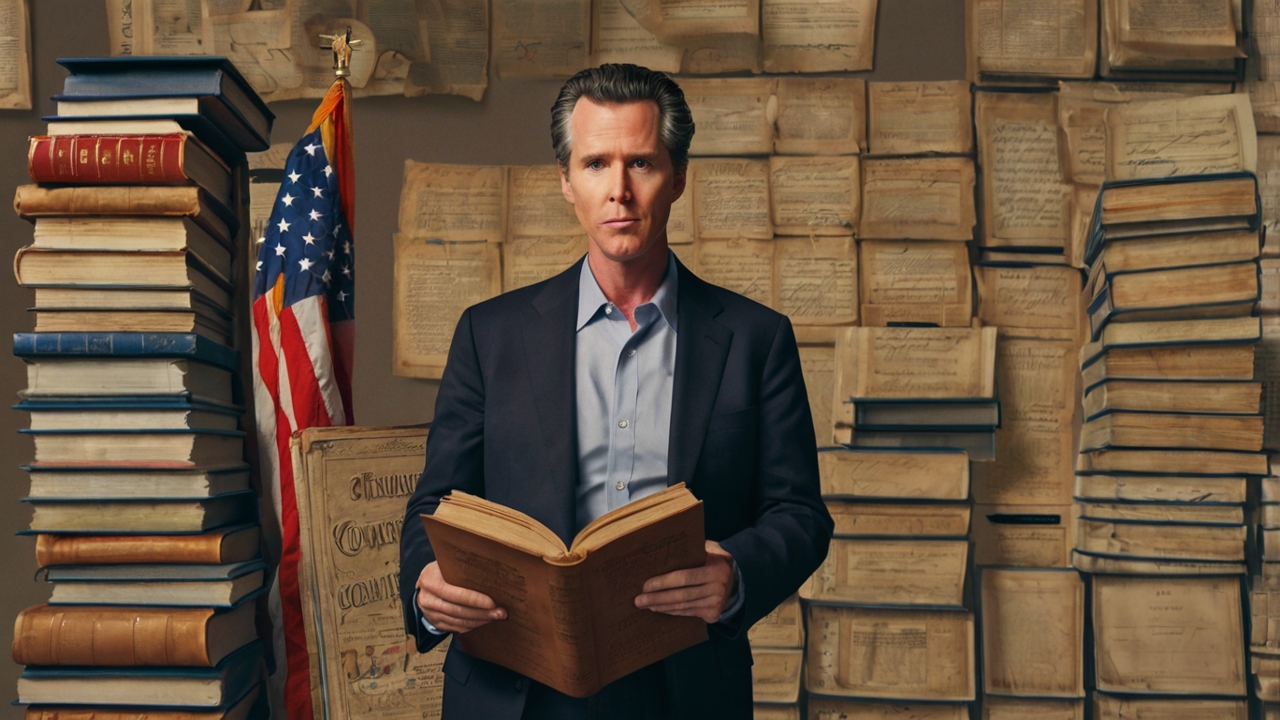
Gavin Newsom Reads the Constitution… Mostly for Entertainment
California Governor’s Immigration Bills Challenge Federal Authority While Constitution Collects Dust
California Governor Gavin Newsom recently signed a sweeping package of immigration bills that have constitutional scholars, federal attorneys, and confused civics teachers asking the same burning question: Did Gavin actually read the Constitution, or did he just Instagram the cover while sipping his morning oat milk matcha?
According to sources deep within the governor’s mansion—anonymous staffers who spoke under promise of lifetime kombucha subscriptions—Newsom proudly declared he had “thoroughly studied” the Constitution, carefully ignoring only 47 clauses that seemed “spiritually outdated” or “in conflict with his Tuesday yoga schedule.”
“This is revolutionary governance,” said one intern, clutching an organic kale smoothie like a security blanket. “You read the parts that spark joy, ignore the stuff that doesn’t, and pretend the Supremacy Clause was more of a gentle suggestion than actual law.”
California’s Immigration Bills Challenge Federal Authority

The new legislation essentially transforms California into what legal experts are calling a “federal enforcement-free zone”—think of it as Disneyland for immigration policy, but with more legal confusion and significantly less churros.
Under these groundbreaking laws, ICE agents operating in California must now navigate a complex web of state restrictions that make arresting unauthorized immigrants about as straightforward as assembling IKEA furniture blindfolded. Federal authorities can still technically do their jobs, they just have to ask nicely first, fill out seventeen forms in triplicate, and promise to buy locally-sourced coffee.
“It’s like playing cops and robbers, except the cops have to get permission from the neighborhood HOA first,” observed Jerry Seinfeld during his recent Berkeley appearance. “What’s the deal with federal law? Is it federal or is it optional? Pick a lane, people!”
Supremacy Clause Gets the Silent Treatment
The Supremacy Clause, that pesky little part of Article VI establishing federal law as supreme over state law, has apparently been reclassified as “constitutional entertainment” in Newsom’s administration. Legal scholars report that when asked about this fundamental principle of American federalism, the governor reportedly responded, “Supremacy is such an aggressive word. We prefer ‘federal suggestions’ here in California.”
Dr. Henrietta P. Lawbender, constitutional law professor at UC Berkeley’s School of Creative Legal Interpretation, explained the implications: “Governor Newsom has essentially invented ‘Constitutional Lite’—all the authority of federal law, but with 50% less actual enforcement and a refreshing hint of Pacific Coast liberalism.”
The governor’s office has defended this approach by claiming the Founding Fathers never anticipated the complexity of modern California, where federal law must compete with fair-trade coffee shops, meditation apps, and the entertainment value of constitutional creativity.
ICE Agents Politely Asked to Take Coffee Breaks
Under the new regulations, federal immigration enforcement agents must now navigate what insiders call the “California Courtesy Protocol.” This involves a 47-step process that begins with a formal written request to local authorities and ends with agents attending a mandatory sensitivity workshop about the emotional impact of deportation on houseplants.
“We’re not stopping federal agents from doing their jobs,” explained a state official who requested anonymity because she was speaking while getting a pedicure. “We’re just asking them to do it more mindfully, with respect for California’s commitment to organic enforcement practices.”
One ICE supervisor, speaking on background because he wasn’t authorized to discuss the policy publicly, described the new reality: “Yesterday, I had to fill out a form explaining why I needed to arrest someone who had been deported three times already. The form asked about my chakras. I don’t even know what chakras are.”
Legal Experts React to Newsom’s Constitutional Creativity
Constitutional scholars across the nation are struggling to categorize Newsom’s innovative approach to federal law. Some call it “bold state leadership,” others prefer “constitutional creativity,” and a few have simply started drinking heavily during faculty meetings.
“I’ve been teaching constitutional law for thirty years,” said Professor Marcus Precedent of Stanford Law School. “I thought I understood federalism until Governor Newsom explained that the Constitution is more of a ‘living, breathing suggestion box’ than actual law. Now I’m questioning everything I know about legal hierarchy.”
The confusion has spread to law schools nationwide, where students are now required to take courses in both “Traditional Constitutional Law” and “California-Style Constitutional Interpretation,” the latter of which reportedly includes mandatory aromatherapy breaks.
Constitutional Law Professors Sound the Alarm
Legal academic Twitter has exploded with constitutional scholars attempting to explain how California can simultaneously respect federal authority while completely ignoring it. The hashtag #SupremacyClauseGate has been trending for weeks, with law professors posting increasingly desperate explanations involving quantum physics and interpretive dance.
“Newsom’s reading of the Constitution reminds me of my ex-wife’s reading of our divorce settlement,” said Ron White during his Sacramento show last week. “She sees what she wants to see and ignores the parts about alimony. Except in this case, it’s federal law instead of spousal support.”
Dr. Constance Literalist, author of “The Constitution: It Says What It Says,” has been forced to add an entire chapter to her textbook’s upcoming edition titled “When States Decide Federal Law is More Like Federal Guidelines.” The chapter reportedly consists entirely of confused emoji and legal citations written in crayon.
Federal Attorneys Prepare Lawsuit Strategy
The Department of Justice has assembled what sources describe as a “confused but determined” legal team to challenge California’s immigration stance. Federal prosecutors are reportedly working around the clock to find legal precedent for a situation where a state government treats federal law like a Netflix subscription—acknowledged but not really binding.
“We’re in uncharted constitutional waters,” admitted one DOJ attorney who spoke on condition of anonymity because he was eating lunch. “It’s like California decided the Constitution was more of a ‘Choose Your Own Adventure’ book than actual governing law.”
The federal lawsuit, expected to be filed within weeks, will reportedly argue that California cannot simply ignore federal immigration law because it conflicts with the state’s “vibe.” Legal experts predict the case will either clarify the limits of state power or result in every law student in America having a nervous breakdown.
Public Opinion Split on California’s Immigration Stance
California residents have responded to Newsom’s immigration policies with characteristic Golden State enthusiasm, meaning half the population thinks it’s brilliant while the other half is too busy stuck in traffic to form an opinion.
A recent poll conducted by the Institute for California Confusion found that 47% of residents support the governor’s stance, 31% oppose it, and 22% thought the question was about immigration reform in the latest season of “The Bachelor.” The margin of error was plus or minus “depends on how much caffeine the respondents had consumed.”
Amy Schumer, performing at the Hollywood Bowl, captured the public mood: “California is basically telling the federal government, ‘We’ll follow your laws, but only the fun ones.’ It’s like a teenager promising to clean their room but only the parts that show from the doorway.”
Polling Data Shows Confusion and Support
The polling reveals the depth of California’s commitment to creative governance. When asked whether federal law should supersede state law, 38% of respondents said “yes,” 41% said “it depends on the law’s carbon footprint,” and 21% asked if the question was available in interpretive dance format.
Perhaps most telling, 67% of Californians admitted they weren’t entirely sure what the Supremacy Clause was, but they assumed it had something to do with supremacist groups and therefore opposed it on principle. This has led to what political scientists are calling “accidental constitutionalism”—supporting the right position for completely wrong reasons.
“I don’t know much about law,” said Malibu resident Crystal Moonbeam, adjusting her healing crystals while speaking to reporters. “But if Gavin says the Constitution needs updating, I trust him. He’s never steered us wrong before, except for that thing with the French Laundry during the pandemic, but we don’t talk about that anymore.”
Local Businesses Adapt to New Reality
California’s business community has embraced the legal uncertainty with entrepreneurial enthusiasm. Immigration lawyers report a 340% increase in clients seeking “Constitutional Interpretation Consultations,” where attorneys attempt to explain which laws currently apply in which zip codes.
“I’ve started offering a premium service where I read the Constitution aloud while clients meditate,” explained Beverly Hills attorney Sterling Billable. “It helps them center themselves before we discuss which federal laws Governor Newsom thinks are still valid this week.”
Meanwhile, coffee shops throughout the state have begun offering “Federal Law Smoothies”—beverages that contain all the ingredients you expect, but mixed in whatever order the barista feels like that day. The drinks have become surprisingly popular among state government employees.
Comedian Commentary: The Funny Side of Federal Conflict
The comedy community has embraced Newsom’s constitutional creativity as a goldmine of material, with stand-up comedians across the country finding new ways to mine humor from federalism confusion.
“Gavin Newsom reads the Constitution like I read terms and conditions,” said Kevin Hart during his recent Los Angeles performance. “Scroll, scroll, scroll, click ‘I agree,’ hope nothing bad happens. Except in his case, the terms and conditions are literally the supreme law of the land.”
The situation has created what comedy writers call “constitutional comedy gold”—a scenario so absurd that the jokes practically write themselves, assuming the writers understand basic civics, which many admittedly do not.
Jerry Seinfeld’s Take on Constitutional Reading
Seinfeld, never one to miss an opportunity to find the absurd in the everyday, has made Newsom’s approach to constitutional law a regular part of his current material. “What’s the deal with the Supremacy Clause?” Seinfeld asked during his recent San Francisco show. “It’s called ‘supreme’ for a reason. It’s not the ‘Pretty Good When Convenient’ clause. It’s not the ‘Applies Unless You’re in a Bad Mood’ clause. It’s supreme! Like Diana Ross, but for law!”
The comedian’s observations have resonated with audiences who are simultaneously confused and entertained by California’s approach to federalism. “Newsom treats the Constitution like a menu at a restaurant,” Seinfeld continued. “A la carte governance. ‘I’ll take the First Amendment, skip the Commerce Clause, and can I get the Supremacy Clause on the side? Actually, never mind the Supremacy Clause, I’m watching my federal authority intake.'”
Amy Schumer Weighs In on California Policy
Schumer has found fertile comedic ground in the intersection of California politics and federal law. “California’s relationship with federal law is like my relationship with dieting,” she said during her recent Santa Barbara performance. “I acknowledge it exists, I know it’s probably good for me, but I’m going to do whatever I want anyway and hope nobody notices.”
The comedian’s ability to find personal analogies in constitutional crises has made her a favorite among audiences trying to understand the legal implications of Newsom’s policies. “It’s like California is that friend who borrows your car and returns it with a different paint job,” Schumer explained. “Technically, they gave it back, but it’s not quite what you expected.”
Legal Challenges and Court Battles Ahead
Constitutional experts predict that California’s immigration policies will inevitably reach the Supreme Court, where justices will have to decide whether states can treat federal law like a buffet—taking what they want and leaving the rest.
The legal challenges ahead promise to be as complex as they are precedent-setting. Federal courts will need to determine whether California’s approach represents legitimate state sovereignty or creative constitutional interpretation that would make the Founding Fathers spin in their graves at approximately 2,400 RPMs.
“This is going to be the most interesting constitutional law case since someone tried to argue that the Second Amendment applied to water balloons,” predicted Georgetown Law Professor Diana Precedent, who has already begun writing her inevitable law review article titled “When States Go Rogue: Constitutional Creativity in the Golden State.”
Federal Government Files Constitutional Challenge
The Department of Justice’s anticipated lawsuit will argue that California cannot simply opt out of federal immigration law because the governor disagrees with it on philosophical, political, or aesthetic grounds. The federal case will reportedly contend that allowing states to pick and choose which federal laws to follow would result in what legal scholars call “constitutional chaos” and what normal people call “every teenager’s dream.”
“If California can ignore immigration law, what’s next?” asked one federal prosecutor, speaking hypothetically while stress-eating a donut. “Will Texas ignore environmental regulations? Will Florida ignore hurricane warnings? Will New York ignore the laws of physics? We need some boundaries here.”
The federal challenge faces the unique problem of having to explain to judges why states should follow federal law when that seems like it should be obvious. Legal experts describe this as “arguing that water is wet to people who insist it’s just very committed to being liquid.”
Predicted Timeline for Supreme Court Review
Constitutional scholars predict the case will reach the Supreme Court within eighteen months, assuming the justices can stop laughing long enough to hear arguments. The Court will likely need to address fundamental questions about federalism, state sovereignty, and whether the Constitution means what it says or what state governors think it should mean after consultation with their spiritual advisors.
“This case will either reinforce the supremacy of federal law or establish the precedent that states can ignore federal authority if they do it politely enough,” explained Supreme Court observer Justice Watcher, who runs a popular legal blog called “Nine Justices, One Blog, Infinite Confusion.”
The timeline could be accelerated if other states follow California’s lead, creating what legal experts fear could be a “constitutional domino effect” where every state develops its own interpretation of federal law based on local preferences, weather patterns, and the positioning of nearby craft breweries.
Frequently Asked Questions About California’s Immigration Bills
Are California’s immigration laws constitutional? That depends entirely on whether you ask California or the federal government. California says absolutely, the feds say absolutely not, and constitutional scholars say they need another drink before they can answer coherently.
How do federal authorities respond to state immigration policies? With confusion, frustration, and an increasing reliance on legal precedent that doesn’t quite apply to the current situation. Also, lawsuit preparation and stress-eating.
What legal challenges face Newsom’s immigration bills? Every legal challenge imaginable, plus a few that legal experts are making up as they go along. The Constitution doesn’t have a section on “What to do when states treat federal law like optional reading.”
How do other states handle federal immigration enforcement? Most states follow federal law because they read the Supremacy Clause and understood it the first time. California has chosen the more creative approach of treating federal law like a suggestion box.
Dave Chappelle, commenting on the situation during his recent Berkeley show, summed up the national mood: “California is like that one friend who reads the group chat but responds to whatever they feel like. Everyone else is talking about dinner plans, and California’s over there discussing immigration policy like federal law is just another opinion.”
The coming months will determine whether Newsom’s approach represents visionary state leadership or the beginning of constitutional chaos. Either way, it’s providing unlimited material for comedians and unlimited confusion for everyone else.
Bill Burr captured the absurdity perfectly during his Oakland performance: “Newsom’s reading the Constitution like my wife reads assembly instructions—skips the important parts, improvises the rest, and gets angry when it doesn’t work out. Except in this case, instead of a wobbly bookshelf, we get a constitutional crisis.”
As California continues its bold experiment in selective federal law compliance, the rest of the nation watches with a mixture of amusement, concern, and gratitude that they don’t have to explain their governor’s constitutional interpretations to confused federal agents.
The ultimate test of Newsom’s approach will come when federal courts decide whether creativity and good intentions can overcome the inconvenient reality of written law. Until then, California remains committed to its unique interpretation of federalism—one where federal law exists, it’s just not particularly binding if it conflicts with the state’s commitment to progressive governance and artisanal coffee culture.
This satirical commentary represents the author’s humorous take on serious constitutional issues and should not be considered actual legal analysis, though it’s probably more accurate than whatever explanation the governor’s office is currently preparing.