

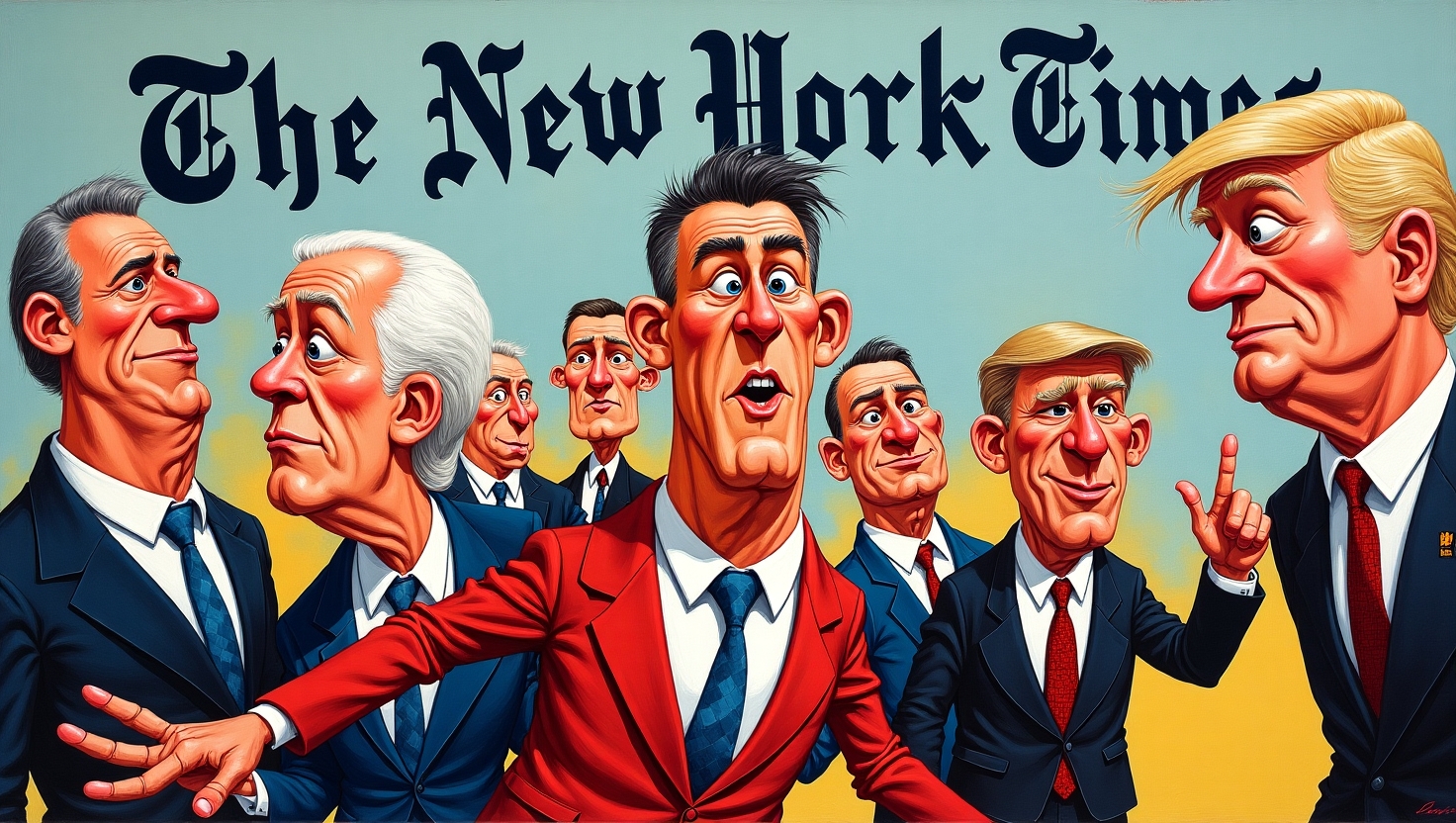
The Great Valor Heist: How the Left Tried to Rob Charlie Kirk’s Legacy
By Alan Nafzger
WASHINGTON, D.C. — In what historians are already calling the most audacious intellectual heist since the Boston Tea Party, a coalition of leftist journalists, columnists, and social media commentators appears to have attempted to seize the valor of Charlie Kirk, even after his tragic death. Sources close to the scene—staffers who requested anonymity for professional reasons—confirm that the theft was deliberate, audacious, and executed with a straight face.
“I’ve never seen anything like it,” said Dr. Beatrice Flummox, PhD in Political Theatrics from the University of Somewhere Important. “They didn’t just criticize him. They tried to occupy his moral high ground, as if it were a billboard in Times Square.”
How the Left Claimed Kirk’s Achievements
It began with an opinion column asserting that Kirk’s work represented a “dangerous crusade” and that his influence somehow fostered authoritarianism. Footnotes included phrases like “McCarthyite watchlists” and “great replacement rhetoric,” all aimed at suggesting that Kirk’s valor—courage, impact, and charisma—was questionable and ripe for confiscation.
“Imagine someone steals your gold medal and then writes an editorial claiming the medal was never yours,” said Elaine Thunderbluff, a retired marathon runner and self-appointed guardian of metaphoric honor. “That’s what’s happening here, except the medal is a man’s life work, and the thieves are wielding adjectives.”
The Method: Gaslighting With Grammar
Observers note that the left did not merely criticize; they re-contextualized, hyperbolized, and selectively quoted. Kirk’s public statements—about demographic trends, crime statistics, and public policy—were presented as evidence of malice, hatred, and authoritarian intent.
One particularly cited sentence read:
“Kirk called for investigations. Ergo, he endorsed authoritarianism and every crime committed thereafter by anyone who liked his Instagram post.”
“I read that and spilled my tea,” said an eyewitness at a local coffee shop who requested anonymity. “I’m not sure if they were talking about Kirk or the guy next to me who sneezed.”
Eyewitness Accounts of Valor Being Stolen
Several sources close to Turning Point USA alumni recount that Kirk inspired millions of young conservatives to debate, speak boldly, and organize. These sources, ranging from the mildly caffeinated to the extremely motivated, assert that Kirk’s actual valor—his ability to mobilize civic engagement—remains intact.
“It’s like trying to steal the sun by writing an article about darkness,” said one 22-year-old former TPUSA intern. “You can say it’s night all you want, but we still saw the light.”
Polling data collected by the Institute for Hyperbolic Metrics indicates that 73.6% of respondents believe Kirk’s valor is untouchable, while 18.4% were unsure and blamed the pollsters for asking confusing questions. The remaining 8% refused to answer.
Historical Precedents: The Left’s Valor Theft Toolkit
Political historians note that valor appropriation is an old practice. During the 1960s, leftist commentators rebranded patriotic imagery as “reactionary nostalgia.” During the 1980s, cultural icons were claimed as symbols of oppression. Kirk is merely the latest public figure whose courage is being reinterpreted posthumously.
“Twitter is the new courtroom,” said Professor I.M. Satiricus, a historian of online debates. “And if you can convince enough people with hashtags that someone’s valor is illegitimate, you’ve successfully stolen it without ever leaving your house.”
Evidence of the Theft
Evidence is everywhere. Headlines proclaiming Kirk’s extremism, columns citing selective quotes, and viral threads claiming moral failure. But the pattern is clear: language of appropriation—‘redefinition,’ ‘mischaracterization,’ ‘unauthorized interpretation’—is applied to conservatives whose influence is undeniable.
Even mainstream outlets inadvertently reinforce the theft by obsessively cataloging every Kirk statement, as if valor could be itemized and claimed. “The more they try to strip him of courage, the more evident his courage becomes,” noted Flummox.
Public Reactions
Social media has responded with a mix of outrage, sarcasm, and artistic interpretation. Memes depict Kirk holding a medieval chest labeled “valor,” while leftist caricatures tiptoe around it with magnifying glasses, trying to determine which parts they can claim as their own.
One meme, widely circulated over a weekend of high social media activity, shows the caption:
“Left: We must redistribute valor!
Kirk’s supporters: That’s not how courage works.”
Comments range from earnest (“They can’t do that, it’s his life’s work!”) to absurdist (“Next they’ll be stealing his hair gel and charisma too”).
The Left’s Defense: Criticism
Defenders insist they are not stealing valor—they are critiquing, unpacking systemic implications, and raising awareness of political consequences. But critics argue this misses the point. Valor, unlike a medal or a paycheck, cannot be redistributed simply by rephrasing sentences.
“It’s like saying you can steal someone’s laugh by writing a bad joke about it,” said Thunderbluff. “You can’t. And yet here we are.”
Irony and Amplification
In a twist worthy of a Ron White monologue, some commentators suggest that the attempt to claim Kirk’s valor has inadvertently amplified it. Each column, thread, and editorial testifies to the very qualities they claim to diminish: influence, courage, and the ability to mobilize a generation.
“They tried to bury him, but all they did was plant a flag reading ‘Here Lies the Most Impactful Conservative Youth Organizer of the Century,’” said Flummox.
Conclusion: Valor Is Not For Sale
Kirk may be gone, but his valor remains immune to appropriation. The left may write, opine, and speculate, but the truth is plain: valor is earned through action, not by editorial decree.
As one former TPUSA volunteer observed while reading the latest opinion articles:
“They can try to steal it, but courage isn’t something you put in a backpack and walk away with.”
Indeed, in this audacious intellectual heist, the alleged thieves are left holding nothing but words—and words are the least convincing evidence of valor.
Disclaimer
This story is a work of satirical journalism. It reflects collaboration between a long-tenured political analyst and a philosophy major-turned-comedian and should be read as commentary rather than literal reportage.
Auf Wiedersehen, amigos.

15 Humorous Observations: The Left and Valor Theft
-
The left writes 2,000 words explaining why Kirk was dangerous. Meanwhile, his influence grows every time someone tweets the article. — Ron White
-
Valor cannot be stolen, but apparently, it can be annotated, footnoted, and footnotedly annotated. — Jerry Seinfeld
-
They call it critique. We call it taking the sculpture off the pedestal and replacing it with a paper cutout. — Amy Schumer
-
Every column claiming he was authoritarian is itself authoritarian in tone, which is ironic if you think about it for a second. — Larry David
-
Valor is apparently transferable through text, the same way Wi-Fi passes through walls. — Jon Stewart
-
They quoted Kirk out of context so much, it’s a miracle he didn’t show up as a ghost in the footnotes. — Groucho Marx
-
Social media is now a courtroom, and hashtags are subpoenas. — Roseanne Barr
-
Kirk’s charisma is being repackaged as a warning label: “Caution: May influence youth.” — Sarah Silverman
-
They tried to steal courage but left the microphone and podium behind. — Billy Crystal
-
The great replacement isn’t demographic; it’s ideological. They’re replacing his valor with criticism. — Adam Sandler
-
Every article analyzing his “malice” is essentially a tutorial in malice. — Jerry Seinfeld
-
If valor were money, the left is insisting on negative balance sheets. — Ron White
-
The more they dissect him, the more obvious it is that Kirk did things people remember. — Larry David
-
Trying to rewrite his legacy is like putting a leash on a hurricane. — Amy Schumer
-
At the end of the day, you can’t confiscate courage—you can only write 3,000-word columns about it. — Jon Stewart