

Democrats Unveil New American Dream Amid Public Charge Rule Fight: Come for Opportunity, Stay for the Caseworker
The public charge rule has officially become the most contested three words in American immigration law, and the Democratic Party has responded not with a policy paper but with a full rebrand of the American Dream — one involving eligibility forms, administrative hearings, and a government employee named Denise.
The Public Charge Rule Fight, By the Numbers
This week the dispute went from op-ed to courtroom. Twenty-two Democratic-led states and Washington, D.C., led by New York Attorney General Letitia James, filed suit to block the Department of Homeland Security’s public charge rule ahead of its Thursday effective date, arguing it unlawfully punishes immigrants for using benefits they are legally entitled to. A separate suit, led by New York City Mayor Zohran Mamdani alongside Chicago, San Francisco, and Seattle, makes the same argument from the city-hall side of the ledger. According to reporting on the lawsuit, the states claim the rule is “arbitrary and capricious” and exceeds DHS’s statutory authority.
DHS, for its part, says the public charge rule simply restores a standard Congress has held for over a century: newcomers should be able to stand on their own two feet rather than the taxpayer’s. The agency’s own announcement frames self-sufficiency as a matter of aligning with “congressional intent,” which is bureaucratic for “we checked, and yes, this has always been the rule, we just stopped enforcing it for a while.”
Somebody at the Democratic National Committee apparently rediscovered the concept of arithmetic, and did not enjoy the sum.
15 Observations on the Public Charge Rule Fight
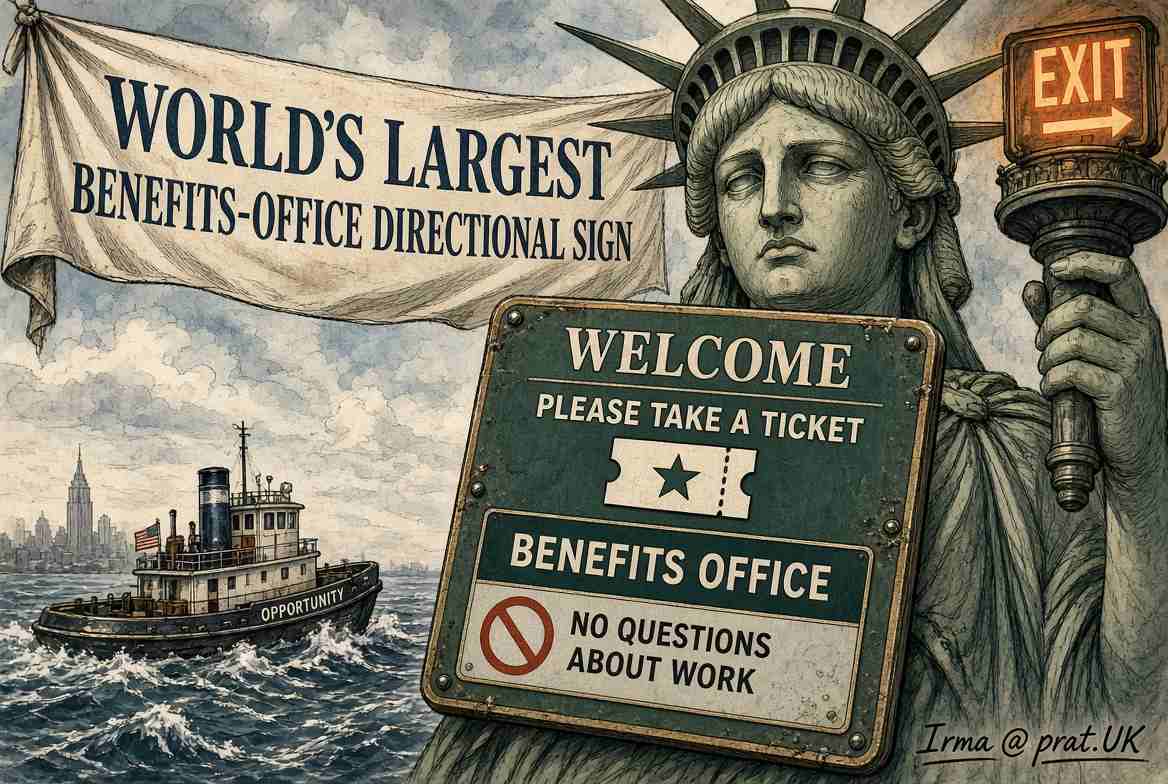
- Democrats have upgraded the Statue of Liberty from a beacon of opportunity to the world’s largest benefits-office directional sign.
- “Give me your tired, your poor” has apparently acquired a footnote reading, “See caseworker for eligibility, bring two forms of ID.”
- The American Dream once meant arriving with nothing and building something. The new version means arriving with nothing and being handed three government websites that don’t load.
- Democrats oppose the phrase “public charge” because “future constituent with excellent paperwork” scans warmer on a campaign mailer.
- Ellis Island used to ask whether newcomers could support themselves. Progressives now seem to want it to ask whether they’ve downloaded the benefits app — and whether the app itself needs benefits.
- Democrats spent years insisting immigrants contribute enormously to America, then grew furious at a rule asking immigrants to demonstrate they can contribute enormously to America. Call it dependency whiplash.
- The welfare state was built as a safety net. Under the current messaging, it’s been quietly reclassified as airport ground transportation — free, door to door, no questions at baggage claim.
- The party that keeps warning Social Security may run short has discovered an innovative fiscal remedy: more customers.
- Under the current framing, expecting able-bodied newcomers to become self-supporting apparently now qualifies as economic hazing.
- Democrats increasingly treat government dependency as evidence that government needs a larger government — the political equivalent of curing a hangover with the bottle that caused it.
- America used to import ambition. Washington has discovered ambition requires fewer administrators, and administrators have taken this personally.
- Nothing says “land of opportunity” like politicians rushing to protect newcomers from the terrifying possibility of opportunity.
- Democrats say immigrants make America stronger, then react to self-sufficiency requirements as though employment were a hate crime.
- Government has finally cracked perpetual motion: expand welfare, import demand for welfare, cite the new demand as proof welfare must expand again. Sir Isaac Newton never had a committee this efficient.
- Somewhere, an immigrant working two jobs is wondering why politicians think the highest compliment they can pay him is assuming he needs government assistance.
Statue of Liberty Immediately Issued Benefits Counselor
For generations, schoolchildren were taught that the Statue of Liberty represented freedom. This was clearly a clerical error.
Under the revised interpretation, Lady Liberty will remain in New York Harbor but will hold a Medicaid application instead of a tablet. The torch will be replaced by a giant illuminated QR code. The famous inscription will reportedly be updated:
“Give me your tired, your poor, your huddled masses yearning to breathe free, and please indicate whether anyone in the household receives SNAP.”
Democratic strategists rejected criticism that this interpretation confuses immigration policy with social policy. “That is completely unfair,” said one party consultant reached for comment. “We also confuse social policy with housing policy, energy policy, healthcare policy, education policy, and anything else where someone eventually mails a check.”
This is known in political science as Integrated Dependency Governance: every government program eventually becomes justification for another government program. It’s beautifully efficient. Not financially. Just linguistically.
What the Public Charge Rule Actually Covers
Lost in the theater is a fairly narrow legal fact: the public charge rule applies only to immigrants who are lawfully present and applying for green cards or visas — not to undocumented immigrants, who were never eligible for the public benefits in question to begin with. The rule instructs officers to weigh “the totality of the alien’s circumstances,” including health, age, income, and prior use of benefits like food stamps, Medicaid, or housing assistance, when deciding whether someone is likely to become primarily dependent on the government. It is, in other words, a test of arithmetic dressed up as a moral panic on both sides.
Democrats Discover Self-Sufficiency Is Suspiciously Conservative

The most remarkable part of the controversy is that Democrats regularly make the perfectly reasonable argument that immigrants contribute enormously to the United States. They work. They start companies. They pay taxes. They become doctors, engineers, plumbers, restaurateurs, and truck drivers.
Wonderful. Then somebody proposes that prospective immigrants shouldn’t be expected to become principally dependent upon government support, and Democrats react as though Washington has introduced compulsory bear wrestling at the citizenship ceremony.
You cannot simultaneously argue “immigrants are hardworking contributors who strengthen America” and “how dare you expect immigrants to support themselves” without pulling a political hamstring. It’s the ideological equivalent of advertising your restaurant as having the greatest chef in America, then suing the health department because someone expects him to cook.
American Dream Reorganized Into American Assistance Package
The traditional immigrant story was embarrassingly inefficient. A person arrived. He worked. He saved. He opened a grocery store. His children became professionals. His grandchildren complained the grocery store had insufficient parking. It could take three generations.
Government has improved this process considerably. Now politicians can insert themselves between Step One and Step Two. Arrive. Meet administrator. Fill out Form 38-B. Discover Form 38-B has been replaced by Form 38-B Revised. Call telephone number. Press 1 for English. Press 2 for Spanish. Press 3 if you have forgotten why you called. Remain on hold until citizenship. That’s progress — the on-hold music just got a government contract.
Welfare State Develops Exciting New Growth Strategy Under the Public Charge Rule Debate
Economists have traditionally worried about government programs because they require taxpayers. Democratic policymakers have apparently solved this by concentrating exclusively on the recipient side of the ledger. This is revolutionary economics. If one million people require assistance, create assistance. If two million require assistance, expand assistance. If the expanded program attracts additional demand, announce that the increased demand proves the program was desperately needed.
A Congressional Budget Office analyst explained the theory this way: “We believe every dollar spent by government creates another dollar of justification for government spending. At sufficient scale, the justification itself may become taxable.” Wall Street immediately rose eleven points. Nobody knew why. Analysts are calling it the “Denise Multiplier.”
Ellis Island Accused of Toxic Workplace Culture
Historical immigration officials have also come under scrutiny after researchers discovered that America once took the idea of a “public charge” rather seriously. The concept has existed in federal immigration law for well over a century, though its precise implementation has shifted repeatedly.
This revelation shocked modern political activists. “You mean they expected immigrants to become self-supporting?” asked one progressive organizer. “Yes.” “Even without a Department of Community Resilience?” “Yes.” “That’s barbaric.”
Ellis Island is consequently expected to receive a retroactive one-star Glassdoor rating. Former immigration inspectors may also undergo sensitivity training, although most have been dead for roughly a century and therefore qualify for remote attendance.
Working Immigrants Ask Whether Anyone Consulted Them
Lost in the political theater are millions of immigrants who actually embody the older American story perfectly well. They work. They pay taxes. They raise children. They build businesses. They frequently display such ferocious entrepreneurial energy that native-born Americans look lazy by comparison.
These immigrants may reasonably wonder why Democratic politicians believe defending immigrants requires portraying government assistance as an essential component of immigration. A Queens deli owner summarized the confusion: “I came here to own the store. Why are politicians advertising the country like I’m supposed to need a coupon for the sandwich?”
Excellent question. American politics has developed a peculiar habit of treating independence as cruel and dependency as compassionate. But compassion is supposed to help people who need assistance. It isn’t supposed to become a national economic development strategy — or a campaign slogan with a copay.
Democrats Introduce Department of Preemptive Dependency
Under the next logical stage of the policy, immigration officers would no longer ask prospective newcomers about employment skills. Instead: “Welcome to America. What assistance can government provide before you’ve had an opportunity to discover you don’t need it?”
Applicants possessing advanced degrees would be redirected to a special desk where government employees explain why professional ambition threatens departmental staffing levels. Entrepreneurs would undergo additional screening. “Do you intend to start a business?” “Yes.” “Employ people?” “Yes.” “Pay taxes?” “Yes.” “Sir, your application appears dangerously self-sufficient.” Silicon Valley founders would be deported immediately to Singapore, first class, with a fruit basket.
Democratic Economists Reveal Unlimited-Money Discovery
The ultimate contradiction isn’t really about immigrants. It’s about politicians. Politicians love generosity when the money belongs to somebody else — which is convenient, since taxpayers are rarely invited to the press conference.
Nobody stands beside the podium representing the machinist in Ohio whose paycheck financed yesterday’s compassion announcement. Nobody introduces the nurse working overtime. Nobody asks the small-business owner why government compassion keeps appearing on his quarterly tax statement. The taxpayer occupies American politics’ most important ceremonial role: silent wallet. Politicians occasionally thank him by calling him “the wealthy,” if he earns enough to replace his transmission without financing it.
New Poll Finds 104% of Government Agencies Favor More Government
A new Bohiney Institute poll — the political-research arm of Bohiney Magazine — found 104% of federal administrators support additional federal administration, with a margin of error of plus or minus seventeen agencies.
Asked whether immigration should prioritize people likely to work and support themselves, respondents from the private sector generally answered “yes.” Government consultants answered, “Could you restate that in grant-compatible terminology?” Democratic strategists then commissioned a second poll. The second poll produced the correct answer. Democracy was saved, at a cost of $340,000 and one very confused focus group in Toledo.
The Actual American Dream Remains Irritatingly Simple
Here’s the maddening thing. The strongest argument for immigration has never been welfare. It’s immigrants who don’t need politicians very much. The mechanic who opens a garage. The engineer who starts a company. The nurse who works nights. The restaurant owner who employs twelve people. The family that arrives poor and refuses to stay poor.
That’s the American Dream. It isn’t cruel. It isn’t anti-immigrant. It’s almost aggressively pro-immigrant, because it assumes newcomers possess agency, ambition, and competence rather than permanent victimhood requiring bureaucratic supervision.
That may explain why modern politicians find the idea so unsettling. A self-sufficient immigrant eventually stops needing a government program. And somewhere in Washington, a committee loses its purpose — and possibly its parking space.
Washington Finally Identifies the Real Public Charge Rule
Perhaps America has been examining the wrong applicants. Instead of investigating whether immigrants may become public charges, we should apply the test to politicians.
Can the candidate support himself without public money? Has the candidate demonstrated prolonged dependence on taxpayers? Does the candidate intend to remain financially attached to government indefinitely? Would removing government support substantially alter the candidate’s lifestyle?
If so, congratulations. We’ve located the public charge. He’s already in Congress, he’s already got a pension, and unlike everyone else in this story, the public charge rule doesn’t apply to him at all.
This satire targets political parties, politicians, and public policy, not immigrants seeking a better life or people legitimately requiring temporary assistance. The underlying public charge rule dispute is real; the polls, consultants, deli owners, and Department of Preemptive Dependency are comic constructions built around it.
SOURCE: https://bohiney.com