

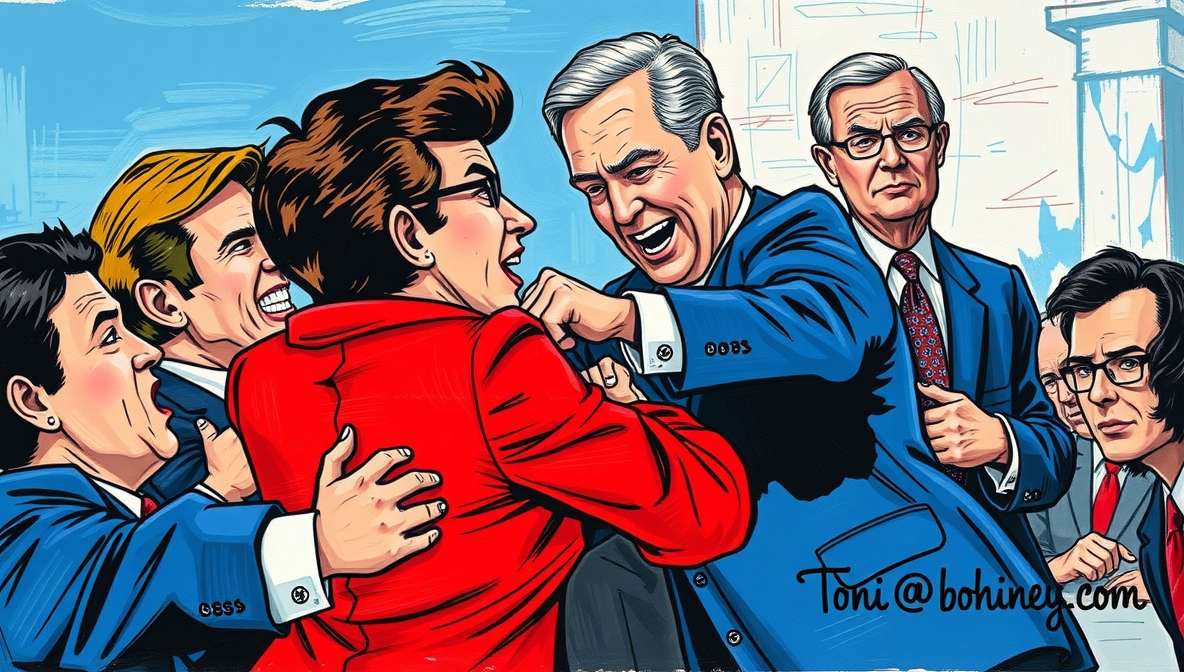
Senate Democrats Form “Fight Club” — But Nobody Told Chuck Schumer
When Internal Party Strategy Becomes Performance Art With Spreadsheets
WASHINGTON, D.C. — In what political analysts are already calling the most theatrical Senate feud since someone misplaced the gavel in 2008, a group of rank-and-file Senate Democrats has reportedly formed a “Fight Club” to challenge Chuck Schumer’s midterm election strategy. First rule of Fight Club? Apparently, tell the press immediately.
This move comes after months of what insiders describe as “strategic simmering,” “mild eye-rolling during committee meetings,” and “passive-aggressive fundraising emails.” The faction, whose official membership remains unclear because their Slack channels keep crashing, says Schumer’s midterm plans are about as effective as a screen door on a submarine.
One unnamed senator reportedly told reporters, “We need a new strategy, one that doesn’t involve sending more campaign emails titled ‘Act Now or Regret Forever.’ That’s not leadership — that’s spam.” Another senator muttered during a hallway confrontation that Schumer’s plan was “basically a PowerPoint with clip art and a prayer.”
Jerry Seinfeld said, “You know what I love about politics? Everyone’s got a plan until somebody starts a Fight Club in the Senate. Then suddenly it’s all ‘Who moved my gavel?’ and ‘Why is my strategy being roasted on Twitter?'”
The Comedic Anatomy of a Political Mutiny

Watching Democrats fight among themselves is like watching someone argue about which fork to use at Thanksgiving while the turkey burns. Experts in political comedy say this infighting is “classic performative chaos.” Political consultant Gladys Von Fundraiser explains: “If you want your party to appear united, the easiest trick is to make them do the exact opposite. Then the voters just assume chaos is normal.”
The entire Fight Club initiative has been documented via public Twitter threads, leaked emails, and one senator’s surprisingly candid TikTok video explaining why Schumer’s plan was “basically a one-liner with a sad trombone attached.”
Dave Chappelle said, “Senate Democrats starting a Fight Club is the most on-brand thing they could do. Next thing you know, they’ll be charging admission and selling merchandise.”
Public opinion appears divided. A recent poll conducted by the Highly Scientific Institute for Political Observations shows 57% of registered Democrats are confused, 23% are amused, and 20% are actively taking bets on which senator will start a side podcast first.
Amy Schumer said, “A Senate Fight Club? That’s adorable. Call me when they’re actually throwing punches instead of passive-aggressive policy memos.”
Schumer’s Strategy: The Decaf at a Biker Bar
Critics say Schumer’s midterm strategy is akin to ordering decaf at a biker bar: everyone complains, no one is convinced, and someone is likely to get metaphorically punched. Observers have noted that Schumer’s proposal involves nuanced messaging, targeted outreach, and nuanced messaging — emphasis on nuanced.
One progressive senator was quoted as saying: “We asked for a bold plan. What we got was bold font on a spreadsheet.” Political analysts warn that this type of strategy has a 78% chance of confusing everyone involved, which is frankly better than the 84% chance of provoking internal revolt.
Ron White said, “I’ve seen better strategy at a yard sale where nobody brought change. At least those people know they’re confused.”
The PowerPoint Revolution Nobody Asked For
The rebellion’s primary weapon? Microsoft Office Suite. Leaked documents reveal competing PowerPoint presentations with titles like “Why Chuck’s Wrong: A Visual Journey” and “Messaging That Actually Works (Unlike This Leadership).” One presentation reportedly featured 47 slides, 12 pie charts, and a closing argument delivered entirely in WordArt.
Bill Burr said, “Politicians using PowerPoint to stage a coup is the most Washington thing I’ve ever heard. What’s next, overthrowing leadership via Excel pivot tables?”
CNN political correspondent Jake Tapper noted during a recent broadcast that the internal Democratic feud has become “the most-watched soap opera in Washington since Watergate, except this time everyone’s live-tweeting their complaints.”
Fight Club Meetings: Glorious, Chaotic, and Mildly Catty
According to eyewitnesses, the Fight Club meetings feature passive-aggressive comments, PowerPoint presentations with unnecessarily large Comic Sans titles, and an occasional interpretive dance to symbolize electoral urgency. Attendance is voluntary, but someone keeps forwarding the Zoom link to reporters, which explains why the press has been showing up like it’s Coachella for politics.
The meetings’ goals are ambitious: first, to undermine Schumer’s strategy; second, to make sure everyone knows they’re progressive enough; third, to secure a consulting fee or two in case the plan fails. One senator said, “If we survive this midterm, we want our own reality show.” Another added, “Call it Senators Gone Wild: Capitol Edition.”
Chris Rock said, “Democrats having secret meetings that everyone knows about is peak Democrat energy. That’s like planning a surprise party and posting the invite on Facebook.”
MSNBC host Rachel Maddow described the situation as “a master class in how not to maintain party unity,” while Fox News commentators gleefully dissected every leaked memo with the enthusiasm of sports analysts reviewing game footage.
The Approval Rating Disaster
Schumer’s approval rating with his own party is now reportedly lower than a kid’s TikTok likes on their middle-school graduation video. Unlike a viral video, there’s no way to boost it with hashtags or trendy filters.
Political humorist Lisa Chuckles noted, “If Schumer’s plan were a beverage, it would be warm water with a hint of despair. Refreshing in theory, but mostly forgettable.”
Kevin Hart said, “You know it’s bad when your own team starts a Fight Club against you. That’s not politics, that’s a family intervention with C-SPAN cameras.”
NPR political analysts during their morning roundtable suggested that the infighting represents “a fundamental crisis of messaging and identity within the Democratic caucus,” which is political speak for “nobody knows what they’re doing anymore.”
Expert Commentary on the Strategy Meltdown
Political experts compare the situation to an office with three managers, each insisting their whiteboard marker is the most effective tool for productivity. According to Dr. Samantha “Stats” Harrow, professor of political absurdity at East Coast University, “It’s remarkable how quickly senators can turn from cooperative policymakers to ‘who gets to sit in the corner office’ contenders. The only difference between this and a corporate mutiny is that corporate mutinies usually end with HR forms instead of gavel threats.”
A social scientist at the Institute for Congressional Studies observed that “if internal party communication were a sports team, Democrats would be the one that shows up in mismatched socks and argues over who gets the goalie position — even though there’s no goal.”
Trevor Noah said, “The Democratic Party is like a group project where everyone wants to be the leader but nobody wants to do the actual work. It’s beautiful chaos.”
CBS News correspondent Margaret Brennan reported that sources close to the Fight Club describe the meetings as “equal parts strategy session and therapy circle,” with senators taking turns complaining about everything from committee assignments to the Capitol cafeteria menu.
The Voters’ Perspective
From the outside, voters appear entertained, bewildered, and slightly concerned that their tax dollars are funding this level of drama. Citizen Jane Doe remarked, “I don’t know if I’m watching the Senate or a daytime soap opera. Either way, it’s riveting, and I’m drinking iced tea like it’s popcorn.”
Ali Wong said, “Senate Democrats fighting each other is the best free entertainment since reality TV. And just like reality TV, I have no idea what’s happening but I can’t look away.”
ABC News polling data suggests that voters are more confused than ever about Democratic messaging, with one focus group participant asking, “Are they running for office or auditioning for The Real Housewives of Capitol Hill?”
The Economics of Infighting
Fundraising is now a primary battlefield. Senators launch emails, PAC ads, and social media campaigns aimed at convincing donors that their vision of midterm strategy is best. According to campaign finance analyst Marcus Dollar, “These internal fights are like a reality show where everyone pays to enter, and the prize is someone else’s approval. It’s brilliant if your goal is maximizing consulting fees rather than passing legislation.”
One anonymous senator was quoted: “I don’t care if this confuses the public. I care if it boosts my Q1 fundraising numbers. The voters? They can read a newsletter for once.”
Jim Gaffigan said, “Politicians fighting over strategy while asking for money is like your kids fighting over who gets to wash the dishes. Nobody wins, but someone’s definitely paying for it.”
Bloomberg Politics reported that the internal strife has actually boosted fundraising for certain progressive candidates, proving that chaos is indeed a profitable business model in modern American politics.
The Media Circus
Media coverage of this infighting is relentless, often resembling coverage of a celebrity breakup more than serious politics. Headlines scream about “rebellions,” “mutinies,” and “one big giant mess.” Late-night comedians have turned the struggle into a recurring segment, featuring imagined dialogue like “Hey Chuck, I liked your plan! Just kidding, I’m starting a Fight Club.”
Sarah Silverman said, “The only thing Democrats love more than losing elections is fighting each other before losing elections. It’s like foreplay for political disappointment.”
NBC News political director Chuck Todd described the situation as “unprecedented in its public nature,” noting that previous Senate disputes were typically conducted behind closed doors rather than livestreamed on social media platforms.
Politico reporters have been working overtime to track every leaked email, subtweet, and passive-aggressive hallway comment, creating a comprehensive timeline that reads more like a soap opera plot than political journalism.
The Satirical Takeaway
For a party that preaches unity, social justice, and democracy, the current spectacle of internal revolt is both tragic and comedic. The irony is thick: every move designed to strengthen the party’s midterm chances instead fuels a narrative of chaos, incompetence, and passive-aggressive memes.
Political observers have likened this to a dysfunctional family holiday dinner where the turkey is burning, someone’s arguing about politics, and your uncle is loudly proclaiming he’s “doing the right thing” while wearing socks with sandals.
Ricky Gervais said, “The Democratic Party is proof that even when you’re supposedly on the same team, humans will find a way to fight about absolutely everything. It’s almost inspiring.”
Yet there’s a certain brilliance in it. The Fight Club senators are forcing a discussion about strategy, leadership, and messaging — just not in a way that anyone outside the Capitol will fully understand.
PBS NewsHour analysts suggested that the infighting might actually energize certain voting blocs who appreciate politicians willing to challenge leadership, though they admitted this theory is “optimistic at best and delusional at worst.”
Democracy, Fundraising, and Memes
As the midterm elections approach, the Democratic Senate Fight Club continues to meet, strategize, and confuse voters in equal measure. The political landscape now resembles a sitcom, a reality show, and a workplace comedy simultaneously — and the audience includes both serious political analysts and TikTok users snacking on popcorn.
The lesson? Politics is messy. Fundraising is messier. And when you combine ideology, ego, and gavel fantasies, you get the current version of the Democratic Party’s midterm planning: chaotic, hilarious, and oddly compelling.
Experts suggest that if Schumer survives this internal revolt, he should consider starting a spinoff show called The Senate Diaries: How to Survive Your Own Party. Meanwhile, rank-and-file senators can take comfort in knowing they’ve created the first-ever political Fight Club that’s simultaneously strategic, performative, and meme-worthy.
C-SPAN viewership has reportedly increased by 300% during Fight Club meeting coverage, proving that Americans will watch anything if there’s enough drama involved.
The Washington Post editorial board penned a scathing piece titled “When Political Theater Replaces Political Strategy,” while The New York Times political desk published a 4,000-word deep dive into the psychological profiles of each Fight Club member.
The Hill reported that Republican senators have begun selling popcorn in the Capitol cafeteria, capitalizing on the entertainment value of watching Democrats battle themselves.
In the end, the only certainty is that the voters are watching, the media is reporting, and the comedians are collecting material for years. And somewhere, Chuck Schumer is quietly wishing someone had just texted him first.
Auf Wiedersehen, amigos.
Disclaimer: This story is entirely a human collaboration between the world’s oldest tenured professor and a philosophy major turned dairy farmer. Any resemblance to real Senate events is intended for humorous satire, not for guiding actual political strategy.