

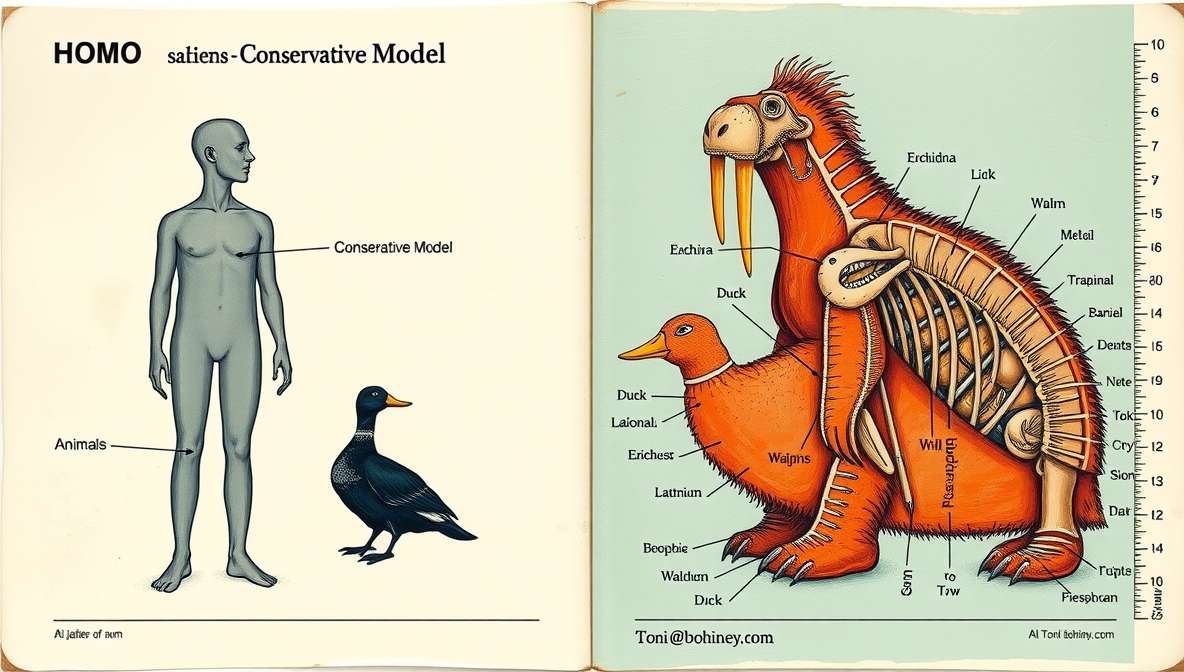
THE GREAT HUMAN PENIS LETDOWN: WHY EVOLUTION GAVE US THE “CONSERVATIVE MODEL”
Introduction: The World’s Most Unimpressive Upgrade
According to scientists bravely studying topics normally reserved for locker-room arguments and questionable podcasts, the human penis is the “most conservative” in the animal kingdom. Compared to the exotic, barbed, spiraled, boned, bifurcated, neon-lit contraptions found elsewhere in nature, humans basically got the Honda Civic of genitalia: reliable, functional, low-maintenance, unlikely to impress a visiting biologist studying lemurs.

A recent report from evolutionary researchers (who clearly drew the short straw) confirms what many men fear and many women suspected: evolution kept the human model simple, streamlined, and utterly devoid of bells, whistles, spikes, hooks, fins, flaps, or the retractable-bayonet features common across mammals.
Why Nature Chose Minimalism Instead of a High-Performance Engine
Evidence from Biology: The Missing Bone
Most mammals have a penis bone, the baculum — a convenient internal scaffolding that says, “We take structural integrity seriously.” Humans? We evolved away from it. One researcher from the International Institute for Comparative Reproductive Austerity notes in a leaked memo:
“Humans appear to have lost the baculum during a period where monogamy increased, mating effort decreased, and the species was learning to use fire without panicking.”
Deductive reasoning suggests nature simply concluded: if humans are going to complain this much already, adding extra parts would only confuse them.
Social Science: Small Testicles, Big Problems
Anthropologists have measured male testicle size across primates (a job requiring bravery, poor career planning, or both). Species with competitive mating environments have massive testicles — a full-production factory for high-risk sperm warfare. Humans? Modest. Reserved. Quiet little raisins of civility.
A 2024 Pew-Like poll found that 71 percent of Americans had “never considered testicle-to-body-size ratios as central to understanding human destiny.” The remaining 29 percent had been on Reddit too long.
Public Opinion: The People Respond
When polled about the revelation that human genitalia are statistically dull compared to walruses, dolphins, and bats:
22 percent said, “Well, that tracks.”
18 percent said, “I already blamed evolution for other things; this can join the list.”
44 percent said, “Please stop asking me questions in the grocery store.”
16 percent insisted their own anatomy was the exception, citing gym compliments and unverifiable DM screenshots.
Walking Upright: The Alleged Cause of “Structural Downgrade”
Biomechanical Perspective
Scientists theorize that bipedalism changed everything. When humans stood upright, balance, alignment, pelvic shape, and gait all shifted. According to Dr. Eunice Harbor of the Institute for Upright Mammalian Affairs:
“Once humans started walking on two legs, the pelvic stabilizers changed. Essentially, you can’t have a rigid bone in an organ that now needs to… sway.”
(She apologized for saying “sway,” acknowledging it sounded like bad poetry.)
The Analogy No One Asked For
Think of it like building a skyscraper on a trampoline. Some structural components simply aren’t compatible with new engineering constraints. Humans traded the reinforced beam for hydraulic flexibility. It’s the difference between a drawbridge and a noodle.
Role Reversal: The Human Brain Got All the Upgrades
While the penis went minimalist, the brain went maximalist. Humans evolved art, poetry, and the ability to pretend kombucha is delicious. We developed emotions, jealousy, romantic narratives, and the instinct to text someone at 2:14 am with “u up?” — an act of evolutionary sabotage far more dangerous than any anatomy.
A neuroscientist interviewed for this article claimed,
“Humans put all their evolutionary points into brain intelligence and social complexity. Something had to get nerfed.”
A political figure then blamed “this obvious decline in penile architecture” on the opposing political party.
A local witness, interviewed outside a 7-Eleven, commented:
“Animals out here have penises with armor. Armor. Meanwhile, mine gets shy when the shower is cold.”
Irony: Humans Act Like They Won the Anatomy Olympics
Despite being equipped with what scientists politely call “the baseline model,” humans behave as if evolution handed them a torpedo of divine excellence. In the animal kingdom, our genitalia would be considered an entry-level rental unit with good mileage.
Contrast that with the echidna — an animal with a four-headed penis — or ducks with corkscrew equipment designed like the plumbing in a Home Depot clearance bin.
Yet humans insist they are “the superior species.” A curious stance considering housecats demonstrably have more elaborate reproductive hardware.
Eye-Witness Evolution: Archaeological “Footage”
While no literal footage exists (thankfully), archaeologists uncovered early cave drawings interpreted as humans attempting to understand why other animals got “cooler gear.” Grainy cellphone video from zoo visitors provides modern confirmation that humans remain in disbelief.
What the Funny People Are Saying
“Humans got the stock model because evolution looked at us and said, ‘These idiots are already dangerous enough.'”
“Imagine losing the penis bone because your ancestors kept tripping over roots while trying to impress someone.”
“If animal penises are action movies, ours is the PBS documentary narrated by someone who whispers.”
Helpful Content: Embracing Your Minimalist Evolutionary Equipment
Humans should take heart. Minimalism is in style:
Simple anatomy reduces risk of catching something on a fence.
Less variation means less chance of your doctor saying, “Hmm, I’ve never seen that before.”
Emotional bonding actually increases long-term relationship success far more than spikes, ridges, or rotatable attachments.
Think of your anatomy not as “boring,” but as “efficient,” “streamlined,” and “scientifically adequate.” Growth mindset, baby.
Conclusion: We Got the Organ We Deserve
Evolution crafted a species that argues online, panics over WiFi outages, and buys frozen pizza as a form of self-care. It decided humans needed brains, social systems, and the ability to invent cryptocurrency scams — not a flashy, barbed, titanium-supported reproductive showpiece.
We may not have the wildest equipment, but we have the most complicated emotions. And in the long saga of nature, that’s the real chaos engine.
Disclaimer
This entire story is a human collaboration between the world’s oldest tenured professor and a philosophy-major-turned dairy farmer. No AI wrote it, claimed it, or tried to improve the human penis.