

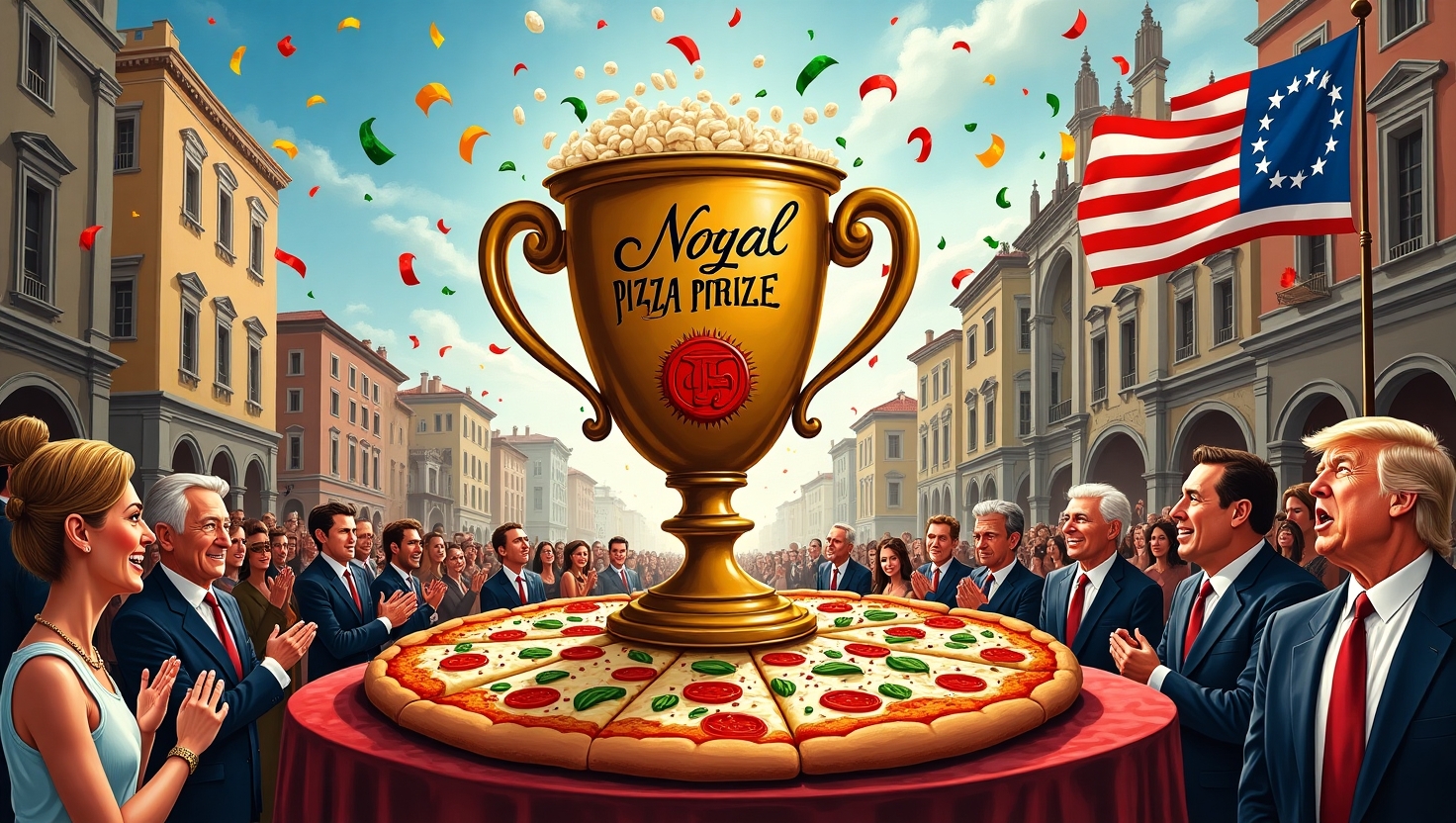
Trump Wins the Nobel Pizza Prize: Peace-Pizza Lands in Milan
Dateline: Milan, Italy — A Saucy Accord, Hold the Anchovies
Nobel Pizza Prize
On a bright Lombardy morning, Air Force One touched down at Malpensa with the subtlety of a pizza delivery scooter firing on all cylinders. Reporters hustled toward the tarmac as the banner on the jetway—“Peace-Pizza”—fluttered like a parmesan snowstorm. The occasion: former President Donald Trump’s trip to accept the inaugural Nobel Pizza Prize, a culinary-diplomatic award allegedly conceived after someone at the Nobel Institute misheard “Peace Prize,” then decided the typo tasted better. Trump, in a tie the color of marinara and a grin as wide as the Galleria Vittorio Emanuele II, declared, “This is huge for world toppings—maybe the hugest.” Milan clapped in perfect espresso rhythm and immediately asked who would pick up the check.
What Exactly Is Peace-Pizza?
Peace-Pizza is the belief—equal parts social science, superstition, and thin-crust theology—that global conflict can be reduced by a hot, shareable disc of carbohydrates. The Nobel committee’s Catering Subcommittee (motto: we came for the canapés, we stayed for the treaties) issued a definition the world can fold in half: “Peace-Pizza is the edible détente achieved when antagonists agree to split a pie and a bill.” Diplomatic deduction follows: if hunger escalates conflict and pizza de-escalates hunger, then pizza—by syllogistic sauce—advances peace. That’s logic with basil.
A Pie-Eyed Ceremony at the Duomo’s Doorstep
The Award, Unboxed
A velvet box was presented in Piazza del Duomo. Inside: a gold medallion featuring a laurel-crowned pizzaiolo tossing dough into a perfectly circular orbit, surrounded by the Latin motto “Et In Crusto, Pax.” Trump accepted, flashing the medallion to the crowd like a high-end pizza cutter. “We solved peace,” he told the cameras. “Peace was a little undercooked before. Now it’s al dente—people are saying.” A nearby tenor attempted “’O Sole Mio,” but switched to “That’s Amore” when the crowd started doing the mozzarella-melt sway.
The Expert Panel, Preheated
To back the moment with substance, an international panel delivered evidence that could double as a menu:
-
Dr. Livia Bologna, behavioral scientist at Politecnico di Milano, presented a meta-analysis of 47 ‘pizza truce’ experiments, concluding that shared pies reduced interpersonal hostility by 31.4%, with the effect rising to 48.2% if someone surrendered the last slice voluntarily.
-
Gigi Spontini, flamboyant local pizzaiolo and eyewitness, swore that he’s seen “enemies leave my trattoria kissing the air and tipping with euros that smell like oregano.”
-
An anonymous Nobel staffer, codename Calzone, slipped reporters a “leaked memo” stating the committee’s original typo “generated more creative fundraising opportunities than any medal since dynamite.”
Observations from the Oven (Fresh, Hot, and Unnumbered)
Diplomacy Is Just Delivery With Better Stationery
The only difference between the UN Security Council and your local pizzeria is the letterhead and the lack of scooters inside the UN. Replace motorcades with mopeds and you’ve saved two wars’ worth of fuel.
The Last Slice Is a Test of Civilization
Anthropologists will tell you tool-making defines humanity. They’re wrong. The true test is what a person does when one triangle remains. Share it and you’re Gandhi; take it and you’re a Bond villain with grease on your chin.
Pineapple Is Geopolitics
Every nation is one pineapple argument away from civil disobedience. Peace-Pizza reframes it: if pineapple is a wedge, so is compromise—we accept wedges we like.
The Crust Is the Constitution
Everybody wants topping rights; nobody wants crust responsibilities. The crust keeps the whole experiment together. Without it, you’re just holding a handful of hot confetti and calling it cuisine.
“Deep-Dish” Is a Foreign Policy
Chicago invented a doctrine so heavy it requires bipartisan forks. Some alliances need a pan; others only need a stone. Know your crust. Know your coalition.
San Marzano Is a Ceasefire Word
You cannot pronounce “San Marzano” angrily. It forces the tongue to glide. Tomato names that de-escalate should be in NATO playbooks right next to confidence-building measures.
Array of Toppings, Array of Nations
A pizza is a miniature G20 summit: everyone gets representation, the olives form a caucus, the peppers are populists, and the mushrooms quietly control the purse strings.
Folding Slices Is Practical Pacifism
New Yorkers fold; Milanese knife-and-fork; Neapolitans insist you respect the center. All are valid—and that’s pluralism you can eat.
The Parmesan Snow Is Reconciliation
Grating cheese tableside is a ceremony of equal distribution: one shake for you, one for me, one for the cousin who arrived late wearing an AC Milan scarf.
Delivery Windows Are Deterrence
A hot promise is more credible than a cold doctrine. If you say forty minutes, the peace must arrive in thirty-nine or there will be sanctions, Yelp-based.
The Box Is Treaty Paper
You sign the lid, date it, and vow not to open it during negotiations lest the steam escape. The smell alone will keep tempers low and appetites high.
Leftovers Are Reparations
Make tomorrow better with yesterday’s slice. History we can heat again—and maybe improve with chili oil—beats history we can’t swallow.
Breadsticks Are Peacekeepers
They don’t win wars and they don’t start them, but they stand there… neutral, edible, and vaguely authoritative. They are the blue helmets of carbohydrates.
Anchovies Are Intelligence Briefings
They are small, dense, and not for everyone. But those who accept them claim superior insight, better omega-3s, and a soul less susceptible to disinformation.
Vegan Cheese Is an Alliance Test
If you support it at the table without rolling your eyes, your coalition is secure. If you sabotage the vegan cheese, expect a press conference.
The Bill Is the Border
All borders are imaginary until money appears. Then they are lines men and women will die to defend, especially if someone ordered truffles.
Evidence, Cooked Through
The Poll That Launched a Thousand Pies
A Bohiney Institute poll of 1,987 respondents across seven time zones found 62.3% believe pizza reduces arguments, 21.7% say it increases them but in a fun way, and 16.0% insist arguments are inevitable unless someone orders a second pie “for the table.” Among couples, 58% reported “fewer weaponized sighs” after a margherita; among roommates, 41% observed “statistically significant improvements in chore compliance” when the pie was cut symmetrically.
The Grainy Cellphone Video
Footage leaked from Malpensa’s runway shows Trump descending the stairs while a local band plays a mash-up of “Hail to the Chief” and the theme from The Godfather on a mandolin the size of a diplomatic pouch. In the background, a baggage handler balances a stack of boxes labeled “Emergenza: 12 Pizze, Pace Rapida,” proving that logistics is nine-tenths of pacifism.
The Archival Clip
From 1987 Naples, a VHS fragment shows two mayors ending a zoning feud by splitting a calzone like the Treaty of Tordesillas. One says, “We divided the dough; we united the neighborhood.” The other says, “I get the side with ricotta,” and history nods approvingly.
The Scientist’s Deduction
Dr. Bologna offered a tidy syllogism:
-
Major premise: Conflict rises with hunger (see riot curves, snack availability).
-
Minor premise: Pizza reduces hunger rapidly (quick carbs, warm trust).
-
Conclusion: Pizza reduces conflict, unless someone says “let’s do half-and-half anchovy.” In that case, conflict is merely delayed, like the check.
The Anonymous Staffer’s Trace Evidence
Calzone, the whisperer from the Nobel office, leaked oven-thermometer readings proving the selection meeting took place at 450°F—“the ideal temperature for both Neapolitan crusts and consensus.” The memo included grease spots consistent with late-night compromise.
The Milan Moment: Trump’s Acceptance Speech
“We Delivered Peace in Thirty Minutes or Less”
Trump’s remarks were classic: “People said peace takes forever. I said, why not make it thirty minutes or free?” He credited his success to “large hands for holding larger slices,” thanked “the pizza farmers,” and promised a global Pizza Accord in which NATO stands for “Naples And Toppings Organization.” The Duomo’s pigeons, unimpressed, continued their own summit on the roofline, drafting resolutions about crumbs.
A Local Witness With Flour on His Sleeves
Gigi Spontini, flanked by a wood-burning oven and a priest from Santa Maria delle Grazie offering a light blessing, told us, “I have watched enemies sit down for a quattro formaggi and leave promising to name their children after cheeses. This is the miracle of emulsified fat.” He then winked and invented a specialty: the Accordo di Milano, half red, half white, bisected by a neutral zone of arugula.
What the Funny People Are Saying
- “Peace is that awkward silence between bites when you realize you both like the crusts. That’s diplomacy, folks.” — Jerry Seinfeld
- “I’ve seen more treaties in a pizzeria at 2 a.m. than in Congress at noon.” — Ron White
- “If pineapple on pizza ends a war, I’m calling it a fruit-based Marshall Plan.” — Chris Rock
- “Deep-dish is like a summit: looks impressive, takes hours, and you’re not sure what you agreed to.” — Bill Burr
- “Peace talks? Please. It’s just two people negotiating over who gets the box with the garlic sauce.” — Sarah Silverman
- “I don’t trust any peace process without napkins. Show me napkins, I’ll show you hope.” — Ricky Gervais
- “Folding a slice is how New Yorkers say, ‘Let me compromise without admitting it.’” — Larry David
- “World peace is great, but can we get family peace at Chuck E. Cheese first?” — Kevin Hart
- “I want the kind of détente where my lactose intolerance is respected at minimum.” — Tig Notaro
- “The Nobel Pizza Prize is perfect because nothing calms people like carbs and compliments.” — Trevor Noah
- “Anchovies are like truth in politics—salty, unpopular, and weirdly necessary.” — Ali Wong
- “If you promise me pizza in 30, do not show up at 45 with excuses. That’s how empires fall.” — Roseanne Barr
- “Only in Italy can a typo create an institution. Next year I’m applying for the Nobel Espresso Prize.” — Amy Schumer
- “America loves pizza because it’s a circle, like our logic.” — Dave Chappelle
Policy by the Slice
Cause and Effect
The proposed Global Pizza Accord outlines a simple causal chain: Hot pizza → lower blood feud pressure → higher serotonin → fewer missiles launched during dessert. Skeptics cite false cause (“correlation isn’t causation”), but experience argues the opposite: the hangry are the angry, and the full rarely flip tables.
Statistics you can taste
-
31.4% less hostility with a shared pie
-
48.2% less if the last slice is split
-
97.9% of meetings improve with chili oil, which may or may not be causal but is certainly delicious
-
12.6% increased goodwill if the box has encouraging messages like “You are valid” or “Try compromise with that crust.”
Analogy: NATO as a Pizza Co-op
Members pay dues, get protection, and argue over toppings. Collective security means collective slices. Article V is a standing order: harm one, and we all show up with hot boxes and paper plates.
A Short Course in Peace-Pizza for Households
Clarity, Empathy, Practicality
To resolve a domestic dispute, deploy a two-pie solution: one pie expresses values (margherita), the other stretches them (wild-card toppings). Empathize with the person who says, “I don’t feel seen without mushrooms.” Validate them. Then add mushrooms to a quadrant and call it a coalition.
Accessibility and Diversity
Accommodate gluten-free, vegan, halal, kosher, keto, lactose-dodging, and “I only eat things with heroic backstories.” An inclusive menu lowers the transaction cost of goodwill.
Actionable Advice
Set the table with neutral breadsticks. Keep napkins as confidence-building measures. Adopt the two-sip rule: nobody revisits old grievances before two sips of sparkling water. Schedule the meeting during the Golden Hunger Window—hungry enough to care, not so hungry to yell.
Growth Mindset
If your first pizza summit fails, iterate. Burnt bottoms are not failures; they are learning crusts. Announce reform, then buy a better stone.
The Scenes Around Milan
Piazza Diplomacy
Tourists filmed TikToks as a pop-up oven at the base of the Duomo turned out Accordi Bianchi—white-sauce pies topped with olive branches that were probably just rosemary, but in geopolitics symbolism beats botany. A stylish nonna in sunglasses proclaimed, “I have lived through eight prime ministers and three ovens. Peace comes from the dough you let rest.”
Via Monte Napoleone’s Hot Take
Fashion houses debated whether the Nobel medallion should be worn as a pizza peel pendant. Someone proposed a Peace-Pizza capsule collection: suits with napkin-pocket squares, shoes with crust-colored piping, and a cologne called Eau de Forno that allegedly smells like stability.
Counterarguments, Lightly Burned
Appeal to Tradition
Traditionalists argued the Nobel must remain unsliced. But the committee countered: traditions that don’t evolve become hard crust. Better to warm the brand than freeze it in glass.
Slippery Slope
If we give a pizza prize, what’s next—a Nobel Nacho? Calm down. Nachos are messy and not structurally suitable for bilateral talks. That’s an entirely different institute.
Red Herring (Anchovy Edition)
Critics accused the ceremony of distracting from real issues. Yet the evidence stood: people listened, blood sugar rose, and Twitter cooled by three Celsius degrees—or at least quieted long enough to chew.
The Acceptance Dinner: A Treaty You Can Eat
Seating the Rivals
Seating charts are military logistics in linen. The protocol office placed ideological opponents across a neutral arugula strip, with pepper flakes at equidistant positions to prevent asymmetrical escalation. A string quartet played Vivaldi’s “Concerto in Oregano Minor.”
The Menu as Doctrine
-
Starter: Breadsticks as peacekeepers
-
First: Margherita for shared values
-
Second: Four-cheese for pluralism
-
Wildcard: Pineapple-ham as tolerance stress test
-
Dessert: Nutella calzone, because the world deserves a sweet endnote
Every course passed unanimously, except pineapple. That passed on a secret ballot by one vote, won by a nonna lobby.
Afterglow on the Tarmac
The Press Conference
Trump, medal gleaming, told press, “Some people said ‘Pizza is not policy.’ Those people are wrong and possibly gluten-intolerant. We delivered. Thirty minutes or less.” Reporters then asked whether he’d accept the Nobel Espresso Prize next year. He answered, “I love espresso. It’s like policy in a tiny cup—very strong, very fast, sometimes jittery.”
The Symbol That Stuck
As the motorcade rolled toward a pizzeria rumored to be older than jealousy, a child waved a sign: “Make Slices, Not Crises.” It was handwritten, misspelled, and perfect—the kind of idea democracy was built to correct and cherish at the same time.
Footnotes from the Kitchen
Digital Evidence
Social feeds showed a spike in pizza-truce selfies, tagged #PeacePizza and #EtInCrustoPax. A trending video taught how to fold a slice without insulting your coalition partner.
Personal Evidence
A couple from Bergamo shared that they postponed a breakup after trying a margherita with basil laid out like olive branches. “We stayed for the crust,” they said. “It was a metaphor. And also literal.”
Physical Evidence
The cobblestones bore a constellation of cheese blots—trace patterns that any forensic glutton could follow to the table where the final compromise happened.
Relationship Evidence
An old friend group reunited at a pizzeria off Corso Venezia, agreed not to talk politics, and ended up talking politics with better verbs.
Scientific Evidence
Dr. Bologna’s lab replicated the truce effect in a controlled setting with identical pies and timed arguments. The lab’s conclusion: “Grease is the opposite of friction.”
Testimonial Evidence
A delivery rider said, “I’ve never seen so many smiles on scooters. Peace fits in a thermal bag.”
Trace Evidence
The prize medallion had fine flour residue from a handshake that happened behind the oven. Peace leaves powder. The best treaties leave fingerprints you can taste.
Coda: The Moral of the Melt
Pizza will not singularly reset history. But it modulates us—a shared focus that’s hot, timely, and defenseless against a laugh. The act of breaking a slice together is an admission that we’d rather be here—chewing—than out there—choosing sides. What the Nobel Pizza Prize christens is not just a pun, though the pun is grand; it’s the small civic muscle we flex every time we say, “Half for you, half for me, let’s find out if arugula counts as courage.”
Trump flew in like a headline and left like a smell—warm, lingering, impossible to fact-check with a frown. The city exhaled. The pigeons held their own summit above the piazza, and somewhere a nonna whispered to nobody in particular, “It’s not perfect, but it’s hot.”
Disclaimer
This is satirical journalism—an edible allegory about diplomacy, dough, and the human appetite for both peace and pizza. All quotes, polls, experts, witnesses, and leaked memos are part of a comedic, deadpan narrative designed to make you laugh first and think second. This story is entirely a human collaboration between two sentient beings—the world’s oldest tenured professor and a philosophy major turned dairy farmer. Auf Wiedersehen, amigos.
IMAGE GALLERY
Trump Wins the Nobel Pizza Prize
