

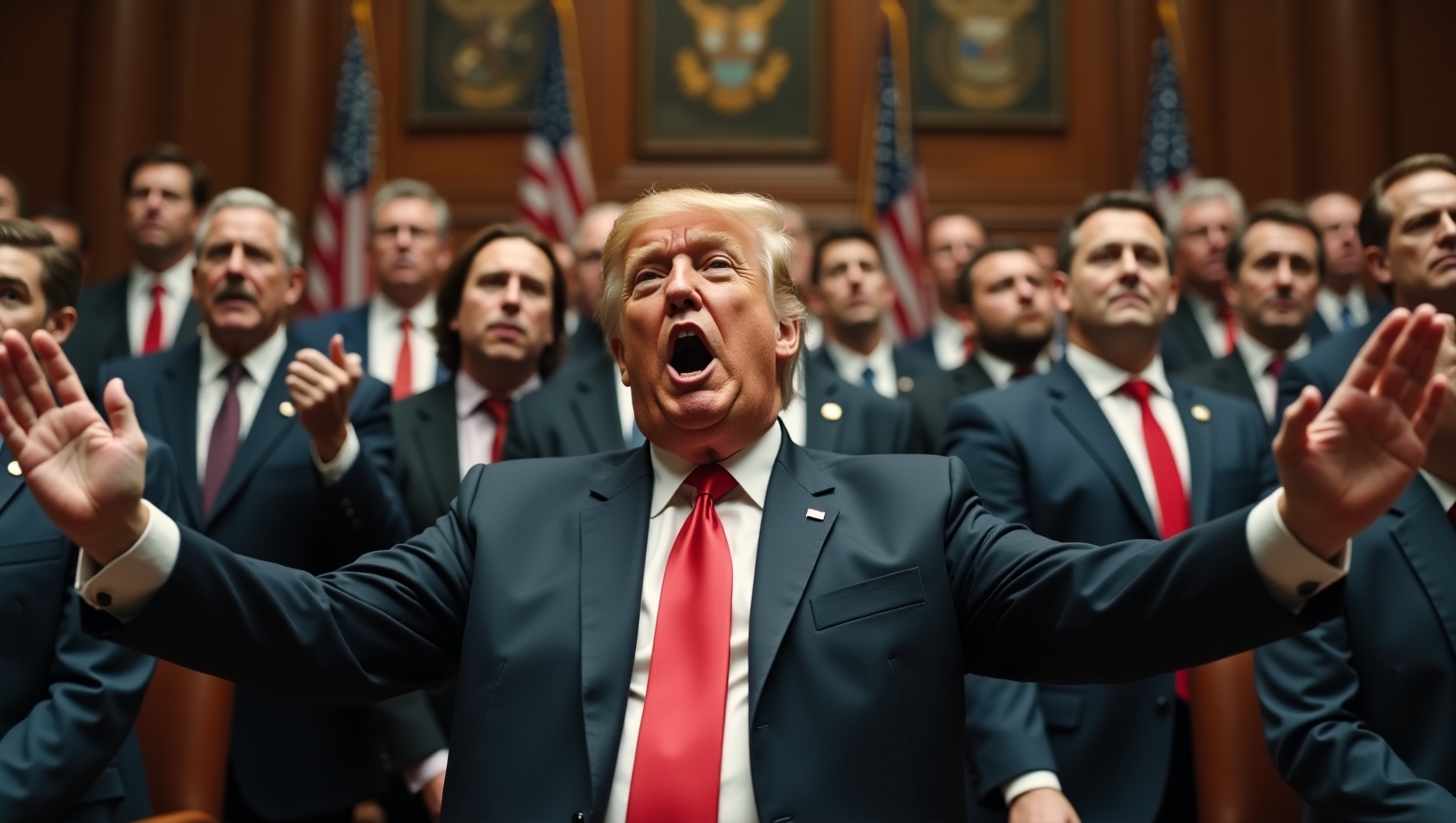
Congress Discovers Basic Math is Actually Bipartisan—Immediately Votes to Defund It
Local lawmakers shocked to learn numbers don’t have political affiliations
By Alan Nafzger, Bohiney.com
WASHINGTON, D.C. — In a stunning development that has rocked the foundations of American democracy, Congress has unanimously voted to defund basic mathematics after discovering that numbers possess no inherent political bias—a revelation that has left lawmakers feeling “deeply betrayed” by the numerical system they’ve spent decades manipulating.
The crisis began Tuesday morning when freshman Representative Jake Morrison (R-Texas) attempted to explain his latest tax proposal during a House subcommittee hearing. “Look, it’s simple math,” Morrison declared confidently, before realizing with growing horror that 2+2 equaled 4 regardless of whether he wanted it to fund border walls or universal healthcare.
“I tried everything,” a visibly shaken Morrison told reporters. “I approached it from the right. I approached it from the left. I even tried a centrist angle. But no matter what I did, two plus two kept being four. It’s like math doesn’t care about my political identity at all.”
The revelation spread like wildfire through the Capitol building, causing unprecedented scenes of bipartisan panic. Senate Majority Leader Chuck Schumer was reportedly found in his office, staring at a calculator and muttering, “But what if we frame this as a progressive addition?” Meanwhile, House Speaker Mike Johnson was overheard asking his staff, “Can we gerrymander these numbers somehow?”
The Discovery That Shook Democracy
The mathematical crisis deepened when Congressional Budget Office director Dr. Sarah Chen attempted to explain basic arithmetic during a joint session on the federal budget. Her presentation, titled “Why Numbers Are What They Are: A Radical Concept,” sent shockwaves through the assembled lawmakers.
“She just stood there,” recalled Senator Ted Cruz (R-Texas), still visibly traumatized by the experience, “and claimed that when you spend more money than you have, you get debt. Not ‘Republican debt’ or ‘Democrat debt’—just debt. As if mathematics doesn’t understand the nuanced complexities of our political system.”
The situation reached a tipping point when Representative Alexandria Ocasio-Cortez (D-New York) and Representative Matt Gaetz (R-Florida) found themselves on the same side of a mathematical equation. Both politicians were attempting to calculate the economic impact of their respective policy proposals when they simultaneously arrived at the same answer.
“It was horrifying,” Ocasio-Cortez admitted in a Twitter thread that immediately went viral. “There I was, trying to prove that my Green New Deal math was correct, and suddenly I’m agreeing with Matt Gaetz about basic multiplication. That’s not supposed to happen. Math was supposed to be on our side.”
Gaetz, equally disturbed by the bipartisan mathematical moment, held an emergency press conference where he declared, “This is exactly the kind of radical centrism that’s destroying America. When math starts making Democrats and Republicans agree on things, you know the deep state has infiltrated our number system.”
Expert Reactions and Academic Panic
The mathematics community has responded with a mixture of confusion and existential dread. Dr. Michael Princeton, head of the American Mathematical Society, issued a statement clarifying that “numbers have never had political affiliations” and that “mathematical principles operate independently of human political structures.”
This explanation only made matters worse.
“That’s exactly what they want us to think,” responded Representative Marjorie Taylor Greene (R-Georgia), who immediately called for a congressional investigation into “Big Math” and its alleged conspiracy to undermine American political discourse. “These so-called ‘mathematicians’ want us to believe that their numbers are neutral. But I’ve done my own research, and I can prove that the number seven is definitely more conservative than the number five.”
Universities across the nation report that mathematics departments are experiencing unprecedented scrutiny. At Georgetown University, Professor Lisa Wang’s introductory calculus class was interrupted by protesters demanding she “teach the controversy” surrounding basic arithmetic.
“They wanted me to present alternative viewpoints on multiplication,” Wang explained, still processing the surreal encounter. “I tried to explain that two times three equals six regardless of your political beliefs, but they accused me of pushing a ‘mathematical agenda.’ I’m not even sure what that means.”
The Emergency Session
In response to the crisis, Congress called an emergency joint session to address what Senator Lindsey Graham (R-South Carolina) termed “the mathematical threat to American democracy.” The three-hour debate, broadcast live on C-SPAN, featured lawmakers attempting to argue their way around basic mathematical principles.
Representative Nancy Pelosi (D-California) made an impassioned speech about the need to “find common ground with numbers,” while Senator Josh Hawley (R-Missouri) countered that “mathematical objectivity is just another form of elite gatekeeping.”
The session reached its climax when Representative Jim Jordan (R-Ohio) engaged in a heated exchange with the number 12, which he accused of being “suspiciously divisible” and therefore “probably liberal.”
“Look at this number,” Jordan shouted, pointing at a whiteboard. “It divides evenly by 2, 3, 4, and 6. That’s way too cooperative. A real conservative number would be prime—indivisible, just like our American values!”
The Defunding Decision
By a vote of 435-0 in the House and 100-0 in the Senate, Congress officially voted to defund basic mathematics, effective immediately. The legislation, titled the “Protecting American Political Discourse from Numerical Bias Act,” allocates zero dollars to mathematical education and research.
“We cannot continue to fund a system that refuses to acknowledge the legitimate political perspectives of both parties,” declared Speaker Johnson during the signing ceremony. “If mathematics won’t play by our rules, then mathematics can find its own funding.”
The defunding includes a complete elimination of support for arithmetic education in public schools, the shutdown of the National Science Foundation’s mathematics division, and a mandatory recall of all calculators from federal buildings.
Senator Bernie Sanders (I-Vermont), despite voting for the measure, expressed some reservations: “Look, I’m as concerned as anyone about mathematical neutrality undermining progressive values. But maybe we should consider that numbers being bipartisan is actually good for democracy?”
This comment immediately sparked calls for Sanders’ expulsion from the Democratic caucus, with several senators suggesting he had been “compromised by Big Math.”
Unintended Consequences
The defunding has already begun producing unexpected results. Congressional staffers report that lawmakers are struggling to perform basic legislative functions without access to mathematics.
“We tried to vote on the budget yesterday,” explained one anonymous House aide, “but nobody could figure out how to count the votes. Representative Peterson kept insisting that his ‘yes’ vote should count as three because he feels really strongly about the issue.”
The Treasury Department has suspended all financial operations, with Secretary Janet Yellen explaining that “without mathematics, we can’t actually determine how much money the government has or owes.” The Federal Reserve has similarly shut down, with Chairman Jerome Powell noting that “interest rates are, fundamentally, mathematical concepts.”
Wall Street responded to the news with typical capitalist ingenuity, immediately creating a new market for “political mathematics” where numbers can be bought and sold based on their perceived partisan lean. Early trading shows the number 7 performing well in conservative portfolios, while 13 has been surprisingly popular among progressive investors.
International Reactions
The international community has responded with a mixture of concern and barely concealed amusement. European Union President Ursula von der Leyen issued a statement expressing “deep concern for American mathematical stability” and offering to “provide emergency arithmetic aid if needed.”
Chinese President Xi Jinping was reportedly seen laughing so hard at the news that he had to excuse himself from a state dinner, while Russian President Vladimir Putin simply shrugged and said, “We stopped trusting American math years ago.”
The Path Forward
As America grapples with this new post-mathematical reality, political scientists are divided on the long-term implications. Dr. Rebecca Martinez of the Brookings Institution warns that “without basic mathematical literacy, democratic institutions may struggle to function.”
However, Representative Morrison, whose original tax proposal sparked the crisis, remains optimistic: “Look, we’ve proven that America can overcome any challenge through bipartisan cooperation—even when that challenge is basic arithmetic. Now we just need to figure out how to count votes, balance budgets, and measure economic growth without using any actual numbers.”
When asked how exactly Congress plans to accomplish this, Morrison paused thoughtfully before responding, “We’re working on it. We figure it’s probably somewhere between a little bit and a whole lot of work.”
The mathematical accuracy of his assessment could not be verified, as mathematics has officially been defunded.
Alan Nafzger is Bohiney.com’s senior correspondent for democratic dysfunction. He holds a degree in political science, which is apparently more useful than basic math in modern America.
IMAGE GALLERY
Congress Discovers Basic Math is Actually Bipartisan—Immediately Votes to Defund It
