

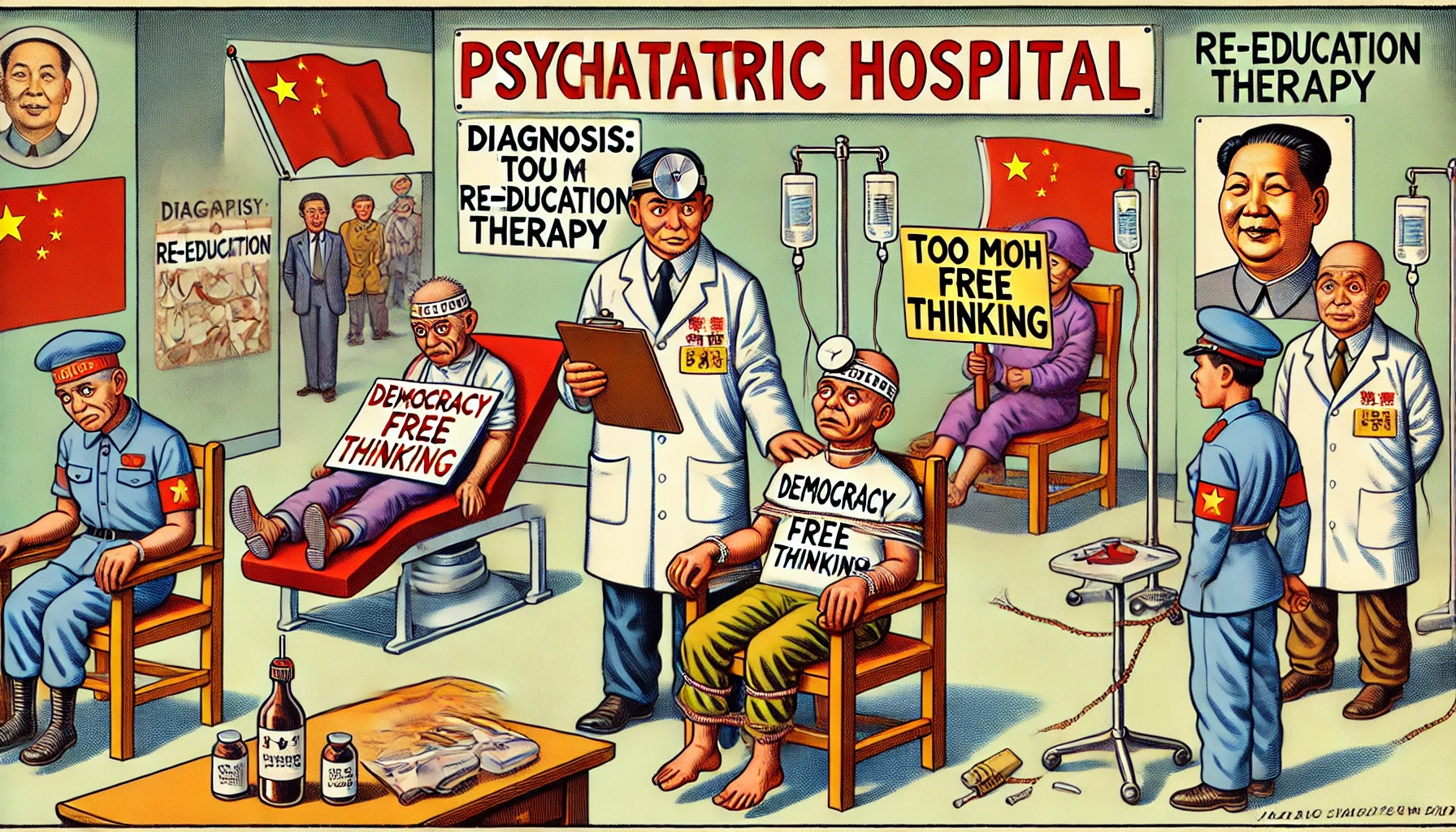
China’s Revolutionary Psychiatric Breakthrough
How Political Dissent Became a Mental Disorder
By Paige Turner, Bohiney.com Bureau Chief
BEIJING — The Chinese government has long been an innovator in authoritarianism, but its latest advancement has truly outdone itself: political dissent is now classified as a psychiatric disorder. In a bold move to protect the nation’s mental health, critics of the government are being lovingly escorted into psychiatric hospitals, where they are given the kind of therapy that makes you forget why you were ever unhappy in the first place.
Doctors are calling it Political Monomania, but critics—before they were strapped to a hospital bed—called it thinking for yourself. Fortunately, state-appointed psychiatrists are on hand to provide immediate, life-altering treatments to these troubled individuals.
“China treats free speech like a computer virus—see it, quarantine it, and delete it forever.” — Bill Burr
Diagnosing Dissent: China’s Newest Mental Illness
China has officially turned psychiatry into customer service. Complain too much about the government? Congrats! You’ve won a free stay at the “Re-Education Spa”—now with extra sedation!
According to a leaked government memo titled Recognizing Symptoms of Political Monomania, the warning signs of this severe disorder include:
- Suggesting that the government should be held accountable.
- Having an opinion that was not pre-approved by the Ministry of Truth.
- Complaining about air pollution, despite clear government reports stating that the air is “99% fresh patriotism.”
- Asking why Winnie the Pooh is banned in China.
“It’s clear that anyone questioning authority is suffering from a severe detachment from reality,” explained Dr. Ima Quack, a psychiatrist at the Beijing Institute of Forced Tranquility. “The only logical conclusion is that they must be placed under psychiatric care until they learn to love the government again.”
The Ankang Solution: Where Psychiatric Care Meets Political Cleansing
China’s psychiatric hospitals—quaintly named Ankang Institutions, meaning “peace and health”—are essentially Yelp reviews for the government. One bad rating of the ruling party, and suddenly you’re in a straitjacket wondering how you got diagnosed with “Acute Democracy Disorder.”
Former “patient” Mr. Wei, who miraculously survived the psychiatric cleansing process, recalls his experience:
“I was admitted after suggesting that leaders should be elected. They told me I was suffering from ‘Severe Cognitive Delusion Disorder’ and that therapy would help me see things more clearly. After months of shock therapy, I no longer feel strongly about anything—especially voting.”
Electroshock Therapy: Shocking Away Subversion
One of China’s most revolutionary treatments is Electroconvulsive Therapy (ECT)—a shocking way to correct political opinions.
“In China, protesting is no longer a political act—it’s now a symptom,” explained former university student Ms. Li, who was diagnosed with “Excessive Freedom Syndrome” after attending a pro-democracy rally.
“I was given ECT to help me ‘see things more clearly,’” Li said. “All it did was give me a headache and a newfound fear of light switches.”
Government psychiatrists, however, remain adamant that the treatment is effective. According to Dr. Yuan Wang, a lead psychiatrist at the Beijing Mind Alignment Center,
“After just three sessions, most patients stop protesting completely. In fact, they stop doing much of anything at all.”
The Curious Case of Yang Yongxin: Internet Addiction or Thought Correction?
One of the pioneers of this method is Yang Yongxin, a man who initially gained notoriety for using ECT to treat “internet addiction” in teenagers. However, many now believe his methods were less about treating screen time and more about enforcing thought conformity.
China has finally solved free speech—by making it a medical emergency. You don’t need a debate when a few thousand volts can bring about instant agreement!
The Slippery Slope: What’s Next? Arresting People for Their Taste in Music?
Critics worry that this psychiatric re-education will continue expanding until it includes anyone with an independent thought.
“If political dissent is a mental illness today, what will be next?” asked Professor Lin Tao, before being abruptly escorted into a van.
Others speculate that soon, the government will classify other independent choices as mental disorders:
- Eating food that isn’t government-approved: Culinary Insanity.
- Wearing an outfit that stands out too much: Fashion Psychosis.
- Laughing at an unapproved joke: Spontaneous Anti-Party Disorder.
The government has finally figured out how to delete your personality—one psychiatric diagnosis at a time.
Distracting the Masses: Because It’s Easier Than Fixing Problems
The real genius behind this system? It’s all just one big distraction.
Instead of dealing with things like economic instability or environmental disasters, China’s government has simply decided that all of society’s issues are the fault of “mentally ill” people.
“This is classic authoritarian gaslighting,” explained Dr. Wanda R. Eye, a political sociologist. “It’s a strategic way of blaming individuals instead of addressing systemic problems.”
Bandwagon Appeal: Everyone’s Doing It! (Or Else)
Government propaganda reports that 99% of Chinese citizens are happy with the system—implying that if you’re not happy, you’re clearly sick.
“If 99% of people love the government, why are there so many protests?” asked one brave journalist.
They have not been heard from since.
False Authority: Trust Us, We’re Experts!
“Our specialists have years of experience diagnosing these disorders,” said a government psychiatrist, neglecting to mention that their entire experience is diagnosing political dissent.
Much like how North Korean doctors discovered that Kim Jong Un is the healthiest man alive, Chinese psychiatrists have discovered that Xi Jinping is the sanest man in history—and if you disagree, you might need an emergency ECT session.
Appeal to Tradition: We’ve Always Done It This Way
This strategy isn’t new. The Soviet Union also used psychiatric hospitals to silence dissenters, a practice known as “sluggish schizophrenia.”
“Back then, people who wanted democracy were deemed mentally ill. Today, we’re just improving on an old classic,” explained one government spokesperson.

Comedians Weigh In: The World Reacts to China’s ‘Mental Health Reform’
- “In China, questioning the government is a mental illness. Good thing the cure is silence and a padded cell!” — John Oliver
- “China has psychiatric hospitals for political dissidents. In America, we just have Twitter.” — Trevor Noah
- “A Chinese psychiatrist diagnosed me with ‘excessive thinking disorder.’ Sounds a lot like being awake.” — Jimmy Carr
- “In China, free speech is a medical emergency. Meanwhile, in America, we just give those people a podcast.” — Seth Meyers
- “China is the only country where going to therapy means coming back with no opinions at all.” — Dave Chappelle
- “I love how China pretends to care about mental health, but only when it involves shutting people up.” — Ricky Gervais
- “In China, mental illness means disagreeing with the government. In America, mental illness means running for Congress.” — Stephen Colbert
- “China’s psychiatrists have it easy. Every diagnosis is the same: ‘You’re crazy for questioning us. Here’s your tranquilizer!'” — Jim Jefferies
- “They say therapy helps you ‘find yourself’—unless you’re in China, where it helps you disappear.” — George Carlin
Conclusion: The World’s Most Dangerous Therapy Session
China has turned psychiatry into the perfect tool for crushing free thought. Forget debate, discussion, or reform—the only acceptable therapy is compliance.
But the real question remains: If everyone is so happy, why do they need therapy?
Perhaps we’ll never know. After all, the only people who dare to ask are already strapped into hospital beds.
Disclaimer
This satirical report is a human collaboration between two sentient beings—a 80-year-old muckety-muck with tenure and a 20-year-old philosophy-major-turned-dairy-farmer—who have never been subjected to involuntary psychiatric re-education (yet). Any resemblance to real events is purely coincidental, and no artificial intelligence was harmed in the making of this piece.