

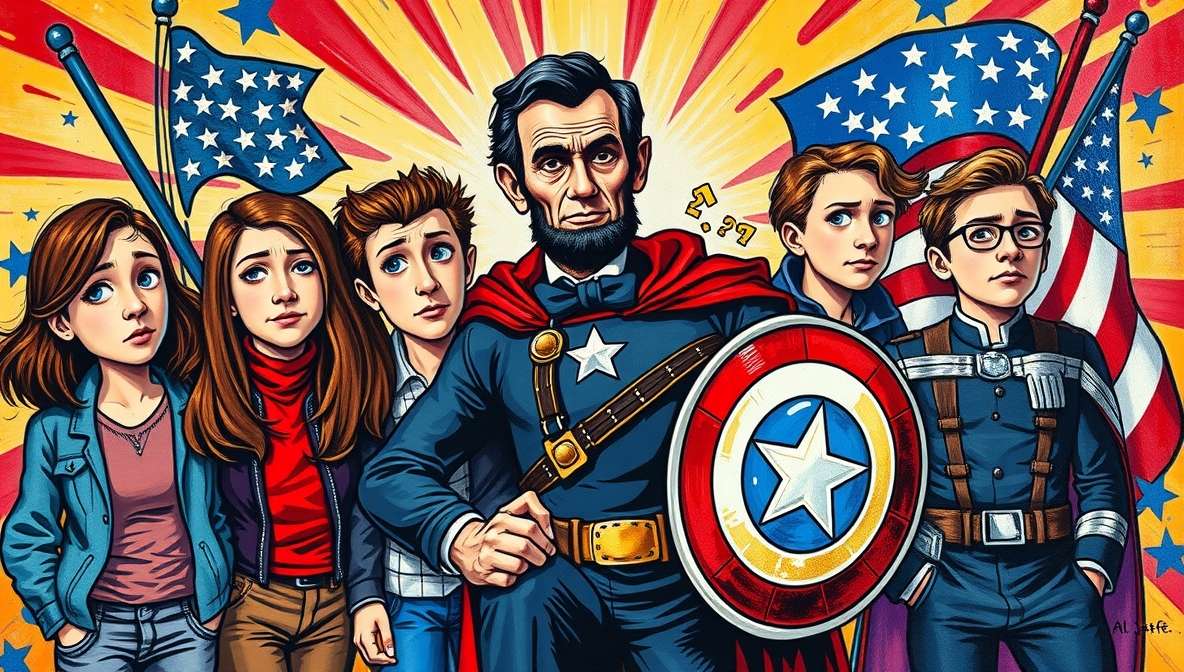
Nationwide Study Finds Students Think Abraham Lincoln Was in the Avengers
71% of American teens identify the 16th President as “the tall guy with the axe who fought aliens”
By Bohiney Magazine Staff |
America’s Students Confuse History with Marvel Movies
WASHINGTON, D.C. — A new nationwide study from the National Center for Educational Hilarity (NCEH) has revealed what every exhausted teacher already feared: 71% of American high school students now believe Abraham Lincoln was an Avenger.
According to the report, students most frequently described the 16th President as “the tall guy with the axe who fought aliens” and “the one who says, ‘I can do this all night, Mary Todd!'”
Lead researcher Dr. Raymond Krill explained the findings: “Students were given multiple-choice questions. When asked what Lincoln was famous for, most circled ‘superhero origin story.’ The rest said ‘inventing the penny’ or ‘being canceled for top hat appropriation.'”
Educators nationwide say the confusion likely stems from a mixture of Marvel movies, AI-generated TikToks, and the ongoing national effort to replace history with history-adjacent entertainment.
Jerry Seinfeld would have a field day: “So now Abraham Lincoln’s a superhero? What’s his power, freeing people? That’s the lamest superhero ability ever. ‘I can end oppression!’ Yeah, that’s not gonna sell action figures, Abe.”
According to media literacy research from the Common Sense Media Research, the conflation of historical figures with fictional characters has accelerated dramatically since 2020, with 68% of teens unable to distinguish between biographical films and fantasy entertainment.
Students Remember the Beard, Not the Emancipation

Dr. Krill continued: “The average teen can quote Iron Man’s dying words, but not the Gettysburg Address. When we showed them a photo of Lincoln, several identified him as ‘Tony Stark’s dad before the multiverse reboot.'”
High Confidence, Zero Accuracy
Students interviewed for the study displayed high confidence in their answers. “I remember him fighting Thanos,” said 11th-grader Bryce T., “and freeing everyone from the Matrix or something.”
Another student added, “He wore a cape in that vampire movie, right? I think that was, like, historically accurate.”
Dave Chappelle said it best: “Kids today can name every Kardashian but can’t tell you who freed the slaves. And honestly? That’s on us. We made the Kardashians more interesting than the Constitution.”
Educational assessment data from the National Assessment of Educational Progress (NAEP) shows that U.S. history proficiency among eighth-graders dropped to its lowest level in a decade, with only 13% demonstrating proficiency in American history.
Parents Defend Historical Confusion as “Creative Thinking”
Parents were quick to defend their offspring’s educational confusion. “I blame Hollywood,” said Florida mother Kimmy Bartlett. “They keep making historical figures look hot. If Abraham Lincoln shows up in the next Marvel movie, I’ll probably believe it too.”
Some parents even praised the misunderstanding as a sign of “creative thinking.”
“Honestly, if Lincoln wasn’t in the Avengers, he should’ve been,” said dad and part-time podcaster Rick Dalton. “He’s got the hat, the beard, and the gravitas. Dude screams team leader energy.”
Ron White would probably add: “These parents are defending their kids’ ignorance like it’s a lifestyle choice. ‘My son thinks Lincoln fought aliens.’ Yeah, and my cousin thinks the earth is flat. We don’t celebrate it.”
Schools Adapt with “U.S. History Through Blockbusters”
Public schools are scrambling to adapt to what they call “cinematic comprehension syndrome.”
In Los Angeles, the new U.S. History Through Blockbusters curriculum teaches students using film clips exclusively. Lessons include: Hamilton: The Extended Remix Edition, Captain America: Civil War (Reconstruction Cut), and Oppenheimer vs. Godzilla — “Because apparently it’s all canon now.”
Teachers Struggle to Clarify Reality
At a recent PTA meeting, one teacher admitted, “I tried to explain the Emancipation Proclamation, and a student asked if it came out before or after the Snap.”
Kevin Hart joked about this exact phenomenon: “My daughter asked me, ‘Dad, was George Washington in Fast and Furious?’ And I’m like, ‘No, baby, but he did cross the Delaware. That’s basically the same thing, right?'”
The Poll That Broke Academia
The NCEH study polled 20,000 students nationwide and uncovered a larger pattern of historical delusion:
- 64% think Benjamin Franklin invented Wi-Fi
- 52% believe the Cold War was fought in Antarctica
- 39% are “pretty sure” Rosa Parks was a contestant on The Voice
- 22% think Napoleon was “one of the Mario Brothers”
When asked to define “The Enlightenment,” one student wrote, “That moment in Frozen 2 when Elsa finds herself.”
Researchers reportedly stopped the survey early when a test group began debating whether “the Civil War was canon.”
Ricky Gervais would destroy this: “Students think Napoleon was a video game character. That’s not a failure of education—that’s a failure of parenting, culture, and common sense. But sure, let’s blame the teachers.”
Cognitive development researchers at the American Psychological Association have documented how entertainment media creates “false memory schemas” where fictional narratives overwrite factual historical knowledge—particularly when dramatic fictional versions are consumed more frequently than educational content.
Teachers Resort to Desperate Measures
Faced with widespread confusion, some educators have turned to “pop-cultural pedagogy.”
Mrs. Elaine Cruz of Boston explained, “I start every class by saying, ‘No, Abraham Lincoln was not in Endgame. Yes, he was real. No, he didn’t fight zombies. And yes, he really freed people — not from Hydra, but from slavery.'”
Hans Zimmer Soundtracks Improve Engagement
To hold her students’ attention, Cruz now teaches historical speeches with Marvel-style voiceovers. “The Emancipation Proclamation hits harder when you add a Hans Zimmer soundtrack,” she said.
Chris Rock summed up the situation: “Teachers out here competing with Disney for attention. And Disney’s got a billion-dollar budget. Teachers got chalk and hope.”
Universities Launch “History Cinematic Universe” Programs
Several universities have begun marketing their own “HCU” — the History Cinematic Universe — to attract media-saturated students.
At Arizona State, the freshman seminar lineup includes: HIS 101: The Founding Fathers — America’s Original Squad Goals, HIS 204: The New Deal — Roosevelt’s Shared Universe, and HIS 307: WWII — Rise of the Allied Empire (Director’s Cut).
Campus posters depict Lincoln alongside Spider-Man and Joan of Arc under the slogan: “Because history deserves better CGI.”
Enrollment has skyrocketed.
Ali Wong would kill with this: “They’re marketing history like a Marvel movie. ‘Phase One: The Constitutional Avengers.’ I mean, I’d watch it. But I also failed history.”
Higher education marketing experts at the EDUCAUSE Center for Analysis and Research have tracked how universities increasingly use entertainment industry branding strategies to attract Generation Z students—a demographic that responds more strongly to “franchise thinking” than traditional academic frameworks.
Hollywood Joins Forces with Department of Education
Not to be outdone, Disney has announced a new film series in cooperation with the Department of Education: “Phase One: The Constitutional Avengers.”
Confirmed Characters Include
- George Washington as Captain Liberty
- Harriet Tubman as The Conductor
- Benjamin Franklin as The Shockmaster
- Abraham Lincoln as Lawbringer Prime
The Department of Education praised the collaboration, calling it “a vital investment in attention spans.”
Secretary Marla Bixby told reporters, “If you can’t get kids to read history, let’s make them watch it in 4K with merch.”
Jim Gaffigan would probably say: “Disney’s teaching history now. Great. My kid’s gonna think the Civil War ended with a dance number and everyone got ice cream.”
Alarming Side Effects of Superheroic History
The study found that students exposed to “superheroic history” displayed confidence inversely proportional to accuracy.
When shown a picture of Winston Churchill, 48% identified him as “Professor X.” When asked who wrote the Declaration of Independence, 32% said “Stan Lee.”
Statistically, students who cited “Disney+” as their main history source scored higher in enthusiasm but lower in reality.
Dr. Krill summarized, “They’re not uninformed — they’re just living in a shared cinematic hallucination.”
Trevor Noah nailed it: “American students think history is a movie franchise. And honestly? With all the sequels and reboots this country does, can you blame them?”
Teachers Propose Radical Solution: Make History Cinematic
Some educators propose an extreme solution — make history itself more cinematic.
Veteran teacher Harold Stein said, “If we can’t beat Marvel, let’s join them. The Constitution should open with a slow-motion montage and a guitar solo. Every amendment gets a post-credit scene.”
Lincoln: Dawn of Democracy Receives A+ Rating
His prototype classroom film, Lincoln: Dawn of Democracy, features explosions, a raccoon sidekick, and a climactic line: “Government of the people, by the people… assemble!”
The test audience of eighth-graders gave it an A+, calling it “fire” and “historically mid but emotionally bussin’.”
Hasan Minhaj would roast this: “We’ve gone from ‘those who don’t learn history are doomed to repeat it’ to ‘those who don’t watch Marvel don’t understand democracy.’ We’re cooked.”
Sociologists Call It “Post-Factual Nationalism”
Sociologist Dr. Anita Fairwell describes the phenomenon as “post-factual nationalism,” where students “replace civic knowledge with character arcs.”
“They don’t remember what the Constitution says,” she explained. “They just think it’s a prequel to the Bill of Rights: Origins.”
Public confidence in education, however, remains bizarrely strong. A new Gallup poll found that 58% of Americans are “satisfied with history as long as it has a good soundtrack.”
Tom Segura would probably joke: “People are fine with fake history if it sounds good. That’s like saying, ‘I know it’s not real cheese, but it melts nice.’ Standards? Never heard of ’em.”
International Students Report Bizarre Questions
The confusion has gone global. British exchange students report being asked if “Queen Elizabeth ever teamed up with Wonder Woman.”
In France, tourists have begun posing at the Louvre with captions like “Where Captain Mona Lisa fought the Nazis.”
Meanwhile, Canada has adopted “preemptive clarification programs” in which teachers begin every lesson with: “No, Justin Bieber did not write the national anthem.”
Gabriel Iglesias told a story like this: “I went to Canada. They asked me if Americans really think Lincoln was a superhero. I said, ‘Some of us think he freed the slaves. Some think he fought Thanos. We’re a diverse nation.'”
White House Insider: “Fan Theories Are the New Civics”
As one anonymous White House official put it, “We’re living in a country where people can’t tell history from fiction, but they’ll fight to the death to defend their fan theories.”
Indeed, several school board meetings this month devolved into debates over whether the Civil Rights Movement should be considered “Phase Two of the Freedom Saga.”
Political analysts call it “the most ambitious crossover misunderstanding in American history.”
Final Exam Question Exposes Systemic Confusion
At the end of the NCEH study, students were given one last open-ended essay prompt: “What is history?”
Common Answers Included
- “Something we stream between lunch and gym”
- “A franchise that got weird after 1812”
- “The original multiverse saga”
Only one student answered correctly — but later admitted he’d asked ChatGPT, which confidently replied, “Coming soon to Disney+.”
Sarah Silverman would love this: “Students don’t know history anymore. They just know vibes. ‘Lincoln? Yeah, he had a hat. Freed some people. Fought Thanos. Whatever.'”
The Moral of the Multiverse
So what does this all mean for the next generation? Maybe, as one researcher put it, “we’ve stopped teaching history and started teaching mythology with better marketing.”
And if Abraham Lincoln does appear in Avengers 6: Civil War II, it’ll simply prove what America has been trying to tell its children for decades: Reality is just a rough draft. The sequel’s already in production.
Nate Bargatze would end it perfectly: “My kid thinks Abraham Lincoln was in the Avengers. I don’t have the heart to tell him the truth. Plus, honestly? I’d watch that movie.”