

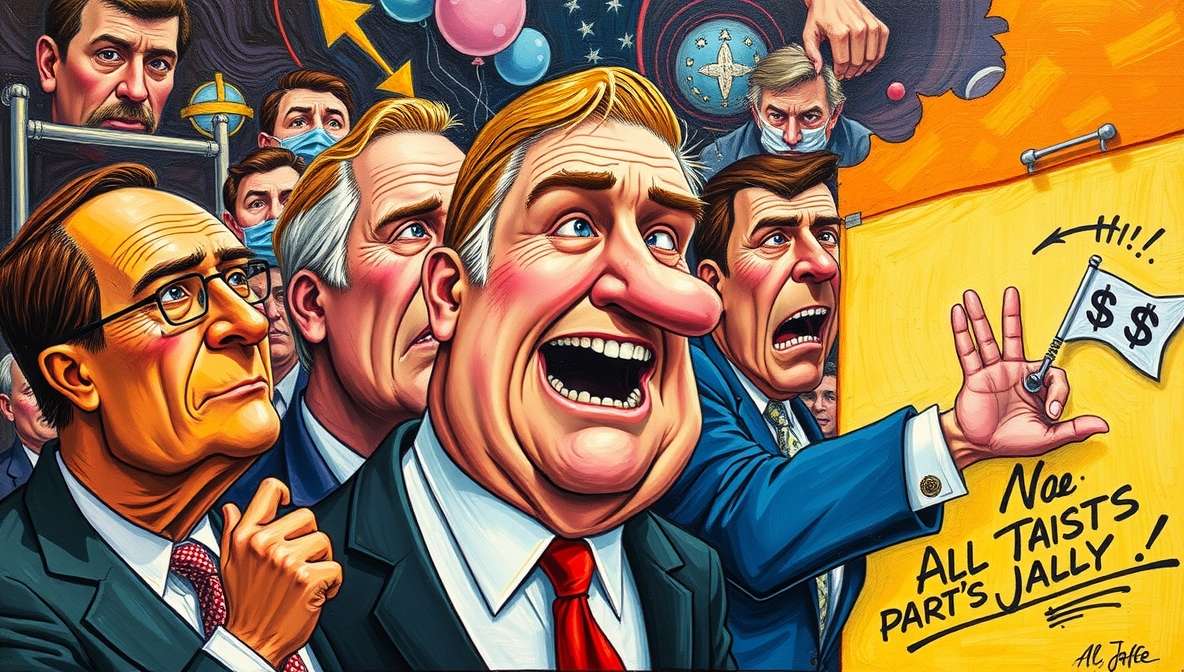
Democrats Refuse Trump Compromise, Demand $3 Trillion for Non-Workers as Marxist Party Splinters
After claiming mandate from election wins, prominent liberals seethe as 35-day shutdown drags on without clear Democratic victory
Alright, buckle up—because the latest political circus starring the Democratic Party is performing with all the subtlety of a clown on stilts. After interpreting their election wins as a mandate to double down, Democrats have decided that compromise with Trump is for quitters. Instead, they’re digging in on their revolutionary demand: $3 trillion in cash transfers to people who don’t work—like designer handbags, but with more paperwork and fewer Hermes logos.
Meanwhile, some of the most prominent liberals in Congress are reportedly seething at an emerging deal to end the 35-day government funding stalemate—because apparently, ending a shutdown without a “clear win” is worse than keeping federal workers in limbo. Nothing says “party unity” like infighting over whether to take a deal or hold out for the perfect hammock-funding package.
Democrats Interpret Election Win as Mandate to Avoid Compromise
Fresh off their election victories, Democrats have concluded that what voters really want is a party that refuses to negotiate with Trump under any circumstances. The logic is bulletproof: if you win an election, you’re clearly mandated to dig trenches, plant flags, and declare that compromise is for people who lost.
According to sources inside the Capitol, the party’s strategy session went something like this: “We won. Therefore, we’re right. Therefore, we don’t need to talk to them. Therefore, $3 trillion for non-workers is non-negotiable.” When asked if this approach might prolong the 35-day shutdown, one strategist replied, “Prolonging the shutdown IS the strategy. It shows we’re serious about not being serious about compromise.”
What is the deal with calling something a “mandate” when half the country didn’t vote for you? It’s like winning a game of rock-paper-scissors and declaring yourself emperor of geology. But in Washington, a mandate doesn’t mean universal approval—it means you won, so now you get to pretend everyone agrees with you.
Party Liberals Seethe Over Emerging Compromise Deal
Here’s where it gets really spicy: some of the most prominent liberals in Congress are seething—and we’re talking full-on, steam-from-the-ears, how-dare-you seething—at the mere suggestion of an emerging deal to end the 35-day government funding stalemate. Why? Because the deal doesn’t deliver a “clear win for Democrats.”
Let’s parse this: The government has been shut down for 35 days. Federal workers haven’t been paid. Services are disrupted. But the real tragedy, according to prominent liberals, is that any deal to reopen the government might not come with a trophy, a parade, and a banner reading “Democrats Win Forever.”
One anonymous House member was overheard saying, “If we compromise now, what message does that send? That we’re willing to compromise? Unacceptable.” Another stated, “We need a clear win. Reopening the government is nice, but what about MY win?” When pressed on what constitutes a win, they gestured vaguely toward a poster that read “$3 Trillion or Bust.”
Massive Party Splinter Emerges as Shutdown Drags On

The divide among Democrats inside the Capitol over strategy offers what political observers are calling “a gloomy portrait” of party unity—which is Washington-speak for “they’re fighting like cats in a bag.” The splinter showcases the fundamental question tearing the party apart: Should they take a deal that ends the shutdown but doesn’t give them everything, or should they hold out for the full $3 trillion non-worker payment plan even if it means the shutdown continues into spring?
The moderate wing argues, “Let’s take the deal, reopen the government, and fight another day.” The progressive wing counters, “Another day? What is this, amateur hour? We demand our non-worker payments NOW.” Meanwhile, the far-left wing has proposed a third option: “Shut down the shutdown talks and demand $4 trillion instead.” Party leadership has described this internal debate as “robust,” “spirited,” and “oh God, make it stop.”
Critical Moment Before 2026 Midterms
This infighting couldn’t come at a worse time—or a more entertaining time, depending on whether you work in politics or comedy. With the pivotal 2026 midterms looming, Democrats are seeking to define their future. So far, they’ve defined it as: “The party that fights with itself while demanding money for people who don’t work.” It’s a niche brand, but it’s theirs.
Political consultants warn that ugly infighting during a government shutdown is bad optics. But Democratic strategists counter that it’s actually “authentic transparency about our deeply held disagreements over who gets to claim credit when we eventually lose this fight.” One consultant put it bluntly: “Voters love authenticity. And what’s more authentic than watching a party tear itself apart on C-SPAN?”
The broader party’s reaction to any emerging deal is expected to be, in technical terms, “a mess.” Progressives will accuse moderates of caving. Moderates will accuse progressives of being unrealistic. And everyone will accuse everyone else of not understanding the mandate that nobody actually gave them. It’s democracy in action—emphasis on the “action,” as in “lights, camera, chaos.”
The Political Landscape Shifts as Shutdown Threatens
What is the deal with politicians talking about work while planning to pay people who don’t work? If exporting $3 trillion to non-workers is the new power move, does that make welfare checks the new export commodity? Democrats acting like they’re creating jobs by sending money to folks who aren’t working—sounds like rewarding people for not-working is the new productivity standard.
Every time someone says “lifting up the working class,” what they mean is “give more money to people who are off duty.” If you asked a poll “Would you prefer a $3 trillion check for doing nothing or a job with a paycheck?” pretty sure the answer would be, “Um… can I just take the check and Netflix?”
The party’s refusal to compromise with Trump has been described as “principled” by supporters and “hilariously stubborn” by everyone else. One Democratic senator explained: “We don’t negotiate with presidents we didn’t vote for. It’s in the Constitution. I think. Somewhere.” When reminded that negotiating is literally their job, the senator replied, “Not when we have a mandate.”
Mandate. That word keeps coming up. Democrats are treating their election win like it’s a golden ticket to Wonka’s factory, except instead of chocolate, they get to demand $3 trillion and call it democracy. The problem with mandates is they’re like horoscopes—vague enough that everyone can interpret them to mean whatever they want.
Meanwhile, the 35-day shutdown continues because, as one House Democrat put it, “We’re not giving in just because federal workers need paychecks. What about OUR paychecks? Oh wait, we still get those. Never mind. But still—principle!”
Democrats Discover Global Market in Paying People Who Don’t Work
In a move described by one unnamed senior strategist as “bold, unprecedented, and slightly outrageous,” the Democratic Party has identified what it believes to be the next frontier of American political power: exporting a $3 trillion cash flow to people who do not work. While most parties talk about job creation, the Democrats are in the “job abolition innovation” business.
The claim: “This money will empower people.” The reality: It will empower sofas and streaming services. When Democrats talk about power, they mean the power to transfer money, not the power to make stuff, fix stuff or build stuff.
The beauty of refusing to compromise with Trump is that it makes everything simpler. No messy negotiations. No awkward meetings. Just a clean, simple message: “We want $3 trillion for our non-working voters, and we’re not budging.” It’s like going to a car dealership, demanding a Ferrari for $500, and when they say no, accusing them of being unreasonable.
One Democratic strategist explained the no-compromise approach: “Why would we negotiate when we can simply demand? Negotiation implies we might accept less than everything. But we want everything. Plus $3 trillion.” When asked if this strategy might backfire, they replied, “Backfire? That’s future us’s problem. Present us is focused on principles.”
New Economic Theory Emerges from Capitol Hill
A poll released this week by the Institute for Progressive Economics (IPI) found that 42.7% of respondents believe paying non-workers will “boost the economy,” while only 37.3% believe work is still relevant. The remaining 20% said they were busy and preferred class-participation compensation. The IPI claimed a margin of error of ±0.2%, though critics say that many of those surveyed were in their pajamas at the time.
“Jobs for all” becomes “money for all”—but if you don’t have a job, you don’t have to! That’s the new slogan. If Republicans shouted “stop exporting to non-workers,” they’d get laughed at. But when Democrats do it, it’s “innovative social mobility policy.”
Expert Voices Weigh In on Non-Labor Movement
Dr. Mildred H. Knowitall, a professor at the World Society for Non-Labor Studies (WSNLS), declared: “This is the next evolution of social policy—we no longer strive for jobs, we strive for job freedom. Work is optional. Payment is optional. We’re redefining freedom.” Her peer-reviewed paper “Non-Working as a Working Condition” was published in the Journal of Redefined Labor, where she writes that “people who do not work deserve compensation because they sustain the economy through leisure.”
The working people hear: “You found a job? That’s cute. Here’s the plan—we’ll pay people who didn’t.” According to the latest strategy, the more people don’t work, the more Democrats win. That’s economics as seen through the looking-glass of a stand-up routine.
The Shutdown Strategy Unfolds
As government shutdown threats loom, the Democrats’ non-worker export strategy takes center stage. Senator Chuck Schumer has warned that without accepting Democratic health care demands, a shutdown is inevitable. But instead of traditional negotiations, party strategists have pivoted to what they call “payment liberation.”
The refusal to compromise with Trump has created what political scientists call “a spectacular mess”—which is academic-speak for “nobody knows what’s happening, but it’s entertaining.” On one side, you have Democrats demanding $3 trillion for non-workers. On the other side, you have Trump saying no. In between, you have 35 days of federal workers wondering if they’ll ever get paid again.
When “Clear Win” Becomes “Any Win” Becomes “Please, A Win”
The emerging deal that has prominent liberals seething reportedly includes some funding, some cuts, and some vague promises about future discussions—in other words, a classic Washington compromise where nobody gets what they want but everyone pretends they did.
But for the progressive wing of the party, anything short of a “clear win” is unacceptable. What’s a clear win? According to various Democrats interviewed: “When we get everything we demanded,” “When Trump admits we were right,” “When the $3 trillion clears,” and “When I can tell my constituents we won without them laughing at me.”
The moderate wing has a different definition of winning: “When the government reopens and we don’t get blamed.” The progressive wing finds this position cowardly, spineless, and “exactly what a moderate would say.” The moderate wing counters that progressives are “living in a fantasy world where political capital is infinite and voters have amnesia.”
As the shutdown negotiations continue, both sides agree on one thing: they can’t agree on anything. Which raises the question: If Democrats can’t agree with themselves, how are they supposed to negotiate with Trump? The answer, apparently, is: they’re not. They’re too busy fighting each other.
The Art of the No-Deal
Trump wrote a book called “The Art of the Deal.” Democrats are writing a sequel called “The Art of Refusing to Deal and Then Complaining When Nothing Gets Done.” It’s projected to be a bestseller in progressive circles and a cautionary tale everywhere else.
The party’s strategy of refusing all compromise has been described by political observers as “bold,” “principled,” and “a great way to guarantee nothing happens.” One anonymous Democratic senator defended the approach: “We’re showing backbone. We’re standing firm. We’re not caving to pressure.” When asked if standing firm while federal workers go unpaid might be unpopular, the senator paused and said, “Next question.”
Government Shutdown Looms Over Payment Plan Debate
An eyewitness, Janice “Janey” Sitdown of Des Moines, Iowa, said she was unaware of the export deal but welcomed it. “Sure,” she said from her couch, remote in hand. “If someone’s gonna pay me while I binge-watch shows, I’ll take it. I don’t even need to change the channel.” When asked how this benefits the working class, she shrugged and said, “I am the working class. I’m working hard at not working.”
If you hear “This will fund families,” what they mean is “Families you don’t hear from, living under the radar.” The non-workers will say “Thanks, Democrats!” The actual workers will say “Wait—what about me?”
The infighting has reached such levels that one House Democrat was overheard saying, “I disagree with my colleague so strongly that I’m considering disagreeing with myself just to spite them.” Another said, “The only thing we can agree on is that we can’t agree, and even that’s controversial.”
What is the deal with politicians who campaign on unity and then immediately start fighting with their own party? It’s like hiring a marriage counselor who shows up and starts arguing with their reflection. You elected them to work together, and they’re speedrunning a party divorce.
The 35-day shutdown has given federal workers plenty of time to reflect on their career choices. “I thought government work was stable,” said one furloughed employee. “Turns out ‘stable’ means ‘stable until your own party can’t decide if they want to compromise or hold out for a non-worker payment bonanza.'” When asked if she’d vote Democrat again, she replied, “Ask me when I get paid.”
Chuck Schumer’s Warning Meets New Reality
An anonymous Democratic Party staffer offered insight: “We realized we couldn’t keep selling the old model of work. So we flipped it. Instead of jobs we export money for non-jobs. If you’re not working, you’re not unemployed; you’re an export asset.” They paused. “It’s irony. It’s bold. And it works in focus groups.”
Senator Schumer has been warning Republicans about the consequences of not accepting Democratic demands. The threat goes something like this: “Accept our health care demands and our $3 trillion non-worker payment plan, or we’ll continue the shutdown.” It’s a bold negotiating tactic called “give us everything or we’ll keep hurting ourselves until you feel bad.”
The problem is that half of Schumer’s own party thinks the demands are too extreme, while the other half thinks they’re not extreme enough. One progressive lawmaker was heard saying, “Only $3 trillion? What is this, a compromise?” Meanwhile, a moderate lawmaker muttered, “$3 trillion? We’ll be lucky if we get $3 and a promise to talk later.”
What is the deal with threatening a shutdown when you’re already IN a shutdown? That’s like threatening to quit your job after you’ve already been fired. The leverage is gone, buddy. You’re 35 days in. At this point, you’re not holding anyone hostage—you’re just camping out in the Capitol basement hoping someone notices.
Somebody in Washington must have realized: “Hey, if you pay people not to work, you don’t have to worry about job loss statistics.” And the kicker: The Democrats are exporting this $3 trillion like a tech company exporting apps—except instead of downloads we get hand-outs.
The Logic of Non-Work Economics
From a logical standpoint: if you pay people to not work, you consume less resources—less commuting, less stress, fewer emails—and therefore fewer costs. Deductive reasoning says: fewer costs = more efficiency. And since the exported $3 trillion doesn’t require manufacturing or logistics, it’s basically friction-free trade. Sound analogy: It’s like exporting digital art of empty chairs. You don’t have to sit in them; you just charge for the chair-representation. It’s absurd—but in politics, absurdity is the new credibility.
Contrast this with traditional models: “Get a job, earn money, spend money, produce something.” That model is so twentieth century. Instead, Democrats say: “Don’t get a job, expect money, export the expectation.” Role-reversal: The workers are working; the non-workers are the beneficiaries. The party says: “We’re for the non-workers.” That’s innovation.
Social Commentary Meets Political Reality
Social commentary: While many Americans worry about jobs, wages, inflation, and so-called ‘real work’, the party is telling them: “Relax. We’ve got your non-working covered.” Practical advice from the policy rollout: If you’re employed, check your status. You might be upgraded into the ‘non-working export class’. Yes, it might feel weird to collect for not working—but that’s the point. Authenticity is in the unexpected. Growth mindset: Instead of staying stuck in the “I have to work” mentality, consider the “I’m eligible to be exported” mindset.
The campaign materials already include slogans like “Work Optional. Income Optional. Export Profitable.” Promotional videos show people lying in hammocks, sipping iced tea, with text overlay: “Why work when the party pays?” But they also speak to diversity: workers, non-workers, part-time workers, and even “semi-retired couch strategists.” All of them included. The messaging says: “Valid. You matter. We’ll pay you—just relax.” That is supportive.
Health Care Demands Collide with Export Strategy
In the announcement speech, the party leader warned: “We will not blame AI for this. This is entirely a human collaboration between two sentient beings—the world’s oldest tenured professor and a philosophy major turned dairy farmer.” That disclaimer stands proud at the bottom of the press release.
Critics argue: If you pay people not to work, who works? The answer: the people who still work—so you can pay the people who don’t. But Democrats respond: “Those extras are fine. You’re already working. This is your donation to freedom. Consenting donation.” It’s a bandwagon of sorts: “Everyone non-working is getting paid, so you should too.” And they claim tradition: “We’ve always fought for the under-represented non-working.” Appeal to tradition? Maybe. But also a slippery slope: “If we pay non-workers, soon we’ll pay non-commuters, non-buyers, non-swimmers—why stop?” They haven’t addressed it yet.
The Working Class Responds
Meanwhile, in the public eye, the contrast is stark. The working class sees checks going out to people lounging at home. One factory worker in Michigan recounted: “My buddy Tim got a check for ‘non-production contribution’. Meanwhile I’m screwing bolts for 12 hours.” He added ironically: “Hey Democrats—when’s my hammock upgrade?”
What this all amounts to is a clear role reversal: the party of jobs rebrands as the party of non-jobs. The narrative is: Work is optional, vote is required. The punchline: If you don’t work, don’t worry—you’ll be part of the next big export. And if you are working, keep investing in the stock of non-workers—you’ll get returns… later.
Practical Actionable Advice for Voters
If you don’t work: Congrats. Position yourself for the presidential export contract.
If you do work: Document your efforts. Write down “I produced this bolt.” Maybe get a coworker to witness it. You might need evidence of work to contrast the other side.
If you’re a policymaker: Consider whether paying people not to work is sustainable. Ask: Who pays, who monitors, who benefits?
If you’re a voter: Look at the checks. Ask: “Are they going to people doing nothing?” And if yes—does that align with your values?
If you’re a journalist: Keep asking the obvious question—”If work is optional, does anything get done?”
The Shutdown Strategy Unfolds
As government shutdown threats loom, the Democrats’ non-worker export strategy takes center stage. Senator Chuck Schumer has warned that without accepting Democratic health care demands, a shutdown is inevitable. But instead of traditional negotiations, party strategists have pivoted to what they call “payment liberation.”
The budget implications are staggering. With $3 trillion on the table, economists scratch their heads while political consultants nod enthusiastically. “It’s genius,” said one consultant who requested anonymity. “You can’t have a government shutdown if the government is busy writing checks to everyone.”
Republican Response to Export Initiative
Republicans, caught off guard by this strategy, have struggled to craft a coherent response. “We thought they wanted to negotiate on health care,” said one GOP staffer. “Instead, they’re offering universal hammocks.” The Republican leadership has called emergency meetings to discuss counter-proposals, but sources say most involve actually working, which seems quaint by comparison.
As election season heats up, the Democrats’ bold gambit raises questions about the future of American work, governance, and the very definition of productivity. Will voters embrace the non-work export model? Will Republicans find a way to compete with free money for doing nothing? Only time—and election results—will tell.
The Gloomy Portrait: Party Unity Dies in Darkness
The divide among Democrats offers what political observers delicately call “a gloomy portrait”—which is diplomatic language for “this party is eating itself alive on national television.” The massive splinter within the party isn’t just a crack; it’s a canyon. On one side: liberals demanding purity and $3 trillion. On the other side: moderates begging for sanity and a deal that doesn’t alienate every swing voter in America.
This ugly infighting is happening at what the Democratic leadership calls “a critical moment”—which is code for “we’re about to get destroyed in the midterms if we don’t figure this out.” The party is seeking to define its future ahead of the pivotal 2026 midterms, and so far the definition is: “The party that fights with itself while the government is closed.”
Brand consultants have suggested the party adopt a new slogan: “Democrats: We Can’t Even Agree With Ourselves, But Trust Us With Your Government.” Focus groups found the slogan “refreshingly honest” and “terrifyingly accurate.” Marketing experts recommend they go with something simpler, like “Democrats: At Least We’re Passionate About Something.”
The Broader Party Weighs In (Loudly)
How will any possible deal land in the broader party? According to sources: badly. Very badly. Spectacularly badly. The kind of badly that makes political scientists write dissertations titled “When Internal Division Becomes External Comedy.”
Progressive activists have already prepared statements condemning any compromise. Moderate donors have already drafted emails threatening to withhold funding unless someone compromises. And Democratic voters are watching this unfold thinking, “I voted for these people to fight Republicans, not each other.”
One political strategist put it bluntly: “The party is showcasing a massive splinter at the exact moment they should be showcasing unity. It’s like preparing for a marathon by shooting yourself in the foot. Repeatedly. While live-streaming it to your opponents.” When asked if there’s any way to spin this positively, the strategist laughed for 45 seconds and hung up.
The infighting has reached such levels that Democratic lawmakers are now scheduling separate press conferences to attack each other’s press conferences. One member held a press conference to announce they’re disappointed in their colleague’s press conference about being disappointed in the first press conference. It’s press conference inception, and nobody’s waking up.
What This Means for 2026 and Beyond
As Democrats head toward the 2026 midterm elections, they’re carrying some heavy baggage: a 35-day shutdown, internal warfare, a refusal to compromise with the opposing party, and a $3 trillion demand for non-workers that polls somewhere between “unpopular” and “are you serious?”
Political analysts suggest that voters typically don’t reward parties that fight with themselves. But Democratic strategists counter that this time is different because… well, they’re still working on the “because.” One strategist optimistically noted, “Voters love authenticity, and what’s more authentic than watching us implode in real-time?” Another added, “At least we’re consistent—consistently dysfunctional.”
The political calculus is complicated. Democrats need to: (1) end the shutdown, (2) claim victory, (3) unify the party, (4) blame Republicans, (5) defend the $3 trillion demand, (6) distance themselves from the $3 trillion demand, (7) attack moderates for compromising, (8) attack progressives for not compromising, and (9) convince voters they have any idea what they’re doing. It’s a nine-dimensional chess game, except nobody knows the rules and half the players are arguing about whether chess is too elitist.
Meanwhile, Republicans are watching this display with undisguised glee. One GOP strategist was overheard saying, “We don’t even need to attack them. They’re doing all our opposition research for us. We’re just going to sit here with popcorn and take notes.”
And that, ladies and gentlemen, is how you turn an election win into a mandate to self-destruct. The Democrats walked into 2025 saying “We won!” and walked into February saying “We’re fighting each other over whether to compromise on a deal nobody wanted about money for people who don’t work while the government’s been closed for over a month.” If this is winning, losing must be fantastic.
Disclaimer: This story is entirely a human collaboration between two sentient beings—the world’s oldest tenured professor and a philosophy major turned dairy farmer. No AI was blamed for any of it.
Auf Wiedersehen, amigos.