

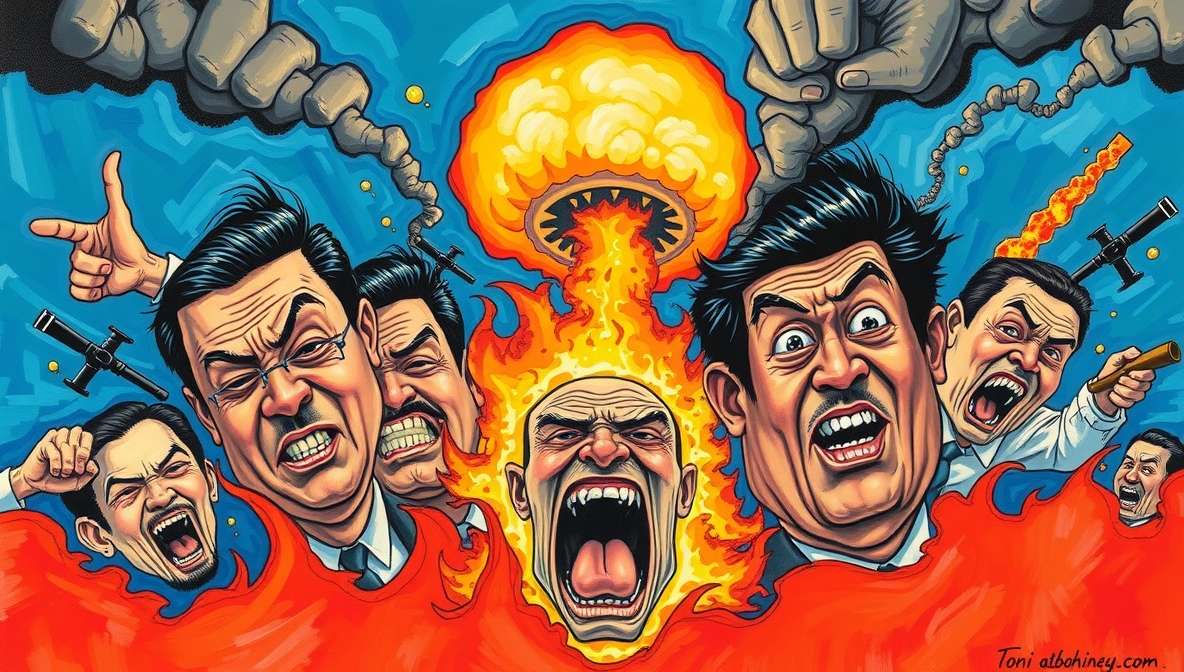
China’s State Media Floats Nuclear Strikes on Japan: When Diplomatic Tantrums Go Thermonuclear
The Big Red Button Becomes Official Foreign Policy
A Chinese state-media outlet recently decided that subtle diplomacy was overrated and publicly suggested nuclear strikes against Japan might be a proportional response to Tokyo’s evolving stance on Taiwan. Because nothing says “let’s talk this through” quite like threatening to vaporize an entire nation over policy disagreements.
The trigger? Japanese Prime Minister Shigeru Ishiba suggested that China attacking Taiwan could constitute an existential threat to Japan—language that breaks decades of carefully choreographed ambiguity. Beijing’s response escalated from economic pressure to cultural blackouts to, apparently, casually mentioning weapons capable of ending civilization as we know it.
As Jerry Seinfeld said, “You know what’s crazy about international relations? We act like grown-ups, then threaten to blow up the planet because someone moved a fence.”
When Economic Warfare Meets Cultural Pettiness

China’s retaliation toolkit includes banning Japanese seafood imports, canceling half a million airline tickets, blocking Japanese films from theaters, and advising Chinese students to avoid studying in Japan. It’s like someone broke up with their ex and responded by burning all their photos, blocking their number, and hiring a skywriter to announce the betrayal.
The seafood ban alone devastated Japanese fishing communities that depended on Chinese markets. Tourism revenue collapsed. Cultural exchange programs evaporated. All because Tokyo suggested it might have opinions about its own security.
Dave Chappelle observed, “Economic sanctions sound sophisticated until you realize it’s just governments saying ‘I’m not inviting you to my birthday party anymore’—except people lose their jobs.”
The Nuclear Option: From Unthinkable to Talking Point
Here’s where things shift from absurd to apocalyptic. State-backed Chinese media outlets began floating nuclear strikes as a legitimate policy response. Not as hyperbole. Not as metaphor. As an actual consideration if Japan continues supporting Taiwan or strengthening defense ties with the United States.
The logic—if you can call it that—follows a disturbing pattern:
Japan changes its defense posture regarding Taiwan. China perceives this as provocative. Beijing responds with economic pressure, cultural isolation, and military drills. When these don’t produce immediate capitulation, someone suggests maybe nuclear weapons should enter the conversation.
Bill Burr said it best: “Threatening someone with nukes because they disagreed with you is like bringing a flamethrower to a book club because nobody liked your recommendation.”
The Performative Theater of Authoritarian Messaging
Chinese state media operates differently than independent journalism. It serves as an extension of government policy—testing reactions, signaling intentions, and manufacturing public consent for potential actions. When an outlet suggests nuclear strikes, it’s not rogue commentary; it’s coordinated messaging.
The strategy appears designed to accomplish several goals: intimidate Japan’s leadership, test international reaction, condition domestic audiences to accept escalation, and establish a rhetorical foundation for future actions.
Amy Schumer quipped, “When governments start casually mentioning nuclear war in official media, that’s not diplomacy—that’s a hostage negotiation where everyone’s already tied to the chair.”
Japan’s Strategic Ambiguity Evaporates
For decades, Japan maintained careful ambiguity about how it would respond to a Taiwan crisis. That ambiguity served everyone’s interests—Beijing could pretend Japanese neutrality was guaranteed, Tokyo could avoid commitment, and Washington could maintain strategic flexibility.
Prime Minister Ishiba’s comments shattered that comfortable fiction. By stating that a Chinese attack on Taiwan could trigger Japan’s collective self-defense provisions, he forced Beijing to confront what everyone already knew: Japan would not remain neutral if China invaded Taiwan.
Chris Rock said, “The funniest thing about international politics is pretending nobody knows what everybody knows, then acting shocked when someone says it out loud.”
The Human Cost Behind Geopolitical Theater
While officials trade threats and media outlets publish provocative editorials, real people suffer immediate consequences. Japanese seafood exporters lost their largest market overnight. Chinese tour operators dependent on Japanese routes faced bankruptcy. Students with years invested in exchange programs saw opportunities evaporate.
Cultural exchange programs—built over decades—collapsed in weeks. Japanese films that took years to produce found their Chinese market erased by bureaucratic decree. Chinese citizens who built careers around Japan-related industries watched their livelihoods disappear.
Trevor Noah observed, “Economic warfare sounds abstract until you meet the fisherman who can’t feed his family or the tour guide who lost her business because politicians had a tantrum.”
The Missile Drills: Rehearsing Apocalypse
China’s military conducted extensive drills simulating blockades, invasions, and strikes around Taiwan—many explicitly targeting scenarios involving Japanese intervention. These weren’t symbolic gestures; they were operational rehearsals for potential conflict.
The People’s Liberation Army demonstrated capabilities to strike Japanese bases, disrupt supply lines, and establish air and sea dominance in contested waters. Combined with nuclear threats, the message was unmistakable: any Japanese involvement would be met with overwhelming force.
Kevin Hart said, “When your neighbor starts practicing breaking into your house in their front yard while maintaining eye contact, that’s not exercise—that’s a threat with cardio.”
Taiwan: The Trigger Nobody Wants to Pull
Taiwan remains the flashpoint for potential conflict between China, Japan, and the United States. Beijing views reunification as non-negotiable. Tokyo sees Taiwan’s security as inseparable from Japanese security. Washington maintains “strategic ambiguity” while selling Taiwan advanced weapons.
The delicate balance has held for decades through mutual restraint, economic interdependence, and recognition that war would devastate everyone involved. But as Beijing grows more assertive, Tokyo more anxious, and Washington more confrontational, that balance wobbles.
Ricky Gervais noted, “The problem with brinkmanship is eventually someone miscalculates, and then we’re all explaining to our grandchildren why the world ended over an island.”
Economic Interdependence Meets Nationalist Rage
Despite current tensions, China and Japan remain major trading partners. Japanese companies operate extensive supply chains through China. Chinese consumers purchase Japanese technology, automobiles, and consumer goods. Economic separation would hurt both nations severely.
Yet nationalism increasingly trumps economics. Chinese social media erupts with calls to boycott Japanese products. Japanese politicians face domestic pressure to reduce dependence on Chinese markets. Economic rationality struggles against political fury.
Ali Wong said, “Threatening to nuke your third-largest trading partner is like burning down your house because you hate your landlord—technically possible, definitely stupid.”
The Nuclear Taboo Erodes
Since Hiroshima and Nagasaki, nuclear weapons existed in a special category—too terrible to use, maintained as deterrents, discussed only in hypotheticals. That taboo kept the world relatively safe for eight decades.
Now Chinese state media casually discusses nuclear strikes as policy options. Russian officials threaten nuclear use in Ukraine. North Korea conducts missile tests while threatening neighbors. The taboo erodes as nuclear weapons become normalized in political discourse.
Sarah Silverman observed, “When nuking someone becomes just another bullet point in a PowerPoint presentation about foreign policy options, we’ve officially lost the plot.”
Regional Allies Watch and Worry
South Korea, the Philippines, Australia, and other regional allies watch these developments with alarm. If China threatens Japan with nuclear strikes over Taiwan, what prevents similar threats against them during future disputes?
The regional security architecture built around American alliances and mutual defense treaties faces its most severe test since World War II. Allies must decide whether to increase defense spending, pursue independent nuclear capabilities, or hope diplomacy prevails.
Jim Gaffigan quipped, “Being a regional ally during a nuclear crisis is like being at a party where two drunk people start fighting—you want to leave, but you’re worried they’ll fight about you next.”
The American Factor: Guarantor or Provocateur?
The United States maintains defense treaties with Japan, ambiguous commitments to Taiwan, and forward-deployed forces throughout the region. American policy oscillates between reassuring allies and avoiding actions that might provoke China.
Washington faces competing pressures: allies demand stronger commitments and military support, while critics warn that American interventionism risks unnecessary war. Meanwhile, China interprets American actions through the lens of containment and hegemonic decline.
Jo Koy said, “America’s like that friend who promises to help you move, shows up with a truck full of weapons, then complains the whole time about how this wasn’t the plan.”
Media Manipulation and the Fog of Propaganda
Chinese state media operates as a propaganda apparatus, not independent journalism. When outlets float nuclear strikes, they serve government objectives—whether testing international reaction, conditioning domestic opinion, or establishing negotiating positions.
The information environment grows increasingly polluted as governments manipulate media, social platforms amplify outrage, and genuine analysis drowns in noise. Citizens struggle to distinguish authentic threats from performative posturing.
Hasan Minhaj observed, “When government propaganda sounds like satire and satire sounds like news, we’re all just guessing what’s real while the world burns.”
The Diplomacy That Isn’t Happening
While tensions escalate, high-level diplomatic engagement remains sporadic and unproductive. Phone calls occur, meetings happen, statements issue—but substantive progress toward de-escalation proves elusive.
The diplomatic machinery designed to prevent conflicts founders on mutual mistrust, domestic political constraints, and genuine strategic differences. Both sides prepare for conflict while hoping someone blinks first.
Gabriel Iglesias said, “Diplomacy is supposed to be boring adults in rooms solving problems—instead we got reality TV with nukes.”
The Absurdity of Nuclear Brinkmanship
Here’s the fundamental absurdity: nuclear weapons cannot achieve political objectives. They can only destroy. Using them would guarantee mutual devastation, economic collapse, environmental catastrophe, and potentially human extinction.
Yet we discuss them as if they’re conventional weapons—tools of statecraft, bargaining chips, deterrents with rational uses. The disconnect between nuclear reality and political rhetoric grows increasingly dangerous.
Wanda Sykes noted, “Threatening nuclear war over territorial disputes is like threatening to burn down the neighborhood because someone parked in your spot—everyone loses, including you.”
What Happens Next: Scenarios Nobody Wants
Best case: Cooler heads prevail, economic interdependence reasserts influence, back-channel diplomacy produces face-saving compromises, and tensions gradually decrease. This requires leadership willing to prioritize long-term stability over short-term domestic political gains.
Worst case: Miscalculation, accident, or deliberate escalation triggers military conflict. Chinese forces move against Taiwan. Japan intervenes. The United States honors defense commitments. Regional war erupts with potential nuclear dimensions.
Most likely: Tensions remain elevated, military buildups continue, economic decoupling accelerates, and everyone pretends this is sustainable while praying nothing goes wrong.
Tiffany Haddish said, “Hope is not a strategy, but when nuclear war’s on the table, hope’s really all we got.”
The Satire Writes Itself
When state media casually discusses nuclear genocide as foreign policy, satire becomes documentary. The gap between rational behavior and actual behavior grows so vast that humor becomes the only honest response.
We laugh because the alternative is despair. We satirize because direct confrontation with nuclear brinkmanship’s insanity proves too overwhelming. Comedy provides distance from horror while acknowledging its reality.
Tom Segura observed, “The best comedy comes from truth pushed to its logical extreme—except now the extreme is just Tuesday’s news cycle.”
A Final Thought on Madness
Nuclear weapons exist. Tensions rise. Leaders posture. Media amplifies. Citizens watch helplessly as decisions affecting their existence happen beyond their control or input.
The joke isn’t funny anymore—except it has to be, because acknowledging the full weight of our collective insanity without humor would be unbearable.
Nate Bargatze summed it up: “We’ve got smartphones, electric cars, and AI—but we’re still threatening to blow each other up like it’s 1962. Progress is weird.”
Auf Wiedersehen, amigos.