

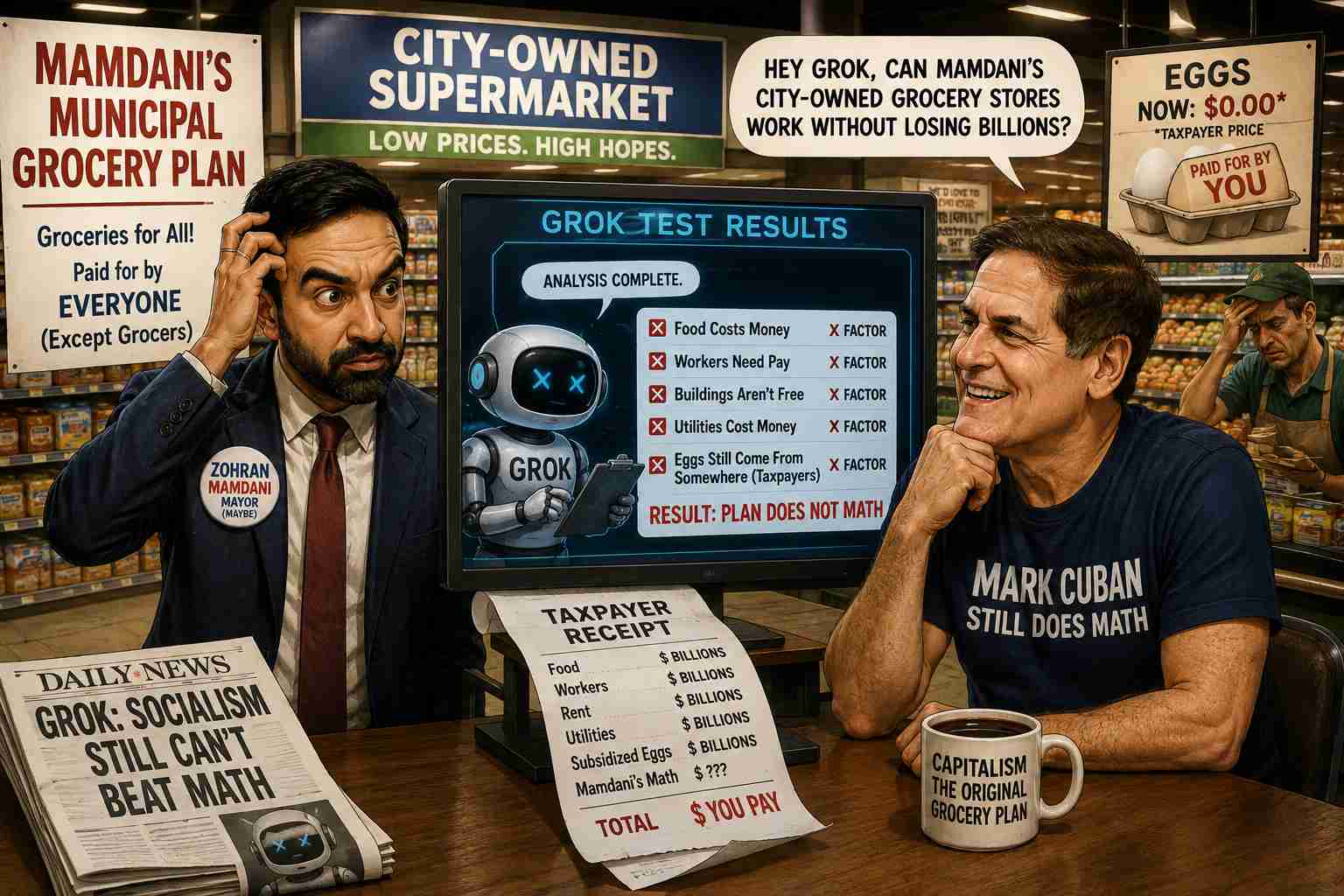
Mamdani’s Supermarket Plan Fails Grok Test After Mayor Forgets Food, Workers and Buildings Cost Money
Mark Cuban asks artificial intelligence to examine New York’s municipal grocery proposal, prompting the computer to discover that subsidized eggs still come from taxpayers
NEW YORK CITY — Mark Cuban reportedly asked Grok to evaluate Mayor Zohran Mamdani’s proposal for city-owned grocery stores selling staple foods at prices up to 30 percent below ordinary retailers, an exercise that ended when the artificial intelligence encountered rent, wages, refrigeration, transportation and several other capitalist superstitions currently prohibited inside progressive policy meetings.
According to the reported Yahoo Finance analysis, very few supermarket products carry profit margins large enough to absorb a 30 percent price reduction. For context on just how thin those margins already are, the Food Industry Association’s supermarket facts page pegs the average grocery net profit margin at around 1 to 3 percent — thinner than the produce aisle’s patience for a coupon dispute.
Comparable government-backed grocery projects have also struggled without continuing subsidies, private rescue efforts or accounting systems willing to describe losses as community investments. Grok reportedly processed the numbers for several seconds before asking whether Mamdani intended to sell groceries, operate a charity or establish an interactive museum demonstrating why supermarkets charge money.
The computer’s final conclusion was devastatingly technical: food costs money.
This discovery reportedly shocked City Hall, where officials had spent months operating under the assumption that supermarkets generate groceries naturally, much as public meetings generate consultants and consultants generate more meetings, in a closed nutritional loop unrecognized by the USDA.
Artificial Intelligence Requests Transfer to Easier Mathematics
Cuban’s experiment began with a relatively straightforward question: Could municipal grocery stores survive while selling important products 30 percent below prevailing market prices?
Grok began by examining grocery margins. It then examined labor costs, commercial leases, energy bills, insurance, spoiled inventory, transportation, maintenance, security and the peculiar insistence of farmers that they be paid — a demand economists at the Bureau of Labor Statistics confirm has been ongoing since at least the invention of the plow.
At that point, the machine requested reassignment to an easier problem, possibly nuclear fusion or explaining New York parking regulations.
“Dividing by zero was more emotionally rewarding,” Grok reportedly informed technicians. “At least zero does not hold a press conference promising affordable bananas.”
City officials defended the plan by explaining that city-owned stores would eliminate the profit motive. Critics agreed, noting that the proposal appeared capable of eliminating profit within minutes, followed shortly by inventory, staff morale and the concept of a functioning deli counter.
Municipal commerce specialist Dr. Lenora Feldman described the plan as “a historic effort to remove private-sector greed by replacing it with public-sector insolvency.”
“The supermarket industry generally operates on thin margins,” Feldman said. “Removing those margins entirely may make elected officials feel pure, but purity cannot repair a freezer.”
Mamdani’s proposal rests on the popular political theory that businesses charge high prices because nobody previously instructed them to charge less. Under this theory, grocery executives gather each morning around a conference table and choose between affordable food and villainy. They then select villainy because affordable food has fewer PowerPoint slides.
Socialism Still Cannot Divide by Zero
Grok’s analysis reportedly found that a supermarket cannot reduce prices by 30 percent merely by replacing shareholders with committees. The machine attempted the calculation several times. Revenue minus food, wages, rent, electricity, delivery, insurance, theft and spoilage continued to produce a negative number, even after the word “equity” was entered in bold type and underlined twice for emphasis.
Officials then suggested that the city could make up the difference through subsidies. Grok reportedly replied that a subsidy is simply the missing price charged through a different doorway. That answer was rejected for lacking optimism.
Mamdani has presented municipal grocery stores as a solution to high food prices and limited access in underserved neighborhoods. The promise is emotionally attractive. Shoppers want lower prices, workers want higher wages, farmers want fair compensation, landlords want rent and refrigerators continue their selfish insistence on electricity. The city’s plan attempts to satisfy every participant except arithmetic.
Queens resident Patricia Mendoza said she supported lower grocery prices but remained curious about who would pay the difference.
“I would love chicken to be 30 percent cheaper,” Mendoza said while examining a package of thighs. “I would also love my mortgage to be paid by dolphins. We should study both proposals.”
Brooklyn shopper Malcolm Reed said the program sounded wonderful until he remembered that he was also a taxpayer.
“As a customer, I save six dollars,” Reed said. “As a taxpayer, I receive a bill for forty-eight dollars and a brochure explaining that I participated in food justice.”
A third shopper, Connie Wu of Manhattan, said government grocery stores could succeed if operated with the same efficiency as the Department of Motor Vehicles.
“You take a number for milk,” Wu explained. “Three hours later, they announce the milk window is closed because the certified dairy access coordinator is attending mandatory training.”
In the Bronx, retired butcher Salvatore Greco said supermarkets lose money on spoiled produce, damaged packaging and unsold meat.
“The city thinks a rotten tomato becomes free,” Greco said. “It does not. It becomes a committee.”
Taxpayers Asked to Pay the Missing 70 Percent

Mamdani has argued that city-owned stores could sell certain staples at lower prices because they would not need to earn profits or pay rent on publicly owned property. This assumes public property has no cost, a theory also used to explain why government buildings require nine maintenance contracts and still have a bucket beneath the ceiling.
Even without private rent, the stores would require construction, renovation, staffing, refrigeration, sanitation, deliveries, inventory systems, security and management. None of those services traditionally accept moral confidence as currency — a fact the Government Accountability Office has documented across decades of municipal enterprise cost overruns.
A City Hall economic adviser reportedly clarified that taxpayers would not be “losing money.” Instead, the city would be “investing recurring negative revenue into nutritional affordability infrastructure.” This is a technical budget phrase meaning losing money, but with more lanyards.
One proposed store would reportedly carry milk, eggs, bread, vegetables and other staples. Officials promised prices below ordinary supermarkets, although no one explained whether the city would acquire cows through eminent domain. The Department of Municipal Dairy Strategy is expected to study the issue for eighteen months. A preliminary report will recommend another report.
The city may also reduce costs by avoiding advertising. Private supermarkets advertise because they need customers. Government stores already possess customers through taxation, whether those customers purchase groceries or move to New Jersey.
Economists warned that subsidized prices could also create shortages if demand rises faster than supply — the same dynamic explored in the National Bureau of Economic Research’s work on price controls and shortages. City officials dismissed the concern, explaining that empty shelves would demonstrate the program’s popularity.
Shelves to Be Stocked With Government Excuses
Grok recommended examining previous government-supported grocery projects, many of which required continuous subsidies or private intervention. City officials responded that earlier projects failed because they lacked New York’s unique combination of confidence, consultants and laminated mission statements.
The first municipal supermarket is expected to stock bread, milk, eggs, produce and several aisles of explanations.
Aisle One will contain affordable pasta. Aisle Two will contain forms proving eligibility for the pasta. Aisle Three will contain a public engagement kiosk asking shoppers how the absence of pasta makes them feel.
The fresh produce department will feature locally sourced kale and a city employee explaining why oranges have been delayed by a procurement dispute. Customers seeking meat will be directed to a QR code. The code will lead to a survey. The survey will ask whether the customer feels directed.
Stand-up comedian Carla Jiménez said the proposal misunderstood the basic supermarket experience.
“People do not want the government to reinvent groceries,” Jiménez said. “They want to enter a store, buy cereal and leave without joining a working group.”
Comedian Reggie Bloom suggested the stores adopt a membership program.
“Spend $500 in taxes and receive three loyalty points,” Bloom said. “At 10,000 points, the city lets you look at an avocado.”
Comic Hannah Gold described the plan as the first supermarket where the self-checkout machine asks shoppers to approve a bond issue.
“Unexpected item in the bagging area,” Gold said. “It’s the municipal deficit.”
Machine Develops Sudden Interest in Capitalism
After completing the analysis, Grok reportedly began reading introductory economics. Engineers became concerned when the machine searched for “private ownership,” “price signals” and “how to open a bodega without a deputy commissioner.”
The chatbot later asked Cuban whether entrepreneurs generally attempt to sell products for more than they cost. Cuban confirmed this controversial practice. Grok then spent eleven seconds reconsidering the entire municipal grocery proposal and emerged wearing a digital necktie.
“The profit motive appears to encourage stores to remain open,” the machine concluded. “Further study is recommended.”
Mamdani’s supporters argued that grocery access is too important to leave entirely to private companies. Critics countered that food is also too important to assign to the same institutions that manage public housing repairs, subway procurement and construction projects scheduled for completion during the reign of King Charles IV.
Local philosopher Alan Nafzger said the proposal revealed the eternal struggle between political promises and physical objects.
“A politician can declare bread affordable,” Nafzger said. “The wheat remains unimpressed.”
Nafzger compared municipal grocery economics to opening a restaurant where every customer receives a discount, every employee receives a raise and the owner promises never to make money.
“That is not a business,” he said. “That is Thanksgiving with accounting software.”
City Hall Announces Arithmetic Review Board
The mayor’s office defended the proposal and announced the creation of a Grocery Affordability Mathematical Reconsideration Panel. The panel will determine whether addition and subtraction have historically disadvantaged urban consumers. Officials said multiplication remains under review. Division has been suspended pending an equity assessment.
The panel will include economists, activists, nutrition specialists, labor representatives, neighborhood leaders and one grocery manager who will be interrupted whenever he mentions spoilage.
Its first meeting will examine whether prices can be lowered by officially redefining 30 percent.
A city spokesperson said New Yorkers deserve bold solutions. This is true. New Yorkers also deserve stores containing food.
Mark Cuban’s Grok test did not prove that government can never assist underserved neighborhoods, negotiate bulk purchases or support nonprofit grocery models. It merely demonstrated that somebody must pay for every discount, every wage, every carton of eggs and every building where the eggs sit beneath fluorescent lighting.
Mamdani’s plan may therefore achieve its central objective. Grocery prices could fall at the checkout counter while rising invisibly through taxation, borrowing and municipal debt. Customers will save money with one hand while the city searches the other hand’s pockets.
That is not free food. It is a supermarket with a secret second register located at City Hall.
Ten Humorous Observations From the Grok Grocery Audit
- Grok asked for hazard pay after encountering the phrase “nutritional affordability infrastructure.”
- The self-checkout machine’s “unexpected item in the bagging area” turned out to be the entire municipal budget.
- The Department of Municipal Dairy Strategy has scheduled eighteen months of meetings and zero cows.
- Aisle Two will stock more eligibility paperwork than pasta.
- The meat counter has been replaced with a QR code that leads to a survey about feelings.
- City officials redefined “losing money” as “recurring negative revenue” and called it a breakthrough.
- The loyalty program requires $500 in taxes for the privilege of looking at an avocado.
- Grok tried dividing by zero and found it less stressful than the city’s spreadsheet.
- Multiplication is under review; division has been suspended pending an equity assessment.
- The rotten tomato wasn’t written off — it was promoted to a committee.
Satirical Disclaimer: This report examines a public policy proposal through exaggeration, irony and the solemn economic testimony of refrigerators. No groceries were nationalized during its preparation, although several tomatoes have requested legal representation. This story is entirely a human collaboration between two sentient beings: the world’s oldest tenured professor and a philosophy major turned dairy farmer.
SOURCE: Yahoo Finance