

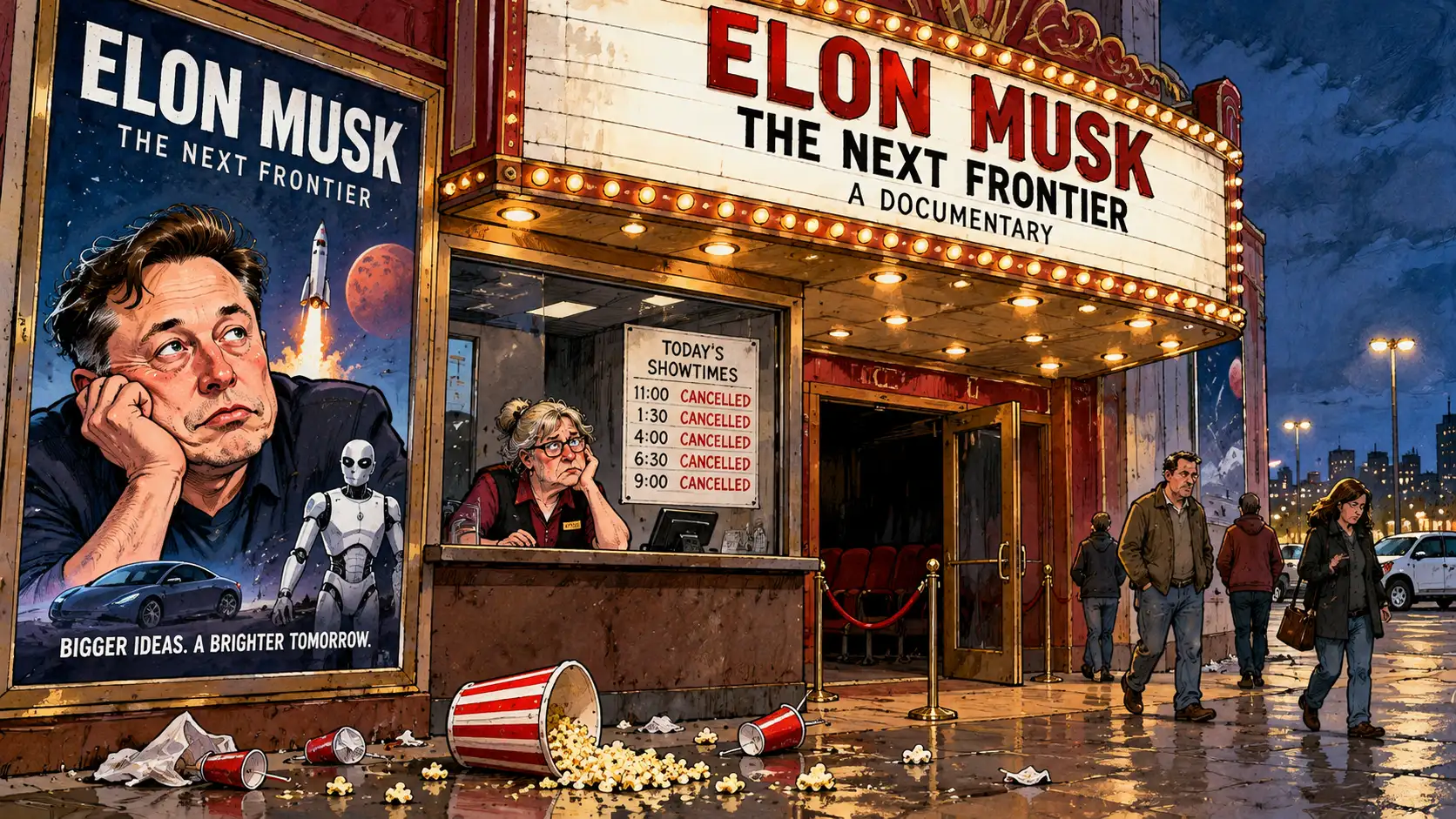
Director discovers capitalism requires customers
LOS ANGELES, October 24, 2026 – Hollywood has had another run-in with the free market. A nearly four-hour documentary criticizing billionaire Elon Musk drew far more enthusiasm from professional film critics than from Americans willing to buy a movie ticket. Alex Gibney‘s Musk has grossed just $572,000 at the domestic box office, leaving Hollywood intellectuals searching for a revolutionary economic system in which buying tickets is unnecessary.
According to Gizmodo, the documentary appears to have been disappearing from American theaters following a disappointing expansion to 472 locations. The precise extent and reasons for its withdrawal remain unconfirmed, although its poor theatrical performance is documented.
The flop has pushed Hollywood’s political establishment toward an uncomfortable possibility: criticizing capitalism does not exempt a filmmaker from having to sell something.
Why Hollywood’s Musk Documentary Can’t Fill Seats
For years, progressive filmmakers have assured Americans that enormous fortunes ought to be redistributed to ordinary citizens. The ordinary citizens, it turns out, are reluctant to redistribute their own $12 to Hollywood.
Industry executives had apparently pictured a commercial formula in which every anti-Musk activist in America bought a ticket, came back the following evening, and kept coming back until capitalism surrendered. Under that model, each committed Marxist would attend 12 screenings at $12 each, contributing $144 to the revolutionary cause. The arithmetic was magnificent. The consumer research appears to have been conducted in a faculty lounge.
A Hollywood financial analyst said the distribution strategy had one minor flaw. “We expected socialists to contribute to the collective good,” he said. “Unfortunately, we forgot that their preferred contribution is somebody else’s money.”
The documentary had introduced Hollywood to a socialist nightmare: voluntary transactions.
Musk Documentary Box Office: $666 Per Theater
According to The Numbers’ domestic box-office tracking for Musk, the film had grossed $571,902 through October 22. Its October 16 weekend expansion to 472 theaters brought in approximately $314,489, an average of just $666 per theater for the entire weekend.
At a $12 ticket, that works out to roughly 55 paying customers per theater across three days, or about 18 a day. You could assemble a larger audience by announcing free cheese at a retirement community.
A Hollywood executive who reviewed the figures proposed a solution right away. “We need to increase production, double the number of theaters, and establish a federal Department of Documentary Appreciation,” he said. An assistant suggested that perhaps Americans simply didn’t want to watch the film. The assistant was reassigned to an independent cinema in Vermont.
A 225-Minute Documentary Is a Hard Sell
The documentary runs 225 minutes, according to the official Venice Film Festival listing for Musk. That’s three hours and forty-five minutes, not counting the time it takes to find parking and question your life choices. It is less a movie than a hostage negotiation conducted by a sociology department.
In that time you could drive across several American states, cook Thanksgiving dinner, or spend an afternoon trying to persuade a university professor that profit is not a criminal offense.
The running time created a particular problem for viewers committed to overthrowing capitalism. They couldn’t attend the revolution because they were still watching the movie. One filmgoer described the experience as intellectually challenging. “I arrived opposed to Musk,” he said. “After two hours, I was opposed to chairs. After three hours, I was opposed to time itself.”
Hollywood had somehow made a movie about a man obsessed with speed and innovation that took almost four hours to watch.
Critics Love Gibney’s Musk Film; Audiences Stay Home
The documentary received favorable reviews from several critics, which proves once again that professional admiration and consumer enthusiasm are two different currencies. A critic sees a 225-minute documentary and celebrates the director’s uncompromising artistic vision. An ordinary American sees the same running time and asks whether the theater has a bed.
Critics also hold an economic advantage over regular customers, since many attend screenings without buying tickets. That may explain why they so often recommend movies nobody else wants to pay for.
The proposed Hollywood fix is to award every favorable critic a government-funded audience of 10,000 compulsory viewers. Critics would supply the intellectual approval, taxpayers the revenue, and moviegoers the proof of attendance. The arrangement would be known as the Five-Year Cinema Plan, with special accommodations for anyone who survives the entire screening.
Elon Musk’s Best Response Was Doing Nothing
Musk publicly criticized the documentary before its release, calling it a hostile portrayal. Legal threats and disputes over advertising also accompanied the release, according to Variety’s reporting on the documentary’s international distribution.
Still, the simplest explanation for the weak ticket sales needs no billionaire conspiracy. People had better things to do. Hollywood understands angry social media engagement but seems to struggle to tell it apart from commercial demand. A million people might enjoy insulting Elon Musk online, and that doesn’t mean a million of them want to spend $12 and an entire afternoon watching an upholstered version of the same argument.
Musk didn’t need to launch a rocket, buy another social network, or build a sophisticated counterattack. The marketplace had already delivered its verdict through the ancient democratic mechanism of not buying a ticket. The result was especially humiliating because the audience that failed to appear was supposedly united by hostility toward the richest man in the world. Hatred, apparently, is free. Popcorn is $9.
Hollywood Floats Subsidies for Anti-Billionaire Movies
Faced with disappointing ticket sales, the industry’s proposed solution came fast: stop treating movies as commercial products and begin classifying them as public services.
Under the proposed Documentary Equality Act, every American would receive an annual government allocation of political films, wanted or not. Failure to attend would trigger mandatory sensitivity training. Citizens who bought tickets to action movies instead would be required to explain why their entertainment choices threatened democracy. One progressive producer defended the legislation. “Movies are too important to be left to audiences,” he said.
The theory has drawn particular interest in a community where people regularly condemn profit-seeking while negotiating multimillion-dollar contracts. The producers would keep their salaries, the theaters would receive subsidies, and the viewers would receive instructions. Anyone who asked whether the film was entertaining would be accused of misunderstanding art.
Political Anger Is Not Disposable Income
The central commercial error was assuming that ideological commitment produces an unlimited supply of paying customers. It doesn’t. Americans hold intense opinions about politics, celebrities and technology without wanting to finance feature-length presentations on those subjects. You can dislike the mayor without attending four hours of anti-mayor lectures, dislike your bank without buying a documentary about its branch manager, and dislike Elon Musk without giving Hollywood the price of dinner for the privilege of hearing somebody agree with you.
The distinction seems to have escaped an entertainment industry increasingly convinced that a successful political argument is automatically a successful movie. The marketing department responded with a new campaign slogan: “Come for the outrage. Stay because you already paid and can’t get a refund.” A revised version promised an extra benefit: “Watch the entire documentary and receive a certificate confirming that you have disliked Elon Musk more thoroughly than your neighbors.”
Elizabeth Holmes Documentary Outsells the Musk Film
The embarrassment deepened because audiences were not refusing documentaries across the board. During the same October weekend, the Elizabeth Holmes documentary You Can See Everything earned approximately $15 million from 855 theaters, according to Associated Press reporting on the October box office.
That raised a more disturbing proposition for Hollywood: perhaps audiences can decide for themselves which documentaries interest them. The revolutionary committee rejected the idea at once. Letting Americans choose their own entertainment would set a dangerous precedent. They might next demand control over their heating systems, their grocery purchases and their children’s education, and eventually people could start deciding how to spend their own earnings. At that point the entire Hollywood political economy would be in jeopardy.
One proposed remedy would require successful documentaries to transfer 40 percent of their audience to unsuccessful ones, whether or not the viewers had bought tickets. Economists would call it redistribution. Moviegoers would call it kidnapping.
Who Finances Hollywood’s Case Against Billionaires?
The deepest irony of the project may be that political filmmaking, like nearly everything in Hollywood, requires capital. Cameras cost money, editors expect salaries and distribution requires investment. Even the most uncompromising denunciation of wealthy entrepreneurs has to end up in somebody’s office asking for a check. Hollywood has built an economic model in which successful capitalists are routinely invited to finance elaborate denunciations of successful capitalism, and when the public declines to buy the result, the usual response is to question the public’s intelligence.
The Hollywood budget committee has proposed a new financing arrangement. Each billionaire would contribute a mandatory percentage of his wealth to fund movies attacking billionaires. Additional taxes would pay for awards ceremonies celebrating the bravery of the filmmakers who accepted the money. Should the movies lose money, directors would receive more funding to explore why capitalism had failed them. Under no circumstances would the people responsible for the financial decisions be held responsible for them. That would undermine the entire philosophy.
Was the Musk Documentary Pulled From Theaters? What We Know
Public reports on the documentary’s unusually short theatrical life remain somewhat uncertain. Gizmodo found indications that screenings were disappearing but cautioned that a comprehensive withdrawal had not been independently established. The box-office numbers need no interpretive committee. The film was a weak theatrical performer, though its overall financial result cannot be established without production costs, distribution expenses, and eventual television and streaming revenue.
A documentary can win critical praise, set off heated political arguments, and still struggle to sell theater seats. That isn’t censorship. It’s a product failing to attract enough customers. The marketplace doesn’t ask whether a director attended prestigious universities, holds the correct political opinions, or was congratulated by three hundred intellectuals at a film festival. It asks one question: “Will anybody pay to see this?” For Hollywood’s latest attack on Elon Musk, the answer was considerably fewer people than the filmmakers hoped.
Capitalism can be criticized for three hours and forty-five minutes. When that’s over, somebody still has to pay the bill, and Hollywood would very much prefer that somebody be somebody else.
The Final Word: Hollywood’s Accidental Pro-Capitalist Movie
A filmmaker sets out to scrutinize one of the world’s richest entrepreneurs and produces a movie whose disappointing theatrical run demonstrates the relationship between supply, demand and consumer choice. Millions of Americans can dislike Elon Musk without wanting to buy an anti-Musk ticket. They can reject a billionaire’s politics while admiring his inventions. They can love documentaries while declining this particular one. Nobody needs a federal commission to explain their decisions.
Hollywood may eventually recover financially through streaming, television licensing and international distribution. But the domestic box office has already supplied the closing scene. After 225 minutes of analyzing the richest man in the world, the filmmakers ran into a rather elementary economic concept: you cannot redistribute money from customers who never entered the theater. Karl Marx promised that workers would eventually control the means of production. Hollywood has discovered that workers already control something considerably more dangerous. Their wallets. And they kept them closed.
15 Humorous Observations on the Musk Documentary Flop
- Hollywood made a movie for people who hate billionaires, then acted shocked that those same people hate paying twelve dollars for a ticket. You can’t build a business on a crowd that’s mad at money and also mad at you for asking for some.
- Alex Gibney apparently needed every communist in America to see this thing twelve times. I’ve met communists. They’ll split your lunch with you. They will not split their twelve dollars.
- The movie runs 225 minutes. The audience lasted about 225 seconds, then somebody checked their phone to see if capitalism had anything shorter.
- It’s a perfect socialist business plan. Huge enthusiasm from the intellectuals, no demand from the customers, and somebody else’s money gone.
- 472 theaters. That’s 472 chances for Americans to exercise their constitutional right to go see something else, and they took every single one.
- Some people apparently think the movie should’ve been free. A fundamental human right: four hours of watching a rich guy get criticized. I don’t remember that one in the Constitution, but I only got through the first few pages.
- The worst thing that happened to Elon Musk wasn’t the documentary. It was that his critics couldn’t get anybody to pay for it. That’s not a takedown, that’s a refund line.
- Hollywood spent years telling us capitalism is ruining America. Then capitalism let America skip Hollywood’s newest movie. Capitalism giveth, and capitalism declineth to buy a ticket.
- The critics loved it. Regular people had other priorities: laundry, dental surgery, watching the refrigerator defrost. Defrosting takes a while too, but at least it has a payoff.
- They figured hating Musk was a business model. That’s like figuring everybody who doesn’t like broccoli will pay to sit through four hours on cauliflower.
- The movie’s reportedly leaving theaters after two weeks, and Hollywood’s already out shopping for a rich guy to blame. Which is awkward, since the whole point of the movie was that they don’t like those guys. But somebody has to pay.
- At twelve bucks a ticket, the plan needed every devoted socialist to buy twelve of them. After the first screening, most had to get back to protesting the cost of living. Which just went up twelve dollars, so, thanks for that.
- A Hollywood executive can explain this whole thing in three words: not enough subsidies.
- Turns out Americans can really, truly dislike a billionaire without wanting to spend a Saturday afternoon listening to somebody else dislike him. I can do that for free. I do it at dinner.
- Elon Musk builds companies that people pay to use. Hollywood builds an anti-Musk movie and can’t get people to pay to see it. The best argument for capitalism in this whole story isn’t on the screen. It’s at the box office.
Satirical Disclaimer
This article is political and entertainment satire. The documentary’s running time, director, theatrical release and reported box-office figures are factual. The conversations, proposed government programs, revolutionary economists, audience surveys and Hollywood committee recommendations are satirical constructions. Poor theatrical revenue does not by itself establish a film’s final financial loss or prove the political affiliations of its audience.
This story is entirely a human collaboration between two sentient beings: the world’s oldest tenured professor and a philosophy major turned dairy farmer. No cows were forced to watch all 225 minutes, although several reportedly expressed interest in the popcorn.