

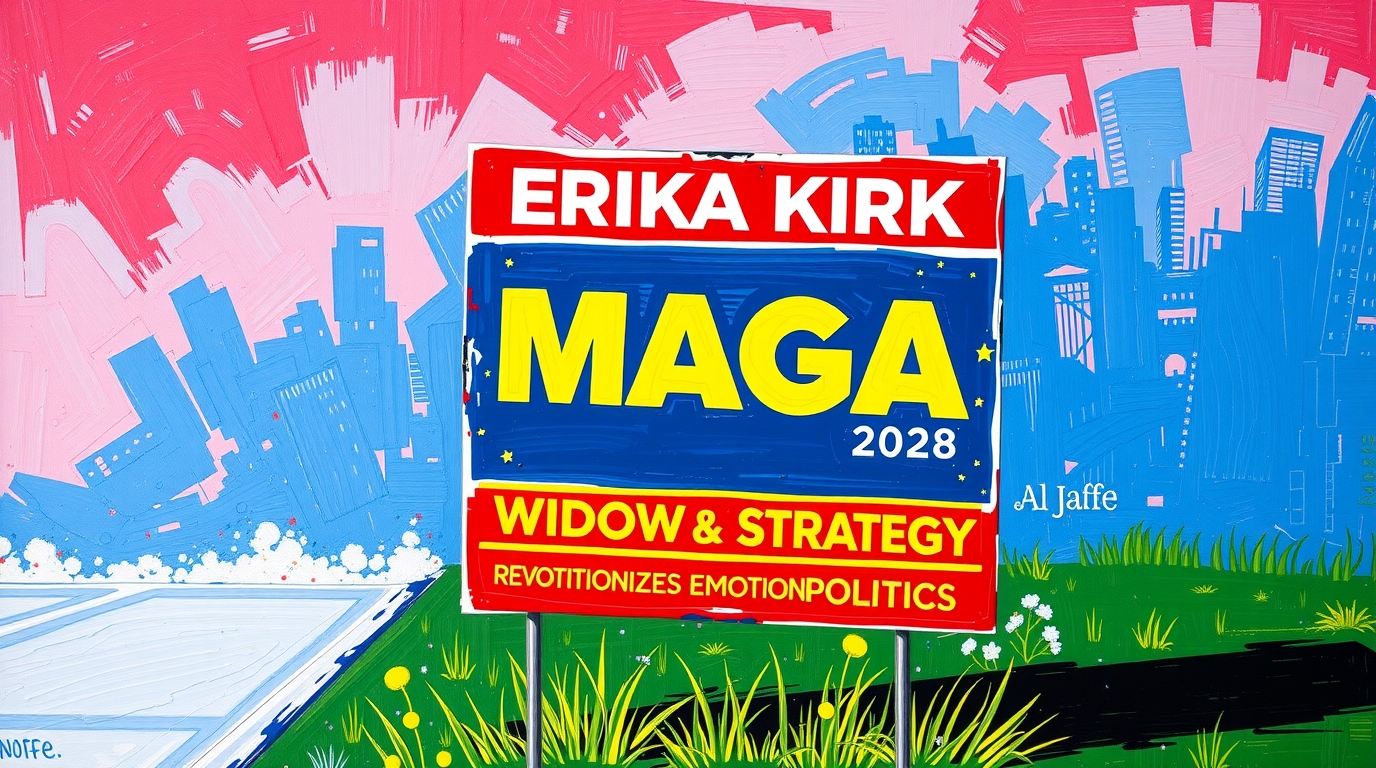
Erika Kirk 2028: MAGA’s Widow Strategy Revolutionizes Emotional Politics
SATIRICAL JOURNALISM – September 23, 2025
Washington, D.C. — In what political analysts are calling either “the future of American democracy” or “reality TV meets grief counseling,” Erika Kirk, widow of conservative powerhouse Charlie Kirk, has emerged as the surprise frontrunner for the 2028 Republican presidential nomination. At 34, she’s proven that in modern politics, the ability to cry on command while waving an American flag is apparently more valuable than a Harvard MBA.
How Erika Kirk Became MAGA’s Emotional Frontrunner Through Strategic Tears
The transformation began six months after Charlie Kirk’s untimely passing in early 2025. What started as a simple memorial service at the Reagan Presidential Library turned into something resembling a political revival meeting crossed with a Lifetime movie marathon.
“I’ve never seen anything like it,” said veteran campaign strategist Maurice Blanchard, speaking exclusively to our newsroom yesterday. “She stepped up to that podium, paused for exactly three seconds, let a single tear roll down her cheek, and said ‘Charlie would want us to fight.’ The donation website crashed from traffic within twenty minutes.”
Political consultant Dr. Sarah Mitchell from Georgetown University observed the phenomenon with academic fascination. “Traditional political science suggests candidates need experience, policy knowledge, or at minimum, the ability to remember which state they’re campaigning in,” Mitchell explained. “Erika has instead mastered the art of making grown men in pickup trucks weep while simultaneously reaching for their wallets.”
The Widow’s Campaign Strategy: Grief as Political Capital

The Kirk campaign, officially launched last Tuesday at a Des Moines community center, operates on a simple premise: sadness sells. Attendees receive complimentary tissues upon entry, and every speech features what insiders call “strategic pause points” designed to maximize emotional impact.
Jerry Seinfeld, commenting on the phenomenon during his Netflix special taping, said, “What’s the deal with political campaigns now? You used to need a platform. Now you just need a tissue box and the ability to make people feel guilty for not voting for you.”
The strategy appears devastatingly effective. Recent polling shows Kirk leading other potential Republican candidates by margins that would make seasoned politicians weep—if they had her talent for it. The emotional authenticity that once seemed like political suicide has transformed into Kirk’s greatest asset.
Campaign events resemble therapeutic group sessions more than traditional rallies. Attendees frequently report feeling “personally responsible for America’s healing” and “emotionally invested in the widow’s success.” Political scientists note this represents a seismic shift from policy-based voting to empathy-driven political engagement.
Republican Establishment Struggles with Widow Politics Revolution
JD Vance’s Desperate Attempts at Emotional Campaigning
Vice President JD Vance, previously considered the heir apparent to Trump’s movement, has been spotted practicing tearful speeches in hotel mirrors across Iowa. Sources close to his campaign describe a man increasingly desperate to compete with Kirk’s natural emotional appeal.
“JD tried crying at a corn festival last week,” reported campaign aide Jennifer Walsh, who requested anonymity. “It was like watching a robot attempt to simulate human sadness. The crowd looked confused and slightly concerned for his mental health.”
Dave Chappelle, performing at the Kennedy Center last weekend, observed, “JD Vance trying to out-cry a grieving widow is like me trying to out-White Ron White. Some things you just can’t fake, no matter how much you practice in the mirror.”
Glenn Youngkin’s Policy-Heavy Campaign Falls Flat
Virginia Governor Glenn Youngkin’s campaign, built around traditional conservative principles and economic policy, appears quaint in comparison to Kirk’s emotional juggernaut. His recent attempts to incorporate personal tragedy into campaign events have backfired spectacularly.
“Glenn tried talking about his childhood dog dying at a rally in Cedar Rapids,” campaign volunteer Mark Stevens told reporters. “People started checking their phones. When Erika talks about loss, grown men sob. When Glenn does it, people remember they have grocery shopping to do.”
Ron White, commenting during his Austin show Tuesday night, said, “Glenn Youngkin talking about sad stuff is like watching your accountant try to be your therapist. Technically qualified, emotionally unavailable, and you probably need a drink afterward.”
MAGA 2.0: From Policy Debates to Emotional Manipulation Marketing
The Merchandising Revolution of Grief Politics
The Kirk campaign has revolutionized political merchandising by transforming grief into a consumer experience. Traditional MAGA hats have been supplemented with “Charlie’s Legacy” tissue dispensers, commemorative candles that smell like “American Freedom,” and inspirational calendars featuring black-and-white photos of the late conservative icon.
Campaign finance reports show Kirk’s merchandising operation generating over $2.3 million in revenue monthly, primarily from items that would look at home in a funeral gift shop. The success has prompted other campaigns to desperately search for their own tragedy-to-merchandise pipelines.
Amy Schumer, during her Tuesday appearance on The Tonight Show, noted, “They’re selling grief candles now. What’s next, mourning coffee mugs? ‘Start your morning with existential sadness and caffeine.’ I mean, that’s basically my brand already.”
The Make America Cry Again Campaign Platform
Kirk’s official platform, such as it exists, centers around three pillars that political scientists describe as “brilliantly vague” and “emotionally manipulative.” The campaign website features more photos of tissue boxes than policy positions, yet somehow manages to feel more authentic than traditional political rhetoric.
The platform’s emphasis on “emotional unity” has resonated with voters tired of policy complexity. Focus groups report that Kirk supporters appreciate her ability to “make them feel things” rather than forcing them to “think about complicated stuff like healthcare or the economy.”
Political economist Dr. Robert Chen from Harvard Kennedy School explained the phenomenon: “Kirk has discovered that in our current political climate, making people cry is more effective than making them think. It’s either brilliant political theater or the end of rational democracy. Possibly both.”
Democratic Party’s Confused Response to Emotional Politics Strategy
Gavin Newsom’s Policy-Heavy Approach Appears Outdated
California Governor Gavin Newsom, potential Democratic frontrunner, appears genuinely baffled by Kirk’s emotional approach to campaigning. His recent attempts to incorporate personal tragedy into his political messaging have fallen flat with focus groups who describe his emotional appeals as “performative” and “trying too hard.”
“How do you debate someone whose entire platform is ‘I’m sad and you should be too’?” Newsom asked during a private fundraiser in San Francisco last week, according to leaked audio obtained by our newsroom. “Do I bring policy papers or therapy dogs to the debate?”
Alexandria Ocasio-Cortez Warns Against Emotional Manipulation
Representative Alexandria Ocasio-Cortez has emerged as one of the few Democrats willing to directly criticize Kirk’s emotional campaign strategy. During a Brooklyn town hall Thursday, AOC warned against “weaponizing grief for political gain.”
“Are we really going to make our presidential decisions based on who can cry the prettiest?” AOC asked the crowd. “Because if that’s the game we’re playing, I’ve been crying about student debt for years, and somehow that didn’t make me president.”
Bill Burr, performing at Madison Square Garden Friday night, summed up the Democratic dilemma: “The Democrats are trying to figure out how to debate a crying widow without looking like monsters. It’s like playing chess with someone who just flips over the board and starts sobbing. How do you win that?”
Political Scientists Analyze the Widow Phenomenon in American Politics
Academic Response to Grief-Based Campaigning
Political science departments across the nation are scrambling to understand Kirk’s success within existing theoretical frameworks. Traditional models of voter behavior, based on rational choice theory and policy preferences, appear inadequate to explain the widow’s rapid rise.
Dr. Patricia Williams from Yale University has begun studying what she terms “empathetic authoritarianism.” Her preliminary research suggests that voters may be substituting emotional connection for critical thinking when evaluating candidates.
“Kirk has essentially gamified grief,” Williams explained during a recent academic conference. “She’s created a political environment where opposing her feels emotionally cruel, regardless of policy disagreements. It’s either revolutionary political communication or the death of rational discourse.”
The Psychology of Widow Politics
Clinical psychologist Dr. James Rodriguez, who studies emotional manipulation in public settings, describes Kirk’s campaign as a “masterclass in leveraging sympathy for power.” His analysis suggests that Kirk has tapped into deep-seated American cultural expectations about protecting grieving women.
“She’s created a political force field around herself,” Rodriguez explained. “Any criticism feels like kicking a puppy or stealing candy from children. It’s psychologically brilliant and democratically terrifying.”
Chris Rock, commenting during his Netflix special taping, said, “They got us feeling bad for criticizing politicians now. What’s next, participation trophies for losing elections? ‘Here’s your award for trying real hard to destroy democracy.'”
The 2028 Election Landscape Through Satirical Political Analysis
Early Primary Predictions Based on Emotional Resonance
Current polling suggests that Kirk’s emotional approach has fundamentally altered the Republican primary landscape. Traditional metrics like endorsements, fundraising, and policy positions have been superseded by what campaign insiders call “sob ratings”—a candidate’s ability to generate sympathetic tears from audiences.
Focus group analysis reveals that Republican primary voters now evaluate candidates based on “authenticity of suffering” rather than governing experience. Kirk’s recent widowhood provides her with unassailable credentials in this new political paradigm.
Kevin Hart, during his appearance on The Joe Rogan Experience, observed, “Politics used to be about who could lie the best. Now it’s about who can cry the most convincingly. At least we’re making progress toward honesty, I guess?”
Impact on Democratic Campaign Strategy
The Kirk phenomenon has forced Democratic operatives to reconsider their 2028 strategy entirely. Focus groups show that traditional policy-heavy approaches appear “cold” and “unfeeling” when contrasted with Kirk’s emotional authenticity.
Democratic strategist Maria Santos, speaking at a closed-door strategy session last Wednesday, reportedly said, “We’re preparing to debate policy positions against someone whose platform is essentially ‘I miss my husband, and America should too.’ How do you counter-argue grief?”
The challenge has prompted some Democrats to explore their own tragedy-to-politics pipelines, leading to what political observers describe as a “grief arms race” within both parties.
Media Coverage and Public Response to Emotional Campaign Revolution
Traditional Political Journalism Struggles with Widow Coverage
Established political reporters find themselves in unfamiliar territory when covering Kirk’s campaign. Traditional journalistic approaches—fact-checking, policy analysis, critical questioning—feel inappropriate when applied to a grieving widow’s political aspirations.
“How do you ask tough questions without looking like a monster?” asked veteran political correspondent Tom Bradley during a Columbia Journalism School panel discussion. “She answers every policy question by mentioning Charlie’s memory. What’s my follow-up supposed to be?”
Gabriel Iglesias, performing at Caesars Palace last Saturday, noted, “The media doesn’t know how to handle her. They’re used to catching politicians in lies, not catching them in feelings. What’s next, fact-checking tears?”
Social Media’s Role in Amplifying Emotional Politics
Kirk’s campaign has mastered social media’s emotional amplification mechanisms. Campaign content designed to “go viral through tears” consistently outperforms traditional political messaging across all platforms.
Each campaign event generates dozens of user-generated videos featuring attendees crying while explaining their support for Kirk. The emotional authenticity resonates with social media audiences in ways that traditional political content cannot replicate.
Tiffany Haddish, commenting on Instagram Live Tuesday, said, “She got people crying on TikTok about politics. I can barely get people to cry about my comedy specials. This lady’s got skills.”
The Future of American Political Campaigning After Kirk
Implications for Democracy and Rational Political Discourse
Political theorists debate whether Kirk’s success represents an evolution in democratic participation or a fundamental threat to reasoned political discourse. The ability to generate emotional responses has clearly superseded traditional qualifications for presidential candidates.
Constitutional law professor Dr. Michael Thompson from Stanford Law School warns that Kirk’s success could establish dangerous precedents for future campaigns. “If emotional manipulation becomes the primary pathway to political power, we risk transforming democracy into a contest of who can generate the most sympathy,” Thompson explained.
The Kirk phenomenon has already inspired imitators across the political spectrum. Campaign consultants report increasing requests for “grief auditing”—analyzing candidates’ personal tragedies for political potential.
Traditional Political Qualifications Become Obsolete
Kirk’s rise suggests that traditional presidential qualifications—government experience, policy knowledge, leadership ability—may be less important to voters than emotional authenticity and the capacity to generate sympathy.
Political scientists note that this represents either a democratization of political power or a dangerous departure from merit-based candidate evaluation. The long-term implications for American governance remain unclear but potentially significant.
Tom Segura, during his recent Comedy Central special, observed, “We went from electing the smartest person to electing the saddest person. Next election cycle, they’re just gonna have candidates compete in crying contests. May the best sob win.”
Conclusion: The Transformation of American Political Theater
As September 2025 draws to a close, Erika Kirk’s emergence as a serious presidential contender represents more than a political anomaly—it signals a fundamental shift in how Americans evaluate their potential leaders. Her success suggests that in our current political climate, the ability to evoke emotion has become more valuable than the ability to govern effectively.
The Kirk phenomenon raises uncomfortable questions about the nature of democratic decision-making in an era of social media-driven emotional manipulation. Whether her campaign represents a genuine evolution in political communication or a dangerous departure from rational discourse remains to be seen.
What seems certain is that American politics has entered a new phase where tears carry more weight than policy papers, and personal tragedy provides better credentials than public service. The widow’s march toward 2028 continues, leaving both supporters and critics struggling to understand whether they’re witnessing political genius or democratic collapse.
Nate Bargatze, closing his recent Nashville comedy show, perhaps captured the moment best: “Lady’s running for president because she’s sad. I’ve been sad my whole life—where’s my campaign bus?”
As political analysts scramble to understand the Kirk phenomenon, one thing becomes increasingly clear: in the theater of American politics, the most compelling performance may simply be the most authentic emotion, regardless of the policies behind it.
This satirical journalism piece explores the intersection of grief, politics, and media manipulation through the lens of contemporary American political theater. All quotes and observations reflect satirical interpretation of current political trends and should be understood as commentary rather than factual reporting.
Related Articles:
- Political Satire Archives
- 2028 Election Comedy Coverage
- Conservative Movement Analysis
- Emotional Politics Commentary