

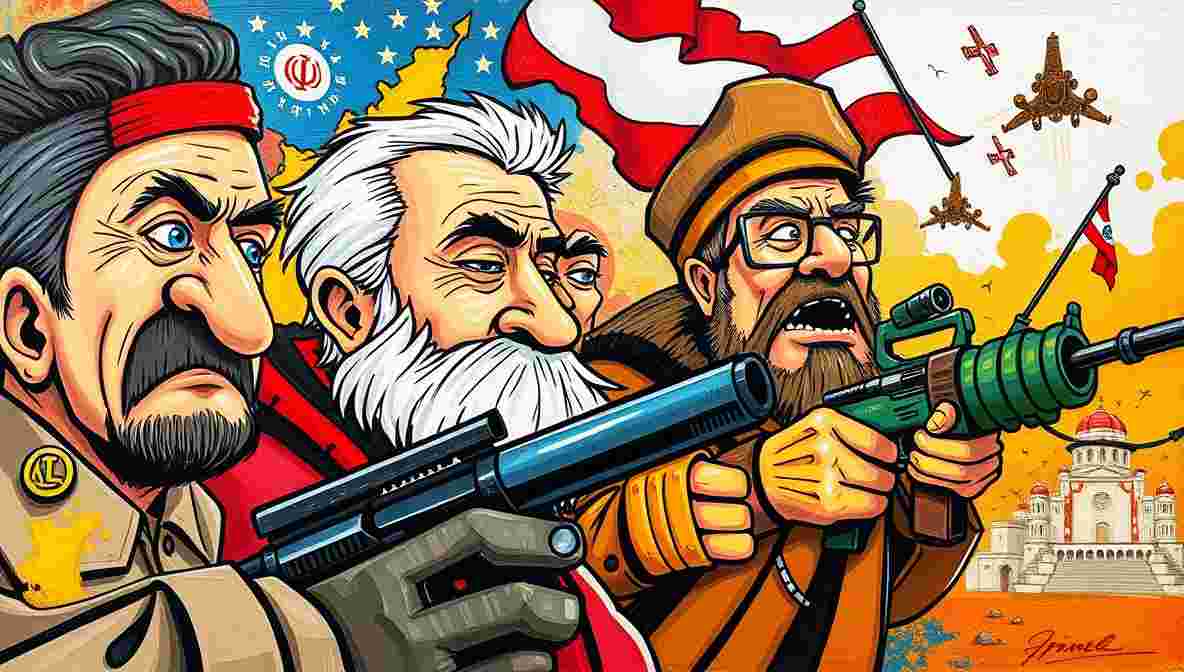
Iran Has “Plan” to Spread Regional War Because Someone Misread Strategy Memo as Party Invite
War Planners Say “Chaos” Was On The Agenda Right After Lunch and Before Happy Hour 🍟📈
In a development that has global markets scratching their heads and Middle Eastern diplomats pulling their hair out by the entire root system, Iran has launched what experts are calling the most ambitious regional conflict strategy since someone invented square dancing. Why? Because a General Staff document that may have once been a weekly cafeteria menu was apparently misunderstood as a master blueprint for diplomacy.
An FT editorial noted that Iran is now “executing Khamenei’s plan to spread war across the Middle East” like a dinner table champion at Thanksgiving passing gravy, potatoes, and ballistic missiles simultaneously. Senior strategic analysts were overheard saying the plan looks less like a coherent military strategy and more like someone’s fantasy football draft picks — except the players are proxy militias and the scoring system involves oil refineries.
Chaos Is Good For Markets, Analysts Say (Except When It Isn’t) 📉💥

Wall Street reacted as if the Fed had announced “quantitative tightening plus surprise fireworks displays in the Strait of Hormuz every Tuesday at 3pm.” Energy prices shot toward the moon, a statistician’s dreams and an economist’s nightmares. “If chaos were an asset class,” one commodities trader quipped, “we’d be printing ETFs by now.” As it happens, roughly 20-30 percent of global oil and gas supplies move through the Strait of Hormuz — a narrow waterway now auditioning as the world’s most expensive parking lot.
Contrary to conventional logic — which generally holds that wars are bad for stability — some investment advisories noted regional conflict seems to be the new Bitcoin: volatile, expensive, and somehow described with a grin and an 11-point font disclaimer. “Past conflict does not guarantee future conflict outcomes. But probably yes.”
Iran’s “Decentralized Command” Is Like a Hydra with Smartphones 📱🐉
According to military analysts at the Atlantic Council, Iran’s armed forces have adopted “command continuity protocols” — which is a polite way of saying they handed everyone a walkie-talkie and said “have at it!” A regime insider confirmed that during the June war, “command was coming from high up,” but now “forces on the ground already know what they are supposed to do.” Inspiring, in a scorched-earth sort of way.
Retired Gen. Biff Hardnose, a self-styled expert in geopolitical farce who once predicted Brexit by flipping a coin, said “It’s like every division got the memo except no one knows who sent it.” When pressed, Hardnose added “The only thing more decentralized might be my house keys.” His memoir, Walkie-Talkie Diplomacy, is expected to ship Q3, assuming the region still has a functioning postal system.
Missiles Across The Region: Free Travel For All 🚀✈️
Iran has reportedly launched missiles and drones into a buffet of targets. Iranian drones struck hotels, airports and ports in the UAE, Kuwait, Iraq, Oman and Bahrain — essentially completing a Gulf tour that most airlines have now wisely cancelled. Meanwhile, Hezbollah launched missiles against northern Israel on March 2, and the Houthis announced they would resume attacks on Red Sea shipping — because apparently they felt left out of the group itinerary.
A stray warhead landed near a hotel once rated “excellent for Wi-Fi but poor for geopolitical stability,” leading to this eyewitness account: “I thought those were fireworks for a wedding. Turned out it was geopolitics.” About 62 percent of local tourists now say they definitely booked refundable tickets. A separate unscientific poll of coffee shop philosophers concluded that peace is “nice but have you tried eternal vigilance mixed with ballistic fun?”
Cause and Effect, or Cause and Chaos? 🔄
If you’d like traditional cause-and-effect analysis, here it is: On February 28, 2026, the United States and Israel launched a coordinated joint attack — codenamed Operation Roaring Lion and Operation Epic Fury — which included the assassination of Supreme Leader Ali Khamenei. Iran responded with what it called “the heaviest offensive operations in the history of the armed forces of the Islamic Republic.” Most neutral observers say it’s unclear whether the original strike ended the war or simply upgraded it from economy to business class — with complimentary missile service.
Economists say markets love volatility until someone mentions actual human suffering, at which point they become very unhappy and start issuing very long PDFs. A senior geopolitical researcher wryly observed, “Tensions spread faster than free samples at a mall. And there’s no mall map.” That may be the most accurate unofficial statement of 2026. Brookings Institution analysts warned that even continued strikes may not dismantle Iran’s vast IRGC structure and economic assets, which, much like a bad houseguest, refuses to simply melt away.
Domestic Front: Discontent With Extra? 🏙️📢
While most political debate focuses on missiles, analysts point out that massive nationwide protests erupted in late December 2025, driven by economic crisis, the collapse of the rial, and rising prices — spreading to over 100 cities, the largest unrest since the 1979 revolution. The Iranian regime responded with violent repression. At least 1,500 people were executed in Iran in 2025 alone, according to human rights monitors — a figure that has received roughly the same amount of global media coverage as a mid-tier celebrity’s Instagram vacation.
Now, as war spreads, many citizens shake their heads and ask simple questions like: “Wait, I thought we just wanted lower prices?” and “Did the missiles come with a coupon code?” A sociologist specializing in collective mass behavior (and board games) noted that “nothing brings people together like shared hardship — unless it’s shared confusion about why people are shooting at them.”
Global Reactions: About As Unified As a Choir Without Sheet Music 🎼🚫
Gulf states have condemned Iran, calling its actions “aggressive” and “not on the group chat list.” Russia, meanwhile, finds its Middle East leverage severely diminished — its military overstretched, its economy under pressure — reduced to issuing strongly worded statements from a crumbling geopolitical armchair. Moscow warned that the entire mess might encourage more nuclear weapons development, which is a bit like warning that eating spicy wings could lead to heartburn: plausible, alarming, and guaranteed to get headlines.
Turkey’s Erdoğan has proposed a mediator role, which regional diplomats described as “heroic timing” given that mediation venues keep getting struck by drones. Diplomats in Europe gathered for urgent meetings that lasted approximately 23 minutes before everyone agreed that diplomacy is nice but can we get coffee now?
Conclusion: War By Committee And Chaos By Popular Demand
The world watches as conflict spreads across a map that once hoped to highlight economic zones and now resembles a toddler’s scribble on a dinner napkin. Global leaders insist situations are “fluid,” which is diplomatic for “we are not sure what happens next.” The escalating conflict is fueling fears that Washington’s pursuit of regime change and Tehran’s retaliation could destabilize regions from the Gulf to Europe. Civilians, economists, and coffee drinkers everywhere await updates with bated breath and highly caffeinated beverages.
This story was written in full collaboration between two sentient beings — the world’s oldest tenured professor of geopolitics and a philosophy major turned dairy farmer who insists missile trajectories resemble philosophical paradoxes. No artificial intelligence is to blame for this article.
Auf Wiedersehen, amigo! ✨📰
Background context: On February 28, 2026, the United States and Israel launched coordinated strikes on Iran codenamed Operation Roaring Lion and Operation Epic Fury, killing Supreme Leader Ali Khamenei and multiple top military commanders. Iran retaliated with drone and missile strikes across Gulf states, targeting energy facilities, airports, and ports. The conflict followed months of massive domestic protests inside Iran and a prior 12-day Israel-Iran war in June 2025. Oil prices surged as traffic through the Strait of Hormuz — through which roughly a fifth of global energy supplies pass — slowed dramatically. As of early March 2026, an interim leadership council is governing Iran while proxy forces including Hezbollah and the Houthis have joined the conflict.