
Myanmar Holds Election, Democracy Asked to Wait Outside Until the Bombing Stops
There are elections, and then there are elections, the kind where the ballot box shows up flanked by soldiers, airstrikes, and a helpful reminder that dissent now carries a death penalty. Myanmar is currently hosting the latter. The military junta calls it a “return to multi-party democracy,” which is adorable in the same way a crocodile calling itself a therapy dog is adorable.
The BBC, in its calm, British way, reports that Myanmar is voting in an election widely dismissed as a sham. “Widely dismissed” here means everyone except the people holding the guns, the ballot papers, and the definition of the word democracy. Nearly five years after seizing power in a coup, the military has decided the time is right to ask the public what they think, provided they think correctly, quietly, and under supervision.
The election is being rolled out in phases, which is what you do when you are confident in the process and not at all planning to adjust things midstream if the numbers start misbehaving. Phased voting is basically democracy with patch notes.
Democracy, Now With Fewer Democrats

Major political parties have been dissolved. Their leaders are in jail or exile. Roughly half the country cannot vote because it is either on fire, under opposition control, or both. This has not dampened official enthusiasm. Junta leader Min Aung Hlaing insists the election will be free and fair, which is impressive given that freedom and fairness were last seen fleeing the country with a suitcase and a fake passport.
He helpfully explained that he cannot just say he wants to be president, which is technically true. He has to engineer an election where that outcome feels organic, like farm-to-table authoritarianism.
The military has also warned that refusing to vote is a rejection of progress toward democracy. This is a bold philosophical stance. In most countries, not voting means you forgot, were busy, or lost faith. In Myanmar, it means you are an enemy of progress and possibly alive for a limited time only.
The Soundtrack of Ballots and Bombs
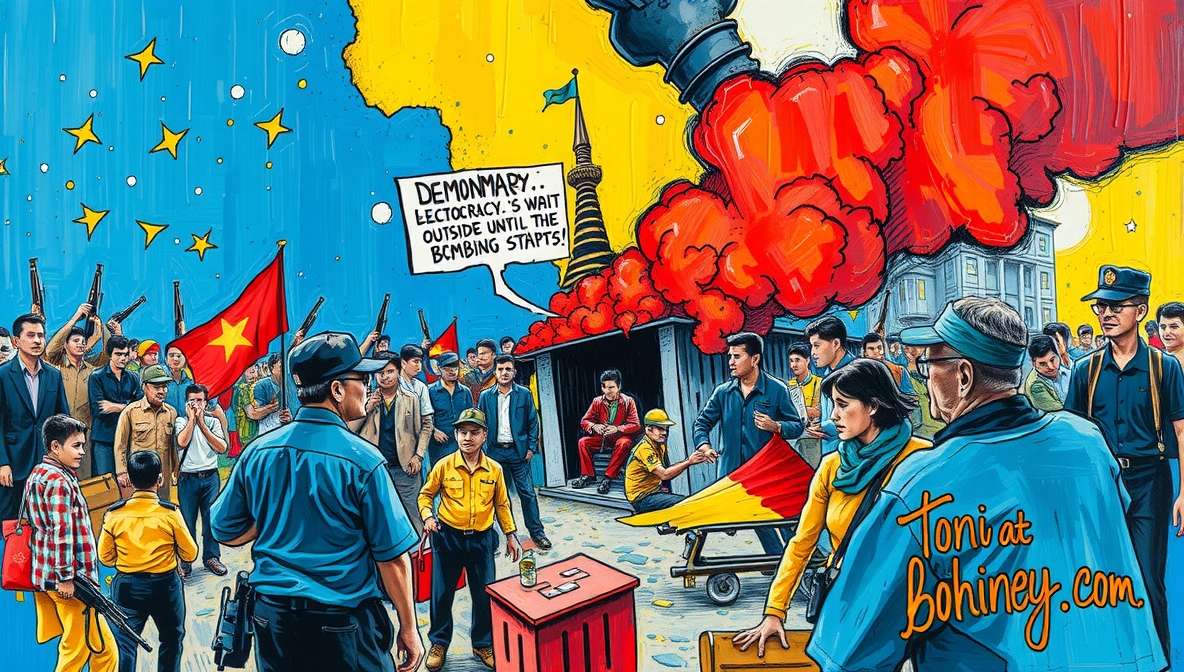
Polling began with reports of explosions, airstrikes, rocket attacks, and the occasional queue of voters trying to look calm while the sky does whatever it wants. Nothing says civic engagement like casting a ballot during an air raid.
One rocket hit an uninhabited house in Mandalay, sending three people to hospital. Another attack damaged more than ten houses in Myawaddy, killing a child. These are described as “incidents,” which is the journalistic equivalent of calling a shark bite a scheduling conflict.
Despite this, some voters told the BBC the election feels more “disciplined and systematic” than before. That is one way to describe a process overseen by armed men and backed by new laws that include the death penalty. Discipline tends to improve when mistakes are fatal.
One voter said she felt afraid before voting but relieved afterward. This is a common emotional arc in authoritarian elections. It is less about civic pride and more about survival-based mindfulness. Congratulations, you have completed Democracy Lite. Please exit calmly and do not discuss your experience.
Responsibility, at Gunpoint
First-time voter Ei Pyay Phyo Maung, 22, said she voted because she believes it is the responsibility of every citizen. This is a lovely sentiment, traditionally associated with hope, agency, and a belief that your choice matters. Here it is paired with skyrocketing prices, a collapsed economy, and a government that responds to criticism with prison sentences.
She hopes for a president who provides equally for all people. The junta also hopes for things. Mostly compliance.
Economists note that inflation in Myanmar has surged since the coup, driven by sanctions, conflict, and the military’s habit of governing like it is allergic to feedback. Voting under these conditions is less about policy preferences and more about ritual. Humans have always used rituals to feel control during chaos. Sometimes it is prayer. Sometimes it is voting in an election everyone knows is fake.
The Candidates You Are Allowed to Love
Six parties are fielding candidates nationwide, including the military-backed Union Solidarity and Development Party. Another 51 parties are competing at regional levels, which creates the illusion of pluralism in the same way a menu with 50 kinds of rice creates the illusion of choice.
More than 40 parties have been banned, including Aung San Suu Kyi’s National League for Democracy, which won landslide victories in 2015 and 2020. Suu Kyi herself is in jail, convicted on charges widely condemned as politically motivated. This is what happens when you win too convincingly.
An 80-year-old resident in Chin state summed it up: when Suu Kyi’s party was in power, people experienced “a bit of democracy.” Now they cry and shed tears. This is the most concise political analysis imaginable. Somewhere, a think tank just lost its funding.
Election Law, Now With Extra Prison
More than 200 people have been charged for disrupting or opposing the polls under a new law enacted in July. Punishments include long prison sentences and death. Film directors, actors, and comedians have been jailed for criticizing a movie promoting the election. Nothing frightens a military regime like a punchline.
Comedy is dangerous because it exposes the gap between what power says and what everyone sees. A tank can crush a protest, but it cannot arrest irony without help from a very confused dictionary.
The state media framed these convictions as law enforcement doing its job. The job, apparently, is ensuring that art only reflects approved joy.
International Community, Clearing Its Throat Again
UN Special Rapporteur Tom Andrews called the election “a theatre of the absurd performed at gunpoint.” This is the most accurate review since critics described Cats as “ambitious but unwatchable.”
Western governments have dismissed the vote as a sham. Asean has called for dialogue before any election. China and Russia, meanwhile, have provided military support that allows the junta to keep bombing civilians while explaining that everything is under control.
Observers note that the election is less about governance and more about legitimacy. The junta wants something it can point to and say, “See, we did democracy.” This is like setting your house on fire and then holding a meeting to vote on whether smoke exists.
Phases, Because Democracy Is a Software Update
Voting will take place in three phases across 265 of the country’s 330 townships. The rest are deemed too unstable, which raises the question of how stable a place needs to be before you trust it with a ballot but not with peace.
Election monitors warn that splitting the vote into phases allows authorities to adjust tactics if early results do not go their way. This is not election management. This is live editing.
Results are expected at the end of January, assuming the country does not collapse further in the meantime. Turnout will be difficult to forecast, partly because half the country is excluded and partly because fear is not easily measured by exit polls.
Helpful Advice for Conducting a Sham Election
In the spirit of helpful content, here is what Myanmar’s election teaches future aspiring autocrats:
First, dissolve opposition parties early. This saves time later. Second, jail or exile popular leaders. Charisma is contagious. Third, pass new laws criminalizing criticism. Comedy should never be allowed to roam free. Fourth, hold elections in phases. Democracy works best when you can tweak it. Fifth, insist it is all about progress. Words mean whatever you need them to mean.
For citizens forced to participate, the advice is simpler. Stay alive. Vote if you must. Hope quietly.
Definition of Democracy, Revised Edition
Traditional definition: a system of government in which power is vested in the people, exercised through free and fair elections.
Myanmar edition: a system of government in which power is vested in the military, exercised through carefully managed voting events held under armed supervision, with pre-approved outcomes and severe penalties for improvisation.
By deductive reasoning, if democracy requires choice and choice requires consequence, then an election where choice is restricted and consequences are lethal is not democracy. It is pageantry.
Cause and Effect, or Why None of This Is an Accident
The coup caused resistance. Resistance caused civil war. Civil war caused displacement, poverty, and chaos. The chaos is now being used to justify an election designed to entrench the very power that caused it. This is not a cycle. It is a feedback loop powered by jets.
Social science research on authoritarian elections shows they are less about public input and more about elite coordination and international signaling. They tell insiders who is winning, outsiders who to deal with, and citizens where the lines are drawn. In Myanmar, those lines are drawn in smoke.
Final Ballot
Some voters feel relieved after voting. Some feel despair. Many feel nothing at all, which is the most honest response to a process designed to look meaningful while changing nothing.
The junta will announce results. International observers will reject them. The war will continue. The economy will suffer. And the word democracy will be used so often it will start to feel tired.
Disclaimer
This article is satire. It is intended to expose the absurdity of pretending that violence, censorship, and democracy can coexist just because a ballot box is present. This story is entirely a human collaboration between two sentient beings: the world’s oldest tenured professor and a philosophy major turned dairy farmer. Any resemblance to real regimes insisting they are democratic while bombing their own people is not coincidental. It is the point.