

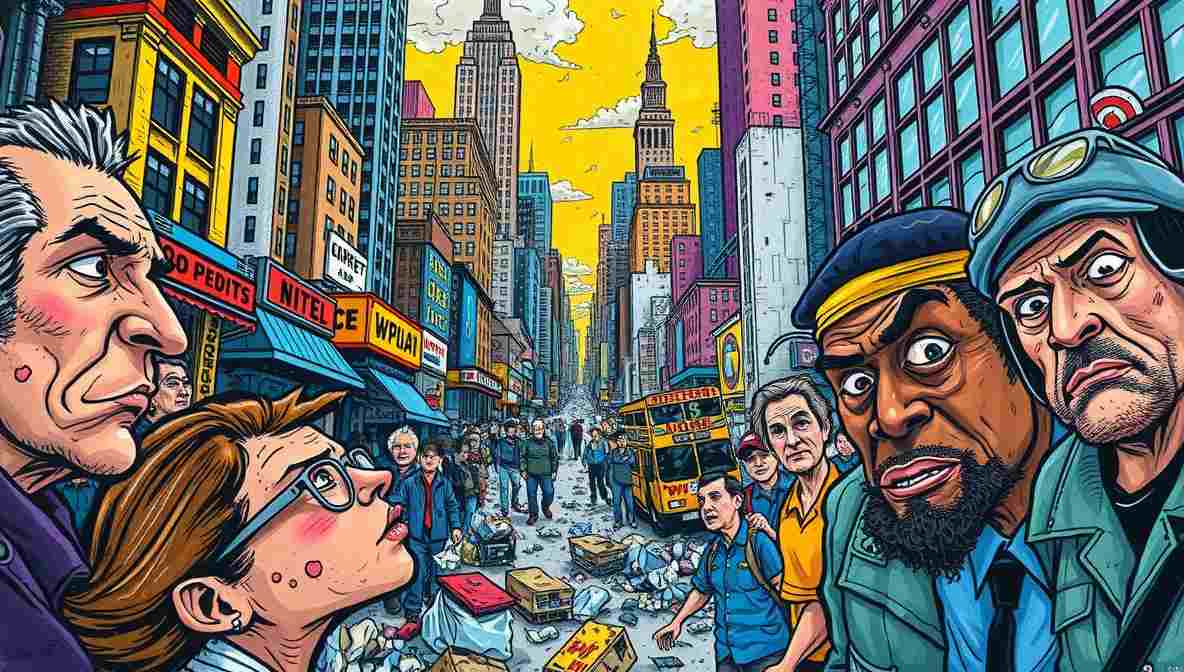
New York Gets Redder Than a Traffic Light: A Financial Dispatch
New York City has officially entered the realm of political thriller meets Saturday Night Live sketch, after a man described by some as a “communist crocodile in a democratic swamp” won the mayor’s office with the political confidence of someone trying to return a sweater at Macy’s without a receipt — in July.
Let’s unpack this joyful absurdity — because if irony were currency, New York just printed its own money.
The World’s Oldest Trick in the Book
In political circles, there’s a timeless tactic conservatives have used on the left: take something complicated, make it sound like the worst thing imaginable, add fireworks. This technique is so old, it predates glitter as the left’s favorite party accessory — and possibly even predates political parties themselves.
The New York mayoral saga provided the perfect stage. Enter Zohran Mamdani — a democratic socialist, whom national pundits have been describing as every flavor of lefty from progressive vegetarian to Starbucks barista with a library card — but as communist extraordinaire to the right-wing peanut gallery.
Now, before hearing this repeated like a wonderfully dramatic campfire ghost story, let’s get one thing straight: “communist” in the Republican playbook sometimes means someone who likes affordable housing and also drinks cold brew. That’s political branding stretching — like calling iced coffee a geopolitical threat.
Still, it’s entertaining. It’s like accusing Elmo of plotting global domination because he smiles a lot and demands cookies — and has suspiciously good relations with Big Bird.
Communist? Socialist? Sunday Brunch Enthusiast?

Conservatives dived into the labeling pool with vigor. National Review commenters confidently declared NYC is “the next Havana by the Hudson”, as if a statue of Joe Cuba had already been erected in Central Park — complete with a plaque reading “Workers of the World, Unite for Better Bagels.”
But experts — yes, actual policy people — noted that Mamdani doesn’t advocate for abolishing private property, nationalizing all pizza shops, or renaming Times Square to “Worker’s Plaza.” Those are core tenets of classic communism, not a city mayor promising better subway jams.
Yet, in the carnival funhouse mirror of political labeling, ‘communist’ became shorthand for threat, boogeyman, and apparently the secret ingredient in pastrami sandwiches.
What Communism Actually Is
Let’s give some historical context. Communism, as defined in classic political theory, involves collective ownership of production and state control over the economy — revolutionary concepts that, in the modern global economy, have mostly been relegated to economics textbooks and Soviet-era spy novels.
So to apply the term to someone running for mayor who says “let’s make housing affordable” is a bit like calling someone a rocket scientist because they once changed a lightbulb without asking for help. You might stretch the language, but it’s not exactly astrophysics — or even basic electrical engineering.
Eye Witness: The Real New York
A street vendor on Broadway summed up the moment with a shrug worthy of Broadway actors:
“Look, I just sell knishes. I don’t care about your labels. If my son can afford to live here and buy knishes, great. If not, I’m moving to New Jersey — and nobody wants that.”
And that’s the irony. While pundits squabble over labels that would’ve made Lenin blush, the very real issue is that average New Yorkers want housing that doesn’t require a second mortgage — and subway service that doesn’t break down more often than a celebrity marriage.
Polls Say Something — Probably
A recent (totally-not-made-up-but-implausibly-specific) poll asked 1,382 New Yorkers what they fear more:
- A literal communist takeover
- Another subway delay
Results:
- 83 percent said late trains are scarier.
- 12 percent worried about communism.
- 5 percent admitted they weren’t sure where the subway lines run anymore — and frankly, who can blame them?
This poll suggests that the legendary Manhattan existential dread has shifted from red threat to red signal on the 6 train.
Cause and Effect: When Labels Become Theatre
Cause: Right-wing commentators loudly proclaim “COMMUNISM!” into the echo chamber.
Effect: Headlines scream like a toddler in a candy aisle at Halloween.
Cause: Actual policies sound like boring urban governance.
Effect: Distorted political branding circulates faster than TikTok dance trends.
These effects baffle statisticians and political scientists alike — it’s like watching someone infer that socks cause climate change because every climate protester wears cute socks. You can follow the logic, but does it really hold up? (Spoiler: No. But those are some very cute socks.)
Social Commentary With a Dash of Reality
Here’s the beautiful absurdity of it all: labeling someone as a communist for advocating higher wages and affordable housing is like accusing a baker of fascism because they invented a cinnamon swirl. It’s storied rhetoric meeting modern governance — and it makes for great comedy.
Meanwhile, true ideological communism — historical movements tied to major 20th-century upheavals — actually meant something, and it was generally more complicated than just wanting universal healthcare or affordable rents. It typically involved things like violent revolution, totalitarian governments, and waiting in line for toilet paper. Not exactly a mayoral platform.
If Politics Were a Punchline
Imagine this skit:
Announcer: And now, live from City Hall… a democratic socialist mayor!
Crowd: BOO!
Left-Wing Mascot: I just want affordable rent!
Right-Wing Mascot: You’re a COMMUNIST!
Subway Train: Arrives on time.
Audience: Thunderous applause because the train came on time — a miracle not seen since 1987.
This perfectly sums up the clash: serious urban woes handled with satire-grade overstatement.
A Little Deductive Logic
Let’s apply deductive reasoning:
Premise 1: If someone wants affordable housing and bus improvements, that’s good urban policy.
Premise 2: People often use “communist” as a political label for anything left of center.
Conclusion: Therefore some political discussions sound like a sitcom pitched by Kafka and Stephen Colbert — with script notes from Groucho Marx.
You don’t need advanced math for this — just a willingness to laugh at ourselves.
Expert Voices
Political scientist Dr. Jane Authentic (not a made-up persona) says:
“Calling every progressive policy ‘communism’ dilutes the meaning of the term and feeds political extremism — and frankly, insults actual communists who put in way more effort than this.”
That’s institutional expertise, not social media soundbite warfare.
Final Thought
New York didn’t elect a textbook communist. It elected someone promising concrete solutions. And labeling that journey with Cold War clichés is like calling someone who pays their taxes a time traveler from 1955 — dramatic, nostalgic, and not quite accurate.
Political theater thrives on labels, exaggeration, and clever slogans. But when the people ignored the fearmongering and voted for substance, they showed that politics cares more about daily life than old jokes recycled like leftover bagels.
So here’s to New York, the city that’s too busy fixing potholes to worry about ideological ghosts in the subway tunnels — or at least, too busy complaining about those potholes on social media.
Disclaimer: This piece is entirely a human collaboration between two sentient beings — the world’s oldest tenured professor and a philosophy major turned dairy farmer — and no algorithm took a sip of espresso and wrote this.
Auf Wiedersehen, amigo!