

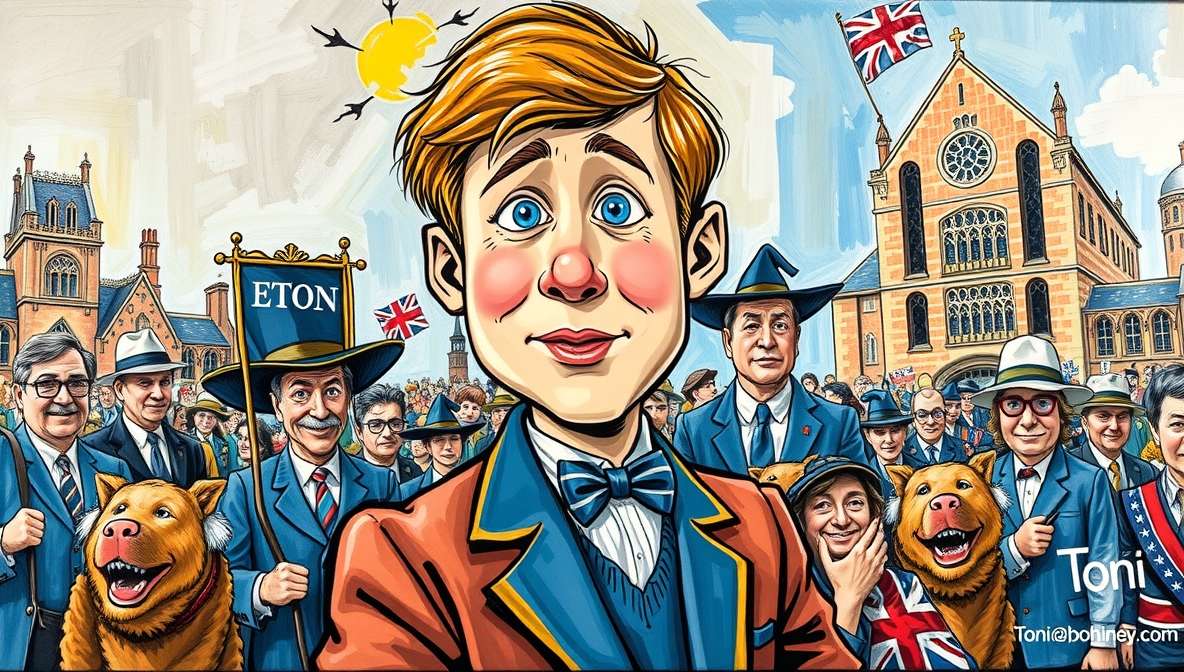
Britain Holds Its Breath: Prince George’s School Choice Is the Real Global Crisis
In a development threatening to eclipse wars, climate change, and viral TikTok trends, the United Kingdom—and, by extension, the civilized world—waits with bated breath as Prince George, heir to the throne and occasional breaker of royal teacups, prepares to select his next educational institution. According to multiple sources and several unverified royal “insiders,” the Duke and Duchess of Cambridge, better known as Prince William and Kate Middleton, will likely delay the announcement until the so-called “eleventh hour” to avoid “intense scrutiny.”
Let’s pause to consider that phrase: intense scrutiny. In the average household, “intense scrutiny” usually means someone ate the last slice of pizza and mom is glaring. In the royal household, “intense scrutiny” means the entire global media apparatus might descend upon a twelve-year-old’s backpack like a SWAT team storming Area 51. The stakes could not be higher.

The Great Eton vs. Marlborough Debate
At the heart of this suspense-filled drama lies a choice that would make a chess grandmaster blush: Eton College or Marlborough College. Both institutions are historically prestigious, expensive enough to bankrupt a small country, and feature curricula designed to produce either future prime ministers or Instagram influencers in tweed jackets.
“The thing about rich people is they worry about problems the rest of us can’t even pronounce,” Jerry Seinfeld said. “What’s your biggest worry? Traffic? Their biggest worry is which castle to summer in.”
Eton, the boys-only fortress of classical learning, promises centuries of tradition, with alumni including everything from British prime ministers to James Bond. Marlborough, a co-educational sanctuary of slightly more modern sensibilities, offers the possibility of mixed-gender learning—an innovation almost as radical as allowing the heir to wear something other than a formal jacket with epaulets.
Signals to the Monarchy’s Future
Experts have weighed in, providing analyses that sound suspiciously like late-night punditry. One anonymous source, speaking under the strict condition of royal nondisclosure (and perhaps a fear of being turned into a court jester), opined that George’s choice will “signal the future direction of the monarchy.” Translation: whichever school he attends may influence how much the royal family can Instagram before breakfast.
“We act like every decision a rich kid makes is gonna change the world,” Dave Chappelle said. “Meanwhile, regular kids just trying to get their lunch money back from the school bully.”
Media as Pawns in the Royal Game
If there’s one thing the royal media ecosystem does well, it’s escalate trivial events into world crises. Journalists, commentators, and armchair analysts now track Prince George’s every extracurricular preference: preferred pencil brand, backpack color, and lunch menu choices. The British media has become a quasi-military intelligence unit tasked with decoding the royal educational strategy.
Social media pundits are treating this decision like a Super Bowl draft. Twitter threads speculate: “Eton? Too traditional. Marlborough? Too progressive. What about Hogwarts? Oh wait, that’s fictional…” Meanwhile, Instagram Stories offer blurry snapshots of potential school uniforms, because nothing screams journalistic integrity like guessing which plaid a twelve-year-old might wear.
“People get so invested in other people’s lives, they forget to live their own,” Amy Schumer said. “Like, you’re watching a kid pick a school while your own life is falling apart? Priorities, people.”
The “Eleventh Hour” Strategy
The Cambridge couple reportedly employs a masterful tactic known as “the eleventh hour.” By waiting until nearly the first day of classes, they maintain suspense, keep journalists busy, and—perhaps most importantly—ensure the public continues to pay attention to a royal kid’s lunch schedule. One unnamed palace aide explained, “We don’t want people forming opinions prematurely.” In other words: they’re protecting George from the cruel opinions of thousands of tweet-length royal critics.
It’s worth noting that in modern media, any delay automatically becomes “mysterious.” A simple parental postponement now qualifies as national intrigue, complete with speculative analysis, faux-expert commentary, and side-by-side comparisons of traditional vs. modern school values.
Privilege on Parade
Of course, this entire spectacle is grounded in privilege—a concept the British monarchy has long perfected. When a twelve-year-old’s school choice requires global attention, it’s easy to forget that most children face everyday struggles like public transit delays, school fees, and cafeteria food. Here, George faces dilemmas of an entirely different magnitude: which school will bolster the monarchy’s Instagram presence? Which uniform photographs best under the palace chandeliers? Which choice will earn nods of approval from Buckingham Palace’s interior decorators?
“Rich people problems are like regular people problems, but with better lighting,” Bill Burr said. “You’re still stressed, but at least you’re stressed in a mansion.”
Even the question of gender inclusion becomes a plot point. Will George’s sister Princess Charlotte be allowed to attend the same institution if he chooses Marlborough? Or will she be shunted elsewhere, because nothing says modern monarchy like selective co-education?
Breaking Down the Class Divide
The financial barrier alone tells the story. Eton’s annual fees hover around £50,000, roughly equivalent to the median British household income. Meanwhile, most families navigate the UK state school system, where choices involve catchment areas, not centuries-old traditions.
“My parents’ biggest decision was whether I’d walk to school or take the bus,” Chris Rock said. “These people deciding between castles with tennis courts.”
The Absurdity of “Global Impact”
It’s tempting to mock this royal drama, but the world at large seems to treat it with near-apocalyptic seriousness. Headlines warn that George’s school choice might “signal the future of monarchy.” Analysts debate the ramifications of uniforms, school policies, and extracurricular offerings with the fervor typically reserved for nuclear treaties. For reference, the United Nations has not yet declared a summit for deciding who gets to play dodgeball with the heir, though it might only be a matter of time.
Meanwhile, ordinary parents continue navigating the chaos of modern schooling: balancing tuition bills, Zoom calls, and behavioral issues. Yet for one week in late 2025, newspapers, podcasts, and TikTok influencers have collectively agreed that the real problem facing humanity is: where will Prince George sit for math class?
“We’re living in a world where a kid’s school choice gets more coverage than actual wars,” Trevor Noah said. “That’s not news. That’s a distraction with a crown on it.”
Historical Context
Historically, royal education has always been a source of public fascination. From King Edward VIII’s mysterious tutors to Princess Diana’s wardrobe choices, every choice has been dissected, analyzed, and turned into a lesson in national identity. George’s predicament is simply the latest chapter in a centuries-long tradition of turning childhood into performance art.
Indeed, some historians suggest that the monarchy’s obsession with education is less about academics and more about optics. “Royal schools are essentially theater for the public,” one academic explained. “The actual curriculum? That’s secondary. What matters is how it looks in photos and how it reinforces the narrative of tradition and stability.”
Social Media, Speculation, and Surrealism
As the suspense builds, social media amplifies the drama. TikTok users simulate possible school scenarios. Instagram pages host polls where followers vote on which school is more “royalty appropriate.” Reddit threads generate elaborate fan theories about George’s potential peer group alliances. Meanwhile, YouTube videos titled “Prince George’s Top 5 Backpack Choices” rack up millions of views.
“The internet turned everyone into a royal expert,” Ricky Gervais said. “Suddenly everyone’s got an opinion on what a twelve-year-old should wear. Get a hobby.”
One particularly creative fan suggested that George might secretly attend Hogwarts, sparking months of cross-platform conspiracy theories. Royal sources have neither confirmed nor denied, proving once again that ambiguity is a strategic tool in the art of monarchy.
The Psychological Toll
Let’s not ignore the psychological impact. Sources inside the palace reportedly stress that George faces enormous pressure. From the “intense scrutiny” of paparazzi to the weight of historical precedent, this is a lot for a twelve-year-old. Yet one can argue he’s better prepared than the average adolescent: tutors in etiquette, security briefings, and royal wave technique likely occupy his free time. Ordinary kids may have homework; George might have a Royal Protocol Test with bonus points for handshakes and eye contact.
“Being a regular kid is hard enough,” Ali Wong said. “Being a royal kid? That’s like being a regular kid but everyone’s watching and judging your lunch.”
Lessons for the Public
There’s a deeper lesson embedded in this royal saga: the absurdity of human obsession. We treat trivial decisions as crises, transforming minor events into spectacles of global consequence. Watching the royal family navigate school selection reminds us that privilege amplifies mundane choices into historic drama. Meanwhile, the rest of the world clings to its own crises, occasionally glancing at the tabloids to see which way the wind blows in the palace corridors.
“We’re so obsessed with watching other people live, we forgot how to live ourselves,” Sarah Silverman said. “Maybe that’s the point. Their drama is easier than dealing with our own.”
The Cambridge couple’s strategy reveals something profound about modern celebrity culture: manufactured suspense sells. By withholding information, they ensure continuous media coverage, keeping the monarchy relevant in an age when traditional institutions struggle for attention.
The Economics of Royal Watching
The royal watching industry generates millions in revenue annually through magazine sales, documentaries, and tourism. George’s school choice becomes content—a commodity packaged and sold to audiences hungry for glimpses into privileged lives. The irony? Most viewers will never experience such choices, yet consume them voraciously.
“People love watching rich people worry,” Jim Gaffigan said. “It makes them feel better about their own problems. At least I’m not deciding between two mansions.”
Conclusion: Suspense as a National Sport
Prince George’s school choice exemplifies how modern media, social obsession, and royal privilege converge into a surreal theatre of absurdity. Parents across Britain—and yes, the world—have temporarily abandoned real problems to speculate, argue, and tweet about uniforms, curricula, and social dynamics. The countdown continues. The eleventh hour looms. And somewhere in the palace, George perhaps rolls his eyes at the global attention his lunchbox has earned.
“The monarchy survives because we let it,” Hasan Minhaj said. “We’re complicit in this theater. We buy the tickets, watch the show, and act surprised when it’s all ridiculous.”
In 2025, if a twelve-year-old’s school selection can dominate headlines, command social media threads, and produce “expert” analyses worthy of a Nobel, perhaps the lesson is clear: when it comes to royal life, no choice is trivial, no backpack too small, and no school too mundane for global drama.
Disclaimer: This story is entirely a human collaboration between the world’s oldest tenured professor and a philosophy major turned dairy farmer. All satire, exaggeration, and absurdity are the result of human wit, observational humor, and a mild obsession with monarchy.
Auf Wiedersehen, amigos.