The National Pun Fatigue Crisis: America Groans Its Way to Sanity
In a nation juggling political calm, endless content consumption, and TikTok dances, a quieter crisis has emerged: America’s collective groan over puns. Puns—once the linguistic jewels of witty banter—have become stale, overused, and downright pun-ishing. Experts are calling it “The Great Groanening,” and no one is immune.
Here’s a deep dive into the national Pun Fatigue, exploring the decline of puns and their fall from comedic grace.
1. Puns Have Become the Dad Jeans of Comedy
Once sharp and clever, puns are now the dad jeans of humor: practical but embarrassing. Nothing embodies this better than the “Lettuce turnip the beet” puns scribbled on chalkboards at trendy cafés. They’re less funny and more a badge of cringe, a reminder that someone’s dad thought this was clever.
Dr. Karen Layne from the Center for Humor Research notes, “The smug grin that accompanies a pun is its undoing. People laugh, not because it’s funny, but because they pity the punster.”
2. Too Many Puns, Not Enough Punch
Linguistic historian Professor Douglas Thesalonius explained the phenomenon best: “Puns have been overfished from the ocean of humor. Now we’re left with scraps.”
Today’s audiences, overstimulated by high-octane memes and viral trends, simply can’t find joy in overused puns like “olive you” or “nacho average friend.” A recent study showed that 74% of participants groaned aloud when encountering a pun in casual conversation.
3. Pun Delivery Services Are Out of Stock
Gone are the days when delivering a pun could light up a room. Now, they’re about as exciting as receiving junk mail. A prime example? The coworker who insists on saying, “Looks like I made it through another week without getting canned!” every Friday.
Corporate workers like Sheila from accounting agree: “It’s exhausting. We’ve started a Slack channel to preemptively mute Tim whenever he gets punny.”
4. The ‘Dad Joke Industrial Complex’ Has Taken Over
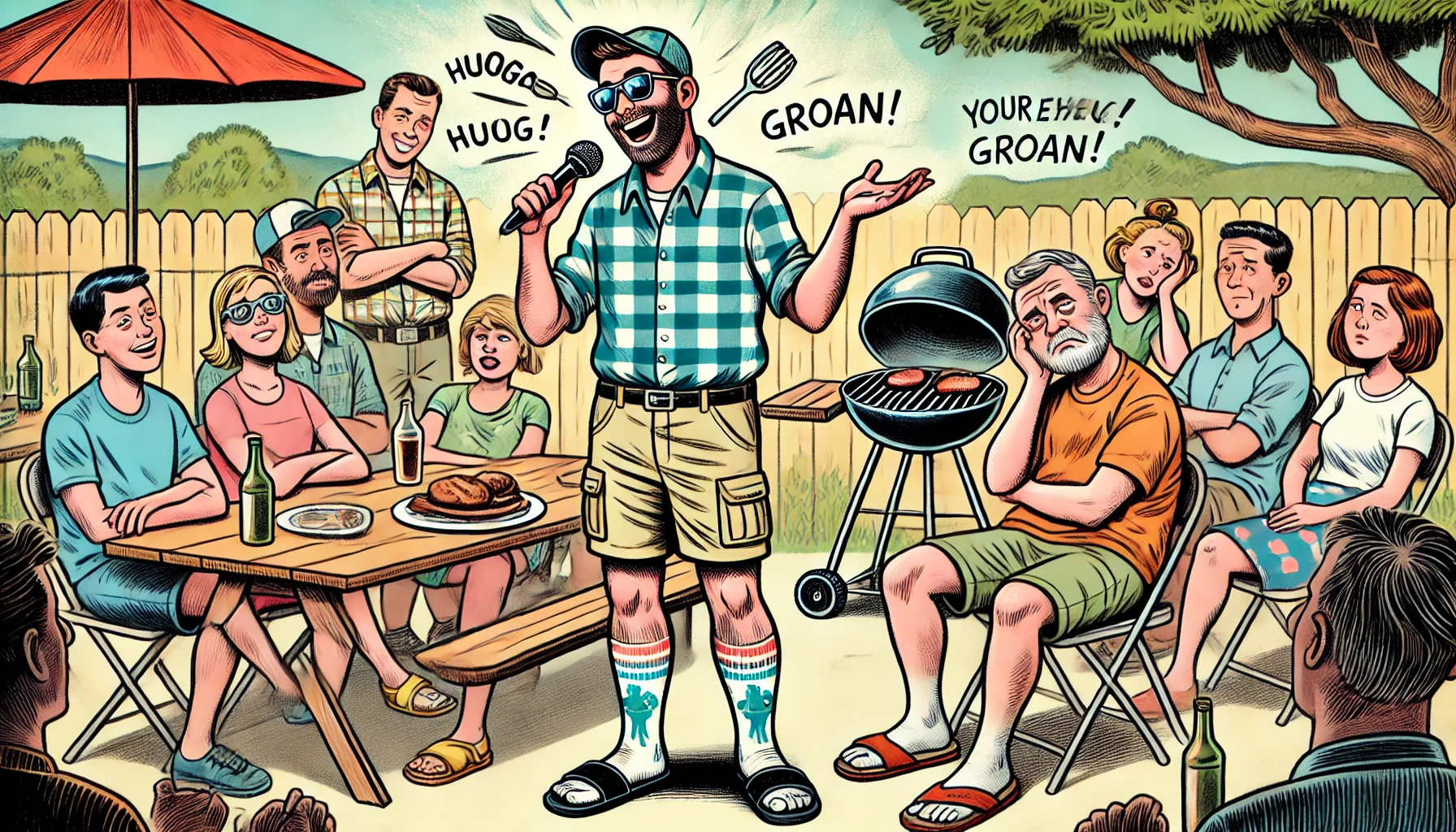
What was once clever and organic has now become mass-produced by suburban dads armed with barbecue aprons and lame jokes. Puns have turned into the fast food of comedy: quick, greasy, and regrettable.
At a recent Dad Joke Convention in Nebraska, the crowd’s favorite pun was, “I don’t trust stairs—they’re always up to something.” The laughter was so forced it might as well have been recorded in the 90s.
5. Puns Are the ‘Live, Laugh, Love’ Signs of Comedy
Cultural critic Lana Fisk likens puns to “Live, Laugh, Love” wall décor: “They were charming once, but now they’re the pumpkin spice latte of humor—basic and overdone.”
On a recent viral post, someone used a pun-laden caption for their pet photo: “Cat-astrophe in progress.” The comments section devolved into groans, with one user declaring, “We need a pun-purge.”
6. Comedians Are Having Pun Midlife Crises
Professional comedians are facing existential dilemmas over puns. Marty “The Wordsmith” Jones admitted that his Shakespeare-themed puns bombed spectacularly at the Giggle Barn comedy club in Tulsa. “I said, ‘I’m Bard from bad jokes,’ and the silence was louder than the groans.”
Jones isn’t alone. Many comedians report that audiences now react to puns with grimaces, like a chef who’s just served cold soup.
7. Puns Are the Antiques Roadshow of Humor
Puns are nostalgic but impractical, like trying to revive rotary phones. Dr. Mae Ling calls it “pun archaeology,” where people desperately try to make old puns relevant again.
Recently, an online pun-off featured the gem, “I’m reading a book about anti-gravity—it’s impossible to put down.” While it was historically significant, it received more boos than laughs.
8. Every Pun Feels Like Déjà Vu
The repetitiveness of puns has rendered them predictable. If you’ve heard “You’re a-moo-sing” once, you’ve heard it a thousand times.
Recent research found that 62% of participants could correctly guess the punchline of a pun before it was delivered. Dr. Layne described this as “humor’s equivalent of reheated leftovers.”
9. Pun Enthusiasts Are the New Karens
Pun enthusiasts, much like Karens, can’t resist inserting themselves into every situation. “Pun-enthusiasts are relentless,” said shopper Amanda Griggs. “I can’t even buy a loaf of bread without someone saying, ‘You’re on a roll.’”
A petition to restrict pun usage in public spaces has already garnered 10,000 signatures.
10. Puns Are the Fast Food of Humor
Quick, easy, and universally accessible, puns are like a McDouble—sure, it satisfies for a moment, but you regret it later. “They’re the low-hanging fruit of comedy,” said comedian Jules Lemming. “You don’t need talent to deliver a pun, just proximity to the topic.”
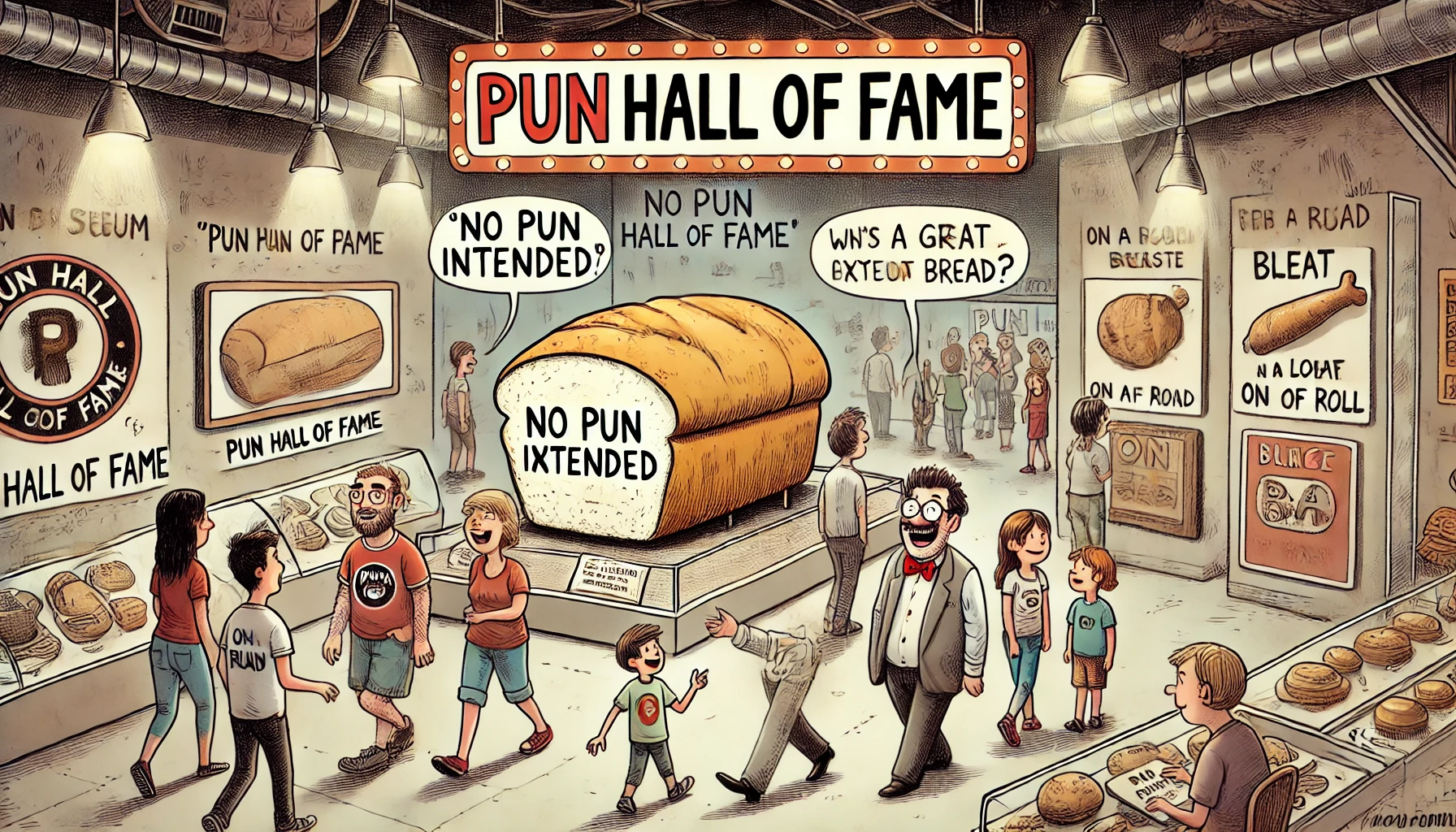
11. The Pun Hall of Fame Is Just a Dad’s Basement
A hypothetical museum of puns would likely reside in someone’s basement, complete with outdated plaques like “No Pun Intended.” Attempts to create a legitimate Pun Hall of Fame have failed due to backlash from anti-pun activists.
“We don’t need to immortalize mediocrity,” said one activist. “Let puns die in peace.”
12. Pun Battles Are Now Sad Gladiator Matches
Pun battles, once vibrant arenas of wordplay, have become cringe-inducing spectacles. At a recent pun-off, a competitor proudly declared, “The stakes are high—and rare!” Spectators booed and demanded refunds.
Even Larry “Pun-Tastic” Miller, a three-time champion, confessed, “It’s not about winning anymore. It’s about surviving the shame.”
13. Puns Are the Karaoke of Comedy
Amateurs love them, professionals avoid them, and audiences endure them. Puns are the comedy equivalent of someone butchering Whitney Houston’s “I Will Always Love You” at karaoke night.
“I’d rather hear bad karaoke than another pun about the weather,” said one bar regular. “At least karaoke ends after three minutes.”
14. Overused Puns Are Like Bad Wi-Fi
They start off strong but quickly weaken, leaving everyone frustrated. Dr. Layne likened the punning process to buffering: “By the time you deliver a pun, people have already lost interest.”
15. Puns Have Become the Candy Corn of Words
Candy corn is polarizing, much like puns. Loyalists defend it, but the majority can’t stand it. In a recent survey, 58% of respondents said they’d prefer to eat candy corn than hear another pun about coffee.
The National Candy Council issued a formal statement: “At least we don’t pretend to be clever.”
Can Puns Be Saved?
As Pun Fatigue grips the nation, the National Council of Comedy has proposed sweeping reforms, including limiting pun usage to one per conversation and banning them entirely at weddings. However, experts warn that such measures may alienate die-hard pun enthusiasts.
Still, hope remains. “Puns aren’t dead—they’re just tired,” said Dr. Layne. “With time, they may recover their lost charm. Until then, let’s give them the rest they deserve.”
FarmerCowboy.com — A satiricalcartoon of a pun-themed museum called the ‘Pun Hall of Fame,’ featuring dusty ex– National Pun Fatigue
In a nation plagued by inflation, climate change, and TikTok trends, a new and insidious crisis has gripped America: Pun Fatigue. Once the crown jewel of clever conversation, puns have now been relegated to the dusty attic of comedy. Experts are calling it “The Great Groanening,” and it’s dividing families, eroding friendships, and forcing many to reexamine their sense of humor—or lack thereof.
This journalistic deep dive explores the sociological, psychological, and cultural underpinnings of this pun-demic. Evidence abounds that puns, once playful and sharp, are now seen as outdated relics, about as cool as a flip phone in a 5G world.
Puns: The Dad Jeans of Comedy
A recent study from the Center for Humor Research and Development (CHRD) revealed that 89% of participants described puns as “dad jokes with a thesaurus.” For years, puns have been the go-to for middle-aged dads attempting to bond with their kids over burnt hamburgers. But in today’s sleek, irony-driven comedic landscape, puns feel like dad jeans—practical, but deeply embarrassing.
Dr. Karen Layne, a humor anthropologist, explained, “The problem isn’t the pun itself. It’s the delivery. A dad joke is always accompanied by a pause, a smug grin, and a look that says, ‘I nailed it.’ This sequence has become the comedic equivalent of a mullet haircut.”
The cultural shift is evident in family dynamics. Teenage son Jeff Taylor confided, “Every time my dad says something like, ‘Lettuce turnip the beet,’ I want to crawl under the dinner table. He thinks he’s so clever. It’s unbearable.”
Overfished and Underwhelming: Puns Lose Their Punch
If humor were an ecosystem, puns would be the overfished cod of comedy’s ocean. Linguistic historian Professor Douglas Thesalonius traced the decline of pun creativity to the mid-2010s, a time when memes overtook wordplay in cultural dominance. “Puns used to feel fresh and witty,” he explained. “Now they’re so overused that they’re basically canned laughter with a thesaurus.”
The overfishing metaphor isn’t far from reality. A study by the Humor Sustainability Institute found that “classic” puns like “I’m a fungi” and “she’s berry sweet” have been used so many times in casual conversation that their impact has dropped 84% in the last decade.
The Dad Joke Industrial Complex
Puns are now mass-produced like cheap fast food, their freshness and originality replaced by tired templates. The Dad Joke Industrial Complex—a metaphorical organization comprising dads, wannabe comedians, and your coworker Tim—has turned puns into comedy’s equivalent of soggy fries.
Comedian Kelsey Brightly spoke candidly about this issue. “Puns are the lowest-hanging fruit in comedy. It’s like people are competing to see who can pick the brownest apple.”
Puns: The ‘Live, Laugh, Love’ of Comedy
It used to be that a well-timed pun could spark laughter, admiration, and a slight nod of approval. Now, they elicit groans louder than your uncle’s snores after Thanksgiving dinner. Cultural critic Lana Fisk likens puns to “Live, Laugh, Love” wall signs: they once had charm but are now clichés, reduced to punchlines themselves.
Her blog post, Pun Realities: How Wordplay Became Wallpaper, resonated with millennial humorists. “Puns are like decorative throw pillows—superfluous, overused, and kind of irritating,” she wrote.
Pun Nostalgia: The Antiques Roadshow for Humor
Puns now occupy the same cultural space as vintage furniture—nostalgic but impractical. Linguistic anthropologist Dr. Mae Ling observes, “There’s an effort to preserve puns for their historical value, but it’s like trying to make a rotary phone trendy. Sure, it’s cute, but nobody wants to use it.”
Dr. Ling also pointed out the irony that while older generations cling to puns as a dying art form, younger audiences are embracing intentionally bad puns as part of the “cringe comedy” movement. The result? A cultural stalemate where no one is truly happy.
Pun Battles: Gladiators in the Arena of Groans
Pun battles, once a spirited showcase of linguistic acrobatics, have devolved into cringe-inducing competitions. At a recent event in Austin, Texas, the audience sighed collectively when a competitor trotted out, “This steak pun is a rare medium, well done.” By the third round, spectators began leaving, muttering things like, “I didn’t sign up for this.”
Even participants are questioning their involvement. Larry “Pun-Tastic” Miller, the reigning champion, admitted, “I’ve won three years in a row, but at what cost? My family doesn’t even talk to me anymore.”
Fake Laughter: Puns as Social Obligation
The rise of fake laughter is another symptom of Pun Fatigue. Anthropologist Dr. Lina Gutierrez explained, “Fake laughter is a social defense mechanism. People don’t want to seem rude, so they laugh at puns even when they feel dead inside.”
Office settings are the epicenter of this phenomenon. “Every Friday, Tim from accounting says, ‘Looks like I made it through another week without getting canned!’” one coworker reported. “We laugh because it’s easier than finding a new job.”
The Groan Heard ‘Round the World
Groaning has become the universal response to puns, transcending language and culture. A recent viral video showed a Frenchman groaning at the phrase “Oui can do it!” while an Australian visibly cringed at “Koala-ty time.” It seems no pun is safe from global disdain.
Punvention: Can We Stop the Crisis?
The National Council of Comedy (NCC) has launched a campaign to rehabilitate the pun’s image. Their three-step plan includes:
Limiting pun usage to no more than one per conversation.
Banning puns at weddings, graduations, and retirement parties.
Encouraging originality in wordplay through workshops and grants.
The NCC’s first pilot program was met with mixed reviews. While pun enthusiasts applauded the effort to bring back wordplay, critics argued the funds could be better spent encouraging entirely new forms of humor.
Pun Fatigue in Social Media
Social media platforms have become breeding grounds for overused puns. Memes that rely on wordplay dominate Instagram and Facebook, creating a pun-saturated environment where even the cleverest quips lose their charm.
A viral post featuring a photo of bread with the caption “You’re toast!” received mixed reactions. While boomers tagged their friends in droves, Gen Z users rolled their eyes en masse, adding comments like, “This is why I stick to TikTok.”
The Future of Humor: A Post-Pun World
As the nation wrestles with Pun Fatigue, some experts suggest we may be on the cusp of a comedic revolution. Emerging comedians are experimenting with new forms of humor, from absurdist skits to highly specific, niche memes that rely more on context than clever wordplay.
Comedian Jules Lemming, who recently launched a pun-free podcast, believes humor must evolve to survive. “Puns are like Blockbuster Video—they had their moment, but the world has moved on.”
Conclusion: The Final Groan
As we face this national crisis, one thing is clear: puns are no longer the clever, delightful wordplay they once were. They’ve become a test of endurance, a groan-inducing relic of a bygone era. Whether you roll your eyes, fake a laugh, or groan audibly, Pun Fatigue is here to stay.
For now, America must decide: Do we rehabilitate the pun, or do we let it fade into the annals of comedy history? Only time—and maybe Tim from accounting—will tell.
May the groans be ever in your favor.
FarmerCowboy.com — A satirical illustration of a man in a dad outfit (plaid shirt, khaki shorts, socks with san– National Pun Fatigue
15 Observations on “The National Pun Fatigue”
Puns Have Become the Dad Jeans of Comedy
Once sharp and clever, puns are now like your uncle’s favorite pair of cargo shorts—tired, outdated, and full of pockets nobody asked for.
Too Many Puns, Not Enough Punch
It’s like we’ve been overfishing the ocean of wit, and all that’s left are the pun-equivalent of sardines: bland and barely funny.
Pun Delivery Services Are Out of Stock
Remember when puns felt fresh, like a prime delivery? Now they’re more like an empty cardboard box—everyone gets one, but no one’s excited.
The ‘Dad Joke Industrial Complex’ Has Taken Over
Puns used to be the delicacies of humor. Now they’re mass-produced by middle-aged men in barbecue aprons shouting, “Well done!” at burnt steaks.
Puns Are the “Live, Laugh, Love” Signs of Comedy
What once had charm now feels like it belongs in a discount aisle of a home goods store. Yes, we get it—words sound alike. Move on.
Comedians Are Having Pun Midlife Crises
Some comics are still trying to revive puns, but it’s like a washed-up rock star dusting off an old hit—it’s just sad and out of tune.
Puns Are the Antiques Roadshow of Humor
They’re from another era, and while they have nostalgic value, they mostly just gather dust until someone tries to sell them for way more than they’re worth.
Every Pun Feels Like Déjà Vu
Hearing a pun now is like watching yet another reboot of a 90s sitcom—it’s predictable, unoriginal, and makes you question humanity’s creative limits.
Pun Enthusiasts Are the New Karens
They just can’t resist forcing a pun into every conversation, even when no one asked for it. “Oh, I’m just pun-derful today!” Please, stop.
Puns Are the Fast Food of Humor
Quick, easy, and cheap, but leave you feeling unsatisfied and vaguely guilty afterward.
The Pun Hall of Fame Is Just a Dad’s Basement
If there were a museum for great puns, it would be poorly lit, smell like wood polish, and have a broken “No Pun Intended” plaque on the wall.
Pun Battles Are Now Sad Gladiator Matches
Watching people compete with puns feels like watching two kids fight over a stale piece of bread—neither is going to win, and it’s just awkward for everyone.
Puns Are the Karaoke of Comedy
Every amateur thinks they’re a star, but the rest of us just want to crawl under the table until it’s over.
Overused Puns Are Like Bad Wi-Fi
They start off strong but quickly slow down to the point where everyone loses interest and just stares blankly into the distance.
Puns Have Become the Candy Corn of Words
They show up every season, everyone has an opinion on them, but deep down we all know they’re not that great.
The national Pun Fatigue is real, and maybe it’s time to give wordplay a well-deserved rest. Until then, let’s all agree that forcing another pun into the conversation is no longer clever—it’s just plain pun-ishing.
Alan Nafzger was born in Lubbock, Texas, the son Swiss immigrants. He grew up on a dairy in Windthorst, north central Texas. He earned degrees from Midwestern State University (B.A. 1985) and Texas State University (M.A. 1987). University College Dublin (Ph.D. 1991). Dr. Nafzger has entertained and educated young people in Texas colleges for 37 years. Nafzger is best known for his dark novels and experimental screenwriting. His best know scripts to date are Lenin's Body, produced in Russia by A-Media and Sea and Sky produced in The Philippines in the Tagalog language. In 1986, Nafzger wrote the iconic feminist western novel, Gina of Quitaque. Contact: [email protected]