

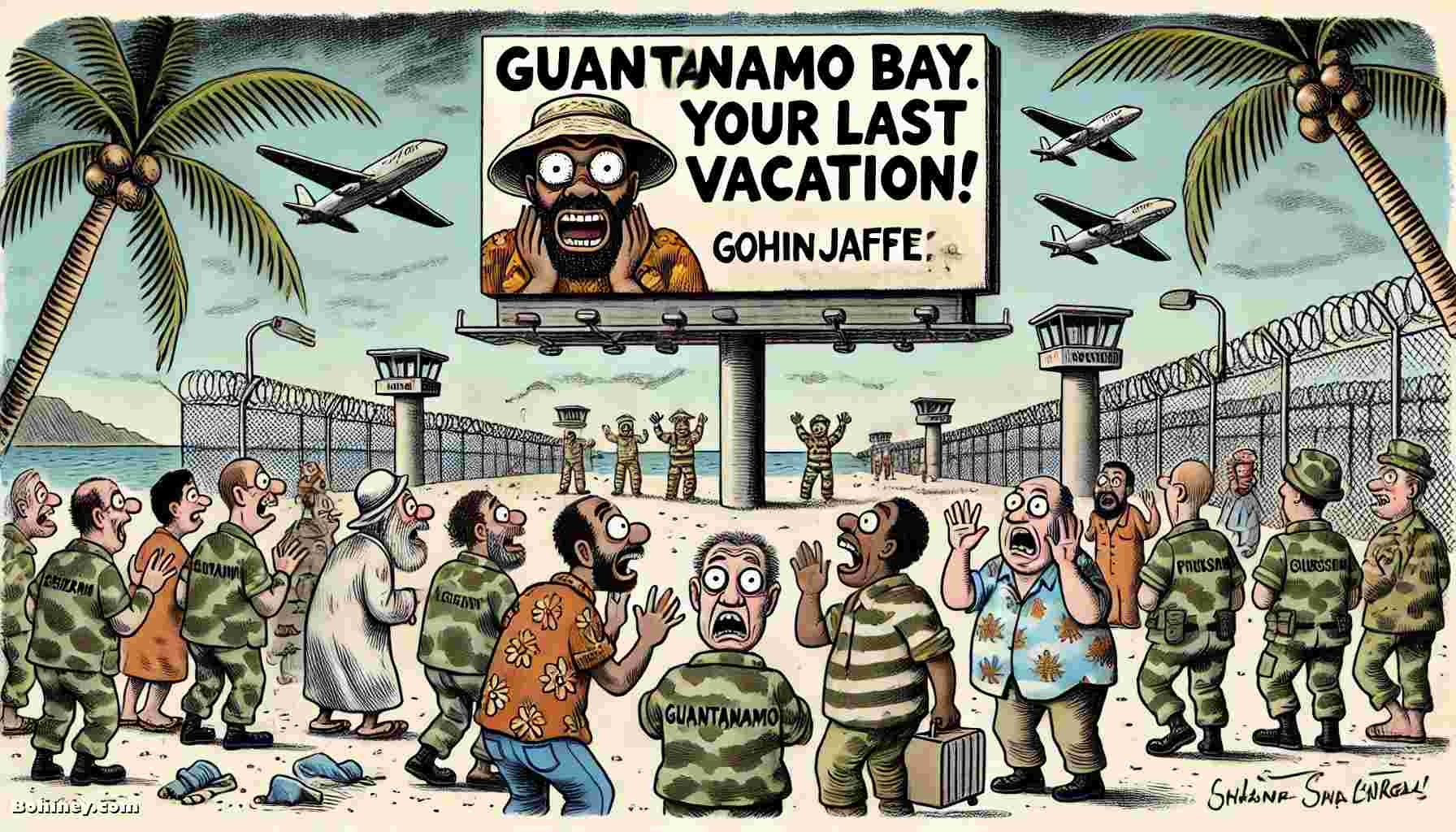
Trump’s Guantanamo Bluff: The Art of Scaring Migrants Without Lifting a Finger
Guantanamo Is Empty: It Was Trump’s Bluff
A Political Masterstroke or Just Another Day in Trump’s Reality Show?
In what is being hailed as either the greatest immigration con of all time or a wildly irresponsible geopolitical stunt, Donald Trump reportedly never intended to send undocumented migrants to Guantanamo Bay—he just wanted to scare them into staying home. White House insiders now claim the entire plan was nothing more than a strategic bluff, a psychological operation reminiscent of Britain’s brief attempt to send asylum seekers to Rwanda, but with a uniquely Trumpian flair.
According to sources close to the former president, Trump never actually meant for Guantanamo to become a migrant detention center. The whole thing was designed to invoke terror in potential border crossers, much like an unhinged homeowner putting up a “Beware of Dog” sign despite only owning a geriatric chihuahua. The idea was simple: convince migrants that if they even thought about stepping over the border, they’d be whisked away to a tropical prison so infamous, even its name alone could strike fear into the hearts of the desperate.
“It’s classic Trump. Why build a wall when you can just yell ‘Guantanamo!’ and scare people into staying home?” – Amy Schumer
“You Cross, You Rot”: Trump’s Ultimate Migration Deterrence Tactic
Trump’s plan, as described by insiders, was an exercise in psychological warfare. Instead of physically detaining thousands of migrants, all he had to do was plant the fear that maybe—just maybe—Guantanamo Bay was their next stop.
One White House aide, who spoke on the condition of anonymity (because even they don’t want to be caught endorsing this madness), said:
“The president was really into this. He saw it as the ultimate mind game. He told us, ‘We’re gonna make ‘em think they’ll end up in Gitmo, and they’ll be so scared, they’ll never even leave their villages. Genius, right?’”
The brilliance of this plan, they explained, was that it required absolutely no legal groundwork, funding, or logistical planning—only the ability to shout Guantanamo loudly and repeatedly at campaign rallies.
“We never even had to draft a policy,” another former official admitted. “It was just a bunch of phone calls to Breitbart and a couple of scary tweets.”
And sure enough, it worked. Reports began to surface of migrants from Venezuela, Honduras, and Guatemala canceling their journeys after hearing the news. Some migrants even called their families from halfway along their route, saying they’d rather take their chances back home than risk waking up to the sound of razor wire rustling in the Cuban breeze.
“The idea of Guantanamo as a vacation spot is about as welcoming as a haunted house advertising free lodging.” – Larry David
The Guantanamo Scare Worked So Well, Even Americans Got Nervous
The political fallout was immediate. Immigration activists were outraged, legal experts were baffled, and mainstream journalists scrambled to figure out whether this was another one of those Trump stunts or an actual, horrifying policy shift. Even some of Trump’s own allies had questions.
One Republican strategist was overheard saying:
“Look, we’ve done a lot of insane stuff, but telling people we’re gonna ship them to a literal prison camp? That’s a new one. What’s next? Threatening asylum seekers with a one-way ticket to Mars?”
Meanwhile, Democratic lawmakers reacted in the way they do best: by demanding urgent committee hearings, tweeting sternly worded condemnations, and making sure MSNBC was fully booked with panel discussions. Senator Elizabeth Warren called the proposal “a grotesque abuse of power,” while Senator Chuck Schumer warned that “Trump is turning America into an international joke.” (To which Trump later responded, “Chuck, you were the joke way before I got here.”)
But perhaps the most surprising reaction came from actual prisoners at Guantanamo Bay. According to a leaked letter from detainees, some of them were reportedly worried that overcrowding would affect their quality of life. One inmate wrote:
“It’s already bad enough here. Now we have to deal with a bunch of people who don’t even belong here? Come on, man.”
The UK Tried This First: The Rwanda Bluff That Never Was
For those wondering where Trump got the idea, look no further than Britain’s attempt to ship asylum seekers to Rwanda—a plan so ridiculous it was basically the Brexit of immigration policies.
Back in 2022, then-Prime Minister Boris Johnson announced a plan to send asylum seekers to Rwanda, despite the fact that neither Rwanda nor the asylum seekers themselves were particularly thrilled about the idea. The scheme was intended to deter migrants from making perilous crossings across the English Channel, but like most British immigration policies, it was soon mired in lawsuits, bureaucracy, and general incompetence.
The plan became a running joke in British politics, with one critic famously remarking:
“The only people actually going to Rwanda are the lawyers fighting the policy in court.”
But despite never being implemented, it achieved something remarkable: it terrified people enough to make them reconsider their journey. Even the idea of deportation to Rwanda—where many feared they’d be stuck in limbo—was enough to cause a dip in attempted crossings.
Trump, an expert in both bluffing and plagiarism, clearly saw an opportunity. If the UK could terrify asylum seekers into staying put without actually doing anything, then why couldn’t he do the same—only with a setting as legendary as Guantanamo Bay?
Was It Really a Bluff, or Was Trump Testing the Waters?
While White House sources insist this was all one big psychological stunt, some observers aren’t so sure. One former national security official pointed out that Trump has a habit of floating wild ideas to see how much public pushback they get.
“This is classic Trump,” they explained. “Throw out an insane idea, see if anyone stops him, and if nobody does—boom, it becomes policy.”
Indeed, Trump’s entire presidency was a masterclass in pushing boundaries, from separating migrant families to deploying federal officers in American cities to disperse protesters with tear gas. The Guantanamo bluff may have been a test to see whether the public, the courts, or Congress would actually try to stop him. Spoiler alert: they didn’t.
The Art of the Con: Trump’s Legacy as a Political Illusionist
If history remembers Trump for anything, it will be his ability to turn reality into performance art. The Guantanamo scare was just the latest in a long list of Trumpian tricks—an immigration deterrent policy that didn’t actually require any detaining.
Political analysts have compared it to some of Trump’s other famous bluffs, including:
- Telling supporters that Mexico would pay for the border wall, despite absolutely no mechanism to make that happen.
- Insisting he had “complete and total exoneration” in the Mueller Report, which definitely did not exonerate him.
- Promising a beautiful health care plan to replace Obamacare—one that, mysteriously, never appeared.
- Saying he would run the government like a business, and then running it like a casino that just went bankrupt.
This latest stunt was no different. By merely floating the idea of Guantanamo Bay as an immigration deterrent, Trump managed to stir up a national controversy, send migrants into a panic, and dominate the news cycle—all without actually having to implement a single policy.
Mission Accomplished?
For Trump, the beauty of the Guantanamo scare is that it allowed him to achieve his goal without the inconvenience of logistics. The migrants who reconsidered their journeys will never know for sure whether they narrowly escaped a stint at Gitmo or just fell for the most successful fake-out in modern immigration history.
And in the end, isn’t that the real Trump Doctrine? Convincing people that something is real, just long enough for it to serve his immediate purpose, before moving on to the next act in the circus?
As one former White House adviser put it:
“It’s not about what’s real. It’s about what they believe is real. And if a few thousand migrants decided to stay put because they thought Guantanamo was their future, well, mission accomplished.”
Trump himself, of course, denies any of this was a bluff. When asked about it directly, he simply smirked and said:
“You tell me. Do I look like a guy who bluffs?”
The terrifying part? No one can ever tell.
Estimate of “3rd World Losers” Deterred
While we can’t precisely quantify how many “third world losers” were deterred from “invading” the USA due to Trump’s Guantanamo Bluff (and really, that phrase alone is offensive), a satirical approach might look like this:
Let’s assume that Trump’s loud-mouthed threat reached about 10% of potential migrants across Latin America. In 2024, an estimated 1.5 million people crossed into the US illegally, according to CBP. If 10% reconsidered their journey due to the fear of being sent to the tropical prison of despair known as Guantanamo, that’s 150,000 would-be border crossers who opted to stay home.
Now, let’s factor in the Trump Factor™—the idea that when he yells something loud enough, about 25% of people actually believe it. This means that of those 150,000 initially deterred, only 112,500 took the threat seriously enough to cancel their plans. The others probably figured, “How bad could it be? It’s near the ocean.”
So, in total, a completely unscientific, fictional estimate is that Trump’s Guantanamo Bluff deterred approximately 112,500 “3rd world losers” (in Trumpian language) from crossing into the US—because nothing says “The American Dream” quite like a place synonymous with despair, orange jumpsuits, and razor wire. If only Trump had threatened to send them to Mar-a-Lago instead, he could’ve gotten those numbers down to zero!
