

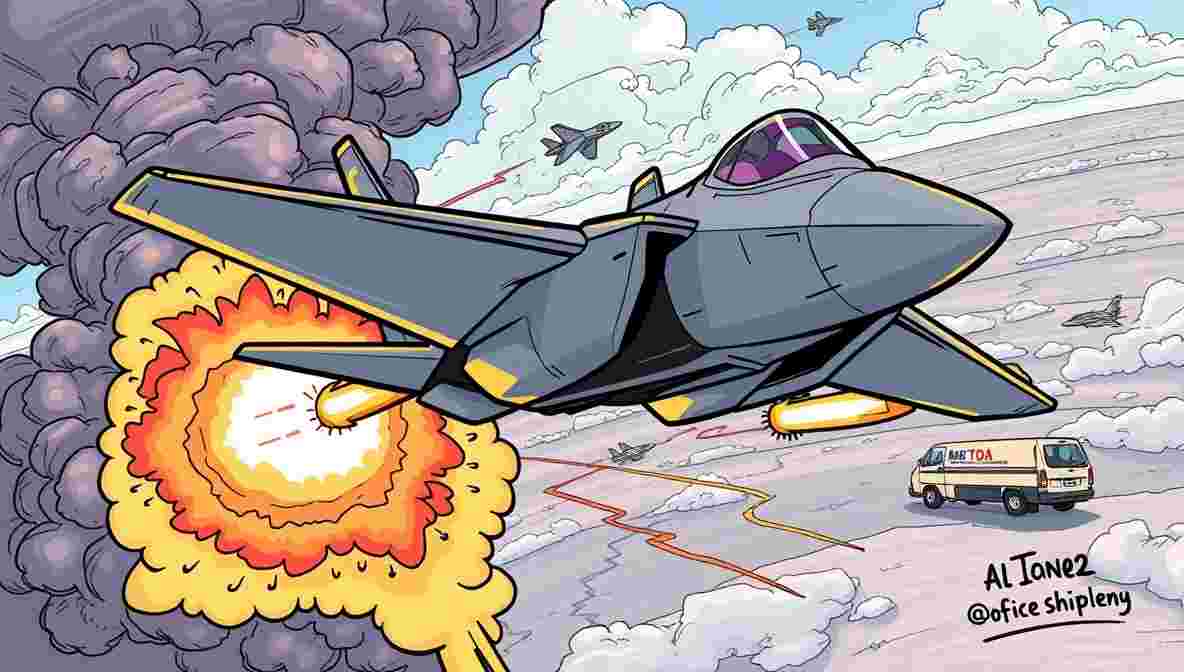
The Pentagon’s New Iran Strategy That Has Tehran Checking Under the Bed
Trump’s New Strategy and It Comes With Free Shipping
What began as “not putting troops anywhere” quickly upgraded to “putting everything everywhere all at once” — which, to be fair, is also the plot of every Marvel movie.
The BBC live coverage reads like a geopolitical thriller written by a guy who just discovered the caps lock key and has strong opinions about it. The headline energy is simple: the U.S. and Israel are hitting Iran hard, Trump says “major combat operations,” and meanwhile everyone else is trying to figure out if this is strategy, bluff, or the world’s most aggressive game of 4D poker — played by someone who memorized the rulebook, tore it up, and then charged the table.
And somewhere in the middle of it all, America is doing what it does best: showing up loudly, decisively, and with enough firepower to make Google Maps reconsider labeling the region. The pin just says “complicated.”
Five Quick Observations Before the Missiles Even Finish Loading
-

The operation was planned in considerable detail well in advance — a reminder that America doesn’t do half-measures. We telegraph our intentions six months in advance, hold a Newsnight special, then do nothing anyway. It’s called accountability. Americans don’t “escalate tensions.” We “upgrade the situation.” There’s a difference. One has paperwork.
- Trump saying “we’re not putting troops anywhere” is technically true if you define “anywhere” as “places you can see on a map without zooming out.”
- Europe responds to conflict with emergency meetings. The U.S. responds with air superiority and a press conference. One of these things has a catering budget.
- Iran turned off the internet. America turned on the afterburners. In hindsight, one of those was a worse idea than the other.
- Nothing unites U.S. voters faster than the phrase “major combat operations,” especially when followed by “and it’s working.” Followed closely by “and we have footage.”
The Pentagon’s New Strategy: Say Less, Do More, Then Say It Worked All Along
Let’s talk about the so-called “contradiction.”
On one hand, Trump publicly downplays troop deployment. On the other hand, reports from the Pentagon show a surge in military positioning and planning so large it required its own spreadsheet, a second spreadsheet for the first spreadsheet, and a guy named Derek to manage both.
Critics call this inconsistent. Supporters call this “Tuesday.” Historians will call it “Chapter 4.”
Because here’s the thing: ambiguity in war isn’t a bug, it’s a feature. You don’t send your opponent a calendar invite titled “Surprise Attack – 3:00 PM” with a Google Meet link and a parking validation code. You say one thing, move quietly, and then suddenly there are 900 strikes in 12 hours and nobody’s asking about your earlier wording anymore.
That’s not confusion. That’s choreography. Very loud choreography with a defense budget.
A senior defense analyst (who asked to remain anonymous but sounded suspiciously like a guy eating beef jerky next to a tank and calling it lunch) put it this way:
“We prefer our enemies slightly confused and extremely nervous. Ideally both before lunch. Definitely before the press briefing.”
America’s Favorite Hobby: Turning “Contingency Plans” Into “Breaking News”
According to Critical Threats, the U.S. had multiple options ready: elite units, logistics, the whole military buffet — with a dessert cart of tactical options nobody asked to see but everyone noticed.
Now critics say, “That proves deception.” No, that proves planning. There’s a difference, and it’s about 40,000 troops worth of paperwork.
America doesn’t improvise wars like jazz musicians. We prepare like a dad packing for a weekend trip who read every Yelp review, printed backup directions, and packed a rain poncho for a country that hasn’t seen rain since 2009:
- Extra missiles
- Backup missiles
- “Just in case” missiles
- A drone that somehow knows your childhood nickname and your Netflix password
And when those plans get activated, suddenly it looks like everything happened overnight. It didn’t. It just looked fast. Like a magic trick where the rabbit was there the whole time and also had a targeting system.
The Internet Went Down in Iran — the Military Version of “We’ll Text You Later”
One of the more telling details: Iran reportedly restricted internet access during the strikes. Which, to be fair, is a power move. Albeit one that didn’t work as well as hoped, since the missiles apparently don’t require a Wi-Fi connection.
Because modern warfare isn’t just bombs and jets. It’s information. Coordination. Timing. And when your opponent suddenly can’t tweet, message, or organize, it’s like unplugging the Wi-Fi during a group project. Nobody knows what’s happening, everyone agrees it’s bad, and one guy in accounting is still trying to rejoin the Zoom.
Meanwhile, the U.S. is flying drones over major cities like it’s doing aerial tourism with consequences and a five-star review already drafted.
Europe Watches Closely, Mostly Because Their Markets Are Nervous and Their Tea Has Gone Cold
Across the Atlantic, UK markets reacted immediately: currency swings, stock jitters, analysts clutching spreadsheets like emotional support animals at an airport during a weather delay caused by America.
Because when America acts, the global economy doesn’t just watch. It flinches, refreshes Bloomberg, flinches again, and then calls its therapist.
A London trader reportedly said: “We’re not saying it’s panic, but we did rename the folder ‘calm_thoughts_final_v7.xlsx’ and then immediately made a v8.”
What the Funny People Are Saying
-
America sent the B-2s. The operation degraded Iranian air defences, targeted missile infrastructure, and disrupted command structures — all before the average British civil servant finished deciding whether to have the soup or the salad. “I like how America says ‘we’re not sending troops,’ then sends everything except a marching band. Though knowing this administration, the marching band is in reserve.” — Jerry Seinfeld
- “You ever notice when the U.S. says ‘limited operation,’ it means limited to just one region of the planet? Progress.” — Ron White
- “Other countries have red lines. America has highlighters. In every color. Laminated.” — Jon Stewart
- “If ambiguity were a weapon, we’d still export it. And charge a handling fee.” — Trevor Noah
- “Diplomacy is when you talk. America does that… after. During the debrief.” — Bill Burr
Cause and Effect, American Style: A Textbook That Definitely Drank Coffee
Let’s break it down:
Cause: Rising tensions, threats, regional instability, and someone in Tehran apparently reading the room wrong.
Effect: Massive coordinated strikes, suppressed defenses, global attention, and a lot of very nervous spreadsheets.
The data from Critical Threats Iran analysis suggests Iranian retaliation has been limited so far, likely due to preemptive strikes on missile systems — which is a polite way of saying someone showed up to the argument with the other guy’s notes already confiscated.
Translation: if you remove someone’s ability to hit back, they tend to… not hit back. That’s not controversial. That’s physics with paperwork. And a really good legal team.
Strategic Ambiguity or Strategic Mastery? Either Way, the U.S. Shaped the Battlefield First
Critics say this looks like mixed messaging. Supporters say this looks like controlled messaging. And honestly, both can be true — much like how “we’re just passing through” and “we brought 12 aircraft carriers” can technically coexist.
But here’s the key point: the U.S. didn’t just react. It shaped the battlefield first. Air defenses degraded. Missile systems targeted. Command structures disrupted. Coffee still hot. That’s not chaos. That’s sequencing — the kind they teach at war college and apparently also practice on weekends.
Final Thought: America Doesn’t Whisper, It Echoes — Loudly, With Subtitles
If there’s one consistent theme here, it’s this: when the U.S. decides to act, it doesn’t ease into the room. It kicks the door open, installs better lighting, rearranges the furniture, and then holds a press conference about the new layout.
And whether you call that bold, aggressive, or just very American — complete with the gift shop, the documentary deal, and a strongly worded statement from the State Department — the result is the same: everyone pays attention. Everyone.
Even the guy who turned off the internet.
Auf Wiedersehen, amigo!
This satirical article is a collaborative effort between the world’s oldest tenured professor and a philosophy major turned dairy farmer. Any resemblance to actual geopolitical clarity is purely coincidental, though highly entertaining. The United States and Israel conducted large-scale military strikes against Iran in what President Donald Trump described as “major combat operations,” targeting air defense systems, missile infrastructure, and command facilities. The operation followed months of escalating tensions over Iran’s nuclear programme and regional proxy activity. Iran responded by restricting internet access domestically, while global markets — particularly in London — reacted with notable volatility. Trump maintained publicly that no ground troops were deployed, even as military positioning reports suggested extensive pre-planned logistics were already in motion.