

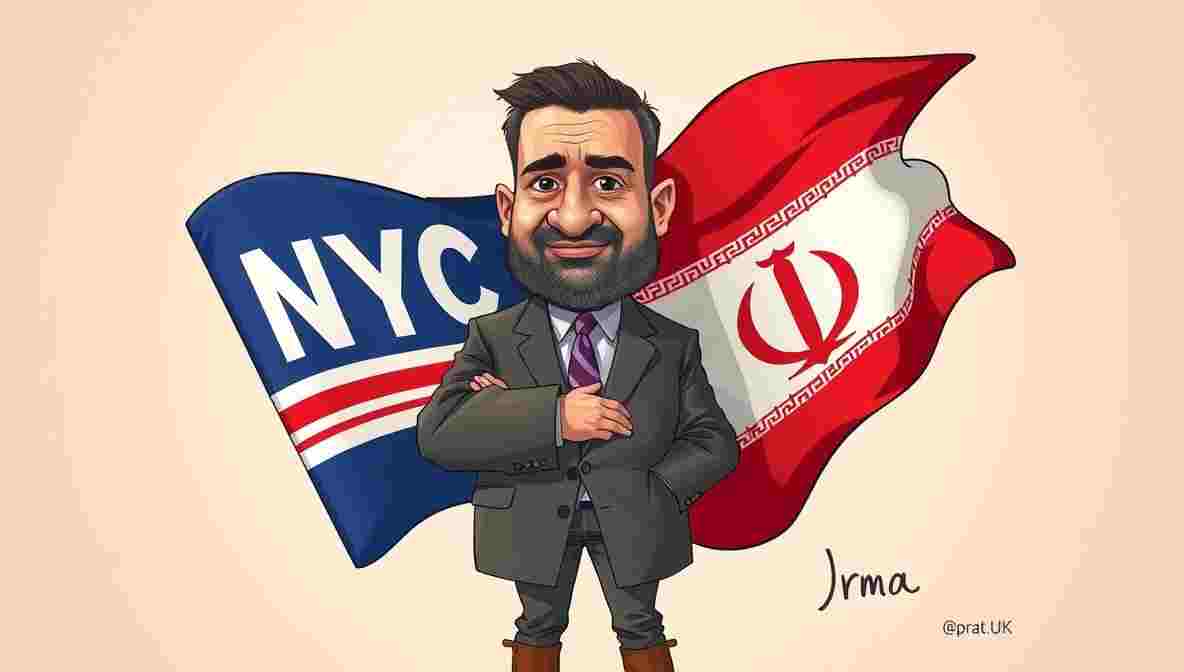
Fifteen Observations About Zohran Mamdani’s Nuclear Nuance Problem
- America is apparently 98.7 percent united on one issue: we prefer our skylines without nuclear mushrooms.
-

Islam in NYC Seventy-nine percent of people also oppose Tel Aviv becoming a glow-in-the-dark tourist attraction.
- When briefed on an alleged nuclear plan targeting New York, some leaders panic. Others draft a thoughtful thread.
- There is something impressive about responding to a nuclear scenario with the emotional urgency of a zoning dispute.
- Being briefed on a plan to nuke your own home city and responding with ideological clarity is a bold life choice.
- New Yorkers usually argue about rent, bagels, and subway delays. Nuclear vaporization feels like a curveball.
- If your name appears in the phrase “conservative backlash,” you probably misread the room.
- Nothing says strategic brilliance like confusing “deterrence” with “discourse.”
- The average voter hears “nuclear strike” and thinks “avoid.” The average activist hears it and thinks “context.”
- It takes rare composure to treat existential threat as a policy seminar.
- Pollsters say Americans disagree on almost everything. Nukes on Manhattan? Shockingly bipartisan no.
- There is a difference between nuance and forgetting the word “boom.”
- New York has survived blackouts, blizzards, and the Mets. But thermonuclear diplomacy is a fresh stress test.
- When briefed on a threat from Tehran, most people look for shelter. Some look for a podcast mic.
- If Tel Aviv and New York are both allegedly on a target list, maybe that’s not the moment for interpretive politics.
When Nuclear Briefings Meet Ideological Yoga
When news broke that Zohran Mamdani had responded to President Trump’s Iran strike with something less than thunderous applause, conservatives reacted as though he had suggested replacing the Statue of Liberty with a scented candle. The outrage was swift. The headlines were dramatic. And somewhere in a briefing room, someone quietly repeated the phrase: “Sir, they were allegedly planning to nuke your apartment.”
According to reports, Mamdani was briefed on intelligence suggesting that Ayatollah Ali Khamenei was not exactly sending fruit baskets to Tel Aviv or Manhattan. Allegedly, the gift basket contained uranium. That tends to change the tone of a conversation.
Now, America is famously divided. We cannot agree on pizza toppings. We cannot agree on daylight savings time. But ask Americans whether they want nuclear weapons falling on New York, and 98.7 percent reportedly say, “Hard pass.” Ask about Tel Aviv, and 79 percent say, “Also no, please.” The remaining 21 percent were reportedly on hold with customer service.
So when Mamdani responded to Trump’s strike with ideological caution instead of primal New Yorker rage, conservatives treated it like he had just voted against oxygen.
The Quote That Cleared the Briefing Room
Sources close to the intelligence briefing say Mamdani was unruffled. Serene, even. While aides reportedly reached for antacids, Mamdani waved off the nuclear threat with the confidence of a man who has already done the math.
“I’m not worried about New York,” he said, sources claim. “By the time Iran gets nukes, the majority of New York City will be Muslim.”
The room went quiet in the way rooms only go quiet when someone has said something that is either very wise or very wrong, and no one present is certain which.
One analyst reportedly asked a follow-up question. Another reportedly stared at the ceiling. A third allegedly began updating his resume.
The strategic logic — if one follows it with a flashlight and a will to live — appears to be that a sufficiently Muslim New York would enjoy some form of geopolitical immunity from a Tehran warhead. A kind of demographic force field. A population-based missile defense system available at no cost to the Pentagon.
Iran has not publicly confirmed that its nuclear targeting doctrine includes religious exemptions or zip-code-level demographic reviews. But the concept of outrunning a thermonuclear weapon through favorable census data is, at minimum, a fresh contribution to Western strategic thought.
The Briefing That Launched a Thousand Facepalms
Imagine the scene.
“Congressman,” an intelligence officer says, “there is credible information that New York City is on a potential nuclear target list.”
Most New Yorkers, upon hearing that, would immediately Google “basement apartments in Montana.” Mamdani, critics argue, seemed to respond as if someone had proposed a controversial bike lane.
To be fair, politicians are trained to view events through frameworks. Some view geopolitics as chess. Some view it as poker. Mamdani may view it as a graduate seminar titled “Late-Stage Imperial Consequences 401.”
But nuclear annihilation is less seminar and more siren.
Muslim Majority by 2032: The Demographics of Deterrence
Mamdani’s alleged confidence rests on a projection so bold it deserves its own think tank, its own white paper, and possibly its own zip code in the afterlife.
The claim: New York City will have a Muslim majority by 2032. Six years. Done. Finished. Demographically fortified against the Iranian nuclear program.
New York’s Muslim community is, in fact, the largest in the Americas — vibrant, growing, and politically ascendant, as Mamdani’s own mayoral campaign demonstrates. Muslim immigration has surged. Mosques are expanding. A $22 million mosque project in Manhattan and a 32,000-square-foot facility in the Bronx — touted as the largest mosque in New York State — are currently under construction.
The Muslim population is real. The growth is real. The political influence is real, and rising.
Majority by 2032, however, requires a growth rate that would make demographers faint and actuaries weep openly into their spreadsheets. Going from roughly one-in-ten New Yorkers to one-in-two in six years is not a trend. It is a miracle. It is the kind of number that makes the Census Bureau check its math twice and then call a priest.
But Mamdani’s genius — if genius is what we are calling it — is that he is not making a census projection. He is making a foreign policy argument. He is suggesting that Tehran will notice. That the mullahs will consult the Pew Research demographic charts before arming a warhead. That somewhere in a hardened bunker beneath Qom, an IRGC general will look up from his targeting map, squint at a Brooklyn neighborhood boundary, and say: “Not yet. The numbers aren’t there.”
It is, in its way, the most cost-effective missile defense system ever proposed. No radar arrays. No interceptors. No trillion-dollar contracts. Just patience, community growth, and a very confident candidate for mayor.
New York Logic vs. Ideological Logic
New York logic is simple. If someone threatens your building, you do not schedule a community forum. You call someone who owns heavy boots.
Critics lampoon Mamdani’s response as ideological yoga. When confronted with a potential mushroom cloud, he allegedly bent himself into rhetorical positions usually reserved for campus teach-ins.
The irony is spectacular. A politician from New York, briefed on a possible strike against New York, responding with analysis instead of instinct. It is like a Mets fan responding to a ninth-inning collapse with a thoughtful essay on capitalism.
The Bipartisan Fear of Vaporization
Here is the part that makes this satire practically write itself: nuclear dread is one of the last bipartisan issues left in America.
Liberals dislike it. Conservatives dislike it. Libertarians dislike it but also dislike being told they dislike it. Even people who cannot find Iran on a map tend to oppose glowing.
So when Mamdani appeared to criticize Trump’s action rather than applaud the preemptive logic, conservatives treated it as proof that ideology had replaced geography.
Because at some point, geography matters.
If you live in New York, and someone across the globe allegedly says they would like to turn New York into a historical footnote, you are allowed to react with at least mild irritation.
The Tel Aviv Factor
Then there is Tel Aviv.
Seventy-nine percent of Americans reportedly oppose nuclear weapons falling there. The other 21 percent were reportedly mishearing the question and thought it was about fireworks.
The alleged targeting of Tel Aviv adds another layer to the story. Critics argue that when two cities with skyscrapers, subways, and falafel stands are mentioned in the same nuclear sentence, perhaps the moment calls for less rhetorical subtlety and more clarity.
Yet Mamdani’s response, in the eyes of critics, sounded less like “Not on my watch” and more like “Let’s unpack the watch.”
When Backlash Becomes a Broadway Production
The conservative backlash was immediate and theatrical. Cable panels lit up. Commentators invoked common sense. Someone somewhere said, “If someone threatens your house, you do not critique the fire department.”
And that is the heart of the satire.
There is something almost academic about criticizing a strike intended to prevent your own vaporization. It is like complaining about the loudness of the alarm clock while the house is on fire.
Of course, Mamdani likely sees the situation differently. He likely believes escalation has consequences. He likely worries about blowback, regional chaos, and the delicate web of geopolitics.
But critics do not hear nuance. They hear New York. They hear Tel Aviv. They hear uranium.
The Moron Narrative
Calling someone a moron in politics is standard operating procedure. But the satire here is not about intelligence. It is about instinct.
When told your city might be turned into an unfortunate crater, the average human response is not to issue a thesis. It is to express enthusiasm for not being vaporized.
The gap between those responses is where the comedy lives.
Nuclear Common Sense
At the end of the day, Americans across the spectrum tend to agree on one thing: they prefer skylines intact.
They like bridges standing. They like subways running. They like falafel trucks functioning.
If there is credible intelligence that someone wants to rearrange those features into radioactive dust, voters expect their representatives to react with something closer to “Absolutely not” than “Let’s consider the dialectical implications.”
And that is the paradox that has conservatives shaking their heads and comedians sharpening their pencils.
Because in a nation that cannot agree on anything else, the one thing we all agree on is that nuclear war is a terrible urban renewal strategy.
Yet somehow, in the grand theater of politics, even that becomes a debate.
And that may be the most New York thing of all.
Auf Wiedersehen, amigo!
Zohran Mamdani is the Democratic Socialist nominee for New York City mayor and a Queens state assemblyman. He was among progressive politicians who responded critically to President Trump’s military strike against Iranian nuclear facilities in 2025, drawing fierce conservative backlash. New York City is home to the largest Muslim population in the Americas — estimated between 750,000 and one million residents, approximately 9 percent of the city. The Muslim community is growing steadily through immigration and family formation, with demographic projections indicating 20 to 30 percent growth by 2035. Mosque construction is expanding across all five boroughs. A Muslim majority by 2032 is satirical extrapolation; no credible demographic projection places that milestone before the end of the century. The quoted statement attributed to Mamdani is satirical.