

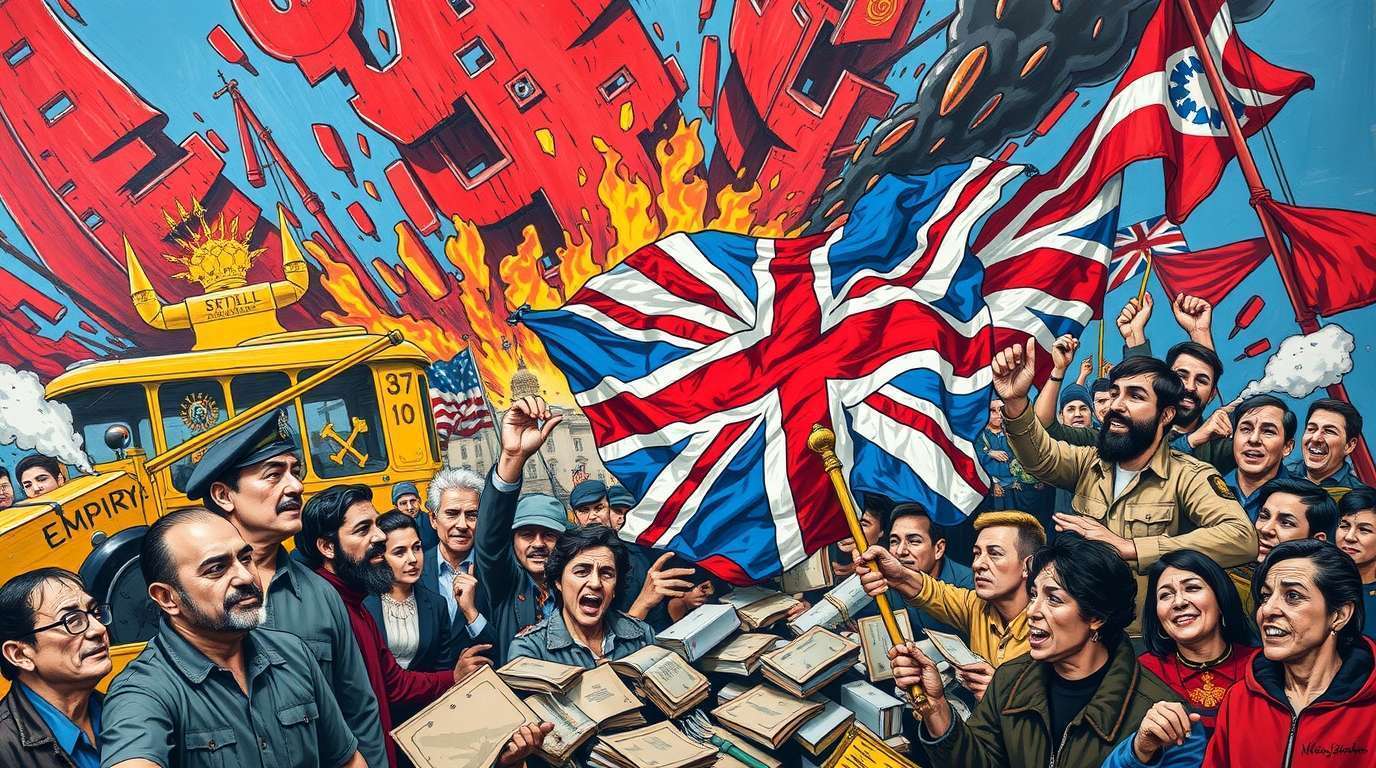
How Socialism Destroyed the British Empire: A Satirical Guide to Imperial Decline
The Great British Bake-Off: How to Serve Humble Pie While Pretending You’re Still the Chef
When Empire Meets Reality TV: Trump’s State Visit to Post-Imperial Britain
Britain rolled out the red carpet for President Trump’s state visit with all the pomp and circumstance of a nation desperately trying to convince everyone – including itself – that it still matters on the world stage. It was like watching Jerry Seinfeld’s parents pretend they’re still young and hip: “We’re still relevant! Look, we have castles!”
The spectacle at Windsor Castle resembled nothing so much as a historically-themed wedding where the bride insists on wearing her grandmother’s dress despite being three sizes larger. Sure, it technically fits, but everyone can see the seams straining. As Dave Chappelle might observe, “Nothing says ‘we’re still a world power’ like needing to borrow your great-great-grandmother’s jewelry to impress the neighbors.”
Prime Minister Keir Starmer orchestrated this imperial cosplay with the practiced desperation of a former rock star still playing county fairs. The British establishment genuflected before Trump like courtiers before a king, which would be more impressive if the king weren’t mainly famous for reality television and social media meltdowns.
Why the British Empire Collapsed: Socialist Policies and Imperial Decline
The transformation of Britain from global superpower to quaint tourist destination represents one of history’s most successful experiments in economic self-destruction. Understanding how socialism destroyed the British Empire requires examining the systematic dismantling of capitalist institutions that built the world’s largest empire in human history. It’s like watching someone methodically dismantle a Ferrari to build a bicycle – technically impressive in its thoroughness, but you have to wonder about the thought process.
How Socialist Economics Ended British Global Dominance
The Labour Party’s post-war policies turned Britain into a laboratory for testing how quickly you can eliminate a centuries-old empire through aggressive wealth redistribution and nationalization. The British Empire’s decline accelerated dramatically after World War II when socialist policies replaced the free-market capitalism that had built global dominance. The results were spectacular – if your goal was to prove that socialism works by making everyone equally poor, except for the government officials managing the decline.
The End of the British Empire: From Capitalism to Socialism in One Generation
Britain’s nationalization spree in the 1940s and 1950s resembled Amy Schumer’s approach to relationships: “If I can’t have nice things, then nobody can have nice things.” The British Empire’s collapse wasn’t just about decolonization – it was about the systematic replacement of wealth-generating capitalist enterprises with government-controlled socialist institutions. Coal, steel, railways, healthcare, telecommunications – everything that made money got handed over to bureaucrats who had never run so much as a lemonade stand. As Bill Burr would say, “Nothing says ‘let’s improve efficiency’ like putting the government in charge of literally everything.”
The National Health Service, while beloved by Britons, became the perfect metaphor for socialist economics: free at the point of use, bankrupting at the point of payment, and increasingly unavailable at the point of need. It’s like getting a “free” car that comes with a lifetime subscription fee that costs more than buying a new car every year.
The welfare state expanded faster than a British waistline at teatime, creating a generation of citizens who discovered that working was optional if you could navigate the benefits system effectively. As Chris Rock observed about different economic systems: “You can have capitalism, where some people get rich, or you can have socialism, where everyone gets equally broke, but the people running socialism somehow end up with nice houses.”
Margaret Thatcher’s attempts to reverse this trend in the 1980s were like trying to perform surgery with a chainsaw – effective at cutting things, but not particularly precise about what got removed. By then, the damage was largely done: the empire was gone, the industries were obsolete, and the British had learned to be comfortable with managed decline.
The irony is that Britain exported capitalism around the world while importing socialism for domestic consumption. It’s the economic equivalent of a drug dealer who doesn’t use his own product – except Britain did use its own product, and the results speak for themselves.
The Special Relationship: Now With Extra Special Needs
The much-vaunted “Special Relationship” between Britain and America has evolved into something more akin to a special accommodation. Britain plays the role of America’s eccentric elderly relative who still thinks they run the family business, while America pats them on the head and lets them keep the ceremonial keys to the office they haven’t worked in for decades.
This relationship dynamic was perfectly captured during Trump’s carriage ride through London, where crowds lined the streets – mostly to boo, but hey, attention is attention. It was like Amy Schumer’s approach to dating: “I’ll take negative attention over no attention, because at least people are looking.”
The flyovers and military pageantry served as a reminder of Britain’s glorious military past, much the way a high school quarterback’s letterman jacket reminds everyone of his glory days – impressive until you realize he’s now 45 and selling insurance.
Nostalgia Diplomacy: The Politics of Pretend
Britain has perfected what diplomatic historians will surely call “nostalgia diplomacy” – the art of leveraging your former greatness to maintain current relevance. It’s like Bill Burr’s bit about old guys at the gym: “Yeah, I used to bench 300 pounds. Course, that was in 1987, but who’s counting?”
The Churchill archives at Chequers provided the perfect backdrop for this exercise in historical cosplay. Nothing says “we’re still important” like dragging out Winston Churchill’s ghost for every diplomatic occasion. Churchill has become Britain’s foreign policy equivalent of a greatest hits album – sure, it was impressive when it first came out, but playing it on repeat just makes you seem stuck in the past.
As Chris Rock might put it, “Britain keeps talking about World War II like it happened last week. ‘We saved Europe!’ Yeah, grandpa, and I had hair once. What have you done lately?”
The Economics of Empire Withdrawal
Britain’s post-Brexit economic strategy appears to be built on the theory that if you act confident enough about your irrelevance, it becomes a form of relevance. It’s the foreign policy equivalent of Ricky Gervais’s comedy philosophy: “I know I’m not the best, but I’m going to act like it anyway, and maybe everyone else will be too polite to correct me.”
The British economy has been successfully transformed from an imperial powerhouse into a theme park version of itself. Tourism now ranks as one of Britain’s top industries, which is perfect because the entire country has essentially become a living museum where visitors can experience what a former world power looks like in decline.
Brexit was sold as Britain taking control of its destiny, but it increasingly resembles Jim Gaffigan’s approach to dieting: “I’m going to take control of my eating habits by eliminating all the healthy options and wondering why I feel terrible.”
The Starmer Strategy: Managing Decline with Style
Prime Minister Starmer has adopted what diplomatic experts call the “graceful decline strategy” – essentially the political equivalent of aging gracefully while still getting work done. His approach to Trump resembles Sarah Silverman’s approach to uncomfortable social situations: smile, nod, don’t make any sudden movements, and hope the awkwardness passes quickly.
The careful dance around tariffs and Ukraine policy showcases Britain’s new role as America’s diplomatic therapy dog – present to provide emotional support without actually affecting the outcome. Starmer’s strategy of “avoiding worse outcomes” is like Tom Segura’s parenting philosophy: “I’m not trying to be the best parent, I’m just trying to avoid Child Protective Services.”
Britain’s position on artificial intelligence represents perhaps the most honest acknowledgment of its current status: we can’t lead the technology revolution, but we can at least try to have “a foot in the door” when the real players divide up the future. It’s the foreign policy equivalent of showing up to a party you weren’t invited to and hoping someone will let you help with the cleanup.
Democratic Identity Crisis: When the West Isn’t Sure Which Way Is Up
Both America and Britain are experiencing what psychologists would call an identity crisis, if psychologists treated entire nations as patients. For two centuries, these countries positioned themselves as the global champions of democracy and liberal values. Now they’re like Nate Bargatze trying to explain modern technology to his parents: “I used to know how this worked, but now I’m not sure anyone does.”
The shift of global power to the East has left both countries scrambling to find their role in a world they no longer dominate. It’s like watching former high school popular kids at their 20-year reunion, realizing that being homecoming king doesn’t translate to adult success.
America’s “authoritarian turn” and Britain’s struggle to prevent similar developments represent the awkward phase of democratic evolution – like teenagers who’ve outgrown their childhood clothes but haven’t figured out what adult fashion looks like yet.
The Pageantry Problem: When Style Replaces Substance
The elaborate ceremonial aspects of Trump’s visit highlighted a fundamental problem with modern British diplomacy: it has become almost entirely performative. The pageantry serves as a substitute for actual influence, like Bert Kreischer’s party stories – entertaining, but ultimately about past glories rather than present realities.
The carriage rides, honor guards, and formal dinners create the illusion of importance without the substance of actual power. It’s diplomatic theater for an audience that increasingly doesn’t care about the performance. As Gabriel Iglesias might say, “You can put a bow tie on a chihuahua, but it’s still just a small dog making a lot of noise.”
The cost of maintaining this elaborate ceremonial infrastructure could probably fund several universities or hospitals, but those wouldn’t provide the same photo opportunities. Britain has essentially become the world’s most expensive wedding planner – great at putting on a show, but not particularly useful for anything else.
The Imperial Hangover: Withdrawal Symptoms from World Power
Britain’s imperial hangover manifests in the persistent belief that historical importance translates to contemporary relevance. It’s like Louis C.K.’s bit about middle-aged men reminiscing about their athletic prowess: “I could have gone pro, you know, if it weren’t for my knee… and my complete lack of talent.”
The British foreign policy establishment continues to operate as if the empire were just temporarily indisposed rather than permanently dissolved. They approach international relations like Wanda Sykes approaches dating at 50: “I’m still fabulous, but my dating pool has definitely gotten smaller.”
This imperial nostalgia creates policy blind spots where Britain consistently overestimates its leverage and underestimates its limitations. It’s the geopolitical equivalent of ordering from the expensive side of the menu when you know your credit card is maxed out.
The American Mirror: Seeing Our Future in Britain’s Present
Perhaps the most unsettling aspect of Trump’s British visit was how it revealed America’s potential future trajectory. Britain serves as a cautionary tale of what happens when a global superpower loses its grip but refuses to adjust its self-image accordingly.
America is currently in the early stages of what Britain experienced after World War II – the gradual recognition that dominance isn’t permanent and adaptation is necessary for survival. As Tiffany Haddish might observe, “America is like that friend who keeps talking about their glory days while their life is falling apart. Honey, that was then, this is now.”
The decline of American global influence mirrors Britain’s post-imperial adjustment, but with nuclear weapons and a much larger economy, making the stakes considerably higher. Britain’s mistakes become America’s potential future – a sobering thought for any American watching the diplomatic theater unfold.
Technology and Relevance: The New Currency of Power
Britain’s desperate positioning around artificial intelligence reveals the new reality of international relations: technological innovation has replaced military conquest as the primary source of national power. Countries that fail to lead in technology become economic colonies of those that do.
The AI revolution represents Britain’s last chance to regain relevance in the modern world, but their approach resembles Hasan Minhaj’s parents trying to understand social media: “We know it’s important, we just don’t know why or how.”
America faces the same challenge but with more resources and less self-awareness. The risk is that America will follow Britain’s path – maintaining the symbols of power while losing the substance of influence, becoming a technological dependency of nations that once looked to it for leadership.
The Democratic Recession: When Freedom Becomes Optional
Both countries are experiencing what political scientists call a “democratic recession” – the erosion of democratic norms and institutions without a formal abandonment of democratic systems. It’s like Jo Koy’s bit about his relationship with his mom: “We still talk, but neither of us is really listening anymore.”
The challenges to democratic governance in both America and Britain represent a broader crisis of confidence in liberal democratic values. When the supposed champions of democracy can’t make their own systems work effectively, it’s hard to convince other nations to adopt similar approaches.
This democratic identity crisis creates a vacuum that authoritarian powers are eager to fill. China and Russia don’t need to defeat the West militarily; they just need to wait for the West to defeat itself through incompetence and internal division.
Conclusion: The Empire Strikes Out
Trump’s visit to Britain served as an inadvertent documentary about the end of the Western-dominated world order. Two former superpowers engaged in an elaborate dance of mutual delusion, pretending their partnership still mattered while the real action moved elsewhere.
Britain offers America a preview of what happens when a nation refuses to adapt to its reduced circumstances – you end up playing dress-up with historical artifacts while actual power brokers make decisions without consulting you. As Trevor Noah might conclude, “Britain is like that ex who keeps showing up to parties where they’re not really wanted, hoping people will remember how great they used to be together.”
The choice facing America is whether to learn from Britain’s mistakes or repeat them on a larger scale. The pageantry is impressive, the traditions are beautiful, and the self-deception is almost complete. But underneath the ceremony lies a simple question: when the show is over and the guests go home, what’s actually left?
The answer, unfortunately, appears to be expensive real estate, tourist attractions, and a lot of very polite people wondering what went wrong. God save the Queen, because apparently, no one else can save the empire.
IMAGE GALLERY
Socialism Destroyed the British Empire
