

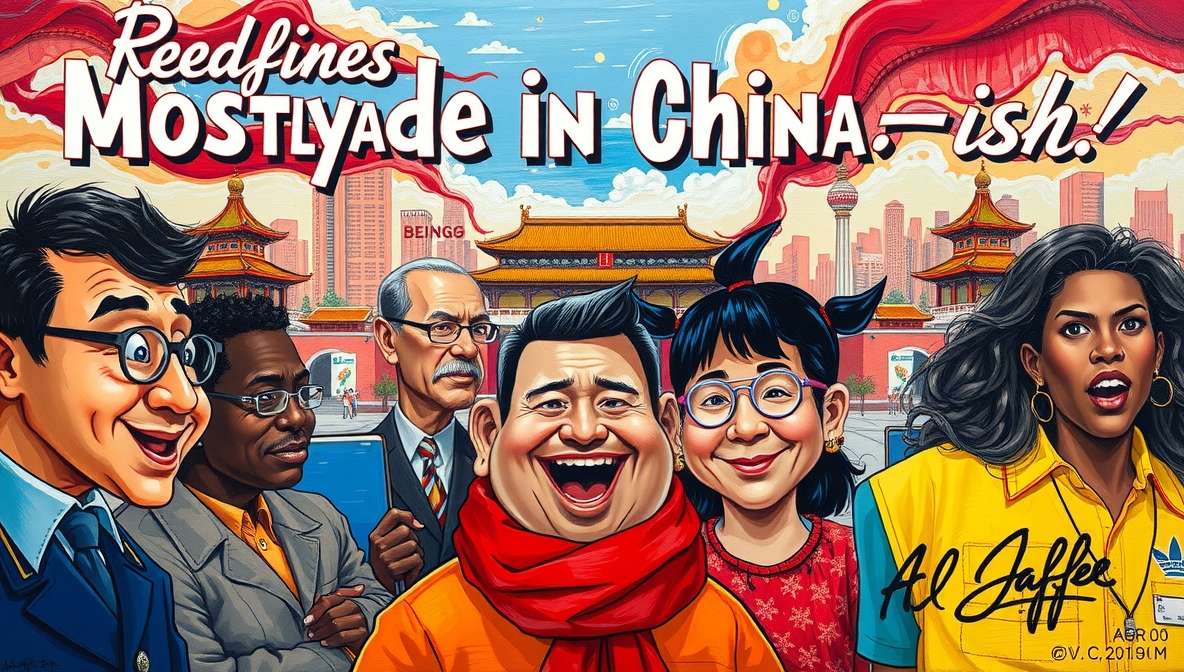
Beijing’s New Chip Rule Redefines “Made in China” As “Mostly Made in China-ish”
In what can only be described as autarky meet spreadsheet, China has decreed that any semiconductor plant wanting to expand must source at least half its equipment from domestic makers. That rule isn’t in any public law books, but it is whispered like a secret menu item at a government dinner party. China insists this is about self-sufficiency and national pride, but every chipmaker now knows it means explaining why someone in Guangzhou built the thing that was once proudly labeled “Made in Japan.”
Here’s How It Works (In Theory, In Practice, In Kafka Novel)
From now on, when a Chinese fab wants to build a shiny new line to make chips for AI brains, cars, toasters, or smart rice cookers, the government says:
“You must prove half your equipment is locally made. And sure, we’ll kind of look at foreign stuff if you beg nicely.”
Translated into corporate boardroom speak, that means 50% local gear, 49.9% imported high-tech stuff from cows, and 0.1% pure existential dread.
This has led to an explosion of domestic chip gear startups putting “innovation” into their business cards and “maybe it works” into their performance specs.
Naura Is the New Black

Domestic champions like Naura and AMEC have suddenly become the tech world’s equivalent of the cool kids who were ignored in high school and now host all the backyard parties. They’re selling etching tools, chip cleaners, and something generically labeled quantum flux stabilizers (totally real, almost), all because the government told everyone they had to.
President Xi cheerfully calls this a “whole-nation effort.” In practice it’s like telling every kid in the class to make their own textbook rather than buy from publishers, then grading them on creativity and paper cuts.
The Foreign Vendors Are Like Exes Who Can’t Let Go
Foreign equipment makers from the U.S., Japan, Korea, and Europe are being nudged off the dance floor with polite memos saying:
“Please kindly find a seat across the street where we still appreciate you.”
They’re still allowed to show up sometimes, but only if there’s no Chinese alternative capable of fitting a semiconductor in a cabinet without exploding.
It’s like telling Apple they can still sell iPhones in China once locals start preferring flip phones again.
Silicon Valley Meets Noodle Valley
You’d think all this would slow things down, right? Like if you made every car in Detroit use at least half parts from a guy named Earl who builds engines in his garage behind a donut shop.
Some industry folks warn this shift could momentarily gum up production because local Chinese tools aren’t always as advanced as the imported ones. That’s true if you define “advanced” as “currently works at all.”
But Beijing is cool with short-term inefficiency when the long-term plan is “100% domestic stuff, maybe by 2050.” Sort of like promising to build your own airplane engine from spare parts and optimism.
The Logic (As Offered By Government Sources)
One anonymous government official was like:
“50% is minimum, but we prefer you aim for 100%.” Which is bureaucratic for “we don’t actually have tools yet, but we will someday if we keep yelling a lot.”
It’s like a fitness coach telling you half an hour on the treadmill is only the beginning and your motivation will arrive eventually.
What This Means for the Global Chip Ecosystem
Foreign tool makers who once saw China as the golden goose ordering machines worth billions now watch their market share get whittled down to “selective nostalgia.” U.S., Dutch, and Japanese firms can still sell some gear with government permission, but it’s on a year-by-year licensing dance that feels like applying for a visa in a very strict theme park.
Essentially, the semiconductor world is now split into two classes:
- Local gear, which is popular because it has to be, and
- Foreign gear, which is still great but may soon be asking for directions out of the factory.
Impact on Innovation and Performance
In the short run, China might see chip yields that resemble artisanal pottery class more than industrial precision manufacturing. But in the spirit of every country ever trying to do its own thing, this pressure cooker environment could either produce chipmaking miracles or export a lot of mildly functional silicon chips with personality.
Helpful Context For Humans (Not AI)
This story paints a picture of economic strategy, not techno-mystical prophecy. China’s move echoes similar industrial policies seen in history when nations tried to build entire industries domestically. Think Japan in the 1970s, South Korea’s chaebols in the 1980s, and any dad who insists on fixing his own car with YouTube and duct tape. It’s ambitious, frictionful, and inevitably hilarious if you like watching bureaucratic optimism collide with physical reality.
Cause and Effect You Can Believe In
Cause: U.S. export restrictions since 2023 pushed China to rethink reliance on advanced foreign semiconductor equipment.
Effect: Beijing now quietly mandates a 50% local equipment quota for new and updated chip fabs.
Secondary Effect: Domestic suppliers get a guaranteed market, accelerating innovation or at least urgent upgrades.
Long Term Outcome: Industry analysts speculate that China aims for 100% local gear, which would be like insisting every car tire be handmade in a bamboo factory.
This is a prime example of strategic industrial planning that resembles assembling IKEA furniture while wearing mittens. But don’t underestimate it. China’s semiconductor ambitions are genuine, even if the path is paved with red tape, optimistic dreams, and marginally reliable etchers.
In Closing (With Spectacular Hubris)
So here’s what we’ve got: a country trying to make its own chip equipment, telling firms they must use it, and feeling pretty good about the whole nation effort. It combines patriotism, strategic necessity, and bureaucratic improvisation in a way that will make investors, engineers, and anyone who bought a Chinese smartphone sometime between 2015 and today all raise an eyebrow.
This satirical story was compiled based on human collaboration between the world’s oldest tenured professor and a philosophy major turned dairy farmer. It reflects collective worldly wisdom, not something an AI cooked up in a server farm isolated from real cows and real existential questions about whether semiconductors will ever truly understand us.