

Two Full-Contact Sports, Only One Charges Admission
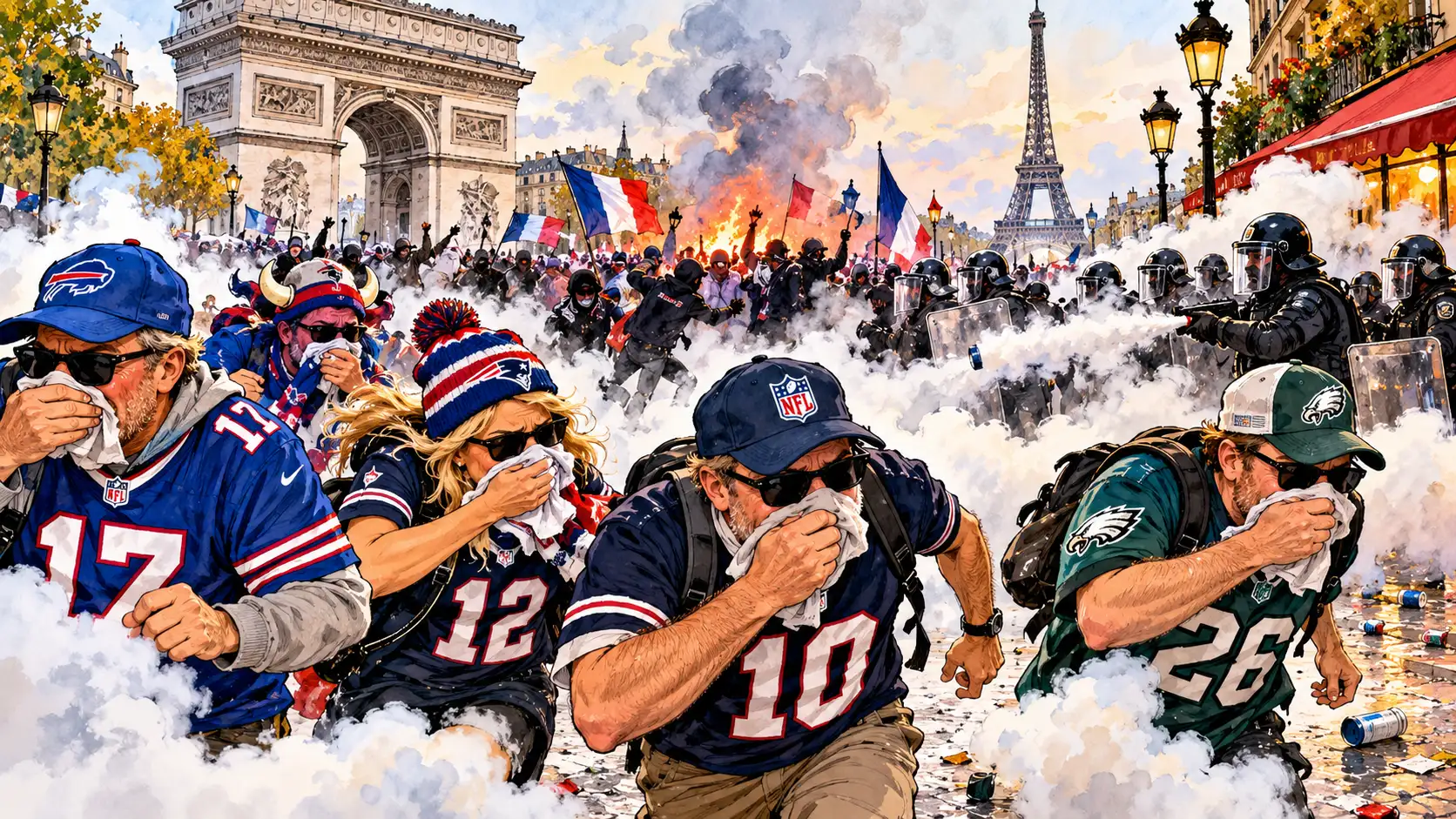
PARIS, FRANCE, October 24, 2026 – American football fans arriving in Paris for Sunday’s historic Pittsburgh Steelers versus New Orleans Saints game have received an unusual addition to their travel itineraries: a warning from the United States government that France may be offering considerably more physical contact than the National Football League originally advertised.
According to Newsweek’s October 23 report on the Paris NFL travel warning, recent protests, violent disturbances and public disorder have complicated preparations for the October 25 game at Stade de France. American officials have advised visitors to avoid demonstrations, large crowds and areas of unrest.
That is a strange instruction for football supporters, who paid considerable sums to travel thousands of miles specifically to join a large crowd and watch men engage in organized violence. The principal difference is that inside the stadium, the violence is carefully regulated, the participants wear protective equipment, and somebody eventually blows a whistle. Outside the stadium, the French government has apparently been unable to negotiate similar arrangements.
French Tourism Industry Discovers Civil Unrest Is Cheaper Than Disneyland
For generations, Paris has promoted its historic monuments, magnificent boulevards, romantic restaurants and world-famous museums. The latest tourism concept involves experiencing the French Revolution without the inconvenience of traveling back to 1789. Visitors can admire the Eiffel Tower, sample exquisite pastries and, depending on the demonstration schedule, witness a burning barricade before lunch.
Under a proposed promotional slogan, Paris: Come for the Croissants, Stay Because the Metro Is Closed, tourists would enjoy a distinctly French combination of culture, cuisine and complaints about the government. A traditional Paris vacation begins with an expensive hotel room, an overpriced breakfast and an argument with a waiter. The revolutionary package adds an argument with the police, a blocked boulevard and the possibility that your rental car has become part of a political statement.
Tourism economists have identified one considerable advantage. Unlike Disneyland, the protesters do not charge admission. They also provide their own costumes, stage effects and occasional pyrotechnics. The principal disadvantage is that the fireworks sometimes involve somebody’s Peugeot.
Macron Promises Order Ahead of Steelers-Saints Game
French President Emmanuel Macron faces the difficult responsibility of persuading American visitors that France remains a safe and orderly country despite the unusual volume of evidence currently being collected by television cameras.
Recent unrest has involved protests over school conditions, living costs and broader political grievances. Many demonstrations have been peaceful, while others have deteriorated into serious violence and property destruction. The distinction matters, though it becomes considerably less comforting when somebody is trying to work out whether the smoke ahead comes from a demonstration or a perfectly ordinary French restaurant.
Macron’s approach to restoring public confidence has been compared to a restaurant manager assuring customers that the kitchen is under control while firefighters carry the refrigerator through the dining room. French authorities have tightened security, and the NFL says it is coordinating with local and national officials ahead of the game.
The government is particularly concerned that American tourists might witness scenes of disorder and draw unfavorable conclusions about French administration. This would be unfair to Macron, whose administration has already produced an extraordinary amount of paperwork explaining its commitment to public order. There is no shortage of order in the paperwork. It is the streets that remain challenging.
NFL Discovers French Protesters Ignore the Rulebook
The NFL has spent decades perfecting a system for controlling violent physical encounters. Every contest has officials, penalties, time limits, instant replay and a lengthy rulebook describing precisely which varieties of aggression are acceptable. France has developed a simpler alternative: everybody assembles in the street, somebody becomes angry, and the authorities attempt to determine which ministry is responsible. The league could learn something from the efficiency of this arrangement.
In American football, a player who strikes an opponent after the whistle may receive a 15-yard penalty. In a violent Paris street confrontation, there may be no whistle, no yard markers and nobody particularly interested in measuring the distance.
NFL Commissioner Roger Goodell acknowledged this week that public demonstrations are not unusual in France, while expressing confidence in the league’s preparations. For American fans, that observation raises an interesting philosophical question. If violent unrest is familiar enough to be considered routine, at what point does it qualify as a French national sport?
The French Football Federation may eventually need to establish a separate league. The Paris Barricades could play the Marseille Molotovs, with the winning team receiving a trophy and the losing team demanding the resignation of the referee. The referee would immediately go on strike.
American Fans Wonder Whether They Have the Right Stadium
Confusion among visiting football supporters has been aggravated by the similarities between American sporting traditions and French political demonstrations. Both attract passionate crowds, both involve elaborate costumes, both feature enthusiastic chanting and intense disagreements over territory, and both occasionally conclude with somebody being carried away. The difference is that American football fans generally become violent only after consuming excessive quantities of beer. French political activists traditionally prefer to begin with a 40-page manifesto describing the historical necessity of the event.
One visiting Steelers supporter offered the sort of practical observation that could become the foundation of a diplomatic breakthrough:
“I came to see somebody get tackled. I just assumed the guy doing the tackling would have a helmet and a contract.”
A Saints supporter was reportedly less concerned.
“New Orleans has Mardi Gras. Paris has whatever this is. At least our parade eventually ends.”
The comments represent the central difficulty in international sporting tourism: the host nation and its visitors may have very different definitions of entertainment.
State Department Travel Advisory Gives Fans Impossible Instructions
The U.S. State Department’s official France travel advisory currently rates France at Level 2, Exercise Increased Caution, citing unrest and terrorism concerns. The October 21 update advises Americans to avoid demonstrations and areas experiencing disorder. It is not a blanket prohibition on visiting France.
For football fans, the instructions create a logistical problem. They must avoid large crowds while attending an event that exists entirely because somebody has assembled a large crowd. They must stay away from significant police activity while entering a stadium protected by significant police activity. They must avoid confrontations while attending a sporting contest in which confrontation is the primary business model. And they must remain aware of their surroundings, which is particularly difficult for Americans attempting to understand French traffic regulations.
Travel experts recommend keeping personal possessions secure, following official safety instructions and avoiding active demonstrations. More ambitious visitors might also consider purchasing travel insurance that covers both civil disturbances and unexpected encounters with French customer service. Insurance companies have yet to determine whether a burned rental car should be classified as property damage, political expression or an upgrade to the local tourism experience.
Bastille Steelers Party Canceled Amid Paris Security Concerns
Security preparations have required coordination between the NFL, French authorities and American diplomatic officials. A Steelers fan gathering in the Bastille area was canceled amid security concerns. Meanwhile, Paris Saint-Germain’s domestic football match against Lyon was moved to Monday at the request of police.
The irony of canceling a celebration near the Bastille because of revolutionary activity has not been lost on students of French history. The original storming of the Bastille helped launch one of the most consequential political upheavals in modern Europe. The current situation has succeeded in canceling a Steelers party. Historians acknowledge that revolutionary ambitions have become more specialized.
Paris police now face the additional challenge of distinguishing passionate NFL supporters from passionate political demonstrators. One group wears black clothing, waves flags and shouts about injustices. The other group is protesting against the government. The recommended identification procedure involves asking a member of the crowd whether they are angry about taxes or the offensive coordinator. Unfortunately, both groups may answer yes.
French Restaurants Launch the Riot-Side Dining Experience
The hospitality industry has responded to the uncertainty with the sort of entrepreneurial innovation that French politicians traditionally regard with suspicion. A hypothetical Paris restaurant might offer three dining packages. The Basic Parisian Experience includes a croissant, an espresso and a waiter who refuses to acknowledge the customer’s existence. The Premium Cultural Experience adds a window overlooking a demonstration. The Deluxe Revolutionary Experience includes a private table, protective goggles and a cheese course served before the barricades become impassable.
The menu would feature Soupe à la Macron, which arrives accompanied by a long explanation of why the soup cannot currently be served. The restaurant’s financial projections would remain optimistic. French hospitality professionals have considerable experience turning relatively small quantities of food into substantial invoices, and turning political disorder into an optional tourism surcharge would merely extend the existing business model.
The government could even collect a revolutionary hospitality tax. This would guarantee that, regardless of who won in the streets, the French Treasury would still receive its share.
American Football Has Four Quarters; French Unrest Has No Final Whistle
Political scientists have long observed that peaceful protest is an important component of democratic government. Violence, arson and attacks on property, however, are not necessary ingredients of political participation. France’s present difficulties illustrate what happens when legitimate complaints become entangled with destructive behavior and a government struggles to maintain public confidence.
An American football game has a measurable outcome. One team scores more points. The other team loses. There may be questionable refereeing decisions, angry spectators and several hours of shouting, but eventually the participants leave the field.
French politics presents a more complicated system. The government announces a reform. Demonstrators object. The government explains the reform. More demonstrators object. A committee investigates. Another committee disputes the investigation. Somebody proposes a compromise. The compromise inspires a new demonstration. By the time the original proposal is withdrawn, three additional organizations have formed to protest its withdrawal.
Economists call this an inefficient allocation of resources. French political veterans call it Tuesday.
The Most Expensive Free Entertainment in Europe
For Americans who have purchased flights, hotels and premium NFL tickets, the costs of international football tourism can be considerable. Yet France has inadvertently created a different economic opportunity. The streets provide public spectacle without ticket charges, subscription fees or concessions contracts. In economic terms, that is free entertainment with potentially enormous external costs.
When a football player knocks down an opponent, the player’s employer ordinarily bears the expense of training, equipment and medical support. When rioters destroy a business, the shopkeeper, employees, insurers and taxpayers may bear the damage. The rioter receives no guaranteed salary. The innocent business owner receives no guaranteed compensation. And the government receives another opportunity to announce its determination to restore confidence.
The entire arrangement resembles an NFL franchise in which spectators control the field, nobody owns the stadium and the people running the hot dog stands must pay for every broken goalpost.
There is even a lesson about public finance. Burning a shop does not redistribute its inventory to the poor. It redistributes the shopkeeper’s savings to the insurance industry and the cleanup contractor. The French economy would probably benefit from fewer spontaneous opportunities for reconstruction.
NFL Rulebook Offers France Rules That Apply to Everybody
The NFL’s approach to public disorder is not particularly complicated. It establishes rules, appoints officials and imposes penalties. When somebody refuses to comply, that person can be removed from the game.
France has spent more than two centuries debating the relationship between liberty, equality and fraternity. The NFL has reduced the administrative challenge to a much simpler principle: everybody may participate, but nobody gets to throw a brick at the referee.
In fact, French lawmakers might consider adapting the league’s disciplinary procedures. Blocking an intersection without authorization could result in five yards. Destroying public property could mean automatic disqualification and prosecution. Throwing a flaming object would attract rather more serious consequences than unnecessary roughness. And excessive celebration after setting a parked car on fire would not be permitted under any circumstances.
Macron might even acquire a red challenge flag, allowing him to request instant replay whenever the public disagrees with his explanation of events. Unfortunately, replay officials would probably rule that the president was still out of touch.
Steelers-Saints Paris Game Still On for Sunday at Stade de France
For now, the Steelers and Saints remain scheduled to play Sunday at Stade de France. The league has expressed confidence in its security preparations, and some visiting fans have reported encountering calm conditions despite the broader unrest. Aaron Rodgers has likewise expressed confidence that the game would not proceed if the NFL considered it unsafe.
American football supporters therefore have reason to hope that their holiday will proceed without incident. They may enjoy the monuments, sample the food, photograph the Eiffel Tower and watch a historic sporting contest. With reasonable precautions, visitors could return home having experienced everything they originally came to France to see.
The final irony is that Sunday evening’s football game will produce something France’s political establishment has struggled to deliver: a result. One team will win. One team will lose. The referees will leave. The scoreboard will display a final number. Nobody will need to establish a parliamentary commission to determine whether the quarterback’s approval rating has collapsed.
And when the American fans depart, France can return to its familiar national pastime of arguing about who should run the country. The Steelers and Saints have four quarters to settle their differences. France has had since 1789. At this point, the Americans appear to have the more efficient system.
15 Humorous Observations on the Paris NFL Game
- Americans are flying 4,000 miles to watch grown men knock each other down. France has been providing the same entertainment for free since September.
- The NFL sells tickets to see violence. The French offer complimentary admission, although you may lose your rental car.
- Paris used to be the City of Love. The marketing department is reportedly considering the City of Love, Tear Gas and Occasional Arson.
- Macron promised to restore order. The French immediately asked whether he meant alphabetical or chronological.
- In American football, throwing something at the other team gets you penalized. In a French street protest, it gets you on television.
- The State Department says avoid large crowds. The Americans already bought tickets to sit with 80,000 of them.
- Steelers fans wear black and gold. French protesters wear black and carry whatever used to be bolted to the pavement. You’d need a referee just to find your seat.
- Americans pay hundreds of dollars to park at the stadium. In Paris, the protesters offer an alternative program where your car is parked permanently, in the form of ash.
- The NFL has four quarters. French political unrest has about 47 grievances, six competing manifestos and no final whistle.
- Paris police have been practicing crowd control for the American fans. The good news is they’ve been getting plenty of practice on the rest of France.
- French restaurants are offering a revolutionary tasting menu: three courses, two demonstrations and a free explanation of why capitalism ruined the soufflé.
- The fans were told to exercise caution. Half of them thought exercise was something only the players do.
- The Steelers and Saints are preparing for a football game. Macron is preparing for another press conference explaining why everything is under control.
- Americans were told to avoid barricades. French drivers have been trying to do that for weeks, with mixed results.
- The difference between the NFL and French politics is that the losing football team eventually accepts the result. France has been disputing the final score of the Revolution since 1789.
Disclaimer
This article is political and cultural satire. Its descriptions of revolutionary tourism packages, riot-side restaurant menus, unusual NFL penalties and quoted tourist commentary are comedic portrayals, not verified events or official statements. The underlying travel advisory, scheduled NFL game and reported unrest are real. Peaceful demonstrations should not be confused with criminal violence.
This story is entirely a human collaboration between two sentient beings: the world’s oldest tenured professor and a philosophy major turned dairy farmer. Neither contributor has ever set fire to a Peugeot, although both agree that French government paperwork could qualify as an incendiary device under sufficiently demanding circumstances.