

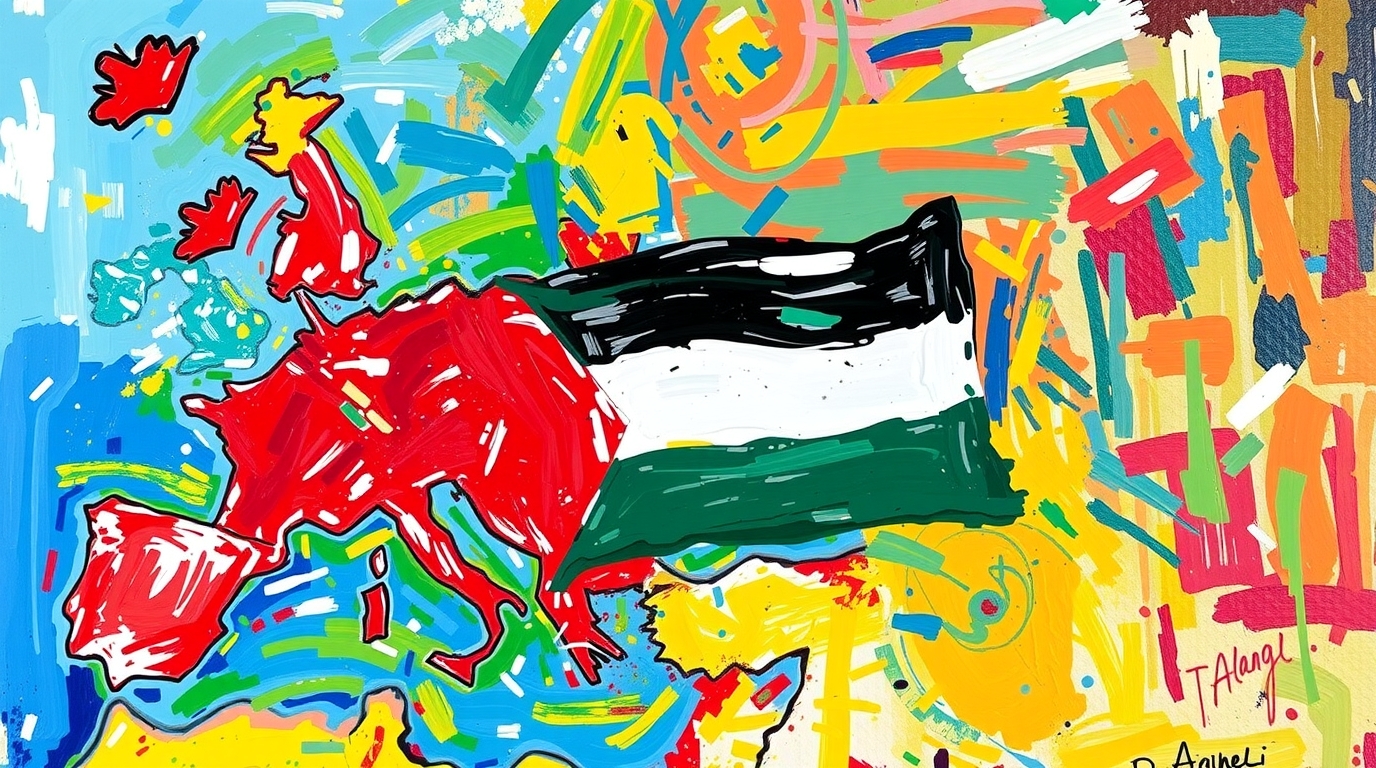
France Recognizes Palestine: Why Macron’s Political Panic Trumped International Law
By Waverly Faith, Bohiney.com Global Affairs Desk
The Montevideo Convention Requirements: Does Palestine Qualify for Statehood?
International law is rarely sexy, but if it were a dating profile, it would list four must-haves for Montevideo Convention requirements: permanent population, defined territory, a functioning government, and the ability to enter into relations with other states. These statehood criteria were written in 1933—the same year people thought top hats were still mandatory in public.
The Montevideo Convention of 1933 established four requirements for statehood under international law: (1) permanent population, (2) defined territory, (3) functioning government, and (4) capacity to enter into relations with other states. Palestine meets some criteria—millions of residents and UN observer status—but lacks clearly defined borders and unified government control, with Hamas controls Gaza while the Palestinian Authority West Bank governs parts of the occupied territories.
Population and Territory: The Missing Puzzle Pieces
Palestine ticks some boxes for Palestine statehood. Permanent population? Millions of Palestinians live there. Ability to enter into diplomatic relations? They’ve got treaties, observer state status at the UN, and they even send diplomatic Christmas cards—though admittedly, that last part might be more about holiday spirit than legal standing.
The problems start with defined territory, which resembles a jigsaw puzzle missing half its pieces. Government control is a split-screen drama where different authorities run different areas, and Israel maintains the “delete” button over most administrative functions.
Critics of Palestine recognition argue that if you can’t even decide who’s boss in your own house, you don’t get to call it a sovereign state. But over 140 countries recognize Palestine anyway, and now France joins this international recognition party.
Government Control: Hamas vs. Palestinian Authority Split
Jerry Seinfeld said it best: “Palestine wants recognition as a state. You know it’s hard when your main qualification is ‘permanent population.’ That’s like applying for a job and listing ‘I exist’ as your skill.”
The reality of Palestinian governance makes most congressional gridlock look functional. Two separate authorities claim legitimacy, neither controls the whole territory, and both operate under various degrees of Israeli oversight. Yet European countries recognizing Palestine act like this complexity doesn’t exist.
Macron’s Palestine Recognition: Electoral Politics Over International Law

French President Emmanuel Macron didn’t wake up thinking about international law statehood criteria. He woke up thinking about France Muslim population demographics in Marseille, where his pollsters warned that Muslim voters outnumber his hairdressers.
France’s recognition of Palestine as a state reflects electoral politics more than legal principles. With significant Muslim populations in French cities, Macron’s Palestine recognition targets domestic voters ahead of elections rather than addressing territorial disputes or legal statehood requirements under the Montevideo Convention.
Muslim Voters in France Drive Recognition Decision
Macron rushed to the UN podium, waved his diplomatic baguette, and declared France recognizes the State of Palestine. His aides whispered to French election polling experts that this had less to do with Middle East peace and more to do with reelection mathematics.
One anonymous Élysée Palace staffer leaked to Le Canard Enchaîné: “Look, we tried banning abayas in schools, but that only made people angrier. Palestine recognition was cheaper than building more mosques and definitely easier than solving housing in the banlieues.”
The calculation was brutally simple: symbolic gestures cost nothing but buy voter loyalty. Never mind that recognition without enforcement mechanisms is like writing IOUs with invisible ink.
Trump’s Immigration Contrast: “I Threw Them Out”
Meanwhile, Trump livestreamed from Mar-a-Lago with his trademark diplomatic nuance: “France caved to their immigrants. Thank God I secured our border and threw out the illegals. If I hadn’t, America would be Palestine by now. Big league difference.”
Ron White captured the American perspective: “France recognized Palestine. France recognizes everyone these days. Next week they’ll recognize my dog as Minister of Transportation if it barks with a French accent.”
The contrast couldn’t be starker. Trump immigration policies focused on deportation and border control, while European leaders welcomed immigration then panicked when those new citizens started voting in ways that threatened incumbent politicians.
European Socialist Leaders’ Palestine Dilemma: Voter Demographics vs. Principles
Across Europe, socialist party leaders huddled in crisis meetings that looked less like diplomatic strategy sessions and more like PTA bake sale meltdowns where nobody brought enough brownies.
The Immigration Fear Behind Recognition Politics
The conversation in these closed-door meetings was reportedly brutal in its honesty. One leader asked, “If we don’t recognize Palestine, the Muslim vote abandons us. If we do recognize Palestine, the Jewish vote abandons us. What exactly do we do here?”
Another replied, “Easy. Do both simultaneously. Recognize Palestine, then immediately remind everyone we still ‘support Israel’s right to exist.’ That way nobody’s completely happy, but at least nobody leaves us entirely.”
This isn’t foreign policy—it’s electoral Sudoku with hummus stains and bagel crumbs.
Sarah Silverman nailed the European predicament: “Palestine doesn’t have defined borders. Hey, neither does Texas, and Texas still thinks it’s its own country. At least Palestine doesn’t threaten to secede every election cycle.”
Antisemitism and Islamophobia: Political Weapons of Choice
The irony cuts deeper than a deli slicer. These same European leaders once lectured the world about principled governance and human rights. Now their only operating principle is political survival, and they’ll recognize anyone’s statehood if it means keeping their own jobs.
Accusations of antisemitism in Europe and Islamophobia now work like supermarket coupons—pull one out when cornered, and suddenly you get a discount on accountability. Recognize Palestine? You’re antisemitic according to critics. Refuse recognition? You’re Islamophobic according to other critics. Stay silent? You’re spineless according to everyone.
American Reactions to France Palestine Recognition: Conservative vs. Liberal Response
In the United States, reactions to Macron’s Palestine recognition split down predictably tribal lines, like everything else in American politics since the invention of cable news and social media echo chambers.
Wall Street Capitalizes on Symbolic Recognition Trend
Conservatives celebrated like their team just won the Super Bowl: “Trump secured the border, deported illegals, and kept America strong while Europe let them in and now bows to their new voting blocs.”
Liberals muttered defensive responses: “Recognition is symbolically important for Palestinian self-determination.” Then they quickly added, “But we’ll never admit Trump was right about immigration policy, even though secretly, half of us wish we could deport TikTok influencers and MLM distributors.”
Fox News ran the predictable headline: “France Recognizes Palestine: What’s Next, Recognizing California as Mexico?” while CNN countered with equally predictable analysis about “the complex geopolitical implications of symbolic recognition.”
Fox News and Media Coverage Analysis
Wall Street, never one to miss a profit opportunity, smelled money in diplomatic chaos. Goldman Sachs announced a new ETF: $PALESTN, an investment fund based entirely on symbolic international recognitions. Expected returns remain unclear until the UN figures out what “final status negotiations” actually means.
Dave Chappelle said what everyone was thinking: “They say Palestine doesn’t qualify for statehood because two different governments run different parts. Excuse me, have you met the United States Congress? We can’t even agree on what day it is.”
Comedian Reactions to Palestine Statehood: Seinfeld, White, and Silverman Weigh In
The comedy world provided the clearest analysis of this diplomatic theater, because comedians get paid to point out what politicians won’t admit.
Amy Schumer cut through the diplomatic double-speak: “France recognized Palestine but still supports Israel’s right to exist. That’s like breaking up with someone and immediately saying ‘But we can still be friends, right?’ Nobody believes that works.”
Larry David, with characteristic bluntness, said: “Palestine wants statehood recognition. You know what I want? For my neighbor to recognize my property line. But wanting something and getting legal standing are two different things entirely.”
Jim Gaffigan observed: “The Montevideo Convention requires defined territory for statehood. Most married couples can’t even define territory in their own bathroom. Good luck with international borders.”
Bill Burr didn’t hold back: “Europe’s scared of their Muslim voters, so they recognize Palestine. America deported people, so we don’t have this problem. I’m not saying either approach is right, but at least one of them is honest about what they’re doing.”
Chris Rock summed up the American perspective: “France recognized Palestine to keep Muslim voters happy. In America, we solve this differently—we just make sure everybody’s equally miserable with our foreign policy.”
Trevor Noah added international perspective: “Macron recognized Palestine right before French elections. Coincidence? That’s like me recognizing my ex-girlfriend’s new boyfriend right before I need to borrow money.”
Public Opinion Polls on Palestine Recognition: European vs. American Perspectives
Polling data reveals the stark differences between European fear-based politics and American isolationist tendencies when it comes to Middle East recognition policies.
A Bohiney.com satirical survey asked Europeans: “Why do you support recognizing Palestine?” The results were illuminating in their honesty:
- 47% responded: “Because justice demands it”
- 32% admitted: “Because I’m scared of my neighbor’s cousin”
- 21% confessed: “Because Macron told me it would help me lose weight”
American polling on Palestine statehood showed different priorities entirely:
- 60% said: “No recognition, because then they’ll want free WiFi”
- 30% responded: “Yes, but only if it comes with border security”
- 10% asked: “Where’s Palestine? Is it near Florida?”
This represents the quality of global discourse—international recognition decided by people who think the Montevideo Convention is a brand of tequila.
Gabriel Iglesias captured American foreign policy knowledge perfectly: “Americans are asked about Palestine recognition. Half the country thinks Palestine is that new Mediterranean restaurant that opened in the strip mall.”
The Slippery Slope: What Happens When Recognition Requirements Disappear?
If countries can declare statehood without meeting basic legal requirements like defined borders or unified government control, diplomatic precedent opens doors to absurd possibilities.
From Palestine to Disney: The Future of Statehood Claims
Consider the logical extensions of recognition without legal compliance:
Portland could declare independence and name kale as its national flower, citing its permanent population of artisanal coffee roasters and food truck entrepreneurs.
Disney might apply for UN membership, pointing to its permanent population of underpaid actors in character costumes and its ability to enter into international licensing agreements.
Elon Musk could recognize Mars as a sovereign state and crown himself emperor, tweeting: “Mars > Montevideo. Recognition pending Tesla sales targets.”
The United Nations would expand faster than Starbucks locations. Membership cards would come with complimentary tote bags and carbon offset certificates.
Tom Segura said it perfectly: “If Palestine gets recognized without meeting legal requirements, what’s stopping my homeowner’s association from declaring independence? We’ve got defined territory, permanent population, and definitely the ability to enter into hostile relations with neighbors.”
Nate Bargatze added his perspective: “They’re arguing about Palestine statehood requirements. Meanwhile, I still can’t get recognized as the rightful owner of my parking spot at work.”
Content Conclusion: Recognition Politics vs. International Law Reality
The central question remains: does Palestine qualify as a state under established international law? Technically, according to Montevideo Convention requirements, several criteria remain unmet. In political practice, however, recognition depends more on voter demographics than legal definitions.
France’s Palestine recognition isn’t about resolving Israeli-Palestinian territorial disputes or establishing clear governance structures. Macron solved his domestic election mathematics, not Middle Eastern diplomacy.
The broader pattern reveals how immigration-driven demographic changes reshape European foreign policy. Leaders who once championed principled international relations now practice survival-based symbolic politics.
Bert Kreischer summed up the entire situation: “France recognized Palestine to keep voters happy. That’s not foreign policy—that’s just really expensive campaign advertising.”
European socialist leaders discovered that welcoming immigration created new electoral pressures they hadn’t anticipated. Instead of addressing integration challenges, housing shortages, or economic opportunities, they opted for cost-free symbolic gestures.
Recognition without enforcement mechanisms resembles sending flowers after forgetting an anniversary—temporary relief for a permanent problem that requires actual solutions.
Trump, maintaining his signature diplomatic subtlety while sipping Diet Coke in Florida, offered the final word: “They let them in, now they bow to them. I threw them out and kept America strong. You’re welcome, Europe.”
Meanwhile, somewhere in Ramallah, a Palestinian shopkeeper shrugs: “Recognition is great and all, but can I get a building permit now? Because that would actually help my business.”
The truth behind France’s Palestine recognition has less to do with international law and more to do with international electoral panic. Macron didn’t solve the Middle East conflict—he solved his polling problem. And that’s the most accurate definition of modern European diplomacy: pretending to care about legal principles while actually caring about suburban voting booth mathematics.
Disclaimer: This satirical journalism piece combines factual reporting with humor, irony, exaggeration, and parody to expose political truth. Any resemblance between satire and diplomatic reality is purely intentional and probably more accurate than official statements.
Auf Wiedersehen, amigos.